
Magento Enterprise comes with full page caching to help speed up the page loading process and enhance user-shopping experience. To enumerate on this process, full page caching allows merchants to shorten their Magento website loading time by caching certain pages of the eCommerce store such as the product, catalog, and CMS pages. This helps in boosting the site performance.
Today’s eCommerce customers are not patient. They expect the web page to load in just a few seconds. In fact, according to Forrester research, customers expect your pages to load in two seconds or less. This means that a delay of even one second in web-response time can lead to a 7% decrease in conversions.
Full-page caching helps you to optimize your Magento Enterprise store and make it faster. Site performance is an extremely important factor that can seriously influence load time, bounce rate and conversions. With full page caching, it is possible to shorten the Magneto website load time.
Magento Enterprise Edition can cache entire page contents and return static stored (X)HTML files rather than build pages dynamically. Only CMS, category, and product view pages support full page caching in Magento Enterprise. Homepage is the most frequently accessed page.
Full Page Cache allows the web server to significantly increase the performance of delivering the pages that are cached statically. When a new product is added, related cache files can be generated. Therefore, this speeds up the store and improves store performance. The following graphs show the efficacy of full-page caching (courtesy Magento Enterprise Performance White Paper at:
http://info.magento.com/rs/magentocommerce/images/Magento_PerformanceWhitepaper-EEv1-9.1.pdf
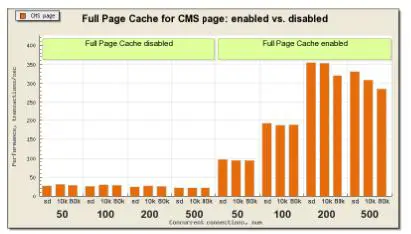
Figure 1. Full Page Cache Results For CMS Page Test: enabled vs. disabled
Result: With Full Page Cache enabled, the performance increase for the homepage exponentially depends on the number of simultaneous concurrent connections. Increasing the number of concurrent connections from 10 to 100 leads to the homepage performance increase.
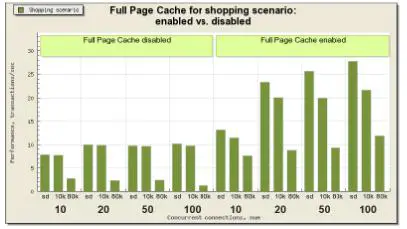
Figure 2: Full Page Cache for shopping scenario: enabled vs. disabled
Result: The performance behavior for the shopping scenario slightly differs from tests for the homepage and cachable URLs, i.e. increasing the number of concurrent connections from 10 to 100 leads to the performance increase up to 150% increase and does not have exponential dependency.
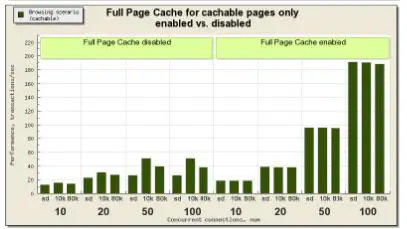
Figure 3: Full Page Cache for browsing scenario: enabled vs. disabled
The performance behavior for the list of cachable URLs resembles tests for the homepage, i.e. increasing the number of concurrent connections from 10 to 100 leads to the performance increase up to 9.5 times; while for the standard set of URLs, the performance gives 150% increase.
Based on these graphs, some of the advantage of Magento full page caching can be described as below
- Improve Magento Store Performance
- Decrease server time
- Reduced Hardware timings
- Increased SEO ratings of Magento Stores
- Product, catalog, and CMS page caching
- Exclusion of dynamic block from caching
- Automatic cache flushing after products, categories, and CMS pages updates
Further research points out that after three seconds, up to 50% of visitors will abandon your site if the page does not open. Also, when website performance is slow during peak traffic periods, more than 75% of consumers said that they would go to a competitor’s website. Accordingly, if you are using the Magento platform, then Magento certified developer need to understand that page speed is one of the most important factors that helps in increasing conversion rates. Additionally, as an eCommerce merchant on the Enterprise Edition, you can:
- Shrink your bounce rates.
- Dramatically decrease page load time
- Dramatically decrease your server load
- Reduce hardware requirements
- Reduce the number of required web servers
- Realize greater savings on server costs
Magento’s full page cache therefore is a boon for those enterprise merchants who require a boost to their internet sales. Besides full page caching, Magento Community edition provides features such as advanced customer segmentation and targeting, private sales, events and invitations, staging, merging and rollback of content, store credits, Solr Search, and many other exciting features.
Table of Content
Subscribe with Us!
Never miss any post, stay tuned!

As Director - Marketing, Zenul leads the marketing and branding at Krish. He brings with him an in-depth understanding of the evolving digital ecosystem and has a proven expertise and experience in strategic planning, market and competition analysis, creating and implementing client-centered, lead-gen and brand marketing campaigns. He has a heart for technology innovation and has been a keynote speaker on various platforms.
Recommended Reading:

10 Hidden Magento Features That Can Transform Your E-commerce Success
26 December, 2025 E-commerce isn't what it used to be five years ago. Heck, it's not even what it was last year. The pace of change feels relentless, and if you're running an online store, you need a platform built to adapt, not just survive. Magento (now part of Adobe Commerce) has carved out its reputation as a serious player in this space. As of 2024, over 239,000 websites worldwide run on Magento, and the platform processes an estimated $155 billion in transactions annually. But here's what most people miss. Magento isn't just another e-commerce platform you install and forget about. It's more like buying a high-performance vehicle and never taking it out of second gear. Most merchants use maybe 30% of what this thing can actually do. The rest? Hidden in plain sight, waiting for someone to flip the switch. The features we're about to explore aren't theoretical. They're practical tools that directly impact your bottom line when you implement them correctly. Whether you're running a small boutique with a handful of products or managing an enterprise operation with thousands of SKUs, these capabilities can fundamentally change how you operate.
Subscribe with Us!
Never miss any post, stay tuned!
Trusted by leading brands


