Introduction
What if your most promising visitors aren’t leaving because of a broken button, slow page, or hidden cost, but because your website is silently misreading their intent?
Most businesses measure clicks and conversions. However, very few measure the unseen metrics like hesitation before clicking “Buy,” visiting a page multiple times, or the unseen “bounce” that doesn’t register. These behaviors reveal insights far deeper than what traditional analytics tools can capture. Not paying attention to these metrics is like navigating a maze blindfolded. Every unseen data point is costing you money, trust, and growth.
Funnel drop-off analysis is not just an instrument but a window into the unseen psychology of your users. It exposes where curiosity turns into doubt, where interest turns into disinterest, and where minor obstacles silently undermine your revenue potential.
In this guide, we break down how to identify conversion drop-offs in analytics, how to find drop-off points in a conversion funnel, and how to turn these insights into measurable business outcomes.
Why Funnel Drop-Off Analysis Is a CRO Priority?
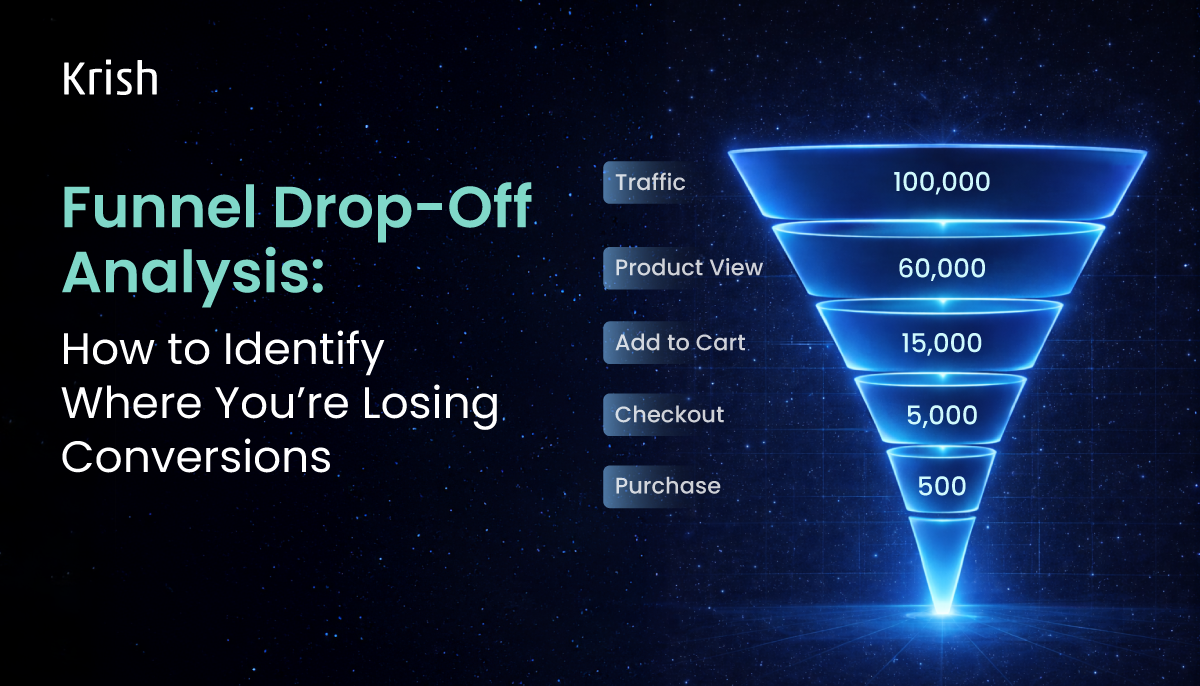
Funnel drop-off analysis is the process of isolating those moments, quantifying their impact, and translating them into revenue opportunities.
For growth leaders, it is not just a reporting exercise. The acquisition efficiency, customer experience quality, and revenue prediction capabilities of the system are directly affected by this factor. The marketing expenses will create unproductive costs because drop-offs remain unexamined.
For example, improving checkout usability alone can increase conversion rates by up to 35.26%, showing how small friction points can have a major impact.
Companies that treat funnel drop-off analysis as a continuous capability, not a one-time audit, create a structural advantage. Analysis powered by GA4 is a strategic lever; it drives faster problem detection, better user experience, and higher ROI on traffic spend. They improve the speed of friction reduction and conversion of demand more efficiently at a lower cost of acquisition.
Further reading
The Complete Ecommerce CRO Audit Guide: Boost Conversions in 2026
A complete ecommerce CRO audit guide to help you diagnose conversion issues, optimize landing pages, product pages, and checkout — and turn more visitors into buyers in 2026.
Read the full blog →Understanding Conversion Drop-Offs Beyond Surface Metrics
Every user journey involves multiple steps, and not everyone completes the purchase. The funnel below illustrates typical stages where visitors move from landing on your site to completing a transaction.
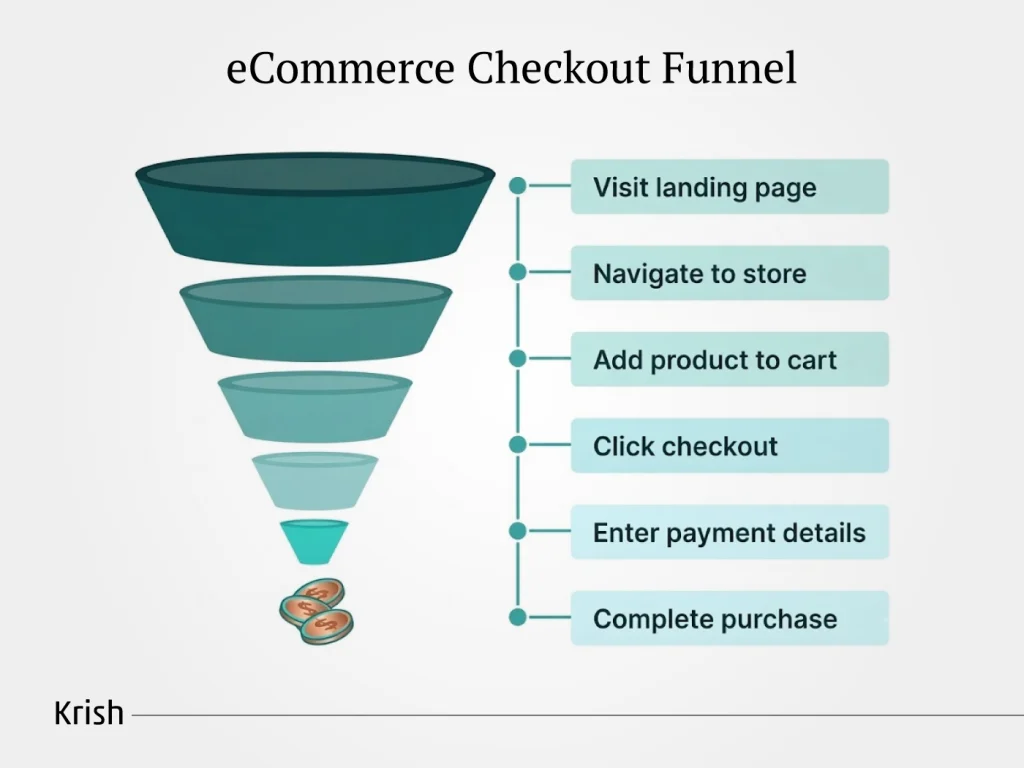
While funnels look simple, actual user behavior is not. Users hesitate, revisit steps, or drop off for different reasons.
Drop-offs are rarely caused by a single issue. They emerge from an interplay of:
- UX friction (navigation, form complexity, unclear CTAs)
- Technical gaps (slow load times, broken events, tracking inconsistencies)
- Psychological barriers (trust signals, pricing clarity, decision fatigue)
- Intent mismatch (misaligned targeting or messaging)
Effective funnel drop-off analysis goes beyond identifying where users leave; it explains why they disengage.
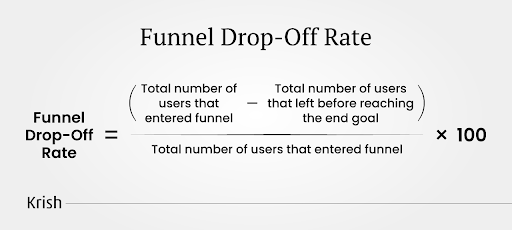
Common Causes of Funnel Drop-Offs
Broken content, tracking problems, and performance bottlenecks can be barriers that are not easily visible and only become apparent after a structured conversion rate optimization audit.
While knowing where visitors drop off is important, knowing why they drop off is where the real power lies.
Here are 5 common reasons why there might be a funnel drop-off:
#1. UX and Usability Friction
Long forms, unclear CTAs, or excessive steps increase cognitive load. Users abandon when effort outweighs perceived value.
#2. Checkout Complexity
Customers abandon their purchase because businesses use lengthy forms, present hidden costs, and provide insufficient payment methods. Research shows that 48% of users stop their purchases because they encounter additional expenses, which include shipping and taxes.
#3. Mismatch in User Intent
If acquisition messaging doesn’t align with landing page content, users disengage quickly. This is common in paid campaigns.
#4. Technical Barriers
Page load delays, broken elements, or inconsistent mobile responsiveness can significantly impact high-intent stages.
#5. Trust Deficits
Lack of social proof, unclear pricing, or security indicators might result in abandonment during the checkout or form submission process.
Research shows that 35% of customers abandon their carts in the absence of trust badges.
Get detailed insights by reading the full post and discovering how structured audits reveal hidden opportunities.
Talk to Our CRO Experts
Recognizing any of these in your funnel?
Our CRO experts can pinpoint exactly where you're losing conversions and fix them with a data-backed game plan.
Book a Free Consultation →How to Identify Conversion Drop-Offs in Analytics?
The most reliable way to understand drop-offs is through structured measurement. This is where identifying conversion drop-offs in analytics becomes a critical capability rather than a tactical task.
Here is how to find drop-off points in the conversion funnel:
Step 1: Define Funnel Stages Based on Business Logic
Avoid generic funnel templates. Instead, align stages with your actual business model:
- Ecommerce: Product view → Add to cart → Checkout start → Payment → Confirmation
- Lead generation: Landing page → Form interaction → Submission → Qualification
Every stage should stand for a significant commitment step, not just a page view.
Step 2. Use GA4 Funnel Exploration for Behavioral Insights
With today’s technology in analytics tools, it is now possible to visualize user journeys. With GA4, there is Funnel Exploration that enables users to visualize:
- Step-by-step user progression
- Percentage of drop-offs between steps
- Segmented funnels (by devices, channels, geographies)
This is essential for answering:
- How to identify conversion drop-offs in analytics across user segments
- Whether drop-offs are consistent or isolated to specific cohorts
A well-configured GA4 setup is important in actually getting real user behavior from the data.
Step 3. Segment Before You Conclude
Aggregate data hides insights.
A 40% drop-off at checkout may look alarming, but segmentation might reveal:
- Mobile users dropping at 65%
- Desktop users converting normally
This shifts the problem from “checkout issue” to “mobile UX or performance issue.”
Effective funnel drop-off analysis always includes:
- Device segmentation
- Traffic source segmentation
- New vs returning users
- Campaign-level behavior
Without segmentation, optimization decisions risk being misdirected.
Step 4. Analyze Step-Level Conversion Rates
Rather than focusing only on final conversion rates, evaluate micro-conversions between each step.
Ask:
- Where is the sharpest decline?
- Is the drop gradual or sudden?
- Does it align with a UX change or campaign launch?
The ability to identify where you’re losing conversions depends on isolating these transition inefficiencies.
Using GA4 for Funnel Drop-Off Analysis
GA4 fundamentally changes how teams approach how to identify conversion drop-offs in analytics by shifting to an event-driven model.
Key GA4 Capabilities for Deeper Funnel Analysis
Funnel Exploration Reports
Allows you to build custom funnels with flexible entry points and user paths. This is critical for non-linear journeys.
Path Analysis
Helps visualize actual user flows, uncovering unexpected exits or loops within the funnel.
Segmentation and Comparisons
Enables side-by-side comparison of user cohorts to detect performance gaps.
Event-Based Tracking
Captures finer details such as clicks, scroll depth, and time spent, which provide richer contextual information.
The success of GA4 relies significantly on proper implementation. Incorrectly set events and naming conventions may lead to incorrect funnel analysis results, which means a GA4 audit is necessary for accuracy.
Further reading
Free ebookThe DIY 20-Point GA4 Audit Checklist for Enterprises
Spot tracking gaps, fix attribution blind spots, and score your GA4 setup across 20 checks — with a clear priority order for fixes ranked by business impact.
From Analysis to Optimization: Closing the Loop
However, to derive any value from funnel drop-off analysis, action needs to be taken. To achieve this, businesses need a simple and straightforward strategy. The next steps are organized so that each can improve their funnel and increase revenue.
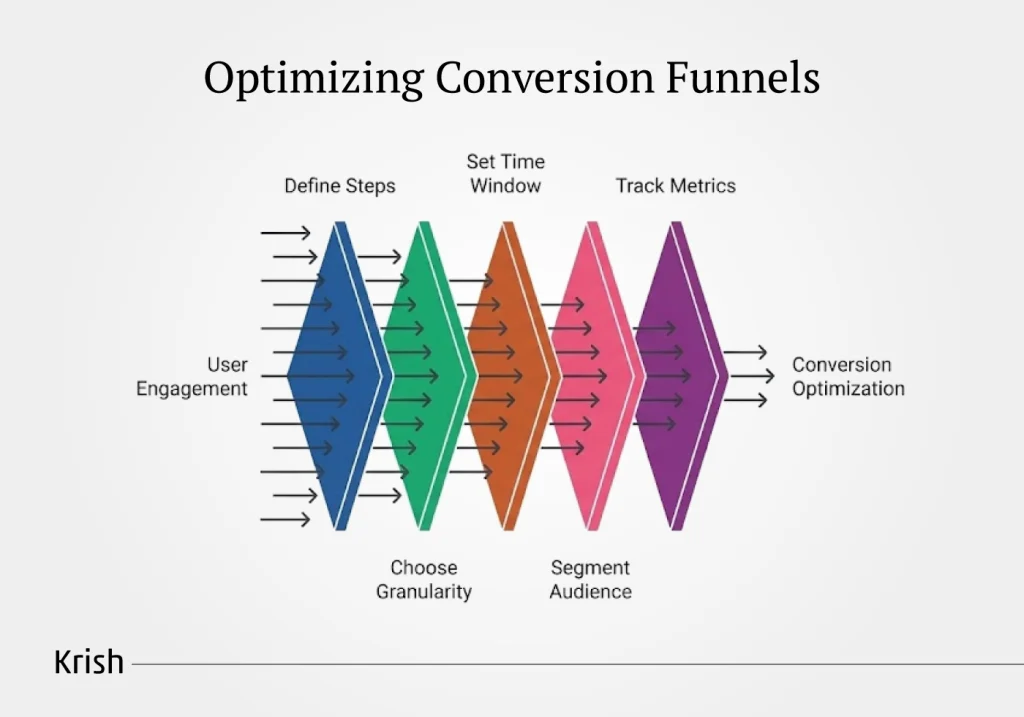
Once the funnel is mapped and metrics are tracked, the next step is to prioritize actions that drive the greatest impact. That includes:
Prioritizing High-Impact Fixes
Focus on stages with:
- High traffic volume
- Significant drop-off rates
- Strong revenue correlation
This ensures efficient allocation of resources.
Also, according to research, an estimated $260 billion in lost ecommerce revenue is recoverable through better checkout and funnel optimization.
Validating Through Experimentation
A/B testing should be employed to validate hypotheses developed through funnel analysis. Changes should be data-driven rather than assumption-driven.
Continuously Monitor and Iterate
Funnel optimization is a dynamic process. User behavior is constantly changing based on market conditions, competition, and product evolution.
Integrating Funnel Analysis into CRO Strategy
Funnel drop-off analysis serves as the primary component for advanced conversion rate optimization programs. The process connects data with experimentation by showing the specific areas that require optimization work.
A structured approach typically includes:
- Diagnostic analysis (identifying drop-offs)
- Hypothesis development (understanding causes)
- Experimentation (testing solutions)
- Measurement (evaluating impact)
For organizations seeking to scale, leveraging funnel insights with overall CRO initiatives has a multiplying effect on overall conversion performance.
To gain a deeper understanding of how to improve conversion performance, have a look at our 5 tips to improve your online conversions.
Operationalizing Funnel Drop-Off Analysis Across Teams
To achieve this consistency in business value, funnel analysis has to extend beyond the domain of individual analytics teams.
Cross-Functional Collaboration
- Marketing teams work to align messages with user intent
- Product teams work to optimize user journeys
- Analytics teams work to ensure data accuracy
- Leadership teams work to prioritize investments based on impact
Positioning Funnel Analysis as a Growth Engine
Organizations that treat funnel drop-off analysis as a reporting task miss its strategic potential. When embedded into decision-making, it becomes a growth engine that:
- Improves marketing efficiency by reducing wasted spend
- Enhances customer experience through frictionless journeys
- Increases revenue without proportional increases in acquisition cost
- Enables scalable optimization frameworks
This is particularly relevant for enterprises managing complex digital ecosystems where incremental improvements at scale translate into substantial financial impact.
Moving Toward Predictive Funnel Optimization
The next evolution of funnel drop-off analysis is predictive rather than reactive.
Instead of asking: “Where are we losing users?”
Leading organizations ask: “Where are we likely to lose users, and how can we prevent it?”
This involves:
- Using historical funnel data to identify patterns
- Applying machine learning models for prediction
- Proactively optimizing high-risk funnel stages
This shift turns funnel analysis into a forward-looking growth lever.
Closing Perspective
While funnel drop-off analysis, as a concept, is not just about fixing the leaks, it’s also about understanding the intent of the customer with greater precision.
For growth leaders, the ability to understand where they are losing conversions, as well as why, is a fundamental structural advantage. In order to improve their funnel more effectively, investing in CRO and A/B testing services is a must for smarter investments, execution, and results.
Globally, eCommerce businesses lose billions annually due to cart abandonment alone, highlighting the scale of conversion inefficiency.
In an environment where acquisition costs continue to rise, optimizing the journey itself becomes the most efficient path to growth.
And that journey begins with knowing exactly where it breaks.
At Krish, our team of CRO experts, GA4 specialists, and growth analysts works together to provide you with advanced insights. We work with you to find friction points while we study user behavior to create methods that will enhance user engagement throughout your sales process.
We will optimize your user journey through two methods, which include configuring tracking and dashboards to study user behavior and conducting A/B tests for your landing pages, product flow, and checkout funnel.
Table of Content
- Introduction
- Why Funnel Drop-Off Analysis Is a CRO Priority?
- Understanding Conversion Drop-Offs Beyond Surface Metrics
- Common Causes of Funnel Drop-Offs
- How to Identify Conversion Drop-Offs in Analytics?
- Using GA4 for Funnel Drop-Off Analysis
- From Analysis to Optimization: Closing the Loop
- Integrating Funnel Analysis into CRO Strategy
- Operationalizing Funnel Drop-Off Analysis Across Teams
- Positioning Funnel Analysis as a Growth Engine
- Moving Toward Predictive Funnel Optimization
- Closing Perspective
Subscribe with Us!
Never miss any post, stay tuned!

Minal Joshi is a content marketer at Krish with a flair for eCommerce and Digital Commerce aspects. She is a MarTech fanatic with a knack of writing with which, she helps brands to curate, create, & commence digital brand positioning. Sharing insights via articles, case studies, eBooks, Infographics, and other forms of content creation is what she lives for. Being an ardent traveler, when not writing, you'll find her sipping coffee into the mountains or petting a stray.
Recommended Reading:

From Test Results to Business Impact: The Attribution Challenge – MarTech Masterclass Series Ep | 18
2 July, 2026 A variant reaches statistical significance. The team celebrates, ships the winner, and moves on to the next experiment. Weeks later, the metrics leadership actually tracks have not moved. Revenue per session is flat. The number the finance team questions every quarter shows no change that can be credited to the test. The experiment was run correctly. The result was real. And somehow, nothing changed.
Subscribe with Us!
Never miss any post, stay tuned!
Trusted by leading brands


