Introduction
Conversion funnels are essential to digital growth strategies. Organizations track every click, scroll, and purchase with the expectation that these metrics tell the full story. The data about funnel drop-off points creates misleading information, which results in decision-makers wasting resources and creating incorrect research hypotheses that slow down gains in conversion rate.
Despite tracking every interaction, most businesses still struggle with low conversion outcomes. Industry benchmarks show that average ecommerce conversion rates hover between 2.5–4%, meaning over 95% of users never convert, making it important to understand whether funnel drop-offs truly reflect user behavior or just misleading data.
For growth marketing managers, CRO specialists, growth team leads, and data analytics teams, it is important to understand the reasons behind low conversion rates and understand funnel metrics to achieve a competitive advantage.
This article explores common funnel analysis mistakes, explains why traditional conversion metrics fail, and outlines what leaders should focus on to unlock measurable business outcomes.
The Illusion of Funnel Drop‑Off Rates
Digital teams often start with a simple question: Why is our funnel conversion so low?
The answer is typically indicated by the percentage of drop-off between different stages of the sales funnel. In Google Analytics or GA4, these manifest as exit rates or step abandonment rates.
However, these metrics are inherently lagging indicators. They tell you where users stopped, but not why they stopped.
The numbers you see are only surface signals of much deeper user behavior.
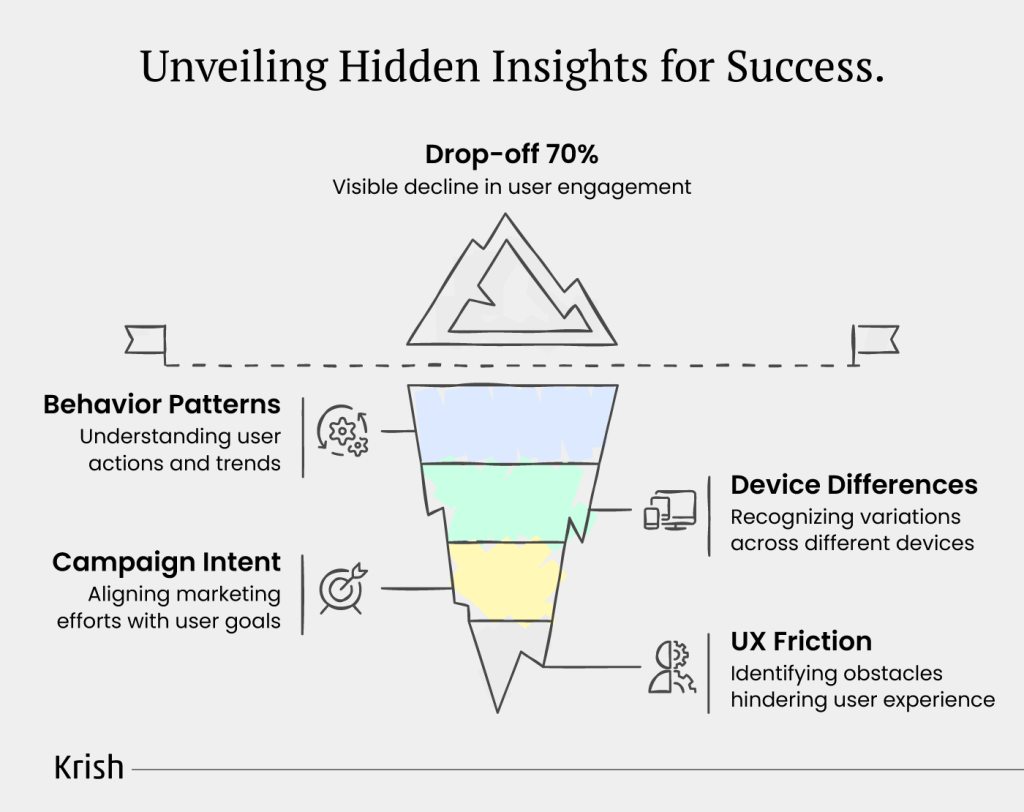
Relying on funnel drop‑off percentages without context invites the following conversion funnel optimization mistakes:
- Treating numeric drop‑offs as causal without behavioral context.
- Prioritizing high‑volume exits over impactful low‑frequency but business‑critical exits.
- Interpreting aggregated data as representative of all user segments.
In essence, the raw drop‑off is a sign, not a diagnosis. To fix the sign alone risks mistargeting optimization resources.
Why Funnel Drop‑Offs Are Misleading?
1. Funnels Are Aggregate, Not Segment‑Sensitive
Most analytics dashboards show a unified funnel:
Homepage → Product → Add to Cart → Checkout → Purchase.
But aggregated funnels mask heterogeneity. Enterprise audiences rarely behave homogeneously. For example:
- Organic search users may convert differently than paid social users.
- Mobile users may exhibit different friction points than desktop users.
- New visitors and returning high‑value customers follow distinct decision journeys.
However, the question of “why conversion rate is misleading” has this segmentation blind spot as a base. For example, a 40% drop-off may exist, but it is necessary to recognize that this does not happen in one segment.
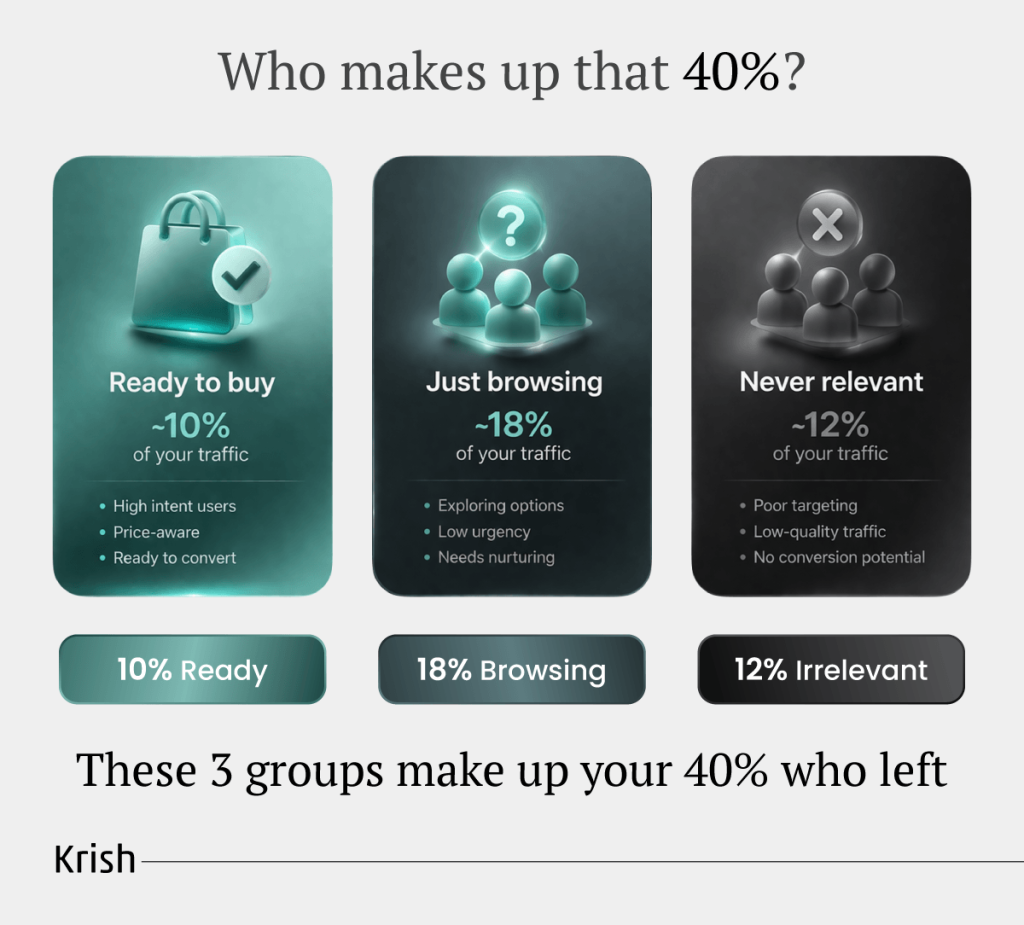
The impact of segmentation is not marginal. Studies show that segmented marketing strategies can drive up to 760% more revenue than non-segmented approaches, underscoring how dangerous aggregated funnel views can be.
Without segment‑aware analysis, you may optimize elements that don’t actually drive revenue, or worse, penalize high‑value cohorts.
2. Funnels Ignore External Context and User Intent
User journeys don’t occur in a vacuum. The journey is shaped through various brand touchpoints that exist beyond the funnel because users rely on social proof, conduct pre-purchase research, compare competitors, and assess economic conditions and seasonal patterns.
Consider what happens when a large number of users “drop off” at the pricing page. Without context, this looks like a UX failure. But it may reflect broader market sentiment, misaligned expectations from prior messaging, or a poorly targeted acquisition campaign.
Research by McKinsey & Company points out that “organizations that leverage customer behavioral insights outperform peers by 85% in sales growth and more than 25% in gross margin.” A company that does not take into account customer behavioral insights is likely to be left behind, as today’s customer demands personalized experiences.
This is a core problem with funnel analysis; it separates user behavior from intent signals. Funnel steps assume a linear, logical path when in reality, user decisions are non‑linear and influenced by unseen variables.
3. Drop‑Off Data Is Volume‑Biased
High‑volume funnel stages attract attention. A 50% drop from Product Page to Cart stands out. But what about the 15% drop in the Review Order stage that represents the company’s highest margin segment?
Focusing exclusively on high‑volume exits prioritizes volume over impact. The business consequence? Misallocated optimization budgets and stagnating revenue performance.
The Risk of Misleading Funnel Data
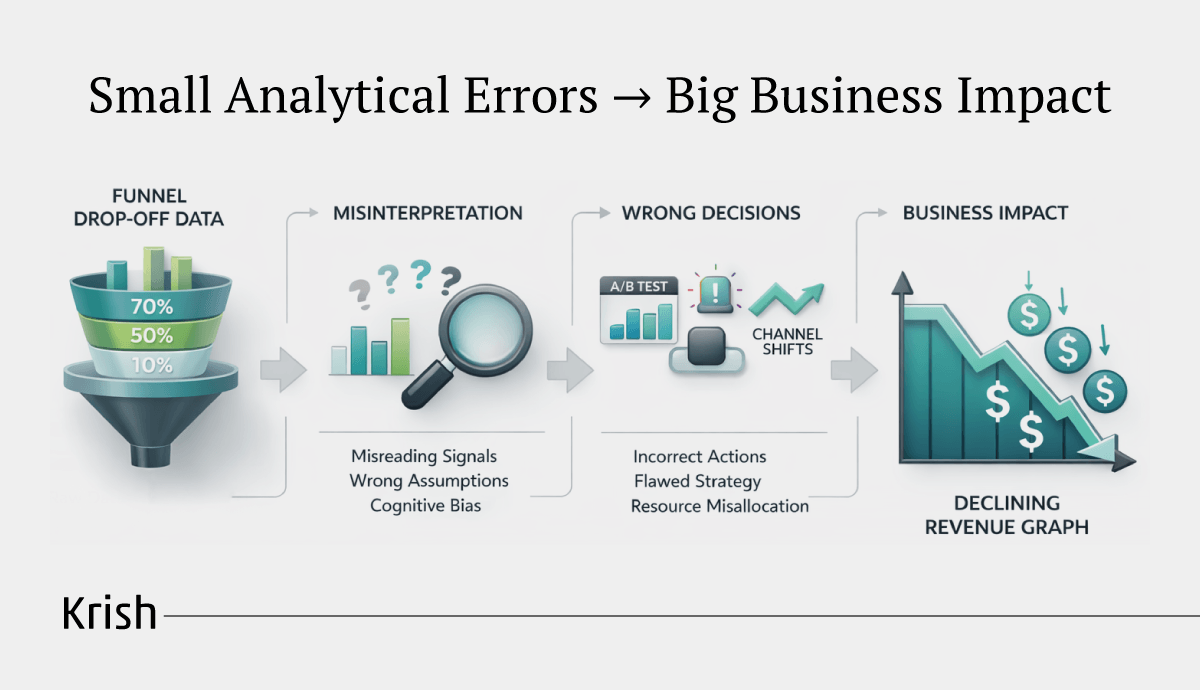
This lack of proper understanding of the funnel metrics results in a strategic misalignment.
All of this ultimately impacts measurable business metrics such as revenue growth, business efficiency, and customer retention.
What to Look at Instead: A Business‑Driven Funnel Analysis Framework
To overcome these analytical pitfalls, organizations should shift from clean but simplistic drop‑off measurements to a contextual, outcome‑oriented analysis framework. Below are the essential dimensions to integrate:
1. Segment‑Driven Funnel Breakdown
Segment your funnel by:
- Traffic source (organic, paid, social, email)
- Channel/medium
- New vs. returning users
- Device and geography
- User intent proxies (e.g., query parameters, engagement scores)
This reveals whether observed drop‑offs are universal or concentrated among specific cohorts. It transforms funnel analysis from a monolith into a strategic diagnostic tool.
For a structured approach, see our guide: Conversion Funnel Analysis: How to Identify & Fix Drop‑Offs, which provides a framework for identifying and contextualizing exit points across segments.
2. Behavioral and Qualitative Signals
Quantitative funnel data should be reinforced with behavioral data:
- Session replays to observe decision intersections
- Heatmaps for interaction hot spots
- Scroll maps to spot content visibility issues
- Exit surveys to capture intent and friction
These signals illuminate why users are leaving, rather than just where.
According to research, companies that use data-driven metrics in their CX strategy see a 15% increase in customer satisfaction and a 10% reduction in costs.
3. Attribution‑Anchored Conversion Paths
Modern analytics platforms like GA4 provide enhanced path exploration tools. Instead of a rigid funnel, leverage path analysis to see multiple journey variants.
GA4’s event‑driven model allows you to identify:
- Looped behaviors (e.g., users revisiting product pages before the cart)
- Non‑standard conversion sequences
- Cross‑device transitions
This addresses a fundamental conversion funnel analysis mistake, assuming that all users adhere to a strict funnel sequence.
4. Intent‑Weighted Metrics
Not all drop‑offs are equal. A user who passed 10 products in the catalog before bailing is very different from a user who bailed on the homepage.
Adding weights to these events, such as the product view, wishlist add, and time spent, makes the analysis of the funnel more detailed, allowing you to optimize the site for the qualified prospect rather than the curious one.
5. Progressive Event and Conversion Attribution
In GA4, you can define and track micro‑conversions (engagement events) that cumulatively lead to macro outcomes. For example:
- Newsletter sign‑ups
- User account creations
- Saved payment methods
- Product reviews submitted
Mapping these intermediate steps offers a more nuanced story than binary conversion vs. exit counts.
Further Reading
Funnel Drop-Off Analysis: How to Identify Where You're Losing Conversions
Most ecommerce stores lose customers at the same funnel stages — but never know why. This guide walks you through funnel drop-off analysis to spot the exact leaks and fix them before they cost you more sales.
Read the full blog →Why Even GA4 Funnel Data Can Mislead You?
GA4 has become the default measurement infrastructure for most digital businesses, yet its funnel exploration reports carry specific structural limitations that amplify funnel analysis mistakes if not properly understood.
| Limitation | What GA4 Does | Why Funnel Insights Break | Impact on Interpretation | What To Validate |
| Data Sampling | Applies sampling beyond ~10M events in funnel explorations | Funnel step counts may represent only a subset of users | Drop-off rates appear stable but are statistically unreliable | Check for sampling indicator; reduce date range or use unsampled data |
| Scope Mismatching | Allows mixing user, session, and event scopes in funnels | Funnel steps are not measuring the same unit of analysis | Artificial inflation or deflation of drop-offs between steps | Ensure consistent scope across all funnel steps |
| Attribution Model Differences | Uses data-driven attribution vs click-based models in ad platforms | Conversion counts differ when compared across tools | Misread discrepancies as funnel performance issues | Align attribution models before comparing funnel performance |
| Funnel Construction Logic | Supports open/closed funnels and flexible step definitions | Users may skip steps or enter mid-funnel | Drop-offs may not represent true abandonment | Confirm whether funnel is open vs closed and interpret accordingly |
A thorough GA4 audit resolves these structural gaps before they inform strategic decisions.
Measurable Business Outcomes From Better Funnel Interpretation
When enterprise teams shift from misleading drop‑off figures to robust funnel analysis, the business impact is tangible.
Revenue Growth Through Precision Optimization
Focusing on true friction points, identified through segment and path analysis, enables incremental lift in conversions that scale. Research shows companies investing in CRO see an average ROI of 223%
Operational Efficiency
This removes low-value activities based on false information and allows teams to focus on high-impact experiments and optimizations.
Enhanced Customer Retention
Customers’ intent and customer behavior at different stages of the customer funnel can be used by a brand to deliver a unique customer experience, thus promoting customer loyalty.
Research by Bain & Company indicates that improving customer retention by just 5% can increase profits by 25% to 95%.
Strategic Scalability
A reliable funnel analytics ecosystem supports data‑driven decision‑making across marketing, product, and growth functions.
Conclusion
Funnel drop‑off data alone can be misleading. Without context, precise segments, and qualitative insights, it can send teams down unproductive paths.
Despite heavy investment in analytics, only about 22% of businesses report satisfaction with their conversion rates, because they rely on incomplete or misleading funnel interpretations.
To grow out of the common pitfalls in conversion funnel analysis, understand that:
- Funnels are networks, not pipelines
- Qualitative and predictive analysis should be combined
- Invest in measurement tools like GA4 that are designed for the way users behave today
- Govern analytics as a team, with business goals in mind
When used correctly, funnel analysis can be a powerful business asset for driving conversion rate growth, business efficiency, and scalable growth.
However, if teams want to improve their analysis, they should opt for CRO and GA4 audits. These help turn funnel data into useful insights that drive growth, instead of leading to wrong conclusions.
At Krish, our goal is to assist businesses in closing this gap between funnel metrics and business strategy. From CRO audits to GA4 setup and analysis, we assist businesses in accurately interpreting their funnel metrics, areas of friction, and optimizations to achieve revenue growth and customer retention.
By choosing to work with us, businesses gain access to a data-driven approach to conversion excellence, where every piece of knowledge gained leads to business results.
Ready to Increase Conversions with Smarter Insights?
Move beyond surface-level metrics and unlock high-impact growth opportunities with data you can trust.
Table of Content
- Introduction
- The Illusion of Funnel Drop‑Off Rates
- Why Funnel Drop‑Offs Are Misleading?
- The Risk of Misleading Funnel Data
- What to Look at Instead: A Business‑Driven Funnel Analysis Framework
- Why Even GA4 Funnel Data Can Mislead You?
- Measurable Business Outcomes From Better Funnel Interpretation
- Conclusion
Subscribe with Us!
Never miss any post, stay tuned!

As Director - Marketing, Zenul leads the marketing and branding at Krish. He brings with him an in-depth understanding of the evolving digital ecosystem and has a proven expertise and experience in strategic planning, market and competition analysis, creating and implementing client-centered, lead-gen and brand marketing campaigns. He has a heart for technology innovation and has been a keynote speaker on various platforms.
Recommended Reading:
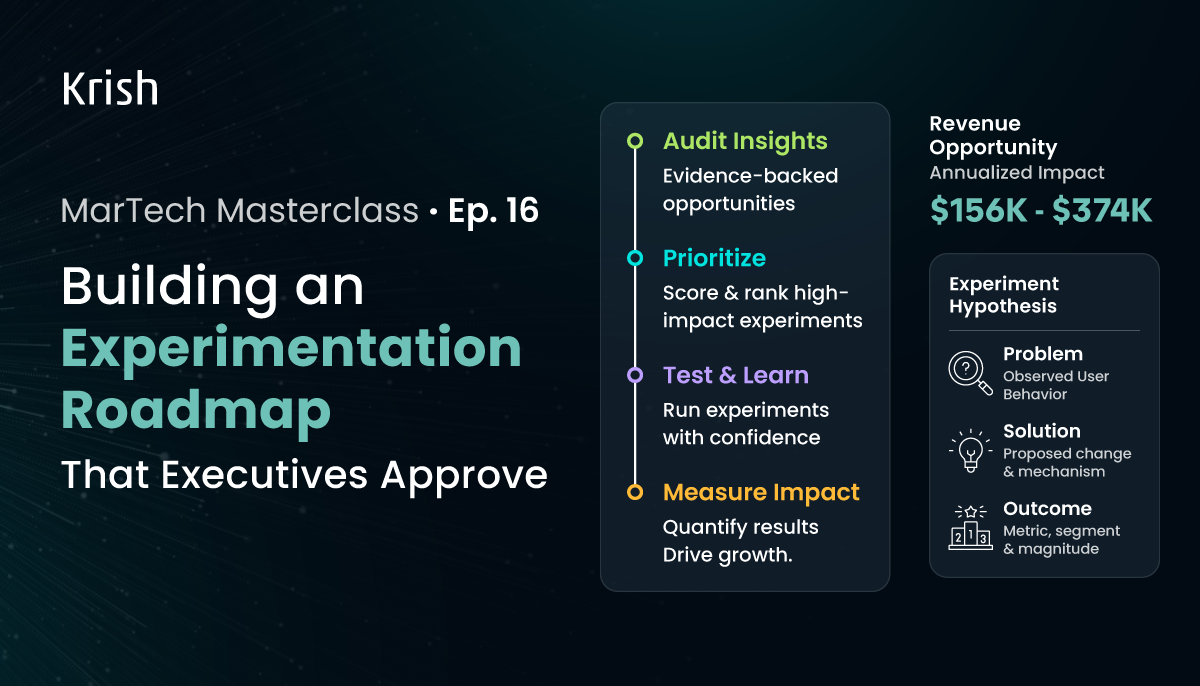
Building an Experimentation Roadmap That Executives Approve – MarTech Masterclass Series Ep | 16
15 June, 2026 In our previous MarTech Masterclass Episode 15, we provided a detailed breakdown of how to run a CRO audit. We mapped where intent dies across landing pages, product pages, and checkout. None of those are traffic problems. They are funnel problems, and the audit is what exposes them.
Subscribe with Us!
Never miss any post, stay tuned!
Trusted by leading brands


