Introduction
Brands are sitting on petabytes of customer data, yet 76% of consumers still experience deep frustration when interactions feel entirely generic, as revealed by McKinsey. Marketing teams know the gaps exist. They see the abandoned carts, the unread emails, and the fragmented experiences across channels. The problem is rarely a lack of intent. It is a lack of architectural capability.
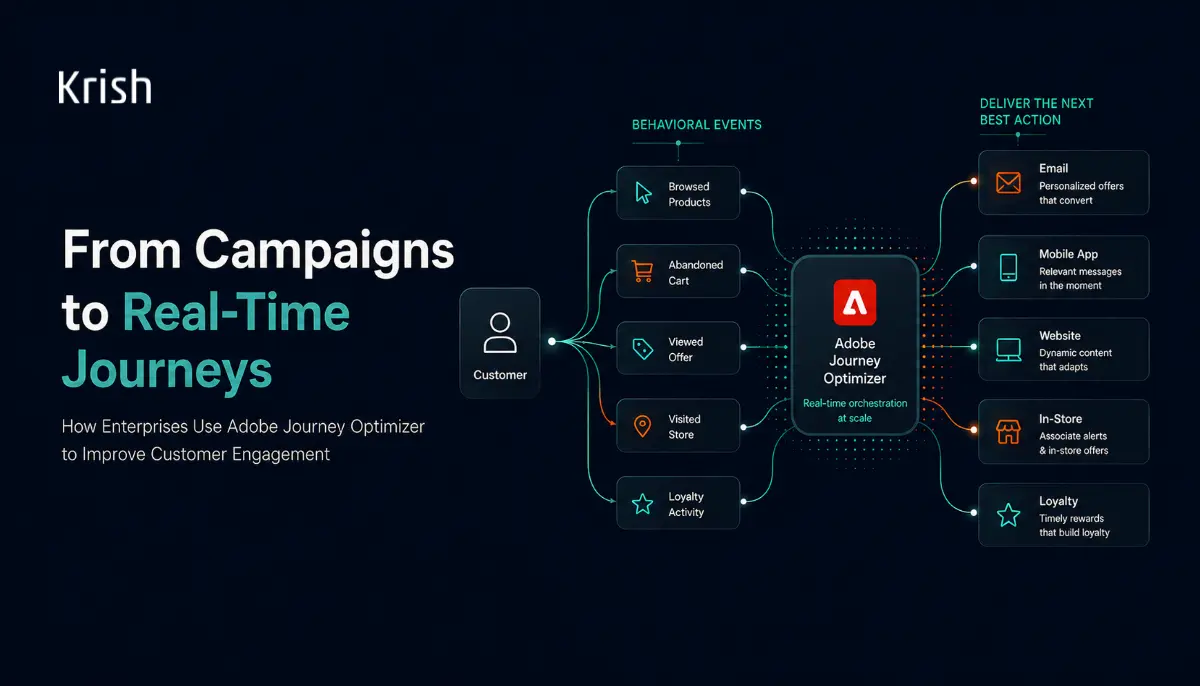
Adobe Journey Optimizer is an agile enterprise orchestration engine built on Adobe Experience Platform that allows brands to manage scheduled marketing campaigns and real-time, one-to-one customer interactions from a single application.
Traditional email service providers (ESPs) simply cannot bridge the gap between data collection and instant, contextual action. When a customer shifts from browsing on a mobile app to walking into a physical store, batch-and-blast systems break down. This guide breaks down how digital leaders use Adobe Journey Optimizer services to replace disconnected campaign silos with intelligent, trigger-based orchestration at scale.
Why Are Enterprises Shifting To Journey Orchestration Engines?
Marketing operations teams are reaching the breaking point with legacy systems. Building complex segment rules inside outdated ESPs takes days. By the time a campaign launches, the customer’s intent has already shifted.
The Limitation Of Traditional Batch And Blast ESPs
Marketers waste massive amounts of time wrestling with fragmented systems, with 63% of digital marketing leaders reporting that leveraging integrated customer data is their top challenge, according to Gartner. Legacy ESPs operate on delayed synchronization. They pull lists from a CRM, run a batch process overnight, and send a static message the next morning.
This latency destroys conversion rates. If a user abandons a cart at 2:00 PM, an email arriving at 8:00 AM the next day is often useless. The customer has already purchased elsewhere. Enterprises require systems that respond in milliseconds, not hours.
The Shift To Real-Time, Context-Aware Engagement
Modern omnichannel journey orchestration flips the model. Instead of pushing audiences into static campaigns, orchestration engines listen for behavioral events and trigger the exact next best action. This context-aware approach ensures that a user who just lodged a customer service complaint does not receive an aggressive promotional SMS ten minutes later.
Core Capabilities Of Adobe Journey Optimizer For Enterprise
To understand how Adobe Journey Optimizer functions, marketing leaders must look beneath the application layer to the data foundation powering it.
Native Integration With Adobe Experience Platform (AEP)
Adobe Experience Platform is an enterprise customer data platform that centralizes and standardizes data across the organization to create real-time profiles. Adobe Experience Platform integration is what sets AJO apart from standalone ESPs. Because AJO sits natively on AEP, it does not need to copy or move data. It queries the Real-Time Customer Profile instantly. When a behavioral trigger fires, AJO has immediate access to the user’s lifetime purchase history, loyalty status, and current browsing session.
Unified Campaign And Journey Management
Enterprise marketing teams often use different tools for mass promotions and automated journeys. Adobe Journey Optimizer eliminates this friction by unifying both on a single canvas. A marketer can schedule a massive seasonal newsletter drop while simultaneously managing highly specific, localized geofencing triggers. They coexist without conflicting.
Intelligent Decisioning And Offer Management
Static rules cannot scale. AJO utilizes an AI-driven offer decisioning engine that evaluates thousands of potential permutations in real time. It ranks offers based on eligibility rules, inventory levels, and predicted conversion propensity. The system automatically injects the highest-ranking offer into the email or push notification right as the message is compiled.
Real-World Enterprise Use Cases For AJO
Moving from theory to practice requires looking at actual business outcomes. Theoretical use cases sound impressive, but enterprise architects care about tangible results and measurable ROI.
Real-Time Behavioral Triggers In eCommerce
When global consumer goods brand Henkel deployed Adobe Journey Optimizer, they completely restructured their direct-to-consumer engagement model. By shifting to real-time, event-based triggers, Henkel increased their overall campaign efficiency by 30%, according to Adobe Customer Stories.
Our own data reflects similar transformations. One of Krish’s enterprise retail clients reduced their cost-per-qualified-lead by 34% within 90 days of deploying AJO behavioral triggers. They achieved this by setting up listeners for specific high-value browsing patterns. When a known user viewed a premium category three times within 48 hours without purchasing, AJO instantly bypassed standard email queues to deliver a highly personalized push notification containing a time-sensitive, dynamic offer.
Bridging Online And Offline Customer Journeys
True omnichannel experiences must cross the physical divide. Consider a customer who browses inventory online and then makes a purchase in a physical retail location. AJO ingests point-of-sale data instantly via AEP. The system immediately suppresses any digital retargeting ads for that specific product and triggers a post-purchase loyalty sequence instead.
Adobe Journey Optimizer: Choosing The Right Platform
Selecting an orchestration engine requires a brutally honest assessment of your current ecosystem. The market offers several powerful tools, but they serve distinctly different technical philosophies.
Adobe Journey Optimizer
AJO is designed specifically for organizations that prioritize centralized data architecture.
- What it does: Orchestrates real-time 1:1 journeys and batch campaigns natively atop the AEP Real-Time Customer Profile.
- Best for: Large enterprises already invested in the Adobe ecosystem, or those requiring massive scale with milliseconds of latency. It is particularly strong for B2C, though the Adobe Journey Optimizer B2B Edition now bridges complex account-based buying cycles.
Salesforce Marketing Cloud (SFMC)
SFMC remains a dominant force, particularly via Journey Builder.
- What it does: Provides deep, highly customizable cross-channel marketing automation tied closely to Salesforce CRM data.
- Best for: Organizations where Salesforce CRM is the undisputed center of gravity. However, SFMC traditionally relies on relational data extensions that can struggle with the millisecond real-time event streaming native to AJO.
Braze
Braze focuses heavily on mobile-first, in-the-moment engagement.
- What it does: Delivers rapid cross-channel messages with a strong emphasis on push, SMS, and in-app experiences.
- Best for: Digital-native disruptors and app-centric businesses. While highly agile, it often requires extensive integration work to match the deep historical enterprise data modeling provided by Adobe’s CDP foundation.
Addressing The Realities: Data Privacy And When AJO Struggles
No technology is flawless. Implementing an orchestration engine without acknowledging regulatory and structural realities leads to failed deployments.
Privacy compliance is non-negotiable. AJO relies on AEP’s patented Data Usage Labeling and Enforcement (DULE) framework. This ensures that GDPR and CCPA compliance rules are hardcoded into the data layer. If a customer revokes consent for personalization, the system physically prevents marketers from using that data in a journey segment.
Where does AJO struggle? Legacy tech debt. AJO will fail if your organization lacks a unified data strategy or identity resolution framework. If your customer data is scattered across five disconnected databases with no common identifier, layering AJO on top will only orchestrate chaos faster. Clean data is the unglamorous prerequisite to AI-driven marketing.
Getting Started: Implementing AJO In A Complex Enterprise Stack
Deployment is an architectural challenge, not just a software installation. Rushing the rollout guarantees data friction.
We utilize the proprietary Krish Journey Readiness Matrix to phase implementations predictably. A realistic timeline for an enterprise deployment spans 12 to 16 weeks.
- Phase 1: Data Foundations (Weeks 1-4): Establishing schemas within AEP, defining identity resolution rules, and ensuring data ingestion streams are clean.
- Phase 2: Event Configuration (Weeks 5-8): Mapping core business behaviors to system events. This defines the triggers that will launch journeys.
- Phase 3: Journey Migration (Weeks 9-12): Replicating existing high-value campaigns into AJO, testing logic, and training the team.
- Phase 4: Optimization (Weeks 13-16): Activating AI decisioning models and launching net-new real-time use cases.
Conclusion
The next 12 to 18 months will dramatically shift how marketing teams interact with orchestration platforms. We are moving rapidly away from manual journey mapping toward agentic AI orchestration. Instead of marketers drawing complex boolean logic trees, AI agents will autonomously determine the optimal path, channel, and timing for individual users based on real-time propensity models. Customer journey analytics will feed these agents, allowing the system to self-optimize journeys without human intervention.
Implementing Adobe Journey Optimizer requires more than just turning on software. It demands deep strategic alignment of your data architecture and marketing workflows. With over 20 years of digital commerce and MarTech implementation experience, Krish helps enterprise brands architect, deploy, and scale Adobe solutions to deliver measurable increases in customer lifetime value. Ready to move beyond batch-and-blast campaigns? Explore our MarTech services or book a technical discovery call with a Krish solutions architect today.
Frequently Asked Questions
Table of Content
- Introduction
- Why Are Enterprises Shifting To Journey Orchestration Engines?
- Core Capabilities Of Adobe Journey Optimizer For Enterprise
- Real-World Enterprise Use Cases For AJO
- Adobe Journey Optimizer: Choosing The Right Platform
- Addressing The Realities: Data Privacy And When AJO Struggles
- Getting Started: Implementing AJO In A Complex Enterprise Stack
- Conclusion
Subscribe with Us!
Never miss any post, stay tuned!

As Director - Marketing, Zenul leads the marketing and branding at Krish. He brings with him an in-depth understanding of the evolving digital ecosystem and has a proven expertise and experience in strategic planning, market and competition analysis, creating and implementing client-centered, lead-gen and brand marketing campaigns. He has a heart for technology innovation and has been a keynote speaker on various platforms.
Recommended Reading:
What is Marketing Automation? Strategies, Benefits, Tools, and Implementation
20 January, 2026 Marketing teams today are expected to do more with less. More personalization, more channels, more data, and more accountability for revenue. At the same time, customers expect timely, relevant communication that feels personal, not mass-produced. Marketing automation exists to bridge this gap.
Subscribe with Us!
Never miss any post, stay tuned!
Trusted by leading brands


