Introduction
Most ecommerce brands do not have a traffic problem. They have a behavior problem.
A user browses your catalogue twice and disappears. A shopper loads a cart and walks away. A loyal customer slowly goes quiet. None of this is random. Every one of these is a behavioral signal and most brands are not equipped to act on it.
The problem is that most retention marketing is still built around schedules, not behavior. Mass blasts on Fridays. Discount emails to the full list. Open rates measured as if they represent intent. They do not.
The brands consistently outperforming on LTV, repeat purchase rate, and acquisition efficiency are not the ones with the biggest ad budgets. They are the ones that have built intelligent customer journeys responding to real behavior, in real time, at scale. That is what WebEngage is built for: not as a messaging tool, but as a customer lifecycle orchestration engine.
Why Journeys Outperform Campaigns
Traditional campaign marketing runs on a schedule. Customer journeys run on behavior.
A user viewed the same product three times in 48 hours without adding to cart. A customer’s replenishment window is closing. A VIP who once bought monthly has gone silent for 45 days. These are not campaign moments. They are intervention moments and capturing them is what separates brands that win on retention from those that depend permanently on paid acquisition.
The Foundation Most Brands Skip
Most journey implementations underperform not because the logic is wrong, but because the data feeding them is unreliable. Before a single journey goes live, the infrastructure has to be right: clean event tracking, product catalogue integration, reliable identity resolution, a segmentation framework, channel consent data, frequency capping rules, and proper attribution setup.
Every journey also follows a consistent architecture: trigger, customer condition, decision logic, channel orchestration, personalization layer, conversion goal, and optimization loop. Remove any layer and the outcome degrades. Get the structure right, and you have the foundation for genuine lifecycle intelligence.
The 25 High-Impact eCommerce Journeys
1. Welcome and First-Time Visitor Journey
✓ Goal: Onboard new visitors, build brand trust, and drive the first purchase.
The instinct for most brands is to sell immediately. That instinct is wrong. A welcome journey that leads with a discount before the customer has any reason to care about the brand is a margin concession made to someone who may never return. A strong welcome journey earns the first purchase, brand introduction, best-sellers from entry behavior, social proof, category discovery, and a first-order incentive timed after trust has been established. The incentive converts better when the customer already has a reason to want the product.
2. Browse Abandonment Journey
✓ Goal: Re-engage high-intent shoppers who left without adding to cart.
Browse abandonment is one of the highest-ROI automations available. Most brands get it wrong in two ways: triggering too late, or messaging too many times. Trigger within 30 to 90 minutes while intent is still live. Surface recently viewed products dynamically. Add inventory urgency only where genuinely warranted to false scarcity destroys trust fast. One or two well-timed touches outperform a sequence of five. Treating all browse abandoners identically is the same mistake as demographic segmentation, it describes a group without understanding the individuals in it.
3. Cart Abandonment Journey
✓ Goal: Recover lost revenue from users who added to cart but did not purchase.
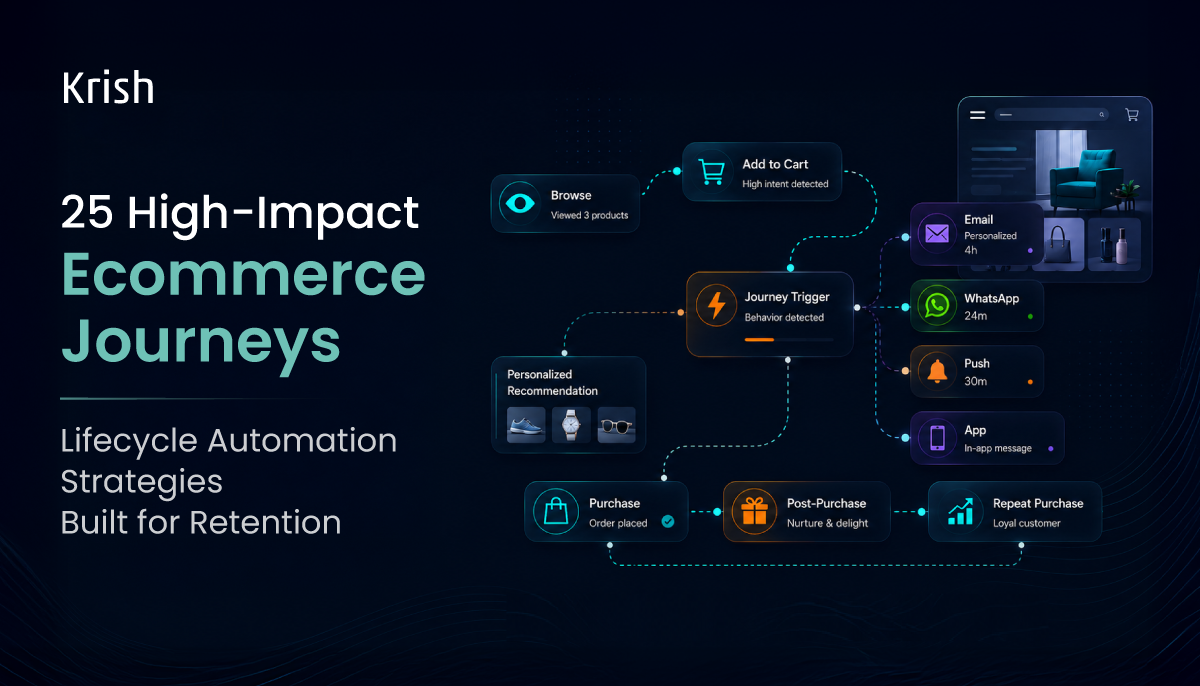
Nearly every ecommerce brand has a cart recovery flow. Very few have one that is genuinely optimized. A high-performing sequence escalates thoughtfully across channels, push at 30 minutes, email at 4 hours, WhatsApp at 24 hours, and applies incentives only where behavioral signals justify them. Offering a discount to every cart abandoner trains customers to abandon carts on purpose. Dynamic incentive application, triggered by propensity signals rather than the abandonment event itself, protects margin while recovering the customers who genuinely needed a nudge.
4. Checkout Abandonment Journey
✓ Goal: Convert users who reached the final step but did not complete the purchase.
Checkout abandoners are not cart abandoners, and most brands treat them identically. A checkout abandoner navigated to the deepest point in the purchase funnel. Something specific stopped them: payment failure, address validation problems, shipping cost revealed too late, a promo code that did not apply. A generic reminder addresses none of these. An effective checkout recovery flow identifies the specific drop-off point from behavioral data and addresses that friction directly. This precision is what makes checkout abandonment disproportionately high-converting.
5. First Purchase Conversion Journey
✓ Goal: Convert registered users who have browsed and signed up but never ordered.
A user who registers but does not purchase is a customer with unresolved hesitation. The registration signals interest. The absent purchase signals that something of trust, relevance, urgency to did not close the gap. Effective journeys combine personalized category recommendations, social proof, brand storytelling, urgency triggers, and a well-timed first-order benefit. Leading with the offer before earning trust is the same mistake the welcome journey makes when it goes wrong.
6. Post-Purchase Experience Journey
✓ Goal: Deepen the customer relationship from the moment the transaction closes.
Most brands treat post-purchase as logistics communication. That is not retention, that is administration. The window immediately after a purchase is where customer relationships are built or lost. A strong post-purchase journey goes beyond confirmation: proactive shipping updates at every milestone, product onboarding where relevant, contextually relevant cross-sell recommendations, and a structured review request timed to when the customer has actually experienced the product. Together, these set the expectation that this brand communicates like a partner, not a transaction processor.
7. Replenishment Journey
✓ Goal: Prompt customers to reorder consumables before they run out, and before a competitor captures the reorder.
For categories with predictable consumption cycles, beauty, supplements, skincare, grocery to replenishment journeys are one of the clearest paths to repeat revenue. The window is what most brands get wrong. Reach customers too late and they have already reordered elsewhere. Predictive timing built on purchase frequency and SKU-level data, refined by individual behavioral history, reaches customers before they run out. No discount required in most cases, the convenience of the reminder drives the conversion.
8. Cross-Sell and Upsell Journey
✓ Goal: Surface complementary or premium products at the moment of highest contextual relevance.
Most cross-sell implementations fail because they are driven by catalogue proximity rather than customer context. The trigger should be behavioral, purchase event, browse pattern, or lifecycle stage, and the recommendation logic should answer one question: does this make sense in this customer’s life right now?
9. Price Drop Alert Journey
✓ Goal: Reach high-intent shoppers the moment a product they have been watching becomes more accessible.
A meaningful segment of shoppers do not abandon out of disinterest. They browse, wishlist, or cart a product and wait for a signal. Effective price drop journeys track viewed products, wishlisted items, and previously abandoned carts, then trigger on price reductions, inventory pressure, and offer expiration windows. The journey does not create intent. It identifies intent that already exists and gives it the trigger it was waiting for.
10. Back-in-Stock Journey
✓ Goal: Convert users who showed purchase intent on out-of-stock products before that intent cools.
Back-in-stock journeys convert at exceptional rates because the work is already done. The customer found the product, evaluated it, wanted it, and was stopped only by availability. The failure mode is timing, a back-in-stock alert firing 72 hours after restocking, in a batch email, arrives after the moment has passed. Real-time event ingestion and immediate trigger firing are what make this journey work.
11. Category Affinity Journey
✓ Goal: Deliver communication that reflects how each customer actually shops.
Not all customers engage with a catalogue the same way. Some gravitate toward premium tiers. Others buy only on discount. Some are loyal to one category with almost no crossover. Behavioral affinity segmentation personalizes based on demonstrated patterns, product tier preference, category loyalty, discount propensity, brand affinity, producing communication that feels written for this specific customer because the signals that shaped it came from this specific customer.
12. VIP Customer Journey
✓ Goal: Recognize and retain your highest-value customers before a competitor does.
The top five to ten percent of customers typically generate a disproportionate share of total revenue, and are most actively courted by competitors. Generic loyalty communications do not retain them. VIP journeys should be architecturally distinct: early access to new collections, exclusive products, milestone recognition, personalized recommendations curated to demonstrated taste, and priority support. Customers who feel genuinely recognized have substantially lower churn rates. This is one of the highest-return retention investments available.
13. Dormant Customer Reactivation Journey
✓ Goal: Win back customers who were once active before their disengagement becomes permanent.
Most brands approach reactivation wrong. A generic discount blast sent to everyone inactive for 60 days recovers some customers and trains the rest to wait for the next offer. Effective reactivation understands why the customer disengaged, not just that they did and personalizes the recovery message to reflect actual purchase history and category affinity. The goal is not to recover every dormant customer. It is to recover the right ones, with the right message, before the window closes.
14. Repeat Purchase Acceleration Journey
✓ Goal: Bring the second purchase forward before the customer’s post-purchase momentum fades.
The second purchase is the inflection point for long-term retention. A customer who has bought twice is substantially more likely to continue buying than one who has bought once. Most brands leave this window entirely unmanaged. Activate within the first 30 days, surface contextually relevant suggestions based on the specific first order, keep the messaging value-driven rather than promotional, and use the channel the customer actually engages with.
15. Seasonal Intent Journey
✓ Goal: Reach customers at seasonal moments with communication that feels personally relevant, not generically timed.
The difference between a seasonal journey and a seasonal blast is the data layer underneath it. Journeys that perform use past seasonal purchase history to predict future intent, browsing behavior during equivalent windows in prior years, gifting intent signals, and category-specific timing that reflects when customers actually start planning, not when the campaign team is ready to send.
16. Wishlist Reminder Journey
✓ Goal: Convert declared purchase intent that customers have simply not acted on yet.
A wishlist is among the clearest intent signals available. The gap between saving a product and purchasing it is almost always timing or distraction, not a change of mind. Wishlist journeys close that gap with periodic reminders, low-stock notifications, trending alerts, and price drop notifications tied to wishlisted items. The intent signal is already there. The journey’s only job is to make it inconvenient to continue waiting.
17. Product Review Collection Journey
✓ Goal: Generate authentic reviews at scale, because reviews are commercial infrastructure, not an afterthought.
Reviews improve on-page conversion rates, strengthen organic search, build social proof, and feed recommendation algorithms. Most brands treat collection as an afterthought one email, 48 hours after delivery, to everyone. Timing should match the actual product experience window, which varies significantly by category. Friction at submission is the primary reason review rates are low. Every review collected is a long-term conversion asset.
18. Loyalty Program Engagement Journey
✓ Goal: Keep loyalty members actively engaged with benefits, because a programme they forget about retains nobody.
Most loyalty programs fail not because the rewards are inadequate, but because customers forget they are enrolled. Automated journeys solve this: points balance reminders near redemption thresholds, notifications when new rewards unlock, milestone acknowledgments, and expiry warnings with enough lead time to drive action. A loyalty programme customers remember retains customers. One they joined and forgot drives no retention value at all.
19. Referral Journey
✓ Goal: Turn satisfied customers into an active, measurable acquisition channel.
Most referral programs fail on timing and friction. The request arrives before the customer has used the product. The mechanic takes more than 30 seconds to complete. Referral journeys that convert trigger at peak satisfaction, make the process genuinely frictionless, and structure the incentive to benefit both referrer and new customer equally. A referral journey is also a measurement of how well the rest of the customer experience is working.
20. High AOV Customer Journey
✓ Goal: Deliver premium experiences to customers whose basket values reflect a fundamentally different relationship with the brand.
Treating high AOV customers identically to the median customer is a segmentation failure that shows up in churn rates. These journeys should deliver exclusivity and early access to new arrivals, personalized recommendations curated to demonstrated taste, premium unboxing experiences, dedicated support touchpoints, and recognition through status and access, not discounts, which devalue the relationship. A high AOV customer who starts feeling like any other customer starts evaluating alternatives.
21. Discount Dependency Reduction Journey
✓ Goal: Recalibrate price-sensitive customers toward full-price purchasing, and protect the margins that discount cycles erode.
Some segments have been trained to purchase only during sales. In many cases, the brand trained them. The result is a segment that is technically active but commercially damaging. AI-driven journeys recalibrate this over time through affinity-based recommendations, exclusivity framing, urgency signals tied to demand rather than manufactured countdowns, and consistent full-price value positioning. This is a longer-cycle journey. The margin impact for brands that commit to it is substantial.
22. App Engagement Journey
✓ Goal: Build genuine app engagement habits that make the mobile channel a retention advantage.
The mobile app offers real structural advantages, higher push open rates, a faster purchase experience, and the ability to offer app-exclusive benefits. Most brands underinvest in app engagement journeys relative to the channel’s potential. Four phases matter: onboarding new installers, driving push notification opt-in early, app-exclusive offers that create habitual usage, and re-engagement sequences for users whose activity has dropped. An app users install and forget is not a retention asset. It is a vanity metric.
23. Predictive Churn Prevention Journey
✓ Goal: Intervene before a customer becomes inactive, not after the disengagement has already happened.
Reactive reactivation is expensive and less effective than the alternative. Predictive churn models identify at-risk customers from early behavioral signals, declining session frequency, reduced cross-channel engagement, lengthening purchase intervals, narrowing category exploration of weeks before visible drop-off occurs. Acting at this stage, while the customer is still reachable, is consistently more effective and more cost-efficient than reactive reactivation. Most brands miss this window entirely.
24. Dynamic Personalization Journey
✓ Goal: Deliver experiences genuinely relevant to each individual customer, not just personalized in name.
Personalization that begins and ends with a first-name token is mail merge with a more sophisticated delivery platform. Real personalization requires a unified customer view and the infrastructure to act on it in real time: behavioral intent signals from recent sessions, real-time context, lifecycle stage and purchase history, category affinity built from demonstrated behavior, and cross-channel engagement history. The infrastructure investment is meaningful. The revenue impact consistently justifies it.
25. Omnichannel Lifecycle Journey
✓ Goal: Orchestrate a consistent, seamless customer experience across every touchpoint, because customers experience brands, not channels.
Customers do not distinguish between the email they opened on their commute, the push notification at lunch, and the WhatsApp message they responded to in the evening. They experience one continuous relationship. Most brands deliver something different: multiple channels on their own logic, overlapping messages, no unified view of what the customer has already seen.
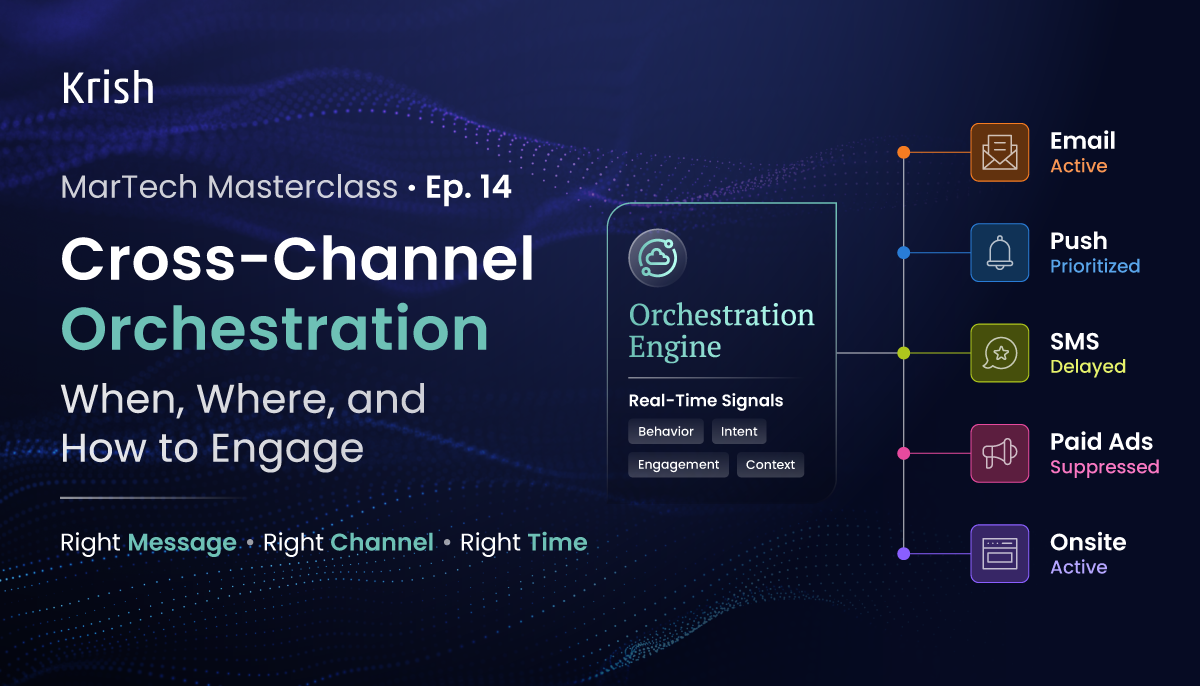
An omnichannel lifecycle journey changes the architecture entirely, email, WhatsApp, push, SMS, onsite nudges, and paid retargeting unified by a single real-time view of customer state, with suppression logic that prevents a customer who just converted from receiving a conversion message on another channel 30 minutes later. This is not multichannel messaging with consistent branding. That bar is too low. This is unified customer journey lifecycle orchestration, and the brands investing in this architecture now are building a retention advantage that will compound over time and become increasingly difficult for competitors to replicate.
Building a Smarter Retention Ecosystem
The 25 journeys above are not a campaign calendar replacement. They are the infrastructure layer underneath the entire customer lifecycle, one that understands behavior, reacts in real time, personalizes at genuine scale, and compounds its impact with every data point it generates.
WebEngage gives you the orchestration engine. What bridges the engine to outcomes is implementation quality, the data infrastructure, segmentation framework, journey logic, and measurement setup that determines whether the platform performs at its ceiling or far below it.
At Krish, our MarTech practice is built around exactly this gap. We help ecommerce brands design and implement lifecycle journey architecture on WebEngage, from event taxonomy and data infrastructure through journey design, channel orchestration, and the measurement frameworks that connect journey performance to revenue outcomes. Because a retention strategy that cannot answer which journey drove this repeat purchase, and why, is not a strategy. It is an assumption with a send button on it.
Further reading Building a Consistent, Cross-Channel Experience for Higher Engagement — How HNAK Unified Its Marketing with WebEngage
Table of Content
Subscribe with Us!
Never miss any post, stay tuned!

As Director - Marketing, Zenul leads the marketing and branding at Krish. He brings with him an in-depth understanding of the evolving digital ecosystem and has a proven expertise and experience in strategic planning, market and competition analysis, creating and implementing client-centered, lead-gen and brand marketing campaigns. He has a heart for technology innovation and has been a keynote speaker on various platforms.
Recommended Reading:
Cross-Channel Orchestration: When, Where, and How to Engage – MarTech Masterclass Series Ep | 14
27 May, 2026 Most brands running five channels are not doing cross-channel marketing. They are doing single-channel marketing five times over. The email team has its own calendar, its own KPIs, its own definition of a good week. Same for SMS, push, paid, and web. No shared view of what the customer has already received. No suppression logic that crosses a channel boundary. No agreed moment when one channel yields to another. The customer who buys on Monday is still getting a conversion-push on Wednesday because the paid retargeting audience sync runs nightly and someone forgot to check.
Subscribe with Us!
Never miss any post, stay tuned!
Trusted by leading brands


