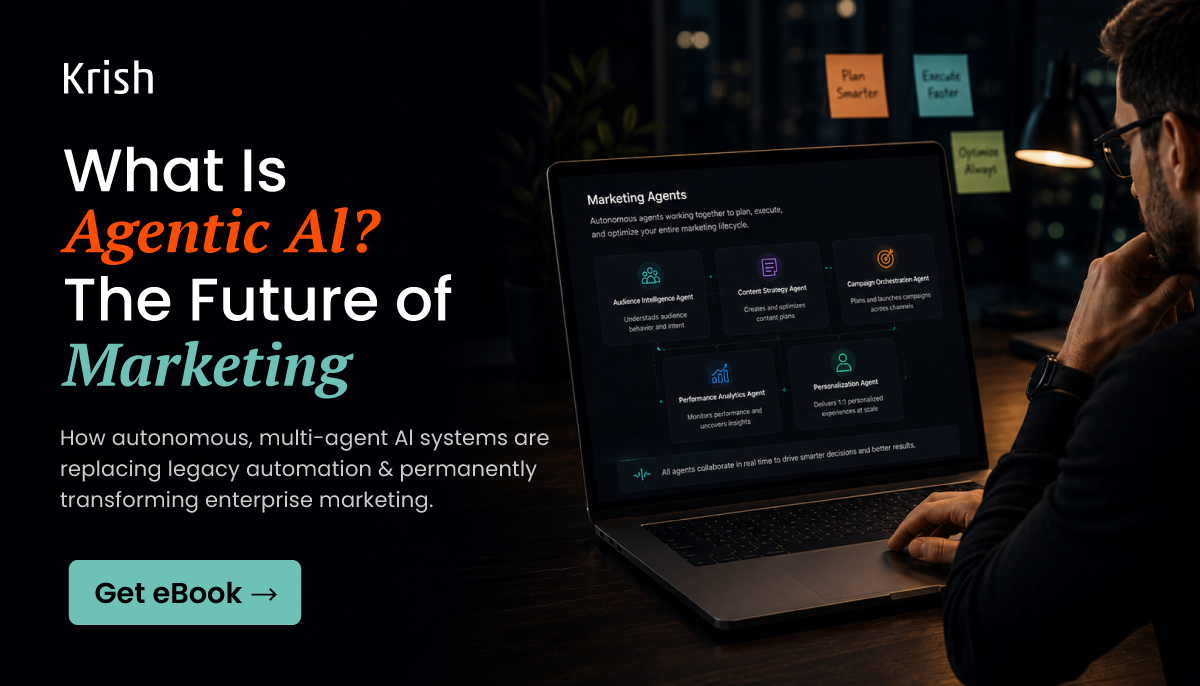
Introduction
Preparing marketing teams for the shift from automation to autonomous intelligence
Marketing is moving beyond AI-assisted execution. A new generation of systems is beginning to reason, coordinate actions, and adapt decisions across workflows with greater autonomy.
According to McKinsey’s State of AI, organizations are increasingly moving AI from experimentation into business operations, with agentic systems emerging as a key area of enterprise focus (62% of survey respondents say their organizations are at least experimenting with AI agents). This signals a broader shift: AI is no longer just improving individual tasks. It is starting to reshape how organizations execute, optimize, and scale decisions.
This ebook explores what that evolution means for marketing leaders. How agentic AI could influence execution, personalization, orchestration, and enterprise readiness in 2026.
Why agentic AI, why now
Marketing is entering a more autonomous operating era
For years, AI improved marketing through predictive analytics, segmentation, recommendations, and workflow automation. But most systems still required manual intervention to connect insights with execution.
Agentic AI introduces a stronger layer of autonomy. Instead of assisting isolated tasks, AI agents can operate across workflows, respond to context, and continuously optimize decisions.
This matters because businesses are under pressure to move faster while managing growing operational complexity.
With agentic AI, leaders can begin rethinking how marketing can become more adaptive through:
- Smarter cross-channel decision-making
- Reduced workflow friction across martech ecosystems
- Faster execution across campaigns and journeys
- More responsive personalization at scale
- Stronger balance between autonomy and governance
What’s inside this ebook
A strategic guide to how marketing may evolve in 2026
This ebook goes beyond AI hype and explores where agentic systems may create real marketing value.
It looks at how AI is evolving from a support layer into a more active operational layer, helping enterprises rethink execution, orchestration, and intelligence.
Inside, you’ll explore:
- The shift from automation to agentic systems
Understand how AI is progressing from task execution toward reasoning and orchestration. - High-impact marketing use cases
Discover where AI agents may influence personalization, campaign execution, optimization, and customer journeys. - The next martech operating model
Learn how connected systems, data, and workflows may evolve around autonomous intelligence. - Governance and oversight
Explore why trust, accountability, and human control remain critical. - Readiness for 2026
Identify what enterprises need across data, teams, and technology.
What leaders will uncover
The strategic shifts that could define stronger marketing teams
The opportunity of agentic AI is bigger than efficiency.
It can influence how organizations reduce decision latency, adapt customer journeys faster, and build systems that respond more intelligently to changing customer behavior.
This ebook helps leaders understand how to:
- Identify practical AI opportunities beyond experimentation
- Build scalable AI-assisted and AI-led workflows
- Improve personalization beyond static rules
- Prepare martech ecosystems for adaptive intelligence
- Align AI innovation with governance and trust
- Rethink marketing operating models for long-term agility
Key themes explored
The building blocks of agentic marketing maturity
At its core, this ebook looks at what happens when intelligence becomes more operational.
It explores how organizations can move from fragmented AI initiatives toward connected systems that support smarter execution.
Themes covered include:
- Autonomous workflow orchestration
- Adaptive personalization
- Predictive decisioning
- Journey intelligence
- Cross-platform marketing execution
- Data readiness and activation
- Human-in-the-loop governance
- Responsible AI adoption
- Marketing efficiency at scale
Who should get this?
Built for leaders shaping AI-led transformation
This ebook is designed for teams evaluating how AI moves from experimentation into operational value.
It is especially relevant for:
- CMOs and marketing leaders
- Martech and automation heads
- Digital transformation leaders
- Customer experience teams
- Personalization and data teams
- eCommerce and growth leaders
- Innovation and AI strategy teams
Why this matters in 2026?
The next advantage will come from adaptive systems, not isolated tools
The first phase of AI improved efficiency. The next phase may reshape execution itself.
As agentic AI matures, competitive advantage will increasingly come from systems that can connect decisions, adapt faster, and reduce complexity across the customer lifecycle.
Organizations that begin preparing now may be better positioned to:
- Scale personalization more intelligently
- Improve speed of execution
- Reduce operational fragmentation
- Build stronger AI governance
- Create more adaptive customer experiences
Explore what marketing looks like beyond automation
Discover how agentic AI could redefine execution, intelligence, personalization, and enterprise marketing readiness in 2026.
Subscribe with Us!
Never miss any post, stay tuned!
Trusted by leading brands


