Introduction
A potential customer asks ChatGPT, “What’s the best marketing automation platform for eCommerce brands?” Your competitor gets mentioned. You don’t. No click. No impression. No chance to compete.
This is the new reality of digital discovery. Traditional SEO builds your visibility in blue-link search results. But in 2026, AI-powered assistants, LLM-based search engines, and generative answer platforms are answering questions directly, and only the brands that understand LLM discovery optimization will earn a place in those answers.
The rules haven’t just changed. They’ve been rewritten entirely.
What Is AI-Driven Search and Why Does It Matter?
AI-driven search refers to search experiences powered by large language models and generative AI platforms like Google’s AI Overviews, ChatGPT Search, Perplexity, Bing Copilot, and Claude. Instead of returning a list of links, these platforms synthesize information and deliver direct, conversational answers.
This shift has massive implications for digital brands:
- Zero-click answers mean users may get information without visiting your website
- Mentions and citations in AI answers are becoming a new layer of visibility alongside rankings
- Conversational queries replace keyword-only searches with natural language questions
- AI agents increasingly research and recommend products, services, and solutions on a user’s behalf
For brands investing in marketing automation, AI search optimization isn’t just an SEO tactic; it’s the engine that determines whether your automated content, campaigns, and assets are actually discoverable when customers are making decisions.
What Is LLM Discovery Optimization?
LLM discovery optimization is the practice of structuring, positioning, and publishing your brand’s content so that large language models recognize, trust, and cite your expertise when generating answers for users.
Think of it as the next evolution beyond traditional SEO. While Google AI SEO focuses on ranking signals and crawlability, LLM discovery optimization goes deeper: it’s about becoming the source that AI models turn to when they need authoritative, accurate, and relevant information in your space.
This includes several related disciplines:
- Answer Engine Optimization (AEO): Structuring content to directly answer specific questions AI systems are asked
- Generative Engine Optimization (GEO): Optimizing for platforms that generate synthesized responses rather than returning links
- AI-powered search visibility: Ensuring your brand appears in AI-generated answers, not just traditional search results
- AI SEO optimization: Combining traditional SEO fundamentals with new LLM-specific content strategies
How AI-Powered Search Is Reshaping Brand Discovery
Traditional SEO vs. AI Search Optimization
Old SEO rewarded keyword density, backlink volume, and domain authority. AI-driven SEO rewards something fundamentally different:
Clarity of expertise: LLMs favor content that clearly demonstrates deep knowledge in a specific domain over broad, generic pages optimized for clicks.
Factual accuracy and consistency: AI models cross-reference information across multiple sources. Inconsistent, outdated, or vague content gets filtered out in favor of precise, reliable information.
Structured, semantic content: Conversational AI engines prioritize content organized around questions, definitions, comparisons, and step-by-step processes, not keyword-stuffed paragraphs.
Brand mentions across trusted sources: When multiple authoritative sites reference your brand in a consistent, positive context, LLMs build a stronger association between your brand and your area of expertise.
How Omnichannel Marketing Supports AI Search
Here’s a connection most brands overlook: how omnichannel marketing supports AI search visibility is one of the most important relationships in modern digital strategy.
AI answer systems draw data from a vast ecosystem of sources like blog posts, social content, review platforms, podcast transcripts, YouTube descriptions, industry publications, forum discussions, and news articles. Your brand’s omnichannel presence determines how widely and consistently you appear across all these data sources.
A cohesive omnichannel marketing automation strategy supports AI search by:
- Creating content consistency: The same core messages, expertise, and brand authority appear across channels, reinforcing LLM associations
- Expanding content surface area: More channels mean more data points for LLMs to reference when building knowledge about your brand
- Building topical authority: Consistently publishing across email, social, blog, video, and partnerships establishes deep expertise signals
- Generating social proof at scale: Reviews, testimonials, and user-generated content across platforms reinforce trustworthiness signals that LLMs value
- Maintaining freshness: Automated content publishing across channels keeps your brand’s information current, especially important for AI systems that use retrieval and real-time sources
How to Optimize Content for LLMs and AI Search Engines
Step 1: Build Topic Clusters Around Core Expertise
LLMs favor brands that demonstrate comprehensive expertise in specific domains. Instead of isolated blog posts, create interconnected content clusters:
- Identify 3-5 core topic areas that define your brand’s expertise
- Build pillar pages that comprehensively cover each topic
- Create supporting content that addresses specific questions within each topic
- Link everything together to demonstrate topical depth and authority
Step 2: Structure Content for Answer Engine Optimization
When optimizing content for LLMs and AI search engines, format matters enormously:
- Open every piece of content with a clear, direct answer to the primary question
- Use H2 and H3 headings formatted as natural questions
- Include definition boxes, FAQs, and summary sections
- Write in clear, concise sentences, LLMs prefer precision over prose
- Use numbered lists and step-by-step formats for instructional content
Step 3: Establish Consistent Brand Entity Signals
LLMs build knowledge graphs about brands. Help them understand who you are:
- Ensure your brand name, description, and expertise are consistent across all platforms
- Complete and optimize your Google Business Profile, LinkedIn, and industry directories
- Publish clear “About” content that defines your expertise, methodology, and unique positioning
- Get cited and mentioned in industry publications, podcasts, and authoritative blogs
Step 4: Create Citation-Worthy Content
The most powerful LLM optimization step is creating content other sites naturally reference:
- Publish original research, surveys, and data studies in your industry
- Create comprehensive guides that become go-to resources
- Develop unique frameworks, methodologies, or models others cite
- Offer expert commentary that journalists and content creators quote
Step 5: Leverage Structured Data and Schema Markup
AI-powered SEO benefits significantly from technical structure:
- Implement FAQ schema on question-based content
- Use HowTo schema for process-driven articles
- Add Article schema with proper author and publication data
- Implement Organization and BreadcrumbList schema site-wide
How to Measure AI Search Traffic
One of the most common questions marketers ask is: how do I measure AI search traffic? This is genuinely challenging because most AI platforms don’t pass traditional referral data. However, these approaches help:
Track Direct and Dark Traffic Increases: A rise in direct traffic often indicates AI-referred visitors who were told to visit your site by an AI assistant. Monitor this trend alongside AI search growth periods.
Monitor Referrals Where Available: Some AI tools and browsers may pass referral sources (e.g., certain experiences from Perplexity or Bing). Track these when they appear.
Monitor Brand Search Volume: As your AI search visibility grows, branded search queries typically increase as people look up brands mentioned in AI answers.
Query AI Platforms Directly: Regularly ask ChatGPT, Perplexity, Google AI, and others questions in your topic areas and document when your brand appears in answers.
Use Specialized AI Visibility Tools: Platforms like Brandwatch, Semrush, and emerging AI visibility trackers are building specific features to monitor LLM brand citations.
How to Improve LLM Visibility Through Marketing Automation
Improving LLM visibility requires consistent, high-volume, high-quality content production. This is where marketing automation becomes your greatest ally in AI-driven SEO.
Automate Content Distribution: Use marketing automation to systematically distribute content across all channels, ensuring maximum coverage across the data sources LLMs reference.
Schedule Regular Content Refreshes: Automate content audits and updates to keep information current and accurate, stale content loses LLM favor quickly.
Automate Review and Testimonial Collection: Social proof signals matter in LLM training data. Automated review request sequences across platforms build this crucial credibility.
Build Automated PR and Link Outreach: Consistent outreach to publications and industry sites that earn citations builds the authority signals LLMs prioritize.
Use AI to Assist Content Production (With Human Expertise): AI tools can help with structure, drafts, and consistency, but expert review and originality are critical for building trust and citation value.
LLM Optimization Steps: A Quick Reference Checklist
Use these core LLM optimization steps to assess your current readiness:
- Content organized into clear topic clusters with pillar pages
- All key pages structured with direct answers and question-based headings
- Brand entity consistent across website, social, directories, and publications
- Original research or data published in the last 12 months
- FAQ and HowTo schema implemented on relevant pages
- Regular AI platform queries to track brand citations
- Marketing automation publishing content consistently across all channels
- Review and testimonial collection automated
- Content updated and refreshed on a documented schedule
- Omnichannel presence maintained across minimum 4-5 content channels
What Brands Get Wrong About AI SEO Optimization
Avoid these common mistakes that undermine AI-powered SEO efforts:
Chasing AI algorithms like traditional SEO: AI search isn’t about gaming signals, it’s about genuinely becoming the most helpful, authoritative resource in your space.
Ignoring non-website content: Your brand’s LLM visibility depends on the entire ecosystem of content about and from you, not just your website.
Publishing without structure: Brilliant content that isn’t structured for answer extraction won’t get cited, regardless of its quality.
Inconsistent brand messaging: If your brand says different things in different places, LLMs build a confused, weak association rather than a clear, authoritative one.
Measuring with only traditional metrics: Standard SEO metrics don’t capture AI visibility. You need new measurement frameworks to understand your true AI-driven search performance.
Your Next Steps Toward AI Search Dominance
Ready to make your brand discoverable in the age of AI-driven search?
- Audit existing content for structure, accuracy, and topical coverage gaps
- Map your omnichannel presence and identify channels where your brand is absent or inconsistent
- Implement marketing automation to maintain consistent publishing velocity across channels
- Create your first original research piece to build citation-worthy authority
- Set up AI visibility tracking by regularly querying major AI platforms for your topic areas
- Apply LLM optimization steps from the checklist above systematically across your content library
- Review and update quarterly AI search evolves rapidly and your strategy must evolve with it
Conclusion
The brands winning in AI-driven search aren’t the ones with the most backlinks or the highest domain authority by old metrics. They’re the brands that have become genuinely authoritative, consistently helpful, and structurally optimized for the way LLMs understand and recommend information.
LLM discovery optimization, Answer Engine Optimization, and Generative Engine Optimization aren’t replacements for good marketing; they’re amplifiers of it. When combined with a powerful marketing automation strategy and a consistent omnichannel presence, AI search optimization positions your brand to be discovered exactly when and where your ideal customers are seeking answers.
The question your brand needs to answer isn’t just “How do we rank on Google?” In 2026, the question is: “When an AI is asked about our category, are we the brand it trusts enough to recommend?”
Build that trust through consistent expertise, structured content, and intelligent automation, and AI-driven search won’t just find your brand. It will champion it.
Table of Content
- Introduction
- What Is AI-Driven Search and Why Does It Matter?
- What Is LLM Discovery Optimization?
- How AI-Powered Search Is Reshaping Brand Discovery
- How Omnichannel Marketing Supports AI Search
- How to Optimize Content for LLMs and AI Search Engines
- How to Measure AI Search Traffic
- How to Improve LLM Visibility Through Marketing Automation
- LLM Optimization Steps: A Quick Reference Checklist
- What Brands Get Wrong About AI SEO Optimization
- Your Next Steps Toward AI Search Dominance
- Conclusion
Subscribe with Us!
Never miss any post, stay tuned!

Ankit helps brands navigate their digital maturity journey by bringing together analytics, CRO, ML, and AI in a practical, business-friendly way. Having worked with global teams across industries, he focuses on simplifying complex MarTech concepts and turning them into measurable outcomes. On weekends, you’ll likely find him deep in a reflective read or sharing a coffee with a client while simplifying MarTech in the most human way possible.
Recommended Reading:
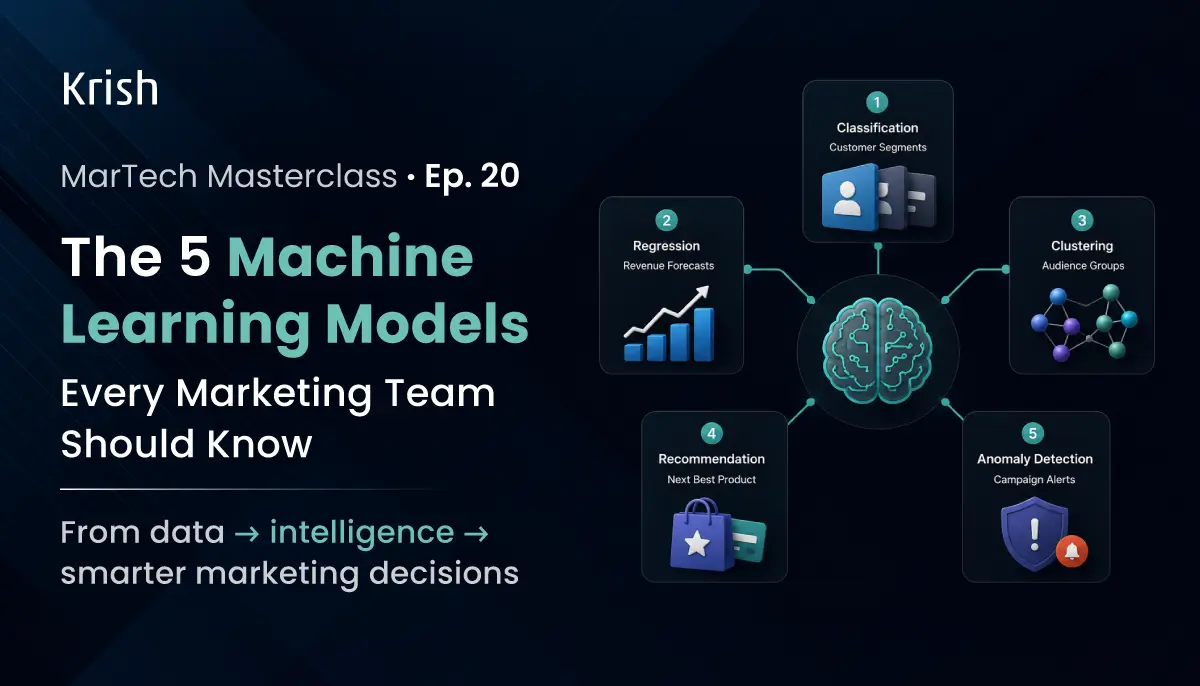
The 5 Machine Learning Models Every Marketing Team Should Know – MarTech Masterclass Series Ep | 20
17 July, 2026 Most marketing conversations about machine learning (ML) collapse it into a single capability. Teams talk about "using AI" or "adding ML to the stack" as though it were one tool with one function. It is not, and treating it that way is why most ML initiatives either overreach and fail or underdeliver and disappoint.
Subscribe with Us!
Never miss any post, stay tuned!
Trusted by leading brands


