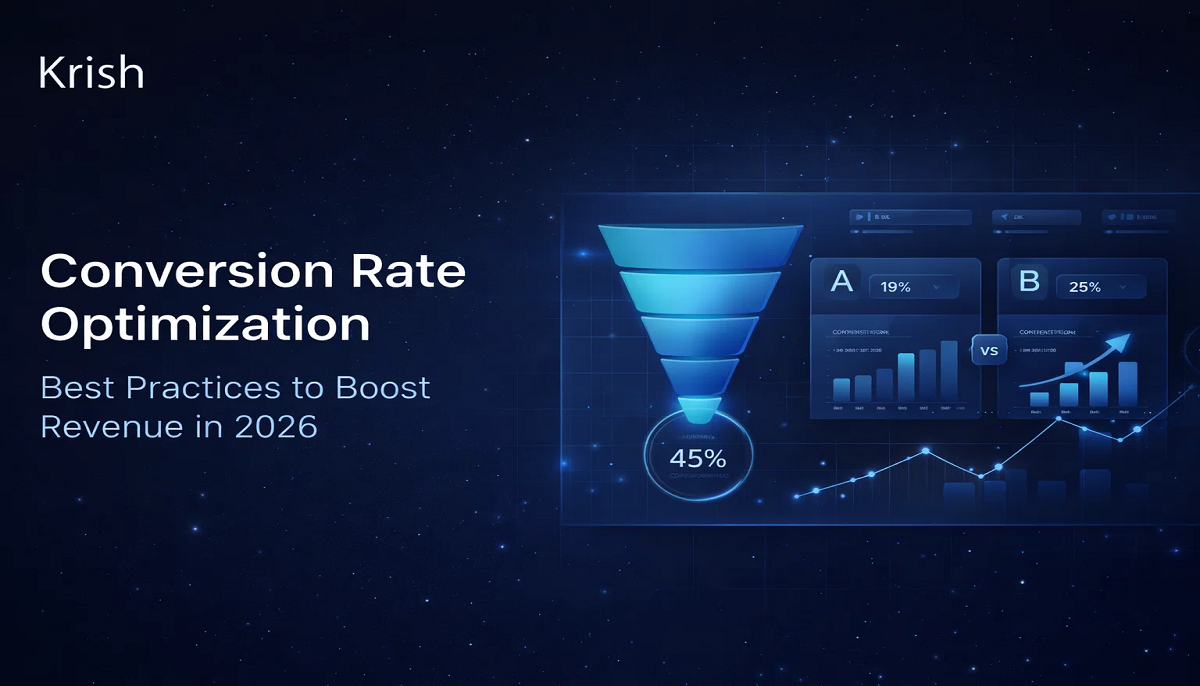
Introduction
The importance of CRO has increased because several structural shifts have changed how digital marketing works.
More traffic doesn’t guarantee better conversions. Before optimizing your funnel, understand what actually counts as a conversion. Read Macro vs. Micro Conversions to build a stronger CRO foundation.
The cost of acquiring customers is increasing on major advertising channels. The solution is no longer just to increase ad spend for businesses that need to increase their revenues. Instead, the solution is to implement conversion rate optimization best practices to get more value out of the traffic they are already generating.
Customers are also becoming more demanding. They expect faster websites, personalized experiences, and mobile experiences that just work. But when these demands are not met, customers just leave. Another complexity is the introduction of mobile commerce. While the majority of traffic may be from mobile devices, the conversion rates are lower because of the “friction” created by mobile commerce.
The issue of privacy regulations and the end of third-party cookies forces companies to focus more on their own digital properties. In some cases, the website is the best source for understanding users.
All these factors are leading us toward a common conclusion, i.e., improvement in conversion performance is as important as acquiring more traffic.
In this article, we’ll explain what conversion rate optimization means and share some practical tips businesses can use in 2026 to turn more website visitors into customers.
What Is Conversion Rate Optimization?
Conversion Rate Optimization is “the process of systematically improving the percentage of people who visit your site that are able to do a desired action on your site. Though advertising campaigns may be costly to the sites where it will be important to boost the number of people visiting, the aim of conversion rate optimization is to make the most out of the people who are already visiting your site.
The formula is as follows:
Conversion Rate = (Total Conversions / Total Visitors) * 100
For example, let’s say you have a total of 1,000 people visiting your site. However, only 50 of those people make a purchase.
Essential Conversion Rate Optimization Best Practices for 2026
1. Start with Real User Behavior, Not Assumptions
Too many CRO projects stall before they start because people dive right in and start redesigning pages.
The first step of any CRO project is always observation.
With Google Analytics 4 or any other tool, it is easy to determine where the users are entering the site as well as dropping off.
The heat maps and session recordings provide straightforward methods to track user movement through the website.
It’s surprising how quickly user behaviors start to reveal themselves. Users may be leaving the checkout process because shipping costs are unexpected. Mobile users may be having a hard time filling out forms. A product page may be popular but not clearly communicate value.
Rather than using opinions about what “should” work, CRO starts with understanding what “does” work.
Expert Insight
The biggest mistake in CRO is changing the design before understanding the problem. Observe user behavior first. Once you know where friction exists, every optimization becomes more intentional and measurable. — Falguni, Krish TechnoLabs
2. Mobile Experience Is Now the Default Experience
The majority of websites are dominated by mobile users these days, but conversion funnels are still designed under the assumption that users are using a desktop computer to access them.
For example, let’s consider a normal scenario: A user is browsing an online shop’s website on his or her mobile phone while on the go. The product is good, but the checkout process requires registration, verification of an email address, and a couple more forms.
Most users abandon the purchase immediately.
Mobile optimization focuses on eliminating these moments of friction. Improvements often include:
- Reducing the number of form fields
- Simplifying navigation structures
- Ensuring pages load within three seconds
- Designing buttons large enough for thumb navigation
- Supporting fast payment methods like Apple Pay or Google Pay
These are all minor changes, yet they have a big impact on the performance of a conversion on a mobile device.
3. Personalization Is Becoming a Core CRO Strategy
One of the biggest changes in CRO over the past few years is the growing use of AI-driven personalization as part of modern conversion rate optimization strategies.
No longer does a website present the same experience for all users.
A user coming from an ad on Instagram may be presented differently from one coming from a natural search result. A returning user may be presented differently from a first-time user. A first-time user may be presented differently from one coming from a referral source.
These personalized experiences reduce cognitive load. Rather than forcing users to search for relevant information, the website surfaces it automatically.
The result is often significant: personalized product recommendations alone can increase ecommerce conversion rates by 20% or more.
What’s genuinely new in 2026 is the shift from personalization to AI-powered session analysis. Instead of only adapting what users see, AI tools now read replays at scale and automatically rank friction patterns by recoverable conversion value — telling teams not just what happened, but what to fix first. This moves CRO from a reporting discipline to a prioritization engine.
4. Messaging Matters More Than Most Teams Realize
However, user experience enhancements cannot replace unclear messaging.
When people land on a website, they have an inherent need to get answers to three questions:
- What does this company offer?
- Why should I care?
- Why should I trust them?
If a website does not answer these questions well, users will leave the website.
Therefore, good CRO techniques emphasize value proposition clarity. Headings, subheadings, and introductions should clearly communicate the value of the product in a matter of seconds.
Another technique used in CRO is changing from a feature-based message to a benefit-based message.
A feature might say:
“256GB storage.”
A benefit explains the outcome:
“Store thousands of photos and videos without worrying about space.”
That difference dramatically affects how quickly visitors understand value.
5. Friction Is the Silent Conversion Killer
Conversion funnels usually have hidden friction points that, while insignificant by themselves, collectively represent a significant problem.
- Some of the most common ones are:
- Long forms requiring unnecessary information
- Hidden shipping charges that are introduced very late in the checkout process
- Confusion in navigation structures
- Slow page load times
- Forced account creation
Research from the Baymard Institute shows that nearly 70% of ecommerce carts are abandoned, and unnecessary complexity during checkout is one of the most common causes.
Reducing friction is often one of the fastest ways to increase conversions.
6. Trust Signals Influence Conversion Decisions
Even with the product looking good, people might avoid using it if there’s any uncertainty about the website itself.
Trust signals help eliminate these doubts.
Customer reviews are one of the strongest trust signals because they are based on real-world experiences of people who have used the product.
Testimonials may also work in a similar manner if results are specified rather than vague statements.
Security badges, payment provider logos, and refund policies help build trust in the transaction process itself.
In most cases, displaying social proof in the form of the number of customers served or the number of reviews received may work.
7. Testing Is What Turns CRO Into a Growth Engine
The most successful CRO teams treat their websites as continuous experimentation environments.
Instead of guessing what might work, they run structured tests. Headlines are tested against alternatives. Call-to-action buttons are redesigned. Page layouts are adjusted.
Sometimes the results are significant. More often, improvements are incremental.
But incremental improvements compound over time.
Testing also produces an institutional knowledge base. Even failed experiments reveal insights about user behavior, which guide future optimizations.
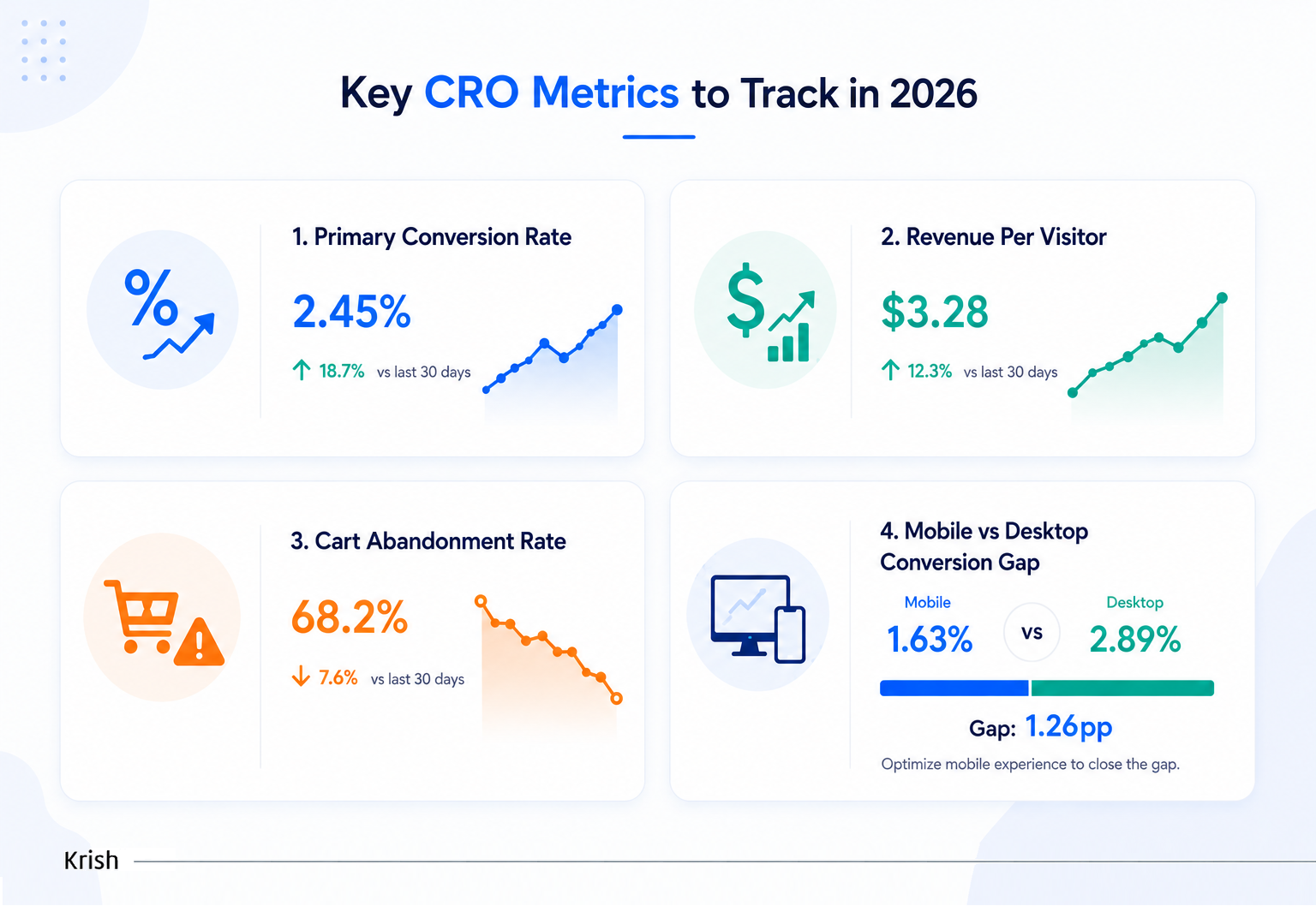
8. Measuring CRO Success
Conversion rate alone does not tell the full story.
Effective CRO programs track several complementary metrics:
- Primary conversion rate (the main action completed)
- Micro-conversions such as add-to-cart events
- Average order value
- Customer lifetime value
- Revenue per visitor
In many instances, the revenue per visitor metric will be the most valuable of these, as it takes into account both conversion rates volume, and order value.
Real-world result
How The Perfect Water turned high-intent traffic into actual sales — with A/B testing, not a redesign.
What is a Good Conversion Rate in 2026?
One of the most common questions CRO practitioners ask is: what should we actually be aiming for? The answer depends on industry, business model, and traffic mix, but here are the 2026 benchmarks:
| Industry | Average | Good | Excellent |
|---|---|---|---|
| Ecommerce | 2.5–3% | 3.5–5% | 5%+ |
| SaaS | 3–5% | 5–8% | 8%+ |
| B2B | 2–3% | 4–5% | 6%+ |
| Healthcare | 3–4% | 5–7% | 8%+ |
Traffic source matters significantly, organic search typically converts at 2–3x the rate of paid social. Benchmarks are averages too, meaning half of all stores perform below them. The goal isn’t to match an average; it’s to build a system that compounds improvement over time.
If your conversion rate is underperforming relative to these ranges, our CRO Audit Services can pinpoint exactly where revenue is leaking.
Further reading
Free ebookCRO Audit Checklist
Audit your store's conversion funnel end-to-end, identify drop-off points, fix friction fast, and prioritize changes that directly impact revenue.
Common CRO Mistakes to Avoid
Even experienced teams sometimes undermine their own optimization efforts.
Some of the most common mistakes include:
- Running experiments without enough traffic for statistical significance
- Testing multiple variables simultaneously making results impossible to interpret
- Ignoring mobile behavior while focusing only on desktop
- Prioritizing short-term conversion gains over long-term brand trust
- Failing to document experiments and learnings
Avoiding these mistakes ensures that experimentation efforts produce meaningful insights, and conversion rate optimization audit services help businesses identify these issues and improve their optimization strategies.
Expert Insight
The biggest mistake we see is teams treating CRO as isolated page tweaks rather than a connected program. The funnel is a sequence of decisions. Fixing one stage without understanding the others often shifts the problem instead of solving it. — Zenul, Krish TechnoLabs
A Practical CRO Action Plan
For organizations that are starting CRO, the process tends to happen in stages.
The first thing that needs to be done is to examine the data that already exists and determine where the largest drop-offs are.
The next step is to determine which management areas have the most impact and which have the most visitors (usually because they are the home, product, or checkout page).
Once the analytics and testing infrastructure are in place, organizations can then conduct their tests.
Over time, these experiments will create a roadmap. Successful organizations will look at the data, refine the hypothesis, and continue to experiment.
Conclusion
CRO unites both data analysis and creativity. It is a process of learning about the behavior of users, identifying issues that make users slow, and developing improved user experiences and testing new directions to determine the most effective ones.
The organizations that are succeeding in the best digital growth today are not just increasing the number of visitors. They are converting existing visitors more effectively.
Every percentage point increase in conversion rate multiplies the return on marketing investment.
Traffic may fluctuate. Advertising costs may rise. Algorithms may change.
But one of the best ways of increasing revenue growth is still making your website convert visitors into customers.
If you want to improve your website’s conversion performance, the expert team at Krish can help with UX improvements and A/B testing to full-funnel optimization. For a deeper, issue-by-issue breakdown of CRO fundamentals, explore our Conversion Maturity Series.
Table of Content
Subscribe with Us!
Never miss any post, stay tuned!

Minal Joshi is a content marketer at Krish with a flair for eCommerce and Digital Commerce aspects. She is a MarTech fanatic with a knack of writing with which, she helps brands to curate, create, & commence digital brand positioning. Sharing insights via articles, case studies, eBooks, Infographics, and other forms of content creation is what she lives for. Being an ardent traveler, when not writing, you'll find her sipping coffee into the mountains or petting a stray.
Recommended Reading:
From Test Results to Business Impact: The Attribution Challenge – MarTech Masterclass Series Ep | 18
2 July, 2026 A variant reaches statistical significance. The team celebrates, ships the winner, and moves on to the next experiment. Weeks later, the metrics leadership actually tracks have not moved. Revenue per session is flat. The number the finance team questions every quarter shows no change that can be credited to the test. The experiment was run correctly. The result was real. And somehow, nothing changed.
Subscribe with Us!
Never miss any post, stay tuned!
Trusted by leading brands


