Introduction
Running a marketing operation today feels like conducting an orchestra where half the musicians are in different buildings, playing from different sheet music, and nobody can hear each other. Your analytics team is drowning in disconnected dashboards. Your media buyers are optimizing campaigns in silos. Your data scientists are building models on stale exports. Meanwhile, your CFO keeps asking one simple question: “What’s working?”
That’s the reality most enterprises face before they discover what happens when Google Cloud Platform meets Google Marketing Platform. This isn’t about adopting another tool. It’s about fundamentally changing how your marketing operation creates value.
The Problem Most Enterprises Don't Realize They Have
Here’s what usually happens: Your team runs campaigns across Google Ads, Facebook, LinkedIn, programmatic display, and maybe a dozen other channels. Each platform has its own dashboard, its own metrics, its own version of the truth. Someone on your team manually exports CSVs every week, copies them into spreadsheets, and tries to stitch together a coherent picture of performance.
By the time you make a decision based on that data, it’s already outdated. By the time you adjust your strategy, the market has moved. You’re essentially driving while looking in the rearview mirror.
The more successful you get, the worse this problem becomes. More channels mean more data sources. More campaigns mean more complexity. More markets mean more variables to track. Eventually, you hit a wall where the old approach simply doesn’t scale.
Why Integration Changes Everything
Google Marketing Platform creates seamless data flow between tools, allowing GA4 360 audiences to be used directly in DV360 campaigns and integration with platforms like BigQuery for a unified view. This matters more than you might think.
When your analytics platform talks directly to your media buying platform, which connects to your data warehouse, which feeds into your business intelligence tools, something magical happens. You stop asking “what happened last week?” and start asking “what should we do next?”
Real integration means your programmatic campaigns automatically optimize based on actual conversion data from your CRM. It means your data scientists can build predictive models on live campaign data, not month-old exports. It means your CMO can actually answer the CFO’s questions with confidence.
Understanding the Ecosystem
Think of Google Cloud and Google Marketing Platform as two sides of the same coin. The Marketing Platform side gives you the tools to plan, buy, measure, and optimize your advertising. The Cloud side gives you the infrastructure to store, process, and activate all that data at scale.
On the marketing side, you get Display & Video 360 for programmatic buying, Search Ads 360 for managing search campaigns, Campaign Manager 360 for ad serving and attribution, and Google Analytics 4 360 for measurement. These aren’t just tools, they’re enterprise-grade platforms designed for teams managing millions in media spend across global markets.
On the cloud side, you get BigQuery as your data warehouse, where all your marketing data lives alongside your CRM data, your transaction data, and anything else that matters to your business. You get Looker for business intelligence, Vertex AI for machine learning, and a whole ecosystem of tools for building whatever custom solutions your business needs.
The real power comes from how these pieces work together. Your GA4 data flows automatically into BigQuery. Your BigQuery audiences flow into DV360. Your DV360 results flow back into GA4. Everything is connected, everything is measurable, everything compounds.
| Layer | Tool | What it does | Who uses it |
|---|---|---|---|
| Marketing Platform |
GA4 360 | Cross-device measurement + predictive metrics | Analytics team |
| Display & Video 360 | Programmatic buying across all inventory | Media buyers | |
| Search Ads 360 | Unified search campaign management | Paid search team | |
| Campaign Manager 360 | Ad serving + cross-channel attribution | Ad ops | |
| Google Cloud | BigQuery | Data warehouse: all marketing + CRM data unified | Data engineers |
| Looker | Business intelligence + dashboards | CMO, analysts | |
| Vertex AI | ML models: churn, LTV, bid optimisation | Data scientists |
Core Capabilities That Drive Results
Google Analytics 4: Beyond Basic Tracking
GA4 represents a fundamental shift in how digital analytics works. Instead of tracking pageviews and sessions, it tracks events and user journeys. This matters because modern customer journeys don’t follow neat linear paths. People research on mobile, compare on desktop, buy on tablet. They visit your site six times over three weeks before converting. They interact with your brand across apps, websites, and offline touchpoints.
GA4 captures all of this. It uses machine learning to fill in gaps where users can’t be tracked (like when they switch devices or browse in incognito mode). It gives you predictive metrics like purchase probability and churn probability. It integrates directly with Google Ads for campaign optimization.
For enterprises, GA4 360 takes this further with higher data limits, extended retention, advanced analysis, and most importantly, direct BigQuery export. This means you’re not limited to what GA4’s interface can show you. You can run any analysis you can imagine.
Display & Video 360: Programmatic at Scale
DV360 brings together everything you need to buy media programmatically. One platform for display, video, audio, and native advertising across the open web, private marketplaces, and guaranteed deals.
What separates DV360 from basic programmatic platforms is the sophistication of its targeting and optimization. You can layer first-party audiences from your CRM with Google’s signals with third-party data providers. You can optimize toward any goal that matters to your business, not just clicks and conversions. You can measure everything in one place, including cross-channel attribution and brand lift.
The platform handles complexity that would overwhelm most marketing teams. Running 50 campaigns across 10 countries with custom creative for each market? DV360 does it without breaking a sweat. Need to optimize video completion rates while maintaining a specific frequency cap across all touchpoints? Built-in.
BigQuery: Your Marketing Data Nerve Center
BigQuery is where everything comes together. It’s a fully managed data warehouse that can analyze petabytes of data in seconds. For marketers, this means you can finally work with all your data, not just samples or summaries.
Organizations using BigQuery and Looker reported significant technical burden reduction on data teams and dramatic improvements in their ability to scale analytics as needed. The transformation isn’t just technical, it’s strategic.
With BigQuery, you can join your advertising data with your CRM data to calculate actual customer lifetime value by channel. You can build attribution models that reflect how your business actually works, not just last-click attribution. You can create audiences based on any combination of signals you have access to, then activate those audiences across your entire media mix.
The real breakthrough comes from automation. Once your data is in BigQuery, you can set up pipelines that automatically segment customers, score leads, predict churn, optimize bids, and trigger personalized communications. Your marketing stack essentially runs itself, getting smarter every day.
Cloud Infrastructure: The Foundation for Innovation
Google Cloud Platform provides the infrastructure that makes all of this possible. When you’re processing millions of ad impressions per day, storing years of historical data, and running machine learning models in real-time, you need infrastructure that’s built for scale.
What makes Google Cloud different is that it’s the same infrastructure Google uses to run Search, YouTube, and Gmail. You get the same performance, the same reliability, the same security. For marketing teams, this means you can build solutions that would have required a massive IT project five years ago with just a few clicks today.
Need to personalize your website in real-time based on a visitor’s predicted purchase probability? You can do that. Want to optimize your email sends based on each recipient’s predicted engagement likelihood? That’s possible too. The infrastructure just works, so you can focus on the strategy.
Why Partner Certification Matters
Here’s something most companies don’t realize until they’re deep into implementation: these platforms are incredibly powerful, which means they’re also incredibly complex. Having access to the tools is different from knowing how to use them effectively.
Partners achieving Specialization designation have established Google Cloud services practices, consistent customer success records, and proven technical capabilities validated by Google and third-party assessors. This validation matters because it separates partners who’ve done the training from partners who’ve delivered real results.
Certified partners bring three things you can’t get on your own. First, they’ve already made all the mistakes you’re about to make. They know which approaches work and which ones look good on paper but fail in practice. Second, they have direct relationships with Google’s product teams, which means they can get answers and solve problems faster. Third, they bring experience from dozens or hundreds of other implementations, so they can spot opportunities you might not know exist.
The certification process itself is rigorous. Partners need certifications, credentials, proven customer success through case studies, and must meet specific revenue thresholds in bookings or consumption. This ensures that certified partners aren’t just technically competent, they’re successful at driving business outcomes.
Working with a certified partner also gives you access to Google’s partner ecosystem, including early previews of new features, co-marketing opportunities, and priority support. When you’re spending millions on media or betting your analytics strategy on these platforms, that support matters.
| What to look for | Strong partner | Average partner |
|---|---|---|
| Technical depth | Certified across full GCP + GMP stack | Runs DV360 campaigns only |
| Industry experience | Implementations in your vertical | Generalist across all industries |
| Approach | Starts with business objectives | Starts with tool features |
| Methodology | Proven templates, clear milestones | Figuring it out as they go |
| Google relationship | Direct access to product teams | Standard support queue |
| Mindset | Thinks about phase 2 during phase 1 | Closes ticket, moves on |
Real Results from Real Companies
Theory is nice. Results are better. Let’s look at what actually happens when companies implement these solutions correctly.
Blue Nile achieved higher email open and click rates after implementing BigQuery integration, leading to revenue increases and overall margin improvement per user, capturing 20% more abandoned cart occurrences by operating from live data. The key wasn’t just having better data, it was being able to act on that data in real-time.
Performance marketers using advanced analytics consistently see significant improvements in return on ad spend through better data analysis and optimization. That’s not a small improvement, that’s the difference between a campaign that works and one that drives real business growth.
The pattern you see across successful implementations is similar. Companies consolidate their fragmented data sources into BigQuery, build audiences based on actual business value rather than proxy metrics, activate those audiences programmatically through DV360, measure everything in GA4, and use the insights to continuously optimize. Each cycle makes the next one smarter.
Choosing the Right Partner: What Actually Matters
Not all certified partners are created equal. Here’s what separates great partners from average ones:
Deep Technical Expertise Across the Full Stack
You need a partner who understands both the marketing platform side and the cloud infrastructure side. Lots of agencies can run DV360 campaigns. Fewer understand how to properly structure data in BigQuery. Even fewer can build the automation that connects everything together. The best partners have teams with certifications across the full Google ecosystem.
Industry-Specific Experience
A partner who’s implemented similar solutions for companies like yours will spot opportunities and avoid pitfalls that a generalist would miss. E-commerce businesses face different challenges than SaaS companies or financial services firms. Your partner should speak your language and understand your business model.
Strategic Thinking, Not Just Execution
Anyone can follow a playbook. Great partners help you figure out what the playbook should be. They start by understanding your business objectives, then work backward to design the technical solution. They ask hard questions about your current approach and challenge assumptions that might be holding you back.
Proven Methodology and Documentation
Implementation shouldn’t feel like you’re figuring it out together. Your Google Cloud & Marketing Partner should have a clear methodology, proven templates, and detailed documentation. They should be able to show you examples of similar projects and explain exactly what success looks like at each stage.
Long-Term Partnership Mindset
The initial implementation is just the beginning. As your business grows, your needs will evolve. New products will launch. New markets will open. New technologies will emerge. Your partner should be thinking about the next phase while they’re building the current one.
Getting Started: The Practical Path Forward
Most companies approach this wrong. They think they need to implement everything at once. They assemble a huge project team, create a massive requirements document, and plan a six-month implementation. Then they get stuck in analysis paralysis or the project gets derailed by organizational politics.
The better approach is to start with one high-value use case and prove the model. Maybe that’s consolidating your paid media data to get better attribution. Maybe it’s building predictive audiences to improve targeting. Maybe it’s creating real-time dashboards so your team can actually see what’s working.
Pick something that matters to your business, that you can implement in weeks not months, and that will generate clear measurable value. Build it, measure the results, learn from the process, then expand to the next use case.
As you expand, you’re building muscle memory across your organization. Your team learns how to work with these platforms. Your processes adapt to take advantage of new capabilities. Your culture shifts from “we’ve always done it this way” to “what else is possible?”
The companies that succeed with this approach share a few characteristics. They get executive buy-in early so resources and priorities are clear. They include stakeholders from marketing, IT, data, and analytics in the planning process so everyone understands how this affects them. They set clear success metrics upfront so they can measure progress objectively. And they work with partners who’ve been through this before.
| Phase | Use case | Timeline | What you prove |
|---|---|---|---|
| 1 — Consolidate | Unified paid media reporting in BigQuery | 4–6 weeks | Single source of truth exists |
| 2 — Activate | Predictive audiences from GA4 into DV360 | 6–8 weeks | First-party data improves targeting |
| 3 — Automate | Real-time dashboards in Looker for CMO | 4–6 weeks | Leadership makes faster decisions |
| 4 — Optimise | Vertex AI churn + LTV models on live data | 8–12 weeks | ML compounds campaign performance |
The Future Is Already Here
The marketing technology landscape keeps evolving, but the fundamentals remain constant. You need to understand your customers. You need to reach them with relevant messages. You need to measure what’s working and do more of it.
What’s changing is the scale and sophistication with which you can do these things. Platforms now integrate first-party, Google, and third-party data within single technology stacks, maximizing insights and targeting potential while maintaining user privacy.
The competitive advantage increasingly goes to companies that can move faster, test smarter, and personalize deeper. That requires infrastructure that can handle complexity without breaking and platforms that get more powerful as you use them more.
Google Cloud and Google Marketing Platform provide that foundation. They’re not the only way to build a modern marketing stack, but they’re the option that gives you the most flexibility, the deepest integration, and the clearest path from where you are to where you want to be.
The question isn’t whether your organization will eventually adopt this approach. The question is whether you’ll be early enough to gain a competitive advantage or late enough that you’re just catching up to the competition.
Next Steps
If you’re serious about transforming your marketing operations, start with an assessment. Look at your current state honestly. Map out your data sources, your workflows, your pain points. Then imagine what would be possible if those constraints didn’t exist.
Talk to certified partners who’ve implemented similar solutions. Ask them about their methodology, their timeline, their success metrics. Get references and actually call them. Ask hard questions about what went well and what didn’t.
Most importantly, get started. The perfect plan doesn’t exist. The perfect time isn’t coming. But every week you wait is another week of lost opportunity, inefficient spend, and missed insights. The companies winning in your market aren’t waiting. Neither should you.
Further reading
Marketing Automation Tools: An Exhaustive List Sorted According to Business Size
Not every automation tool fits every business - size and scale matter. This exhaustive list breaks down the top ecommerce marketing automation tools sorted by business size, so you pick the right one from day one.
Read the full blog → Table of Content
- Introduction
- The Problem Most Enterprises Don't Realize They Have
- Why Integration Changes Everything
- Understanding the Ecosystem
- Core Capabilities That Drive Results
- Why Partner Certification Matters
- Real Results from Real Companies
- Choosing the Right Partner: What Actually Matters
- Getting Started: The Practical Path Forward
- The Future Is Already Here
- Next Steps
Subscribe with Us!
Never miss any post, stay tuned!

As Director - Marketing, Zenul leads the marketing and branding at Krish. He brings with him an in-depth understanding of the evolving digital ecosystem and has a proven expertise and experience in strategic planning, market and competition analysis, creating and implementing client-centered, lead-gen and brand marketing campaigns. He has a heart for technology innovation and has been a keynote speaker on various platforms.
Recommended Reading:
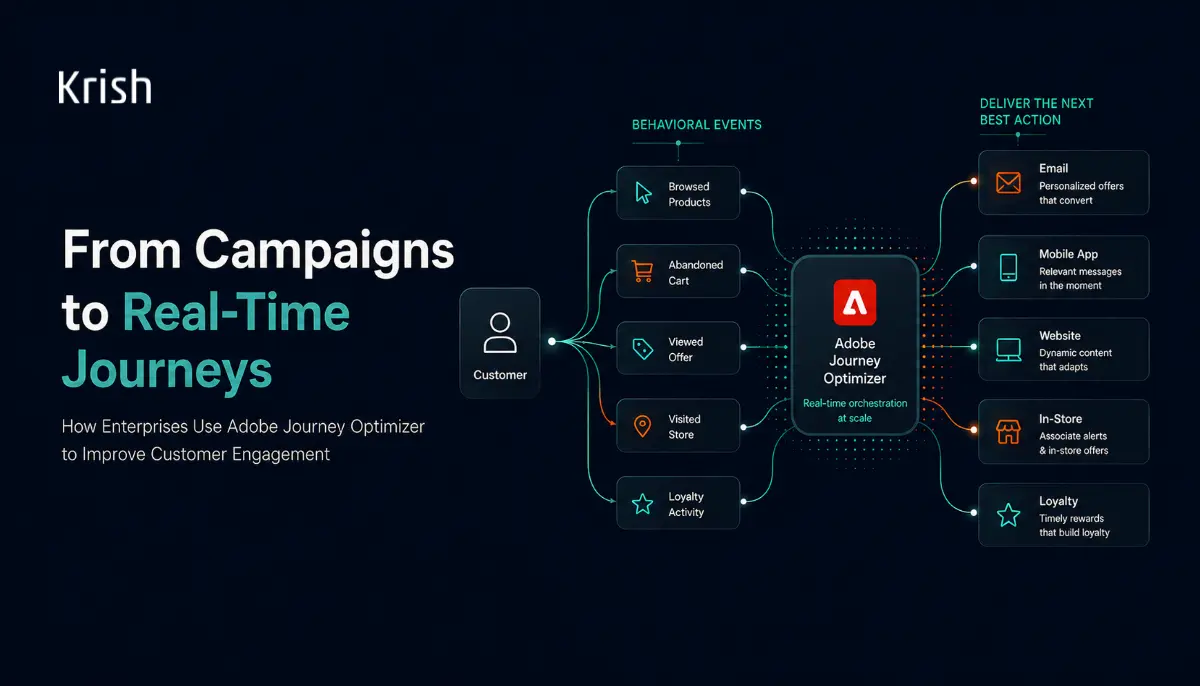
How Enterprises Use Adobe Journey Optimizer to Improve Customer Engagement
20 April, 2026 Brands are sitting on petabytes of customer data, yet 76% of consumers still experience deep frustration when interactions feel entirely generic, as revealed by McKinsey. Marketing teams know the gaps exist. They see the abandoned carts, the unread emails, and the fragmented experiences across channels. The problem is rarely a lack of intent. It is a lack of architectural capability.
Subscribe with Us!
Never miss any post, stay tuned!
Trusted by leading brands


