Introduction
A customer browses running shoes on an online website during lunch. Later in evening, the same customer receives a promotional emailer about winter coats. The next day, a retargeting ad for kitchen appliances appears. And three days later, the person visits the store, and the staff have zero idea about the prior online browsing.
Situations like the above happen more than most brands realize. Marketing channels operate like separate businesses under the same roof. Email teams don’t know what the website team is doing. Paid media runs independently from content. Social campaigns ignore what’s happening in stores. Each touchpoint works individually, but not in sync.
And customers are no fools. They notice the disconnects, feel the friction, and often leave. This blog discusses how connected touchpoints work together, how connected experiences drive better conversions, and the capabilities that will drive your omnichannel success.
What the Data Shows
Brands with connected touchpoints see conversion rates around 3.9%, while those running disconnected channels average 2.9%, according to Digital Commerce 360. The gap widens when looking through the lens of customer retention. Likewise, companies with strong omnichannel customer engagement keep 89% of their customers. In contrast, their counterparts keep 33%.
Purchase frequency tells a similar story. Shoppers who interact with multiple coordinated touchpoints buy 250% more often than those who interact with a single channel, according to Omnisend. The revenue impact compounds quickly. The improvements aren’t just marginal gains from optimization tweaks. The numbers represent huge differences in how customers pursue brands.
The pattern continues to appear across retail sectors. Businesses that connect their marketing touchpoints grow revenue 9.5% annually. Companies still operating in silos see 3.4% growth. The difference comes down to one thing: experience quality.
What Connected Touchpoints Actually Look Like
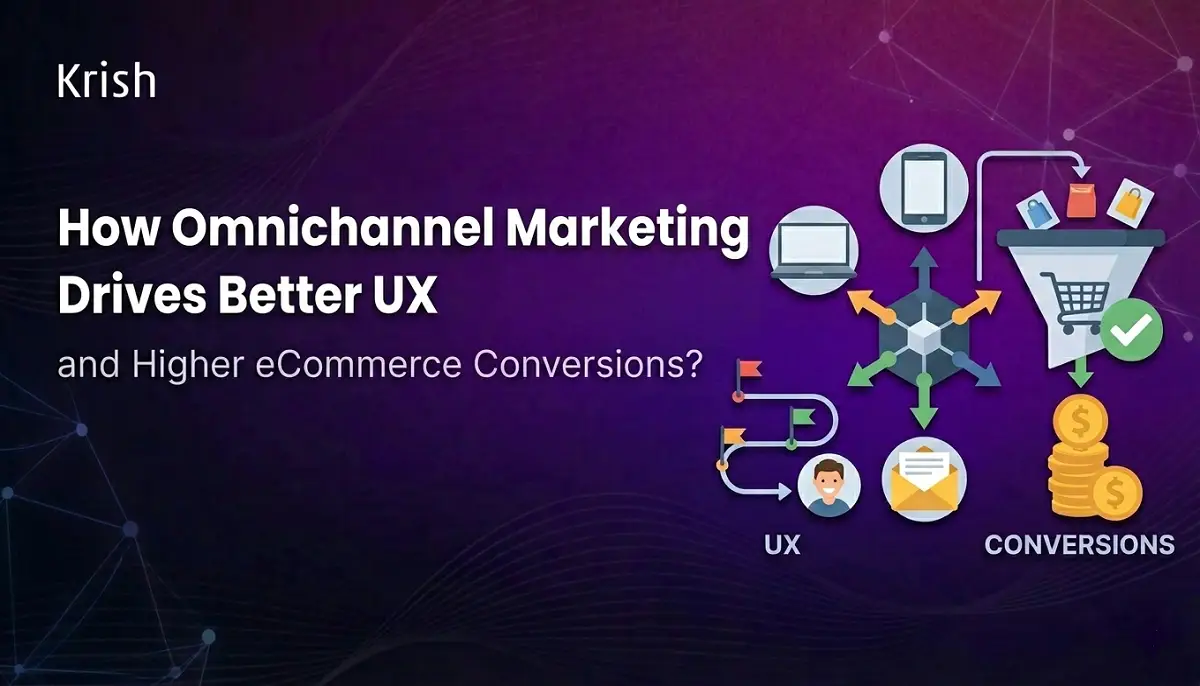
Connected touchpoints share customer data across every interaction. When someone browses products on a website without purchasing, email systems access the browsing data. The person receives messages featuring exact products viewed, plus algorithmic recommendations based on behavior patterns.
Retargeting platforms access the same data. Ads display products that the customer already shown interest in. In-store systems connect to the same profile. Sales associates see online browsing history and can reference specific products viewed. Staff access real-time inventory data to suggest available alternatives.
Information flows between touchpoints. Each interaction builds on the previous one. Nothing repeats. Nothing contradicts. Customers don’t restart their journey at each touchpoint.
eCommerce omnichannel marketing delivers coordination, not complexity. Underlying systems share data, marketing automation solutions connects the dots, and customer behavior in one channel informs what happens in others – and that is how a cohesive marketing campaign with seamless UX takes place.
Why Continuity Changes Everything
When a customer moves from website to email to app to store, the person and intent remain the same. But most marketing systems treat each touchpoint as a fresh start. The customer has to rebuild context every time.
Connected experiences remove friction. The customer doesn’t repeat information. Each interaction acknowledges what came before. Shoppers feel recognized, not anonymous. Progress persists across devices and channels. When improving eCommerce UX with omnichannel marketing, continuity becomes the foundation.
Purchases become easier when customers don’t lose their place. Product views on mobile remain accessible on desktop. Carts stay consistent. Recommendations reflect full browsing history, not just the current session. The experience naturally flows toward conversion rather than creating new obstacles.
How Better Experiences Convert
Reduced friction directly translates into higher conversion rates. When customers maintain context across touchpoints, they don’t abandon the journey. When recommendations are based on cross-channel behavior, relevance increases. When timing is coordinated across channels, messages reach people at more optimal times.
The conversion lift comes from multiple factors working together. Cart abandonment decreases when recovery messages coordinate across email and retargeting. Average order value increases when recommendations use complete browsing history instead of single-session data. Purchase speed improves when customers spend less time reconstructing their journey.
Better experiences form the core of UX-driven marketing. Improved experiences create more loyal customers than just satisfied ones. Seamless coordination removes the friction that prevents purchases.
How Data Powers Coordination
Behind coordinated experiences sits unified customer data. A single profile updates across every touchpoint. When someone browses products on a website, the behavior becomes immediately available to email systems, ad platforms, and in-store systems.
Marketing automation connects data points into actions. Someone abandons a cart, triggering a coordinated response. An email is sent with the abandoned products. Retargeting ads show the same items with a limited-time offer. If someone visits a store, the staff can check the online cart and assist in finishing the purchase.
The same principle applies in reverse. An in-store purchase updates the online profile. Recommendations on the website reflect offline buying. Email campaigns acknowledge recent store visits. The system maintains a single continuous conversation rather than multiple disconnected ones.
Unified customer data reduces duplication and inconsistency. Customers don’t receive three different promotions for three different product categories simultaneously. Instead, shoppers receive coordinated messages that reflect their actual interests and journey stage.
Omnichannel marketing services handle technical coordination. The goal is simple: ensure that every touchpoint understands what the others are doing. However, achieving coordination involves connecting platforms, syncing data in real time, and automating responses to cross-channel behavior.
Four Capabilities That Drive Omnichannel Success
McKinsey’s research on consumer decision journeys, involving work with over 50 companies and the study of more than 200 best practices, identified four distinct capabilities that allow brands to shape customer journeys rather than simply react to them actively
1. Automation
Automation streamlines journey steps without requiring customer effort. Banks allow mobile check deposits instead of branch visits. Airlines send automated gate change notifications. The focus sits on enabling simple, useful, and increasingly engaging experiences rather than just technical efficiency. Check out our guide for more on omnichannel marketing automation.
2. Proactive Personalization
Proactive personalization uses customer information from past interactions or external sources to customize experiences instantaneously. Hotels place valued travelers on upgrade lists automatically. Retailers remember preferences to optimize next steps in the journey. The capability extends beyond basic segmentation to personalizing each interaction based on demonstrated behavior.
3. Contextual Interaction
Contextual interaction uses knowledge about where customers are in their journey to deliver relevant next steps. Retail sites show order status on home pages. Hotel apps function as room keys. Systems recognize journey stage and respond accordingly rather than forcing customers to navigate generic interfaces.
4. Journey Innovation
Journey innovation extends interactions to new sources of value for both customer and brand. Airlines integrate taxi services into booking apps. Retailers use customer data to identify adjacent services customers might value. Companies mine insights to figure out what additional services make sense, then design journeys enabling constant prototyping of new features.
When Service Becomes Sales
Customer service interactions reveal where omnichannel coordination creates unexpected value. Support teams with access to complete customer journey data can turn problem resolution into sales opportunities.
The same principle applies to service interactions. When omnichannel marketing customer service teams work with a complete customer context, problems are resolved faster, and natural upsell moments are identified.
The experience also improves from the customer’s perspective. Shoppers shouldn’t have to repeat themselves again and again. The support interaction should be a continuation of their relationship with the brand, not a new beginning. Understanding how UX-focused marketing improves customer experience goes beyond conventional channels.
Understanding Where Organizations Stand
Most brands already have pieces working. Email connects to websites. Ads retarget site visitors. The question isn’t whether to start building omnichannel capabilities. The real question is understanding the current state and identifying which gaps create the most friction.
Before investing in new platforms or expanding team capabilities, mapping the current state helps. Key questions to answer:
- Where do customer journeys break?
- Which touchpoint transitions lose the most people?
- What data sits in silos?
- Which channels don’t talk to each other?
Knowing where the gaps exist shapes what to fix first. Connecting email platforms to browsing behavior would have more impact than adding another ad channel. Store staff may need access to online customer data before expanding social presence. UX-driven customer journey optimization for ecommerce starts with understanding which connections will drive the most value.
And at Krish, we are all about building connected experiences. Take our omnichannel journey assessment to understand your current position and create a seamless customer experience.
Table of Content
Subscribe with Us!
Never miss any post, stay tuned!

Minal Joshi is a content marketer at Krish with a flair for eCommerce and Digital Commerce aspects. She is a MarTech fanatic with a knack of writing with which, she helps brands to curate, create, & commence digital brand positioning. Sharing insights via articles, case studies, eBooks, Infographics, and other forms of content creation is what she lives for. Being an ardent traveler, when not writing, you'll find her sipping coffee into the mountains or petting a stray.
Recommended Reading:
Cross-Channel Orchestration: When, Where, and How to Engage – MarTech Masterclass Series Ep | 14
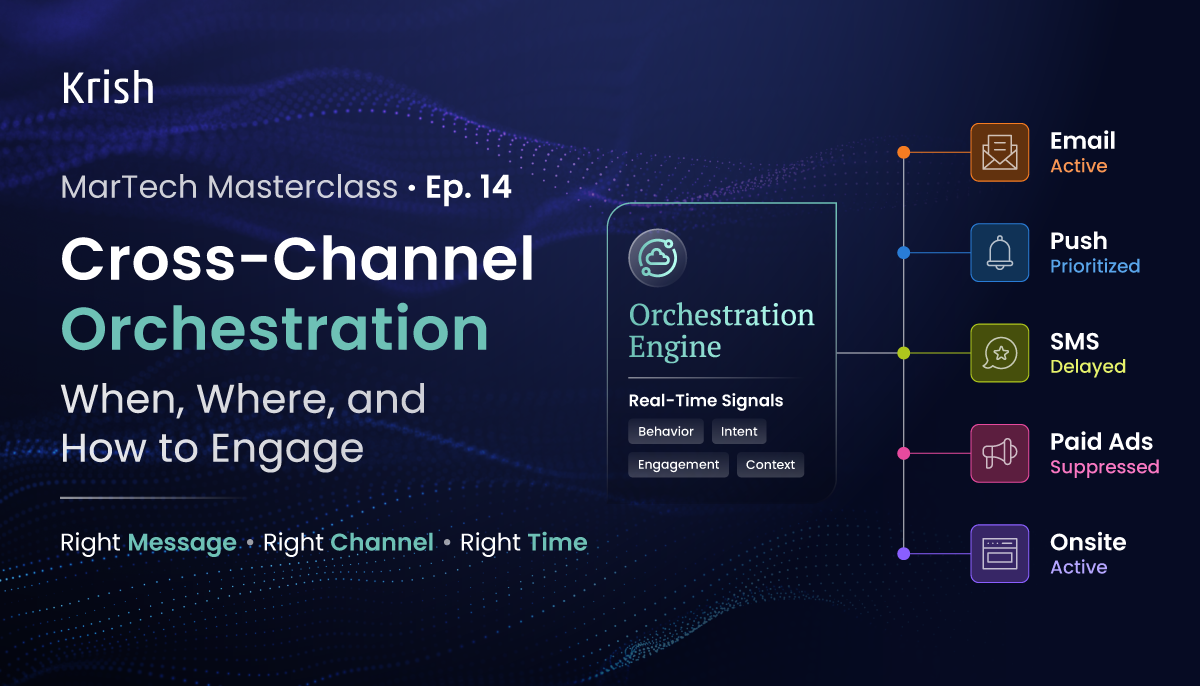
27 May, 2026 Most brands running five channels are not doing cross-channel marketing. They are doing single-channel marketing five times over. The email team has its own calendar, its own KPIs, its own definition of a good week. Same for SMS, push, paid, and web. No shared view of what the customer has already received. No suppression logic that crosses a channel boundary. No agreed moment when one channel yields to another. The customer who buys on Monday is still getting a conversion-push on Wednesday because the paid retargeting audience sync runs nightly and someone forgot to check.
Subscribe with Us!
Never miss any post, stay tuned!
Trusted by leading brands


