The word everyone uses, nobody defines
What does “a conversion” actually mean?
Ask 5 people on a digital team what a conversion is. You’ll get 5 different answers.
- The developer says it’s a form submission.
- The CMO says it’s closed revenue.
- The analyst says it’s whatever is tagged in GA4.
- The product manager says it depends on the stage.
- The paid media lead says it’s a landing page click-through.
They’re all right. That’s exactly the problem.
When “conversion” means different things to different people, your CRO program optimizes for whichever metric is loudest in the room that week. That’s how teams spend quarters improving checkout flow while the top of the funnel bleeds qualified visitors who never even reached checkout.
A conversion is not a single event. It is a hierarchy. And until your organization maps that hierarchy, you’re not doing CRO. You’re doing cosmetics.
In Issue 01, we established that most websites don’t have a traffic problem. They have a conversion problem. But before you can fix conversions, you need to agree on what one actually is.
Spoiler: your team probably doesn’t.
Macro vs micro: two tiers that change everything
Every meaningful action a visitor can take sits on a spectrum from low commitment to high. There are two tiers that matter.
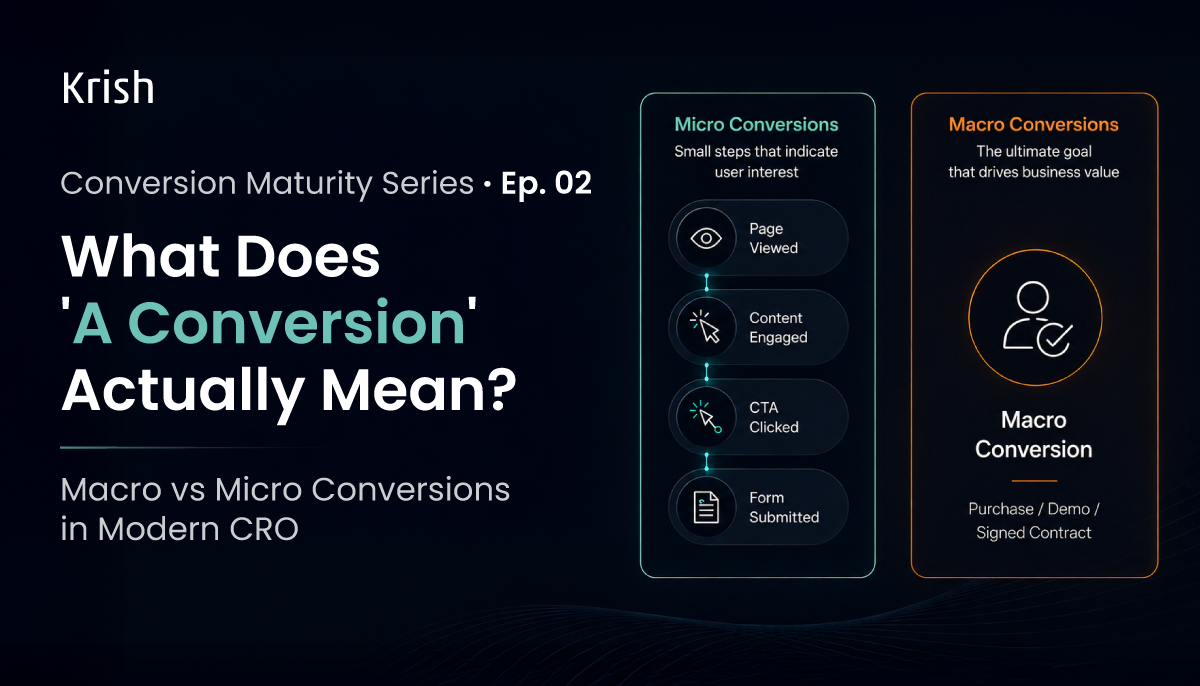
A macro conversion is the primary business outcome: a purchase, a booked demo, a signed contract. This is the number that appears in the board deck.
A micro conversion is every meaningful step on the way there: A product page scrolled past 60%. A pricing page visited. A comparison table interacted with. A CTA clicked that didn’t yet result in a form fill. None of these put money in the bank alone. All of them tell you whether the journey is working.
Here’s the critical insight
If your macro conversion rate drops and you only track macro conversions, you know revenue fell. You don’t know where in the journey it fell, or why. That gap is where CRO budgets get wasted chasing the wrong fix.
Micro conversions are the map. The macro is the destination. You need both to navigate.
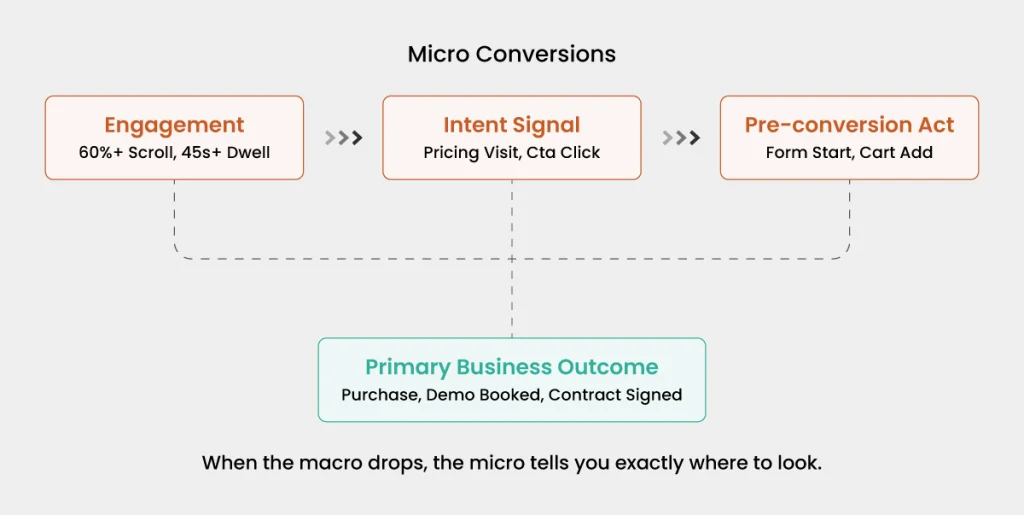
Each micro conversion is a diagnostic checkpoint. When your macro drops, you audit the micros in sequence. The stage that dropped first is where you intervene. Without the micros, you’re guessing.
Three criteria a conversion event must meet
Not every click is worth tracking. Not every tracked event is a conversion. The distinction is where measurement programs fall apart.
For an event to function as a meaningful conversion signal, it needs to clear 3 bars:
It must reflect intent, not mechanics. A scroll to 60% on a product page is intent. A page load is not. A video played past 30 seconds is intent. Autoplay is not. The difference matters because instrumenting accidental behavior makes your data look better than your funnel actually is.
It must have measurable variance. If 97% of visitors trigger the event, it doesn’t discriminate between engaged and disengaged. A conversion signal with no variance is background noise dressed up as a metric.
It must have a traceable relationship to your macro outcome. This is where most measurement frameworks quietly fail. Teams instrument what is easy to tag, not what actually predicts revenue. According to Forrester’s research on analytics maturity, most organizations track activity volume rather than behavioral quality, which means their conversion dashboards look active while their revenue story stays unclear.
If a micro conversion cannot be shown to correlate with eventual macro conversion in your own data, it is noise. Track it for curiosity if you like. Do not let it drive CRO decisions.
The B2B version is a different problem entirely
In eCommerce, the macro conversion is relatively clean: product page, cart, checkout, purchase. Linear. Attributable. The journey has defined edges.
In B2B, “conversion” fractures across teams and timelines. Marketing calls a completed form a conversion. Sales calls a qualified call a conversion. Revenue calls a signed contract a conversion. Finance calls recognized revenue a conversion. Same visitor, four different conversion definitions, zero shared vocabulary.
Without a unified conversion taxonomy across those teams, your CRO program will optimize one stage while the others erode. You improve the demo-booking rate. Demo-to-proposal rate quietly falls. Net revenue doesn’t move. The dashboard looks better. The business doesn’t.
The fix isn’t a better analytics platform. It’s a shared definition of what a conversion means at each handoff point, with one team owning accountability for each. A structured CRO audit starts here, before a single test is run. Because if you don’t agree on what you’re optimizing, you can’t agree on whether it worked.
The ratio trap most teams fall into
Conversion rate is conversions divided by sessions. Both sides of that ratio move. Teams almost always only watch one.
Send lower-quality traffic through paid campaigns: conversion rate falls, not because your funnel got worse, but because your audience changed. Run a flash sale that pulls in one-time buyers who never return: conversion rate spikes for a week, then collapses. Retarget a high-intent email segment to a landing page: conversion rate looks exceptional, but you’ve self-selected for intent, not improved the experience.
None of that is conversion improvement. It’s denominator manipulation.
This matters because it distorts which tests get credit and which problems get flagged. As Baymard Institute’s research on checkout usability consistently shows, the most significant conversion losses are structural, not cosmetic, and they persist regardless of traffic quality. Fixing them requires understanding the numerator. Changing the denominator just moves numbers around.
Issue 03 covers exactly that: Why Analytics Alone Cannot Explain User Behavior. Stay tuned. Meanwhile, feel free to reach out to our CRO experts for a detailed discussion.
Table of Content
Subscribe with Us!
Never miss any post, stay tuned!

Mayank is a Digital transformation strategist passionate about helping global brands scale through transformative digital experiences. With deep expertise in customer-centric journeys, he partners with enterprises to align technology with business goals, driving value across the customer lifecycle, brand experience, and performance. Known for building authentic relationships, he uncovers meaningful growth opportunities through thoughtful collaboration. When he’s not crafting the next big move in digital strategy, you’ll likely find him at the snooker table, lining up his next perfect shot.
Recommended Reading:
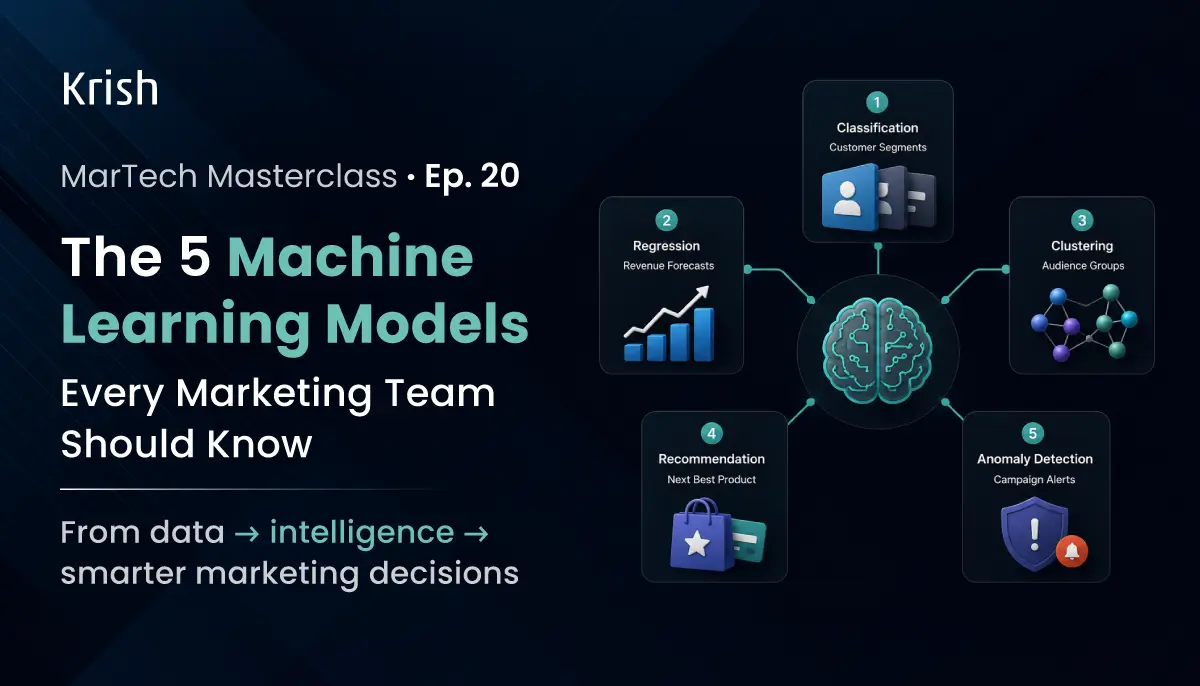
The 5 Machine Learning Models Every Marketing Team Should Know – MarTech Masterclass Series Ep | 20
17 July, 2026 Most marketing conversations about machine learning (ML) collapse it into a single capability. Teams talk about "using AI" or "adding ML to the stack" as though it were one tool with one function. It is not, and treating it that way is why most ML initiatives either overreach and fail or underdeliver and disappoint.
Subscribe with Us!
Never miss any post, stay tuned!
Trusted by leading brands


