
What’s Inside
Do marketers know that ‘Ad Overdo’ will not work in the world of personalized CX (Customer Experience)? An omnichannel commerce solution is a sales strategy that combines various channels, such as physical stores, desktop websites, and mobile apps, into one cohesive experience. This approach ensures that customers have a smooth and consistent shopping journey no matter how they shop. It uses intelligent data to understand and cater to customer preferences and needs at every step.
Brands bombard our inboxes and social channels with tons of irrelevant advertising messages. In the world of this advertising clutter, it is difficult to stand out. It exacerbates the problem of eCommerce to stay ahead of the curve.
eCommerce is at the cusp of an era where online ads are going overdo, and customers are using ad blockers. Marketers are unsure how much is enough for targeted marketing. And the blurring line between the ’right marketing mix’ and ‘overexposed ads’ made it difficult.
Then, what do customers want? Marketers are flummoxed here!
How can marketers meet the rising needs of personalized CX and break down the silos in eCommerce marketing?
The evolving customer journeys should be carefully noticed for meaningful insights and to think beyond siloed channels. When done correctly, personalized marketing can do a miracle for brands and benefit marketers with customer retention, earn long-term loyalty, increase conversion rate, lower bounce rate, and enhance the customer experience for eCommerce brands.
Omnichannel marketing is the need of the hour as customers will only engage if valuable communication is offered at each buying journey stage.It enables an immersive, seamless experience across all channels and stages with an automated platform.
Definition
Omnichannel commerce is a sales and marketing strategy that unifies physical stores, websites, apps, and all digital channels into one cohesive, data-driven customer experience, so every touchpoint feels connected, not siloed.
Let’s understand Omnichannel marketing and its automation strategy for enhanced CX.
Towards a Personalized CX Approach
Omnichannel marketing is the buzzword that roams around the corner for brands and marketers. The marketing strategy uses customer data to provide an immersive, seamless customer experience no matter the customer, the channel, or the stage of the customer journey. It is a more sophisticated and mature strategy where all channels work cohesively and harmoniously, keeping the customer and CX at the center of it. Now customers experience multiple touchpoints before they shop. Omnichannel marketing ensures these touch points add value to the buying journey and direct customers to a relevant and personalized experience irrespective of the engagement channels.
Many marketers tend to confuse omnichannel and multichannel marketing. However, the reality is that they are fundamentally two different concepts.
So, where to start?
Let’s first understand the difference between multichannel and omnichannel marketing.
Multichannel Vs. Omnichannel: One-on-One
You can understand the difference as multichannel marketing uses the ‘business-centric’ approach, whereas Omnichannel follows the ‘customer-centric’ approach. Here, we have the difference between these two marketing strategies.
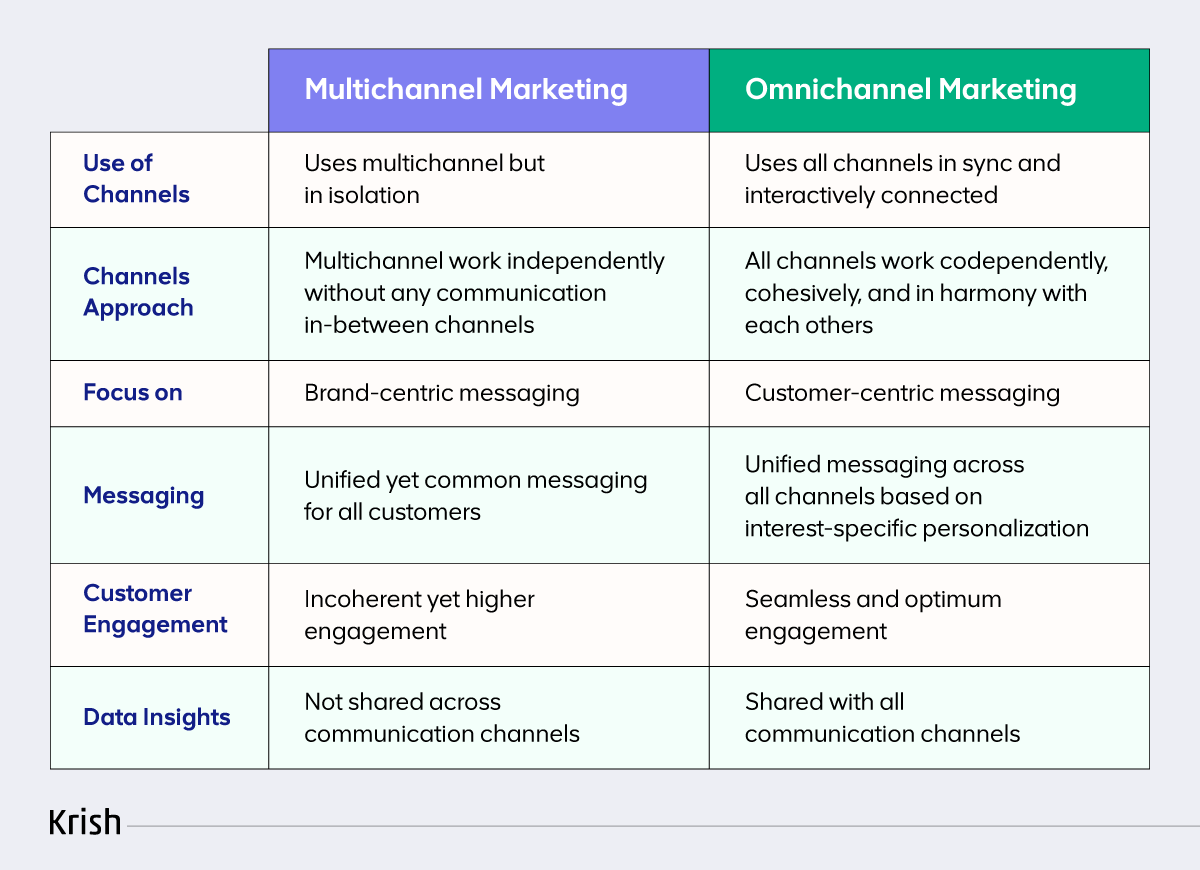
Marketers moved to multichannel marketing from the conventional ‘single channel’ marketing, and then the new age demanded ahead of multichannel, so we have Omnichannel marketing now. As Omnichannel requires coordinating all channels, communication, and customer journey stages, the brands need an automated solution to keep them in sync. Managing all the channels, customers, brands, and mediums for a personalized offering manually is practically impossible, so an automated application is a must.
The ‘Omnichannel Marketing Automation’ Edge
In the research by Bain & Company, it has been found that a 5% increase in customer retention yields at least 25% more profit for brands. No surprise, the intelligent and relevant messages across channels with a ‘personalized –touch’ can go a long way. We have data to support this claim of increased ROI, have a look at these interesting findings.

Besides increased sales, customer retention, and better revenue generation, omnichannel automation marketing earns brand loyalty, and customers get more personalized CX, which they crave in this cluttered marketing world. However, the impact omnichannel has on customer spending, experience, Customer LifeTime Value (CLTV), and loyalty, the choice becomes even clearer.
Omnichannel Marketing Automation and Customer Journey
Omnichannel marketing keeps the customer and the data surrounding that customer at the center of the strategy to redefine the customer experience (CX). In fact, turns customers as your brand advocates and derives User Generated Content (UGC) as innovative success stories.
According to the research by eMarketer, by 2025, global eCommerce sales will exceed $7 trillion, but with slower growth, which is a concern for marketers. To win big in a state of decline, it is best to streamline marketing efforts and target customers with relevant messaging across channels. Building a connected shopping journey may lead to better sales, and that’s where omnichannel marketing automation services comes into play.
Reasons to Adopt an Omnichannel Marketing Strategy
- Seamless channel integration
- Unified customer experience
- More control over channels
- Improved ROI
- Increased brand awareness
- More loyal customers
Contrary to traditional marketing channels, be it single, multi, or cross channels, omnichannel creates the difference by using the data for customer cohorts’ analysis. The channels are the brand in lieu of an extension of the brand. Then, brands can create a completely personalized and seamless experience with the help of channels.
Omnichannel Marketing Automation Strategy

| Stage | Who they are | Goal | Best channels |
|---|---|---|---|
| Visitor | First-time site browser | Capture attention & email | Push notifications, pop-ups |
| Subscriber | Opted-in, not yet bought | Build trust, drive first purchase | Email welcome series, SMS |
| Shopper | Browsing, adding to cart | Reduce abandonment | Abandoned cart email, retargeting |
| Buyer | Completed first purchase | Confirm, delight, upsell | Order email, post-purchase SMS |
| Repeat buyer | 2+ purchases made | Retain, earn loyalty, get UGC | Loyalty programs, referral flows |
An effective omnichannel marketing strategy requires automation to keep pace with trends and rising customer expectations. Of course, managing manual messaging that is also personalized and sent at the right time on the right channel is only ideal when you have limited customers to cater to. Hence, you need an OmniChannel Marketing Automation strategy and application to streamline the entire experience journey. We can segregate the customer journey into 5 stages: visitor, subscriber, shopper, buyer, and repeat buyer. Then, you can put together the most beneficial messaging and strategies for customers using omnichannel marketing tactics. You can download and read more about this insightful study by Krish and understand the transformational strategy.

Further reading
Free ebookThe Complete Guide to Omnichannel Marketing Automation for eCommerce
For ecom managers and CMOs looking to unify their customer experience across every channel — and automate it at scale.
Commerce Omnichannel Marketing Automation Tools
We learned about the growing eCommerce market and the dire need to offer personalized CX – the answer to this is an effective and future-ready Omnichannel Marketing Tool that suits your business needs.
Here are some leading tools to automate your omnichannel marketing strategies and redefine the CX. The ripples of customer expectations will be more aggressive, so these automation tools will be an integral part of marketers’ day-to-day life. For your ease, we have categorized these tools based on the business size accordingly.
1 – Large/Enterprise Businesses

2 – Mid-size Businesses

3 – Small-size Businesses

Brands and marketers can choose any tool according to their business size and requirements. However, if you need more understanding or want to know how to prepare your marketing strategy in the customer-centric world, grab this detailed study here. This would help you to pace up your omnichannel marketing strategy to prepare for the next decade of eCommerce that belongs to the customers.
| Tool | Best for | Key strength | Size |
|---|---|---|---|
| Adobe Marketo Engage | ABM + lead nurturing | Omnichannel campaign orchestration | Enterprise |
| Salesforce Marketing Cloud | AI-driven personalization | Einstein AI predictive journeys | Enterprise |
| Emarsys | Cross-channel campaign scaling | Trusted by Shein, Puma, Sephora | Enterprise |
| Klaviyo | Email + SMS behavioral flows | Order & browsing-based segmentation | Mid-size |
| MoEngage | Push + in-app messaging | Visual omnichannel journey builder | Mid-size |
| HubSpot | Cart recovery + upsell | Native eCommerce integrations | Mid-size |
| Mailchimp | Email campaigns + journeys | WooCommerce / BigCommerce ready | Small |
| Omnisend | Multi-channel drag & drop | Pre-built eCommerce workflows | Small |
| Zoho One | All-in-one operations | 40+ integrated apps | Small |
Krish for Your eCommerce Omnichannel Marketing Automation
Krish delivers advanced commerce capabilities and provides personalized solutions to B2B, B2C, and D2C brands all over the world across diverse niches. If you are struggling to meet your eCommerce business goals, Krish can be an extended growth partner for you. We can be your eCommerce Marketing Automation partner by offering strategy and consulting services to yield results. Moreover, we also help with migrating, integrating, or setting up campaigns on the marketing automation tools. Let’s connect!
Further reading
Omnichannel Marketing Automation for Scalable Customer Journeys and Growth
Disconnected channels kill customer experience and growth. This guide shows how omnichannel marketing automation unifies every touchpoint into seamless, scalable customer journeys that convert and retain.
Read the full blog → Table of Content
Subscribe with Us!
Never miss any post, stay tuned!

Minal Joshi is a content marketer at Krish with a flair for eCommerce and Digital Commerce aspects. She is a MarTech fanatic with a knack of writing with which, she helps brands to curate, create, & commence digital brand positioning. Sharing insights via articles, case studies, eBooks, Infographics, and other forms of content creation is what she lives for. Being an ardent traveler, when not writing, you'll find her sipping coffee into the mountains or petting a stray.
Recommended Reading:
What is Marketing Automation? Strategies, Benefits, Tools, and Implementation
20 January, 2026 Marketing teams today are expected to do more with less. More personalization, more channels, more data, and more accountability for revenue. At the same time, customers expect timely, relevant communication that feels personal, not mass-produced. Marketing automation exists to bridge this gap.
Subscribe with Us!
Never miss any post, stay tuned!
Trusted by leading brands


