Introduction
The retail industry is undergoing a structural shift, and quick commerce sits at its heart. Not because ten-minute delivery is a novelty, but because everyday life no longer leaves room for delay.
The scale of adoption reflects this shift. Quick commerce has grown from a niche convenience play into a multi-billion-dollar category in just a few years. Leading markets are expanding at a breakneck speed, with projections pointing to sustained, outsized growth by the end of the decade. Quick commerce is projected to account for 6–8% of global e-retail by 2030, moving it from convenience layer to core retail infrastructure.
The category grew on three forces: speed, which decides its viability; convenience, which turns it into a habit; and reliability, which determines its survivability. Delivering fast is easy to market, but delivering precisely what was promised, repeatedly, is far harder to execute.
In this environment, conversion rate becomes a proxy for operational reliability. When conversion drops, it’s rarely the interface. It’s the system failing to deliver certainty. The piece examines why traditional Conversion Rate Optimization (CRO) frameworks struggle in Q-commerce, what breaks down in real businesses, and how winning teams design experiences that preserve reliability.
What Breaks in Real Business
Bad design is rarely the prime cause of failure in quick commerce. More often, the real problem is optimization that runs ahead of operational reality.
Interfaces get streamlined before dark stores can handle the volume. Checkout friction is removed, conversions lift, and orders spike. Eventually, fulfillment slows, delivery windows stretch, and ratings fall. The optimization worked, but the system fell behind.
Excessive experimentation also reinstates this false confidence. A/B tests surface apparent winners while competitive promotions and supply volatility quietly distort outcomes. Results look decisive, but decisions get made on noise. In low-margin business models, growth pressure compounds the damage; the loss from a failed first order is permanent. In many quick-commerce models, 5-25% of seller revenue is absorbed by platform commissions, leaving little tolerance for failed first orders.
Many platforms also borrow patterns from traditional e-commerce that actively slow urgent decisions. And some failures sit beyond CRO altogether. Weak store density, fragile supply chains, and unrealistic delivery promises are leadership decisions. Until those are addressed, optimization decisions just expose the gaps faster.
Why Traditional CRO Frameworks Break in Quick Commerce
Traditional CRO frameworks assume users have time. Quick commerce breaks that assumption completely. The frameworks are built to optimize persuasion, but fail when the real task is proving reliability.
The customer arrives with intent already. The real question is whether the platform can fulfill the request immediately or risk losing the session. There is no browsing phase to recover from hesitation, no comparison loop to persuade later, and no second chance to correct the broken impression. When speed becomes non-negotiable, persuasion stops working.
Optimization strategies such as social proof, rich product detail, urgency copy, and layered recommendations are designed to move undecided users forward. In quick commerce, they add friction, not confidence. The funnel collapses under the same pressure. When something breaks, the session ends.
Even experimentation logic fails in Q-commerce. Q-commerce behaviour is shaped by availability, timing, and operational constraints that change constantly. What appears to be a winning experience is a fluke that converted under better operating conditions. In quick commerce, conversion matters only to the extent that it drives repeat behaviour. To truly create winning experiences, businesses need to recognize how customer behaviour changes with speed.
How Customer Behavior Changes with Speed
In Q-commerce, speed reshapes customers’ behaviour the moment they make decisions. Quick commerce captures micro moments that carry high intent and zero patience. Running out of essentials, guests arriving sooner than expected, and tasks that cannot wait. Here, customers are solving a problem under pressure, so there is no time for browsing.
Discovery, evaluation, and checkout happen in minutes, often within a single session. There is no time for trust-building or second interactions; if something feels uncertain, the journey ends. Conversion in these moments is driven by three signals: trust, availability, and delivery promise. According to a Journal of Retailing research paper, delivery failure impacts the time to next order by 7.22% on average.
Businesses should focus on creating buying journeys with clear communication and accurate estimates, as they reduce anxiety. Creating urgency-based journeys only adds anxiety around fulfillment and timing. And when they fail, loyalty is replaced by frustration. Most conversion bottlenecks emerge here, because users hesitate to believe rather than buy.
Seeing the Truth: Foundational Research for CRO in Q-Commerce
In Q-commerce, decisions are made in minutes, which means the truth lies in behavior. Under that kind of pressure, who is articulating preferences? Probably no one, what customers say they value, often contradicts what they do. When preferences collapse under pressure, behavior leaves a visible trail.
The behavioural signals here are blunt and difficult to ignore. Repeated searches, sudden exits, backtracking, abandoned carts. These are moments where certainty collapsed, and the only valid question is where confidence broke and why.
Again, businesses should consider offline behavior as a baseline. People replace what they already trust. When digital experiences ignore these mental models, they force customers to think when they arrive and act, creating immediate, unforgiving friction.
Quantitative data serves the same purpose at scale. Funnels, heatmaps, and session replays consistently expose where belief weakens. The clarity only holds when behavioural signals are backed by dependable digital analytics, separating real patterns from noise before optimisation decisions get made.Competitive benchmarking should do the same. Reliability, fulfilment speed, substitution behaviour, and assortment depth explain outcomes far more clearly than layout choices ever will.
Diagnosing Experience Breakpoints
In quick commerce, experience breakpoints are rarely subtle. They are obvious moments where the platform stops feeling dependable, even if teams fail to acknowledge them.
The standard here is not intuition or elegance, but certainty. Every step in the journey must answer four questions without hesitation: is the item available, will it arrive on time, will it arrive complete, and will the price hold. Anything that delays those answers introduces doubt, and doubt is where sessions end.
These breakpoints cluster in predictable places. Items that disappear after checkout, delivery promises that shift late in the flow, payments that fail without a clear recovery path, and substitutions that feel arbitrary rather than helpful. These are trust failures, and they terminate intent immediately.
Prioritisation is where credibility is usually lost. Low-impact polish ships quickly while high-severity failures linger because they are operationally inconvenient to fix. Improving what looks rough while ignoring what breaks belief creates movement without progress.
Alignment is not a soft requirement here. Product defines the promise, operations fulfill it, engineering keeps it stable, and marketing amplifies it. When these functions drift out of sync, the interface becomes dishonest, regardless of how clean it looks. And, quick commerce does not forgive misplaced effort.
Product-led CRO Strategies for Q-commerce
In quick commerce, CRO lives inside the product itself. Discovery, selection, and commitment are already happening under pressure, and the product either supports that reality or fights it.
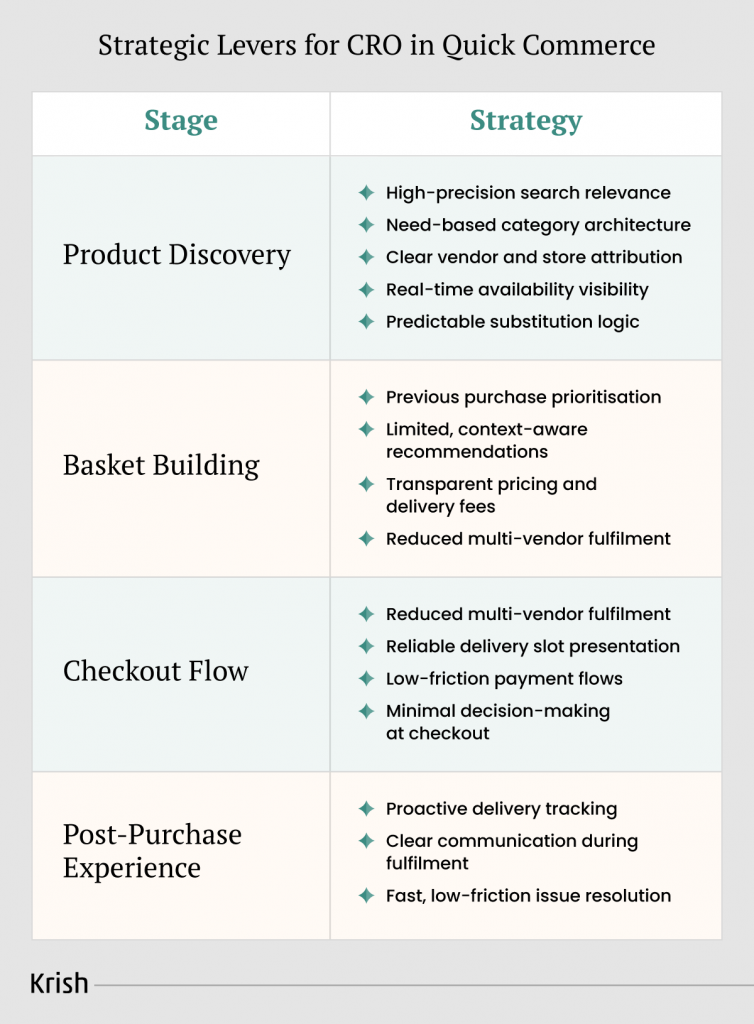
Product Discovery Optimization
Discovery works only when relevance is ruthless, and clarity is immediate. Users are not exploring; they are locating.
- Search relevance and category architecture
Discovery must prioritise exact intent over interpretive breadth. Category structures should mirror how people think in moments of need, not how inventory is organised internally.
- Vendor and store clarity
Fulfilment source ambiguity creates hesitation. Knowing where an item is coming from matters because it signals speed, availability, and reliability.
- Availability filters and substitution handling
Availability should reduce anxiety, not defer disappointment. Substitutions must feel intentional and predictable, not opportunistic.
Basket Building Optimization
Basket building is where economics surface. Repeat behaviour, not assortment depth, determines value. Anything that slows replenishment or forces reconsideration works against frequency.
- Previous purchase heuristics
Past behaviour is the strongest signal of future intent. Making replenishment effortless protects both speed and frequency.
- Smart recommendations and bundling
Recommendations work only when they feel obvious. Over-suggestion introduces cognitive load at the wrong moment.
- Price cues and delivery fee visibility
Cost clarity must exist throughout the journey. Late surprises weaken confidence at the point of commitment.
- Minimising multi-vendor fragmentation
Fragmented fulfilment complicates delivery and increases the risk of failure. Where possible, cohesion beats optionality.
Checkout Flow Optimization
Customers arrive here with intent intact, but fragile. Any hesitation around delivery slots, payment flow, or last-minute choices weakens commitment. The role of checkout is to stay out of the way.
- Delivery slot confidence
Promises must feel dependable, not optimistic. Reliability here matters more than speed claims. - Payment friction removal
Payment should require no thought. Any hesitation introduced at this stage threatens completion. - Reducing cognitive load at commitment moments
Every unnecessary choice weakens intent. The final step should feel inevitable, not evaluative.
Post-Purchase Signals That Influence Repeat Conversion
In post-purchase, visibility into delivery progress calms anxiety. In contrast, communication gaps create unease that no discount can undo later.
- Delivery tracking and communication clarity
In time-sensitive purchases, knowing what is happening matters as much as what was ordered, because uncertainty lingers longer than delays.
- Order accuracy and issue-resolution pathways
Mistakes are recoverable. Friction in resolution is not. How issues are handled determines whether trust survives the first order.
Designing Experiences that Protect Operations
In quick commerce, experience design is inseparable from operational truth. The interface does not just guide users; it makes promises on behalf of the system.And if the promises fail, you lose customers. According to a PwC CX survey, 52% of customers stop purchasing from a brand after a bad experience online or in person.
Information architecture must prioritise speed over completeness. Users are not exploring a catalogue; they are locating a solution. Structures that reduce scanning, minimise branching, and surface the most likely choices protect both decision time and fulfilment efficiency. Cognitive load is the real enemy under time pressure, and every additional choice, banner, or secondary flow taxes it.
Guardrails matter more than creativity here. Experiences should actively prevent over-promising by constraining delivery promises to what the network can reliably meet, even during peaks. Conservative estimates that hold build more trust than aggressive ones that slip. Availability should be shown honestly, not optimistically, because late failure damages belief far more than early absence.
Specific flows require additional care. Age-gated and restricted products must balance compliance with user experience, ensuring verification occurs without derailing the session or introducing last-minute friction. Responsible design in these moments is not about elegance; it is about keeping intent intact while respecting constraints.
Experimentation and Validation in Fast-Moving Commerce
Experimentation in quick commerce is inherently fragile. The environment rarely offers the stability traditional testing assumes, which makes restraint as crucial as curiosity.
A/B testing helps when changes are isolated from operational volatility, such as interface clarity, copy, or interaction patterns that do not depend on inventory or delivery capacity. It hurts when teams test experiences that are tightly coupled to supply, logistics, or external demand shocks. In those cases, results often reflect timing rather than design.
Readiness matters. Without sufficient traffic, consistent availability, and stable fulfillment performance, experiments generate confidence without causality. Small sample sizes and fluctuating conditions make apparent winners unreliable, even when statistical thresholds are met.
Metrics also need interpretation discipline. Behavioural signals like time on site or interaction depth can mislead in urgency-driven journeys, where efficiency, not engagement, is the goal. Business outcomes such as completion rate, order accuracy, repeat frequency, and contribution margin carry far more weight.
The most valuable experiments do not end with dashboards. They feed directly into operational decisions, closing the loop between product changes and system performance. In quick commerce, validation matters only if it improves the customer’s ultimate experience: reliability, speed, and trust.
Final Thoughts
Quick commerce exposes a simple truth that many teams still resist: conversion cannot be separated from what the system can actually deliver. When decisions happen under pressure, customers stop responding to persuasion and start reacting to certainty. Every screen becomes a promise, and every broken promise leaves a permanent mark.
The platforms that endure are not the ones that optimise faster or test harder, but the ones that stop promising what they can’t consistently deliver. They are the ones who align product decisions with operational reality and design experiences that protect trust before chasing growth. In a category where margins are thin and patience is thinner, reliability compounds far more powerfully than conversion lifts.
The real question is no longer how to improve CRO. It is whether the experience you are optimising reflects the business you can reliably run. For teams serious about answering that honestly, CRO and experimentation cannot exist in isolation. Disciplined CRO and A/B testing only work when grounded in operational readiness, turning experimentation from a growth lever into decision infrastructure teams can actually rely on.
Table of Content
- Introduction
- What Breaks in Real Business
- Why Traditional CRO Frameworks Break in Quick Commerce
- How Customer Behavior Changes with Speed
- Seeing the Truth: Foundational Research for CRO in Q-Commerce
- Diagnosing Experience Breakpoints
- Product-led CRO Strategies for Q-commerce
- Designing Experiences that Protect Operations
- Experimentation and Validation in Fast-Moving Commerce
- Final Thoughts
Subscribe with Us!
Never miss any post, stay tuned!

As Director - Marketing, Zenul leads the marketing and branding at Krish. He brings with him an in-depth understanding of the evolving digital ecosystem and has a proven expertise and experience in strategic planning, market and competition analysis, creating and implementing client-centered, lead-gen and brand marketing campaigns. He has a heart for technology innovation and has been a keynote speaker on various platforms.
Recommended Reading:
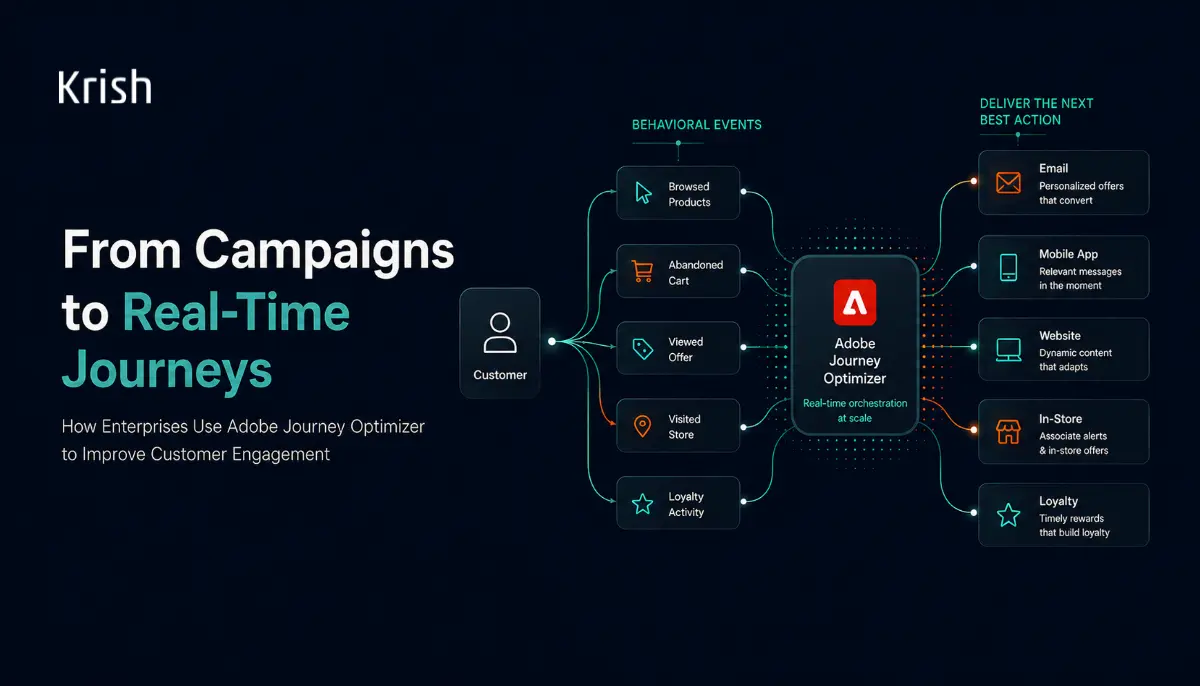
How Enterprises Use Adobe Journey Optimizer to Improve Customer Engagement
20 April, 2026 Brands are sitting on petabytes of customer data, yet 76% of consumers still experience deep frustration when interactions feel entirely generic, as revealed by McKinsey. Marketing teams know the gaps exist. They see the abandoned carts, the unread emails, and the fragmented experiences across channels. The problem is rarely a lack of intent. It is a lack of architectural capability.
Subscribe with Us!
Never miss any post, stay tuned!
Trusted by leading brands


