The Strategic Role of Event Tracking in Modern MarTech
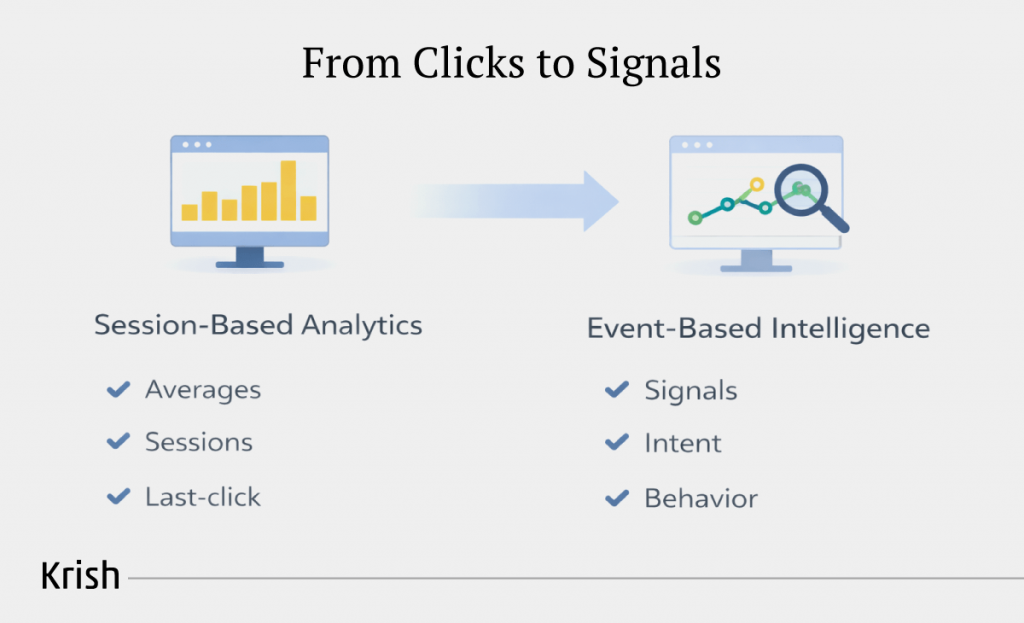
Customer behavior today is fluid, multi-threaded, and increasingly unpredictable. Users jump from mobile to desktop, browse anonymously, return via email, abandon carts, revisit from paid channels, and interact with dozens of micro-elements before taking any meaningful action. In this environment, traditional session-based analytics flatten this rich seam of behavior into broad averages. Event tracking preserves each meaningful action as a data signal, giving precision and context to every customer interaction.
This shift matters because the brands winning today are the ones that understand why customers behave the way they do, not just what they clicked. Brands that harness behavioral insight outperform peers. A 2023 McKinsey research shows that personalization strategies built on accurate customer data can boost revenue by 5–15% and simultaneously reduce acquisition costs by up to 50%, because tailored experiences convert more effectively than generic ones. Further reinforcing this, the same McKinsey analysis highlights that organizations with stronger personalization capabilities tend to grow 40% faster than slower-moving peers and often derive a larger share of their revenue from personalized experiences.
For leaders optimizing revenue, LTV, and channel efficiency, the questions have evolved:
- What behaviors truly drive outcomes?
- Which signals indicate intent before conversion?
- Where does friction silently kill profitability?
Event tracking is the connective tissue across the MarTech ecosystem by which behavioral data becomes usable intelligence. It feeds CDPs (Customer Data Platforms), digital analytics engines, personalization algorithms, and experimentation platforms with the raw signals they need to predict intent, measure effectiveness, and optimize journeys.
Why This Episode Matters (Key takeaways)
In the previous MarTech Masterclass episode (3), we examined how hidden data gaps create unreliable reports. This episode addresses a deeper problem.
It goes beyond tools to settings to examine how event-tracking decisions shape what your analytics can and cannot tell you, even when everything appears to be working. Small choices in what you track, how you structure events, and how much context you capture compound quietly over time. The result is analytics that look complete, but slowly drift away from real customer behavior. By the end of this episode, you will understand:
- Why does tracking too many events reduce clarity instead of improving insight?
- How does an inconsistent event structure cause different teams to trust different numbers?
- Where do intent signals disappear when micro-conversions are not captured?
- How shallow events limit insight, even with clean dashboards?
- Why weak governance and privacy discipline eventually erode trust in analytics
At its core, this episode asks a critical question:
Are your decisions driven by customer behavior, or by the hidden gaps inside your event tracking design?
Most enterprises over-collect signals, under-structure data, and end up with analytics that answer yesterday’s questions instead of guiding tomorrow’s decisions. The curated 5 strategies ahead address this gap head-on, outlining how to design an event tracking system that is intentional, scalable, insight-driven, and resilient to change across platforms, teams, and regulations.
Strategy 1: Track What Matters, Ignore What Doesn’t
“Event tracking breaks down when it tries to be exhaustive instead of intentional.”
Most organizations instrument digital experiences by starting at the interface layer. Buttons are tagged because they exist, scrolls are tracked because tools allow it, and Interactions multiply quickly, but meaning does not. The result is a behavioral dataset that is technically rich and strategically weak.
At a strategic level, events are not interaction logs. They are decision signals. A meaningful event changes how the business acts. If an event does not influence optimization, targeting, attribution, or forecasting, it does not belong in the core tracking layer.
Why does restraint scale better?
If an event does not support a decision, it does not belong in your core tracking strategy. Tracking fewer, higher-value events delivers compounding benefits and, most importantly, leadership can trust the data:
- Cleaner attribution models
- Stronger experimentation hypotheses
- Lower governance and privacy risk
- Faster insight-to-action cycles
Strategy 2: Build a Scalable Event Taxonomy
“Event taxonomy is not a documentation exercise. It is a control system for meaning.”
This core problem is not data accuracy; it is semantic inconsistency. Even when teams track the right events, analytics breaks at scale because the same behavior is described differently across systems. Naming drifts, parameters vary, and over time, definitions change quietly.
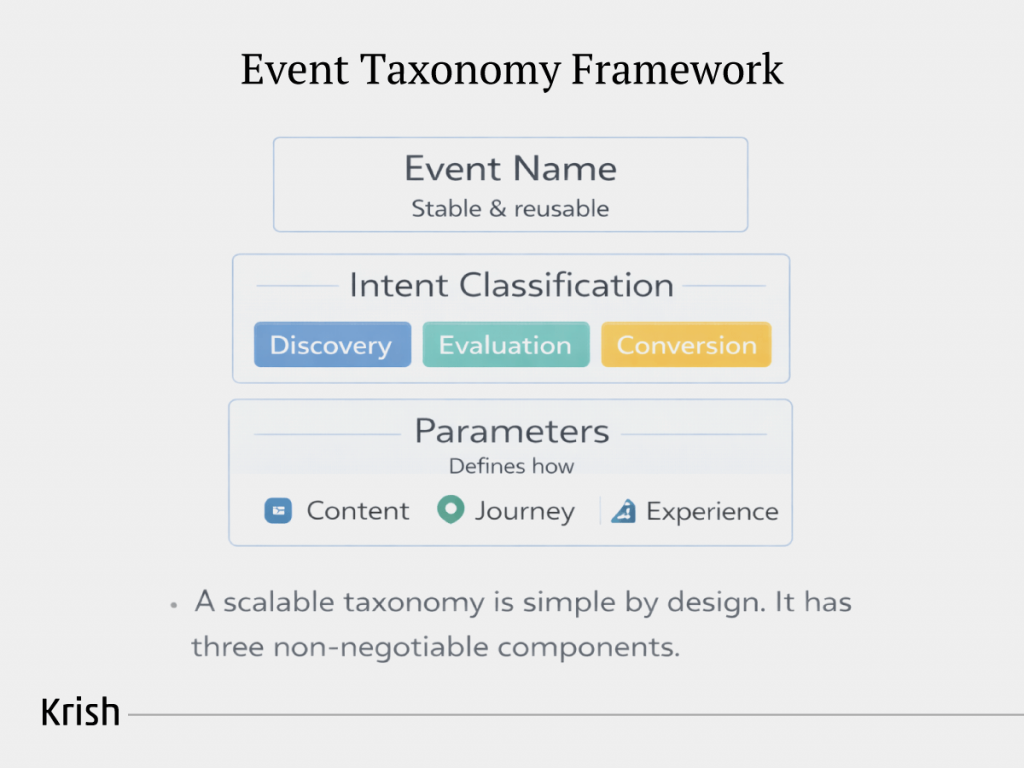
A scalable taxonomy is simple by design. It has three non-negotiable components.
- Event name: Defines what happened, is stable and reused, and it should change rarely.
- Intent classification: Defines why the event matters in the journey. (Examples include discovery, evaluation, conversion, retention)
- Contextual parameters: Define how the event occurred. (Used for depth and segmentation, not for creating new event names)
This structure prevents event sprawl while allowing flexibility. An event taxonomy ensures that a behavior has one meaning, one definition, and one structural representation across teams, tools, and time.
GA4 and modern CDPs are designed to support fewer event names enriched with parameters, not hundreds of loosely related events. This model preserves consistency as products, journeys, and teams evolve.
If events are inconsistent, insights are unreliable. Taxonomy is what keeps analytics usable at scale. When taxonomy is ignored, analytics resets every quarter, but when taxonomy is enforced:
- Funnels remain stable across releases
- Attribution inputs stay comparable
- Experiments remain interpretable
- Historical data retains value
Once events are consistently defined, the next lever is foresight. Strategy 3 focuses on micro-conversions that signal intent before outcomes occur.
Strategy 3: Measure Micro-Conversions That Predict Macro Outcomes
“Micro-conversions shift analytics from reporting to prediction.”
Micro-conversions are meaningful intermediate actions that correlate strongly with outcomes. They are not vanity interactions. They surface intent, hesitation, and momentum way before revenue appears. Most organizations measure outcomes only at the finish line: purchases, form submissions, sign-ups, and more. By the time these events fire, the user’s decision has already been made. Leaders actually need early signals and tracking micro-conversions, make it happen.
3 useful criteria of tracking micro-conversion:
- It indicates decision progression or friction
- It occurs before the primary conversion
- It improves prediction, targeting, or optimization
If it does not change how teams act, it is not a micro-conversion. Across mature programs, micro-conversions typically sit in four zones:
- Evaluation depth: Actions that show comparison or validation behavior.
Examples include: feature comparison, spec downloads, pricing interaction, and reviews engagement. - Commitment signals: Actions that indicate rising intent.
Examples include: save for later, wishlist adds, repeated product views, and form step progression. - Friction indicators: Actions that expose hesitation or blockers.
Examples include: error encounters, backtracking, and form abandonment points. - Acceleration triggers: Actions that shorten the path to conversion.
Examples include: calculator usage, demo scheduling, and financing checks.
These signals surface opportunity long before outcomes are visible. Without micro-conversions, optimization cycles remain slow and reactive. Micro-conversions shift analytics from reporting to prediction. They allow teams to:
- Identify high-intent users earlier
- Intervene before drop-off occurs
- Improve lead quality scoring
- Optimize journeys without waiting for revenue lag
Macro outcomes explain what happened. Micro-conversions explain what is about to happen. Once micro-conversions are identified, the next challenge is depth. Knowing that a behavior occurred is not enough. Strategy 4 focuses on enriching events with custom parameters to unlock deeper behavioral insight without fragmenting the schema.
Strategy 4: Enrich Events With Custom Parameters for Deeper Insight
“Parameter discipline increases insight density without increasing data noise.”
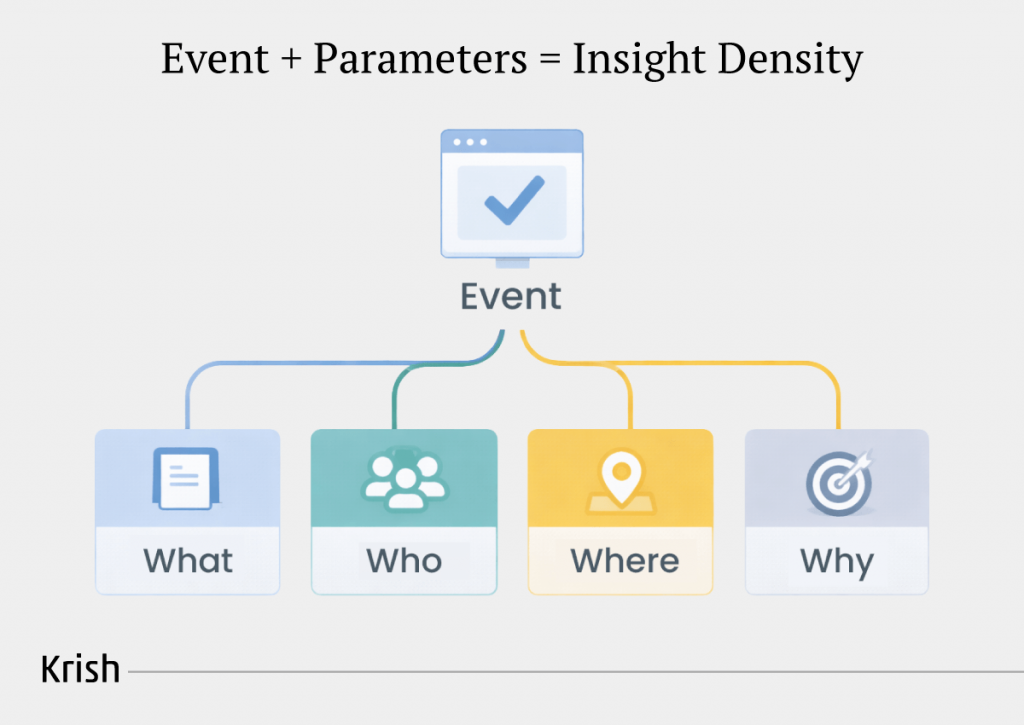
Knowing that an action occurred is rarely enough. A product view, a form start, or a checkout initiation only answers the first question. The more valuable questions follow immediately: which product, in what context, by which user type, and under what conditions.
This is where most event strategies tend to plateau. Teams create more event names to capture nuance. The result is fragmentation, not insight. Custom parameters add context without increasing the number of events. They turn a single event into a structured data object that can be segmented, compared, and modeled across dimensions.
A well-designed parameter answers one of three questions:
- What was interacted with?
- Who acted?
- How or where does it occur?
High-impact parameter categories
Across mature analytics programs, custom parameters typically fall into a small number of high-value groups.
- Content and product context
Attributes such as product category, SKU, price band, content type, or feature set explain what the user engaged with. - Journey and intent context
Parameters like funnel stage, step number, or comparison depth explain where the user is in their decision process. - User and audience context
Signals such as customer type, account tier, or eligibility status explain who is acting, without exposing personal data. - Experience and friction context
Indicators like error type, latency bucket, or validation failure explain why progress may stall.
These parameters enrich insight without introducing semantic chaos. Modern analytics platforms are designed around this model. GA4 explicitly encourages teams to reuse event names and rely on parameters for depth, ensuring consistency while enabling sophisticated segmentation and modeling.
This approach also aligns with CDPs, experimentation platforms, and personalization engines, where parameters power audience rules, feature flags, and decisioning logic. Attribution models become more precise, micro-conversions become explainable, and personalization and optimization become targeted rather than generic. Just as importantly, governance improves. Fewer event names mean fewer compliance touchpoints and clearer data ownership.
Events tell you that something happened. Parameters tell you why it matters. As events grow richer, responsibility grows with them, and the next and final strategy addresses how to balance comprehensive event tracking with privacy, consent, and regulatory compliance, without sacrificing insight quality.
Strategy 5: Balance Tracking Depth With Privacy and Compliance
“Privacy-safe tracking is not about tracking less. It is about tracking with intent and control.”
As event strategies mature, depth increases. More signals. More parameters. More context. What often gets missed is that every additional data point increases regulatory, reputational, and operational risk. Privacy failures rarely come from malicious intent. They come from uncontrolled accumulation.
- At the executive level, this shows up as exposure. Exposure to compliance risk, exposure to platform policy violations, and exposure to loss of customer trust.
- And for leaders, poor privacy discipline creates downstream friction. Campaigns pause, platforms throttle data, and legal reviews delay launches, resulting in trust eroding quietly and expensively.
High-performing organizations do not treat privacy as a legal afterthought. They design tracking systems that are privacy-aware by default. This means asking three questions before any event or parameter is introduced:
- Is this data necessary to support a business decision?
- Can the same insight be achieved with less granularity?
- Does this data respect user consent and regional regulations?
If the answer is unclear, the data does not belong in core tracking. On the other hand, effective programs apply:
- Data minimization: Collecting only what is required for analysis
- Purpose limitation: Ensuring data is used only for its stated objective
- Consent-aware firing: Where events respect user opt-in states
- Separation of identity and behavior: Reducing unnecessary personal linkage
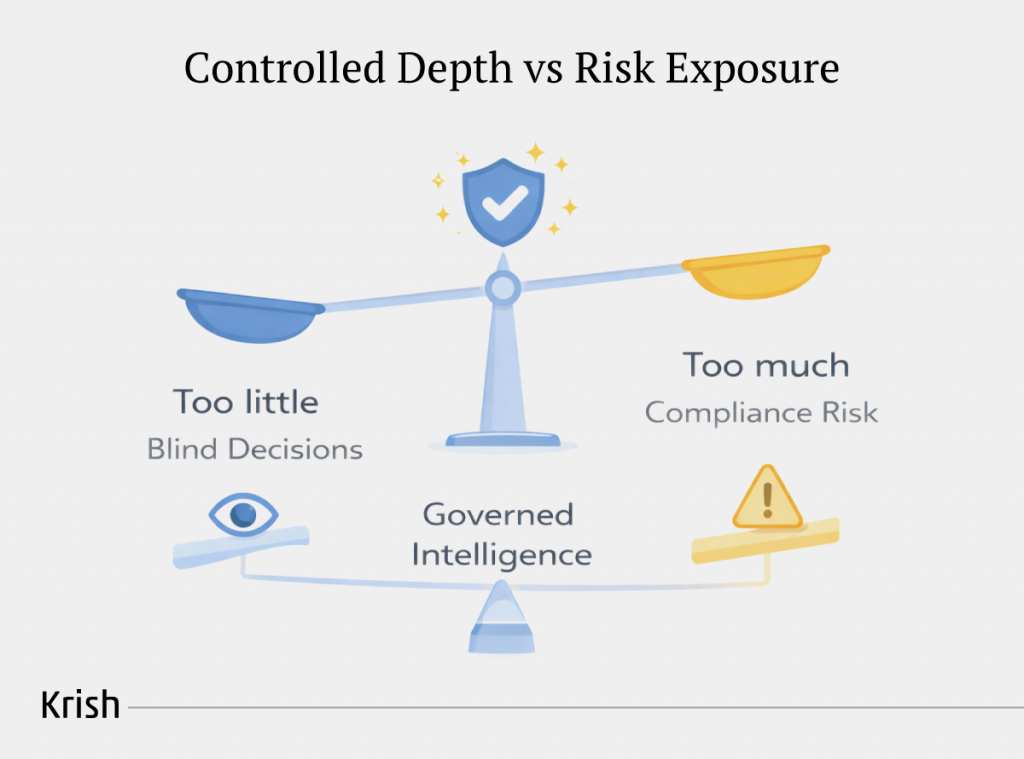
These principles keep analytics actionable without crossing regulatory boundaries. It accelerates execution. Teams ship faster because rules are clear, and data remains usable across regions. Leadership avoids reactive governance, and most importantly, customer trust is preserved.
The most valuable event data is data you can confidently use tomorrow.
Together, these 5 strategies form a single, solid system because you:
- Track only what matters.
- Structure it consistently.
- Capture early intent.
- Enrich it intelligently, and
- Govern it responsibly.
When these elements work together, event tracking stops being an analytics task and becomes a decision engine.
Operationalizing Event Tracking Across the MarTech Stack
Most event strategies collapse not at design, but at execution. Events are defined correctly, but implementation drifts. Operationalizing event tracking means treating it as a living system, not a one-time setup. High-performing organizations institutionalize 4 controls.
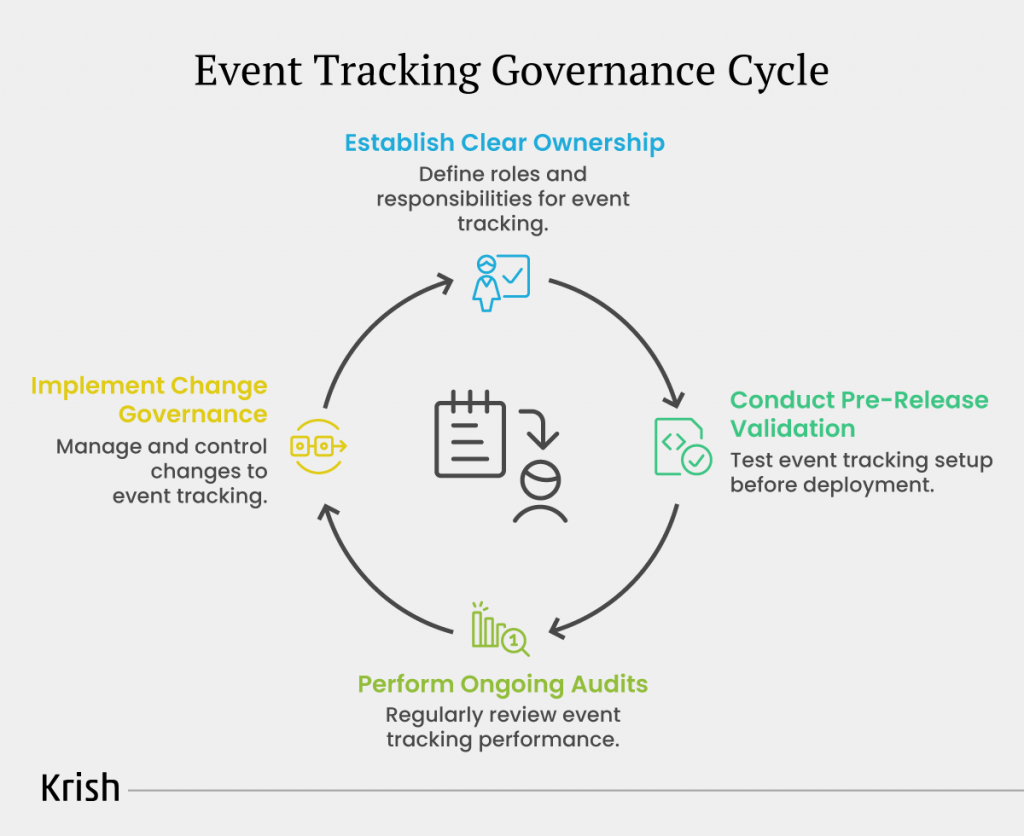
- Clear ownership
Every event and parameter has an owner. Ownership includes definition, validation, and lifecycle management. Without ownership, schemas fragment. - Pre-release validation
Events are QA’d before deployment, not debugged after dashboards break. Validation includes naming, parameter population, and consent behavior. - Ongoing audits
Regular audits catch unused events, broken parameters, and drift across platforms. This prevents silent data corruption. - Change governance
Event changes follow a documented process. New events are justified. Deprecated events are retired deliberately. Nothing changes invisibly.
These controls keep insight stable even as products and campaigns move fast. Operational discipline protects decision confidence. It ensures that trends remain comparable over time, experiments remain interpretable, attribution does not reset with every release, and analytics continue to reflect reality.
Event tracking only creates value when it survives change. Operations is what makes that possible. Aligning these strategies at all MarTech levels is how you achieve harmony and trust in your data and decisioning.
Conclusion: Building an Event-Driven Decision System
Event tracking only becomes powerful when it stops being treated as instrumentation and starts being treated as infrastructure. Most organizations collect events. Far fewer design them to support how decisions are actually made.
The 5 strategies discussed in this episode are not independent improvements. They are interdependent controls in a single system.
- Tracking only what matters creates focus.
- A scalable taxonomy preserves meaning as teams and platforms grow.
- Micro-conversions introduce foresight by exposing intent before outcomes occur.
- Custom parameters add depth without complexity. And,
- The privacy discipline ensures that the system remains usable and trusted over time.
When any one of these breaks, the value of the others collapses; precision without structure fragments, structure without intent becomes bureaucracy, and insight without governance becomes risk. This is because the advantage comes from orchestration, not optimization in isolation.
For leadership, this reframes the role of analytics. Event data is no longer a record of past activity. It becomes an early-warning system for friction, a signal engine for growth, and a shared source of truth across marketing, product, and experience teams.
The organizations that win with MarTech are not the ones with the most data. They are the ones with the clearest signals. Event tracking, when approached deliberately, is how that clarity is built and sustained.
Up next, the MarTech Masterclass Ep. 5 will highlight how to build dashboards that actually drive decisions. Stay tuned!
Table of Content
- The Strategic Role of Event Tracking in Modern MarTech
- Strategy 1: Track What Matters, Ignore What Doesn’t
- Strategy 2: Build a Scalable Event Taxonomy
- Strategy 3: Measure Micro-Conversions That Predict Macro Outcomes
- Strategy 4: Enrich Events With Custom Parameters for Deeper Insight
- Strategy 5: Balance Tracking Depth With Privacy and Compliance
- Operationalizing Event Tracking Across the MarTech Stack
- Conclusion: Building an Event-Driven Decision System
Subscribe with Us!
Never miss any post, stay tuned!

Ankit helps brands navigate their digital maturity journey by bringing together analytics, CRO, ML, and AI in a practical, business-friendly way. Having worked with global teams across industries, he focuses on simplifying complex MarTech concepts and turning them into measurable outcomes. On weekends, you’ll likely find him deep in a reflective read or sharing a coffee with a client while simplifying MarTech in the most human way possible.
Recommended Reading:
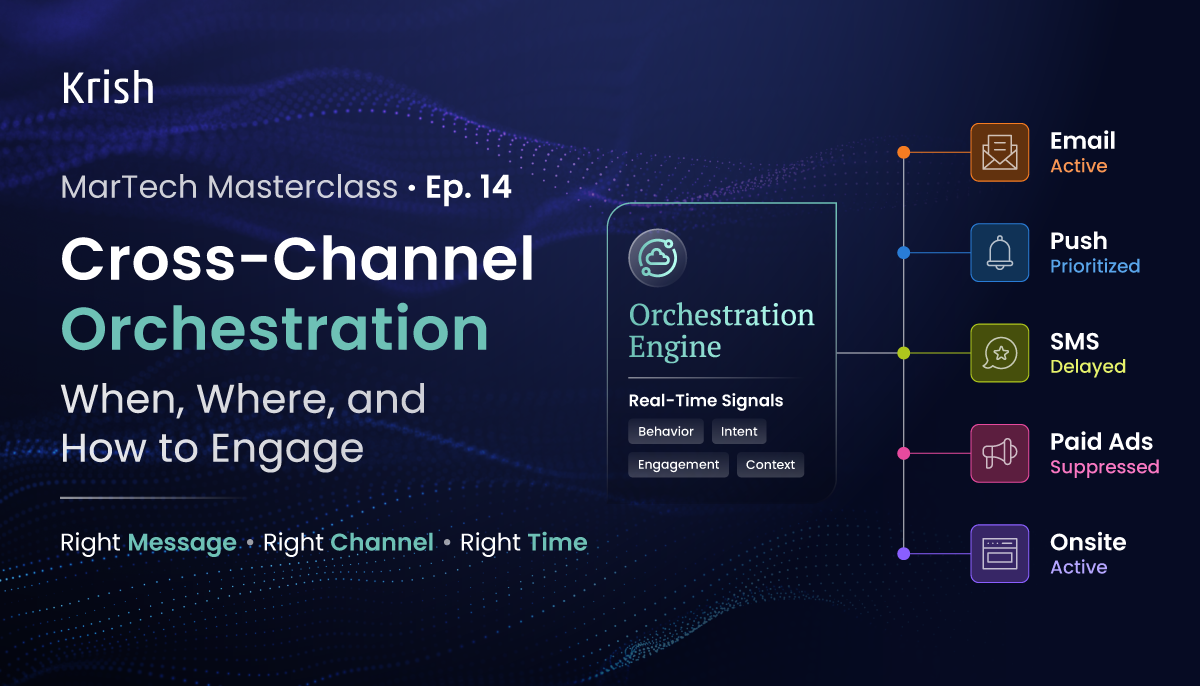
Cross-Channel Orchestration: When, Where, and How to Engage – MarTech Masterclass Series Ep | 14
27 May, 2026 Most brands running five channels are not doing cross-channel marketing. They are doing single-channel marketing five times over. The email team has its own calendar, its own KPIs, its own definition of a good week. Same for SMS, push, paid, and web. No shared view of what the customer has already received. No suppression logic that crosses a channel boundary. No agreed moment when one channel yields to another. The customer who buys on Monday is still getting a conversion-push on Wednesday because the paid retargeting audience sync runs nightly and someone forgot to check.
Subscribe with Us!
Never miss any post, stay tuned!
Trusted by leading brands


