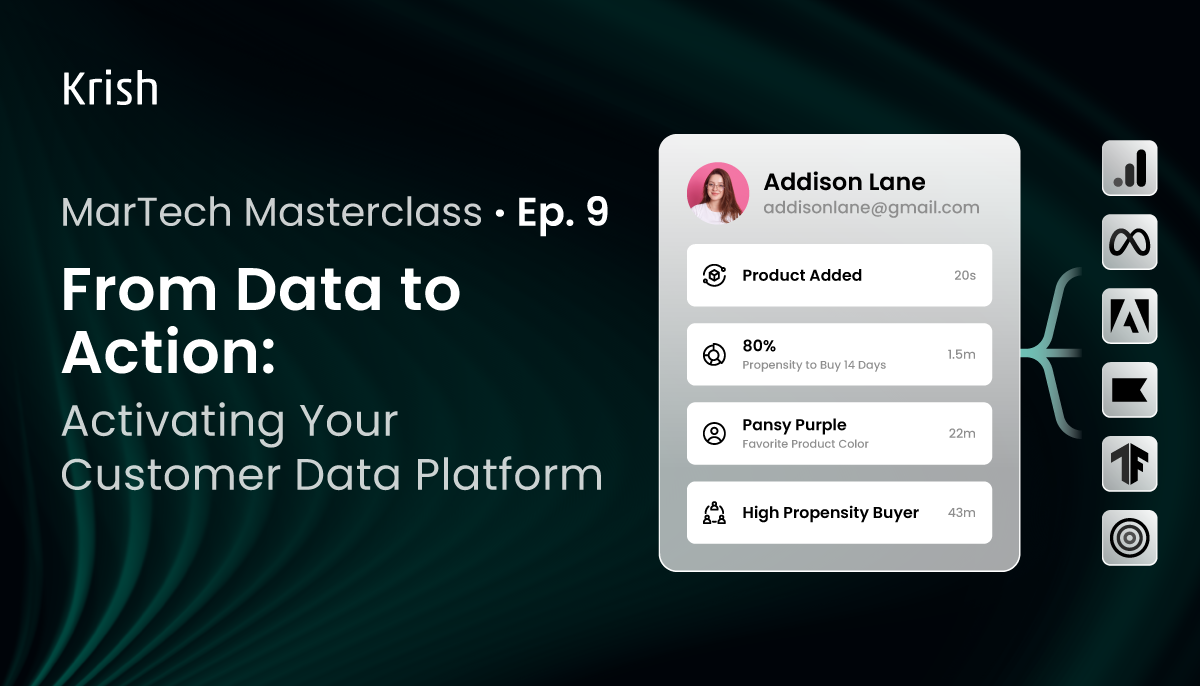
The CDP Potential Mismatch
A Marketing Analytics and Technology Survey from Gartner shows that 68% of respondents have adopted a CDP (Customer Data Platform) in 2024, while nearly half (~47%) still underutilize its full potential.
The platform is live. The data is unified. And most of it never reaches a campaign. That is not an implementation problem. It is an activation problem.
A CDP deployed to drive revenue is being used as expensive storage. Your CDP likely knows who your high-intent users are right now. The real question is: are your campaigns, journeys, and experiences reacting to that signal, or is it waiting in a dashboard?
In episode 8, we covered the infrastructure case for CDPs: identity resolution, data unification, and why legacy architectures fail. If you missed it, read it here first.
In this episode, we move beyond unification to execution: how to activate segments, operationalize real-time signals, and turn insight into outcomes.
Because a CDP’s true value isn’t in what it knows. It’s in what it does next.
Moving from Data Collection to Data Activation
Most CDPs were purchased to activate data. Most are still being used just to store it.
Gartner’s 2024 Critical Capabilities report highlights a telling pattern: the strongest executed CDP use case, in most enterprises, remains around data management, and data not activation! Teams have mastered ingestion, but consistently acting on that data in real time is where systems break.
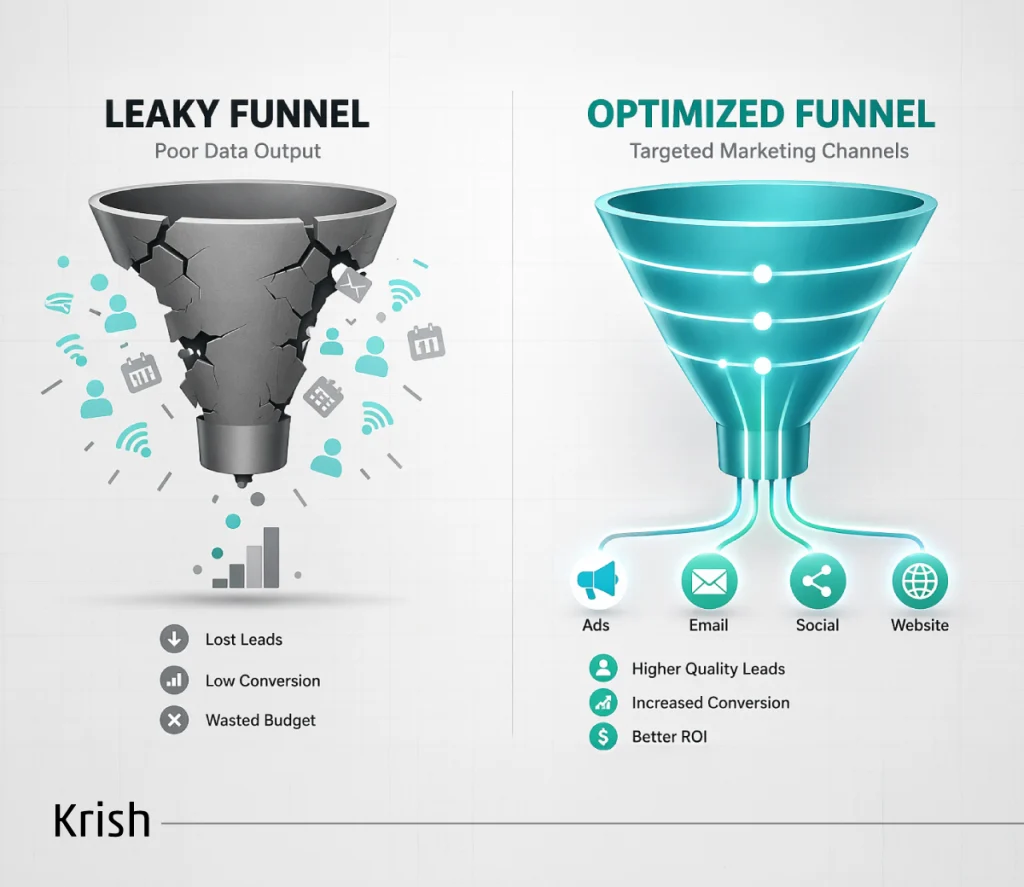
Here’s where activation actually fails:
- No predefined “if this → then that” use cases before CDP implementation
- No ownership of who responds to which signal (marketing, product, lifecycle)
- Segments created once, but never kept live or refreshed
- Downstream systems (ads, CRM, email) are not aligned to consume signals in time
Activation is not about pushing data out. It’s about defining what should happen next, and making sure it actually does. To move forward, activation needs to be designed before it is deployed.
What this looks like in practice:
- Start with 3–5 trigger-led use cases (e.g., pricing-page revisit, cart abandonment, drop in engagement)
- Map each to: signal → audience → action → channel → SLA (how fast it must fire)
- Validate if your current stack can execute within that SLA (hours vs minutes matters)
If your CDP cannot answer “what action did this data trigger today?”, you don’t have activation, you just have visibility. And that’s where segmentation becomes the next critical thing to fix.
How to Design Audience Segments That Drive Campaign Performance?
Most CDP segments describe customers. Wherein, high-performing segments decide what happens to them.
The traditional segmentation protocol is to define customers by geography, persona, affinities etc., and the activation gap is that they still dominate CDP setups because it’s easy to define and align with reporting. But it fails at the exact moment activation begins: timing.
A user who visited your pricing page three times in 24 hours is not the same as one who downloaded a whitepaper last quarter. Yet both often sit inside the same “high intent” segment. That’s not segmentation. That’s dilution.
Twilio Segment’s 2025 CDP report shows a 57% increase in the use of predictive traits YOY, signaling a clear shift toward intent-driven audience design. What’s changing is not the data. It’s how segments are constructed.
High-performing segments are:
- Behavioral → based on actions, not attributes
- Time-bound → defined within a decay window (hours/days, not months)
- Trigger-aligned → directly tied to an action (not just inclusion)
Example:
- Weak: “High-value users”
- Strong: “Users with 3+ pricing visits in 48 hrs and no conversion”
One informs reporting. The other drives revenue.
Make it operational:
- Define a signal threshold (what qualifies as intent?)
- Attach a time window (how long is it valid?)
- Link to a predefined action (what happens immediately?)
- Ensure the segment auto-refreshes, not manually rebuilt
The governing rule is simple: If your segment cannot answer “why this person, why now, and what happens next”, it is not activation-ready.
Because once you move from static segments to real-time, signal-driven audiences, your CDP stops being a system of record and starts becoming a system of action.
Real-Time vs. Batch Activation: When to Use Each Approach
Not all CDP activation needs to happen in milliseconds. The mistake is not choosing one over the other. It is not knowing which situation demands which, as real-time infrastructure is expensive to build, complex to maintain, and wasted entirely if it fires on signals that did not need to move that fast.
The decision is use-case driven, not platform driven.
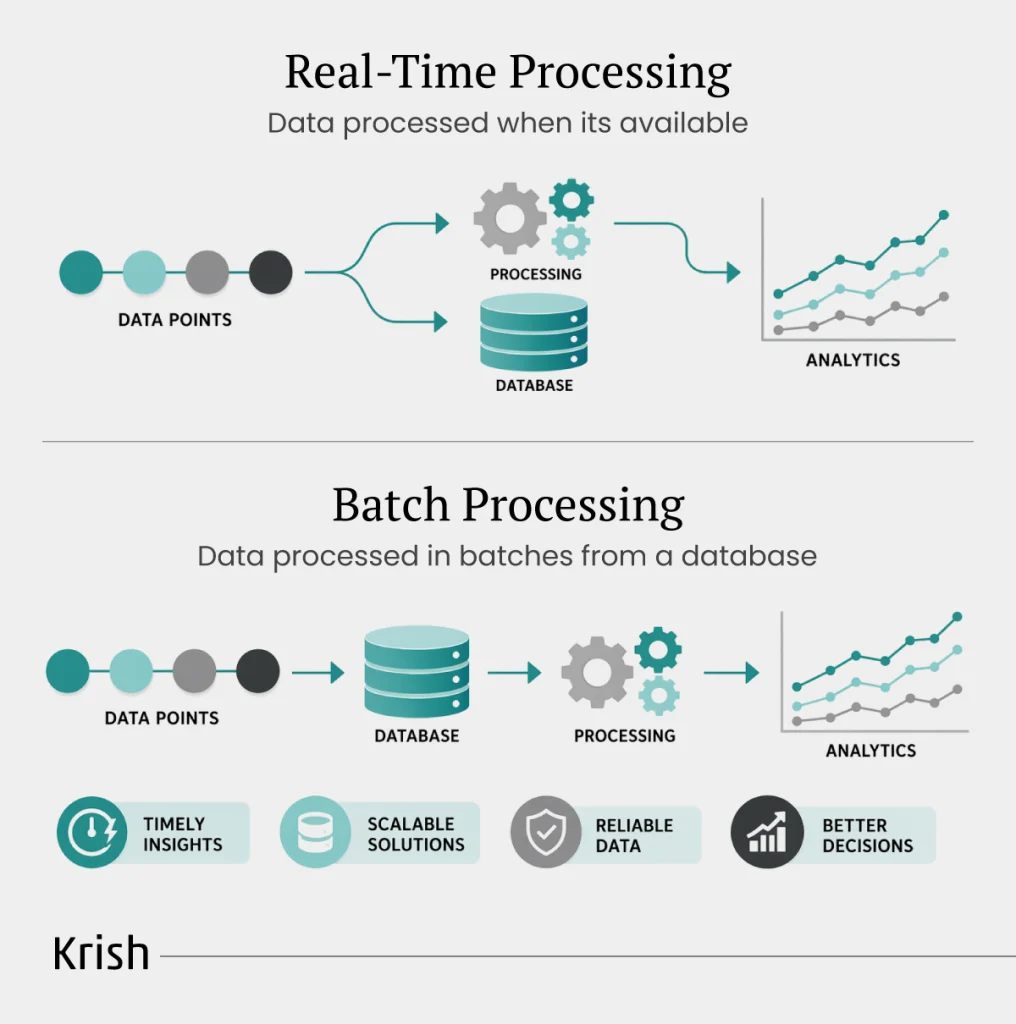
Real-time activation is non-negotiable when:
- Customer intent is perishable (pricing page visit, cart abandonment, live chat exit)
- The window to convert closes within minutes, not days
- Suppression must happen before the next ad impression fires
Batch activation is the right call when:
- Audiences are built for planned campaigns (monthly newsletters, seasonal promotions)
- Predictive models need to run across full historical data sets
- Downstream systems like CRM or email cannot consume streaming updates anyway
A real-time CDP ingests events as they happen, resolves identity instantly, updates the unified profile, and makes it available to AI and execution layers in sub-second timeframes. Without this, any automated response is based on stale information.
The governing question is not “can our CDP do real-time?” Most claim they can. The question is: which signals in your customer journey expire in minutes, and which ones hold for days? Build your activation cadence around that answer.
Once execution speed is defined, another layer becomes critical. The same signals driving activation must also respect how data can be used.
Privacy-First Activation Strategies in a Cookieless World
Privacy compliance is not a legal checkbox. For CDPs, it is an activation constraint that must be designed in from the start, not bolted on after.
Gartner predicted in 2023 that by 2025, 75% of marketing programs leveraging customer data will generate less incremental revenue than the costs of acquiring, managing, and activating it. Largely because most programs were built on third-party data assumptions that no longer hold. The cookieless transition did not create this problem. It exposed it.
A CDP built on first-party, consented data sidesteps this entirely. But most organizations have not closed the loop between consent signals and activation logic. A customer who opts out of behavioral tracking in your consent management platform may still be receiving behaviorally triggered emails if those two systems are not wired together.
Where systems break:
- Segments are built without checking consent eligibility
- Activation flows ignore channel-level permissions
- Identity resolution connects profiles faster than governance frameworks can support
This creates risk at scale.
What privacy-first CDP activation actually requires:
- Add consent as a mandatory filter in every segment
- Maintain separate views for consented vs non-consented audiences
- Ensure each channel enforces permission-based activation
- Build suppression logic alongside targeting logic
Privacy defines the boundary within which activation operates. When this boundary is built into the system, activation remains both scalable and compliant.
And once activation is timely and governed, the next question becomes unavoidable. Is it delivering measurable impact?
Measuring Activation Success: Metrics That Matter
Once activation is running across segments, channels, and time windows, the next question is simple. Is it working?
Most teams measure activity. Fewer measure impact. Opens, clicks, and impressions indicate movement. They do not confirm whether activation is influencing outcomes. When CDPs are involved, measurement needs to connect signal → action → business result.
This is where many setups fall short. Data flows, campaigns execute, but attribution to activation logic remains unclear.
What to measure instead:
- Trigger-level conversion rate
Did the action tied to a signal drive the intended outcome? - Time-to-action impact
How does response speed affect conversion or engagement? - Incrementality
What changed because this activation happened? - Audience freshness
Are segments acting on current behavior or outdated signals?
Make it operational:
- Tag every activation with a specific use case ID
- Track performance at signal level, not campaign level
- Compare real-time vs delayed execution outcomes
- Build feedback loops into segmentation and trigger logic
If measurement stops at campaign performance, activation remains at a surface level. When measurement connects back to signals, systems start optimizing themselves. Campaign metrics tell you what happened. Activation metrics tell you why it happened.
And once that clarity is in place, activation stops being a set of executions and starts becoming a system that learns.
From Insight to Impact: Making Activation Stick
Most organizations have the data. Many have the platform. Few have built the system that turns signals into timely, governed, and measurable action. The gap is not in capability. It is in orchestration.
Activation works when:
- Signals are defined with intent
- Segments are built to act in the moment
- Execution aligns with timing
- Data usage respects boundaries
- Measurement connects actions to outcomes
Individually, these are solvable. Together, they define maturity.
A CDP does not create impact on its own. It enables a way of operating where decisions are continuously informed by customer behavior and executed without delay.
At Krish, our digital analytics and activation services focus on building this exact layer, where unified customer data translates into measurable business outcomes across channels. Because the real value of a CDP is not in the data it unifies. It is in the actions it enables, every single day.
Table of Content
- The CDP Potential Mismatch
- Moving from Data Collection to Data Activation
- How to Design Audience Segments That Drive Campaign Performance?
- Real-Time vs. Batch Activation: When to Use Each Approach
- Privacy-First Activation Strategies in a Cookieless World
- Measuring Activation Success: Metrics That Matter
- From Insight to Impact: Making Activation Stick
Subscribe with Us!
Never miss any post, stay tuned!

Ankit helps brands navigate their digital maturity journey by bringing together analytics, CRO, ML, and AI in a practical, business-friendly way. Having worked with global teams across industries, he focuses on simplifying complex MarTech concepts and turning them into measurable outcomes. On weekends, you’ll likely find him deep in a reflective read or sharing a coffee with a client while simplifying MarTech in the most human way possible.
Recommended Reading:
Personalization at Scale: Moving Beyond First Name Tokens – MarTech Masterclass Series Ep | 12
11 February, 2026 Most brands have already accepted that personalization matters. The numbers make that case clearly. McKinsey confirmed long back that personalization most often drives 10% to 15% revenue lift, with company-specific lift spanning 5% to 25%, driven by sector and ability to execute. Companies that grow faster even drive 40% more of their revenue from personalization than their slower-growing counterparts.
Subscribe with Us!
Never miss any post, stay tuned!
Trusted by leading brands


