The Mail Merge Theory
Most brands have already accepted that personalization matters. The numbers make that case clearly. McKinsey confirmed long back that personalization most often drives 10% to 15% revenue lift, with company-specific lift spanning 5% to 25%, driven by sector and ability to execute. Companies that grow faster even drive 40% more of their revenue from personalization than their slower-growing counterparts.
And yet, the dominant execution across most MarTech stacks is still the first name in the subject line.
That is not personalization. That is mail merge with better infrastructure behind it.
The gap between 5% and 25% is not data. Every brand in that range has data. It is not the platform either. It is execution depth.
The single clearest indicator of where a brand sits in that range: are they personalizing on identity signals or behavioral signals? One tells you who someone is. The other tells you what they are doing right now, and what needs to happen before that window closes.
In episode 11, we learnt about which journeys to automate first. Personalization is the intelligence layer that decides what those journeys actually deliver. Without it, automation is well-timed broadcasting.
Why Personalization Is More Than Using Someone's First Name
Recognition and relevance are different problems.
A first name token solves recognition. It is a data retrieval operation. Personalization solves relevance. It is a decisioning operation: given what this person has done, across which channels, how recently, what should they see next, on which surface, within what window?
Most programs never make this shift. And the cost is measurable.
Gartner’s survey of 1,464 buyers and consumers found that customers who experienced personalization were 1.8x more likely to pay a premium, but also 2x more likely to feel overwhelmed, and 2.8x more likely to feel time pressure. 53 percent felt personalization did more harm than good. Those individuals were 3.2x more likely to regret the purchase and 44% less likely to buy from that brand again.
Volume without context does not just underperform. It damages the relationship.
Where execution breaks:
- Segments built on persona or demographic, not on what someone did in the last 48 hours
- Content personalized by category, not by intent state: a pricing page visitor and a blog reader are not the same audience
- Channels operating in silos: email, web, and paid serving conflicting experiences to the same person simultaneously
- Measurement at campaign level, which hides whether the personalization logic is actually working
The fix is not more personalization. It is sharper personalization: fewer, more precise signals, tighter response windows, cleaner suppression logic. But sharpening anything requires knowing where you actually stand. And most organizations are further back on the maturity curve than they think.
The Personalization Maturity Curve: From Basic to Predictive
Most organizations think they are further along than they are. It is a definition problem. Each stage looks similar from the outside and requires entirely different infrastructure to execute.
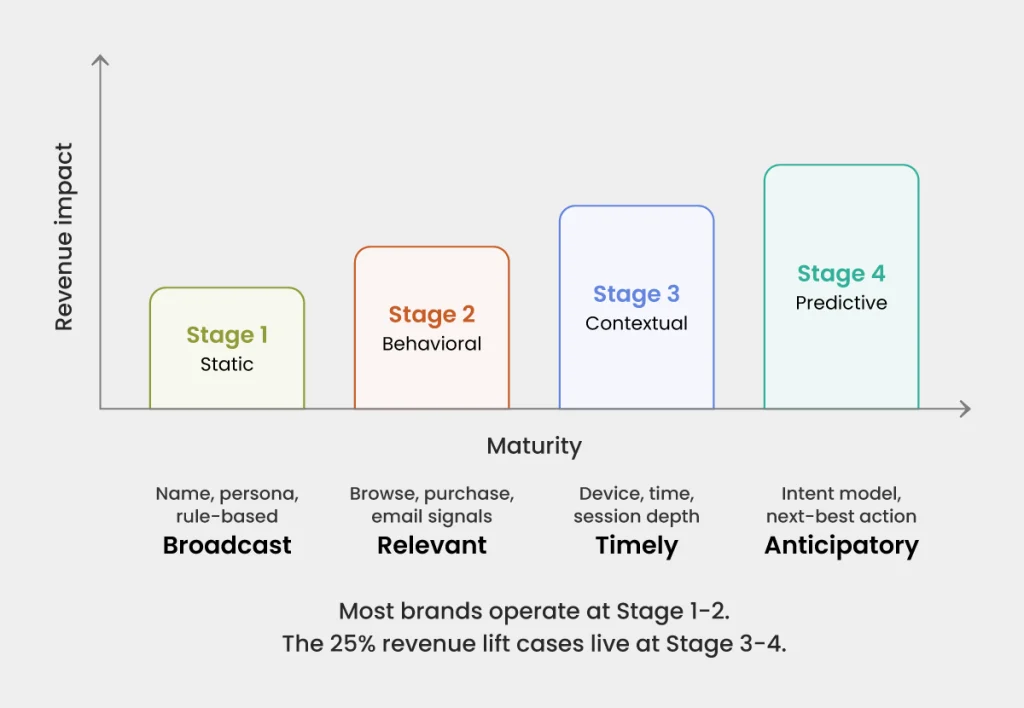
What each stage transition actually demands:
- Stage 1 to 2: Segment refresh measured in hours, not weeks. Overnight rebuilds mean behavioral personalization is not actually behavioral. It is yesterday’s behavior dressed up as today’s
- Stage 2 to 3: A decisioning layer that evaluates context at the moment of interaction, not at page load. In-session signals are the most predictive data points available, and the least used
- Stage 3 to 4: ML infrastructure, 12 or more months of clean behavioral data, and a feedback loop that retrains on outcome data, not just engagement data
The most expensive mistake: buying Stage 4 capability and running it on Stage 1 data infrastructure. The model predicts intent on segments last refreshed three weeks ago. Confidently wrong, at scale.
Knowing your stage changes the investment conversation. It also changes what you can realistically execute across channels, because the channel execution layer can only be as intelligent as the data infrastructure beneath it.
Dynamic Content Strategies Across Email, Web, Mobile, and Ads
Each channel has a different signal latency, a different relevance window, and a different consequence for getting personalization wrong. What works as a strategy at Stage 2 on email fails badly at Stage 2 on web, because the signal speed each channel requires is completely different. A unified personalization strategy does not mean treating all channels identically. It means understanding what each channel can do, and building to that ceiling.
The most underused capability on most stacks is open-time rendering: content that resolves at the moment of open, not at send. A customer who purchased between Tuesday send and Thursday open should see a post-purchase experience, not a conversion push. Most platforms support this. Almost no one configures it.
- Build content-state logic before building content: what should this email show if the person already converted? Abandoned? Opened three previous sends without clicking?
- Move subject line testing from list-level A/B to behavioral cohort level: the right subject line for someone on their fourth pricing visit is not the right subject line for a first newsletter open
- Write suppression rules before writing copy: who should not receive this trigger is more important than what it says
Web
The highest-leverage personalization surface and the most underbuilt. A pricing page visitor on their third session in 48 hours is not the same audience as a first-time homepage visitor. The CTA, the copy weight, the social proof format, the chat trigger: all should differ. If both sessions serve the same layout, the data is being collected and ignored.
- Evaluate segment membership at scroll depth and time-on-page, not only at page load: the most valuable in-session signals never reach the experience layer if evaluation happens at entry
- Test at segment level, not page level: a test against all visitors produces a population average, not intelligence about a specific intent state
- Treat personalization as a content layer that changes page meaning, not a widget appending recommendations below the fold
Mobile
Richest signal set of any channel. Least operationalized personalization layer. Push notifications on behavioral triggers instead of schedules. In-app messages responding to session depth instead of time since install. These capabilities exist on most modern stacks. The gap is almost always strategy, not platform.
Paid Advertising
The most immediately punishing channel for poor personalization. Retargeting a customer who converted yesterday is a direct margin problem. The suppression list, audience exclusion, and creative variant by funnel stage are not optimizations. They are the baseline. Nothing on paid is credible without them.
Channel execution sets the ceiling. But the mechanism that actually triggers these experiences in the right moment, on the right surface, is the trigger architecture beneath it.
Behavioral Triggers That Create Timely, Relevant Experiences
Everything discussed so far, the maturity stage, the channel capability, the content logic, is inert without triggers. Triggers are the operational unit that converts a signal into an experience, within the window that the signal is still worth acting on. A segment identifies who. A trigger decides when, where, and how fast.
Most programs treat triggers as a campaign feature: set once, monitored rarely, measured never at the trigger level. That is why personalization underperforms even when the content is right, the segment is right, and the channel is right. The timing is wrong. And timing is everything.
Six definitions every trigger needs before it goes live:
- Signal threshold: Precise behavioral definition, not a category label. “High intent” is not a threshold. “Pricing page visited three or more times in 48 hours with no conversion” is
- Time window: How long is this signal valid. Cart abandonment: hours. Re-engagement: days. Lifecycle: scheduled. Without this, trigger performance cannot be evaluated
- Suppression condition: Who should be excluded. A customer mid-sales conversation, one who already converted, one who opted out of this trigger type. Suppression logic is more important than targeting logic
- Action and channel: What fires, on which surface, in what sequence. One behavioral signal can warrant simultaneous responses across channels, or suppression on two of three
- SLA: How fast must the system respond from signal to delivery. No defined SLA means no accountability for whether the trigger is working
- Success metric: Trigger-level conversion rate, time-to-action impact, incrementality. Not campaign opens and clicks
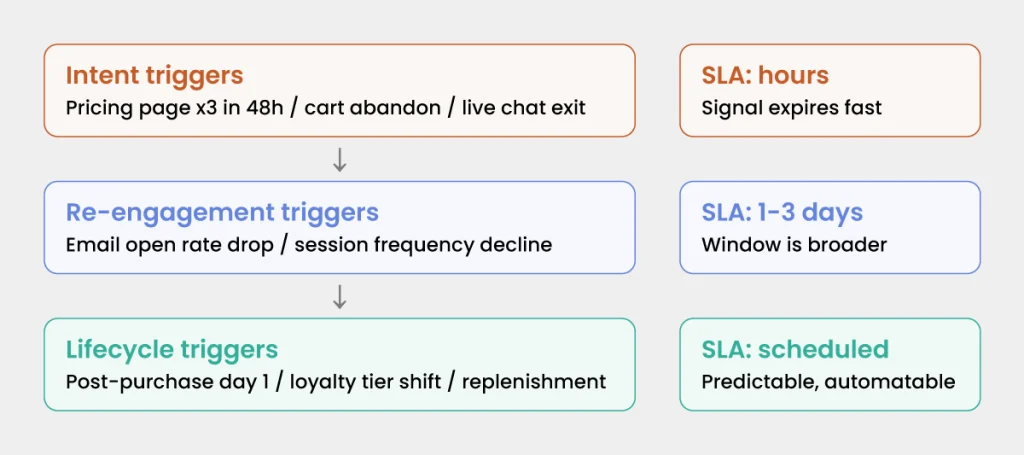
Operational rules that rarely get written down:
- Suppression lists must sync from the CDP in near-real-time, not nightly. A customer who converts at 2pm cannot receive a cart abandonment trigger at 3pm
- Every trigger needs a named owner accountable for SLA performance, not just for trigger existence
- Run a weekly review: fire rate, suppression rate, and conversion rate by trigger type. High fire rate with low conversion signals a threshold problem. Low fire rate signals a pipeline latency issue
Triggers without sequencing produce one-shot responses. Sequencing without behavioral triggers produces scheduled broadcasting. The two complete each other.
But here is the problem that trigger architecture alone cannot solve: even a perfectly designed trigger, firing at exactly the right moment, on exactly the right surface, can still violate customer trust if the data powering it was never meant to be used that way.
Balancing Personalization With Customer Privacy Expectations
Every trigger discussed in the previous section relies on behavioral data. That data does not exist in a vacuum. Customers are increasingly aware of what is being collected, how it is being used, and whether they consented to either. And the consequence of getting this wrong is not just a compliance fine. It is the exact regret and churn dynamic that Gartner’s research described at the start of this article.
Where consent-to-activation sync breaks:
- Consent platform and CDP run on separate pipelines with no real-time connection
- Segments apply consent as a post-build exclusion, not an upstream filter: non-consented data gets built in before anyone checks
- An email opt-out does not suppress email-triggered retargeting on paid. In most stacks, it does not
- Preference centers exist as legal checkboxes but do not route back into segment eligibility
What privacy-first activation actually requires:
- Consent as an upstream filter in segment construction, not a downstream cleanup pass
- Real-time sync between the consent platform and CDP, with a defined SLA for opt-out suppression across all downstream activation
- Four distinct permission states mapped to four suppression layers: email opt-out, push opt-out, behavioral tracking opt-out, ad targeting opt-out
- Zero-party data collection built into the experience: preference selectors, guided journeys, quiz flows. These signals are more accurate and more durable than any inferred behavioral attribute
- Preference centers that route selections into segment eligibility within a defined SLA, not into a disconnected form
In 2026, mature organizations are shifting toward context-aware personalization: using AI models to predict preferences based on context rather than extensive data collection, reducing the data footprint while maintaining relevance.
Privacy-first personalization and high-performance personalization are not in opposition. Brands that build on consented, first-party data are not doing less. They are building on a foundation that holds.
For teams auditing where consent logic and activation logic are misaligned, the MarTech stack audit framework Krish has documented covers exactly this: data integration health, undocumented consent flows, and stale permission records driving non-compliant activation.
Finally: From Tokens to a System
Brands confuse recognition for relevance, so they build personalization on identity signals instead of behavioral ones. Because they misdiagnose their maturity stage, they invest in Stage 4 capabilities on top of Stage 1 infrastructure. That infrastructure mismatch plays out differently on each channel, because each channel has a different signal latency and a different ceiling. The mechanism that connects all of it is the trigger: the precise condition under which a signal becomes an experience, within the window, it is still worth acting on. And the whole system only holds if the data driving it was collected with consent, synchronized to every activation layer, and governed with enough precision that customers feel served rather than surveilled.
None of these is a separate problem. They are the same problem at different layers of the stack.
Organizations that build personalization capability at scale drive double-digit revenue growth, stronger retention, and higher customer lifetime value. The capability is not in the data. It is in the system that acts on it, within the window, that the signal is still worth acting on.
At Krish, our MarTech services are built to close exactly this gap: behavioral signal infrastructure, trigger SLA architecture, consent-activation synchronization, and measurement that connects signals to outcomes rather than campaigns to clicks. Because a program that cannot answer “what action did this signal produce, how fast, and did it work” is not a personalization program. It is expensive data collection with a first name field at the top.
Table of Content
- The Mail Merge Theory
- Why Personalization Is More Than Using Someone's First Name
- The Personalization Maturity Curve: From Basic to Predictive
- Dynamic Content Strategies Across Email, Web, Mobile, and Ads
- Behavioral Triggers That Create Timely, Relevant Experiences
- Balancing Personalization With Customer Privacy Expectations
- Finally: From Tokens to a System
Subscribe with Us!
Never miss any post, stay tuned!

Ankit helps brands navigate their digital maturity journey by bringing together analytics, CRO, ML, and AI in a practical, business-friendly way. Having worked with global teams across industries, he focuses on simplifying complex MarTech concepts and turning them into measurable outcomes. On weekends, you’ll likely find him deep in a reflective read or sharing a coffee with a client while simplifying MarTech in the most human way possible.
Recommended Reading:
Predictive Analytics 101: Moving From Hindsight to Foresight – MarTech Masterclass Series Ep | 19
9 July, 2026 Most MarTech stacks are architecturally optimized for one thing: describing the past. Revenue last quarter, churn in the last 90 days, campaign performance last week - the dashboards are polished and the data looks clean. Yet every output from that stack is a response to something that has already happened. The customer already churned. The demand spike already passed. The high-value cohort already drifted before anyone noticed.
Subscribe with Us!
Never miss any post, stay tuned!
Trusted by leading brands


