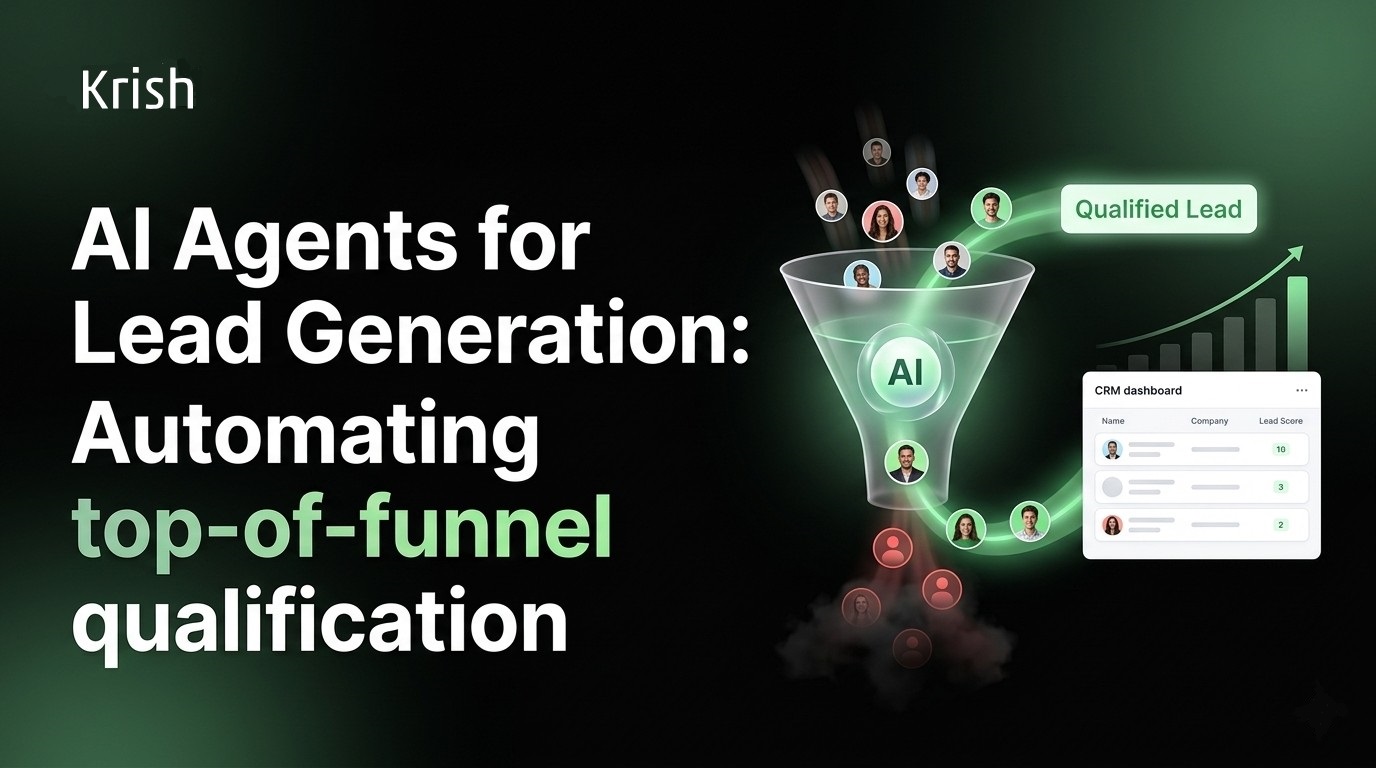
Introduction
According to Harvard Business Review, companies that try to contact potential buyers within an hour of receiving a query are nearly seven times as likely to qualify the prospect as those that wait even 60 minutes longer.
Most marketing teams know this. Few can execute it at scale.
AI agents for lead generation are autonomous software systems powered by large language models that engage, qualify, and route prospects without human intervention. They close the speed-to-lead gap entirely.
Treating these systems as mere chat widgets fundamentally misinterprets their value. When integrated correctly into comprehensive AI-powered marketing automation frameworks, they function as tireless Sales Development Representatives (SDRs). They parse unstructured buyer intent, query external databases, and update CRM records while your human sales team sleeps.
This guide maps how marketing operations leaders are deploying these models right now. We will examine the architecture required, explore real-world integrations, and outline the guardrails necessary for AI workflow automation.
Beyond The Chatbot: What Exactly Is An AI Agent?
An AI agent operates on autonomy. It parses an ambiguous user input, formulates a multi-step execution plan, accesses external systems via API to gather context, and executes actions based on defined business logic.
Large Language Models (LLMs) are the reasoning engines of these systems. The LLM handles the semantic understanding of the buyer’s language, but it requires surrounding infrastructure to actually function as a lead generator.
Autonomy In Lead Generation
Standard chatbots fail because they rely on rigid decision trees. If a buyer asks a question slightly outside the programmed flow, the bot breaks.
Autonomous agents use semantic search and retrieval-augmented generation (RAG) to dynamically construct responses based on your entire marketing knowledge base.
They understand nuance. If a prospect says, “We’re evaluating solutions for Q3 but budget is tight,” the agent instantly recognizes both timeline and budget constraints, adapting its follow-up questions accordingly.
Key Components: LLMs, APIs, And Workflows
A functional AI lead generation system relies on three pillars:
- The LLM: The cognitive layer (e.g., GPT-4, Claude) processing the conversation.
- The API Layer: The connective tissue allowing the agent to read from ZoomInfo, write to Salesforce, or trigger actions in your marketing automation platform.
- The Workflow Engine: The orchestration layer dictating the sequence of events.
To help teams map this out, we use the Krish Autonomous Qualification Matrix.
This framework evaluates an agent’s readiness by plotting its contextual knowledge access against its API write privileges. An agent that can converse beautifully but cannot write data back to your CRM is a stranded asset.
Evaluate your current or proposed vendor against this matrix to expose missing integration capabilities early.
Why Does Traditional Lead Qualification Fail At Scale?
Human-led qualification breaks under volume. Marketing ops teams spend heavily on demand generation only to watch conversion rates plummet due to structural bottlenecks in the SDR handoff.
The Speed-to-Lead Problem
Buyer patience has evaporated. According to [InsideSales], the odds of qualifying a lead decrease by 400% if the response time drops from 5 minutes to 10 minutes. Human SDR teams, constrained by time zones, meetings, and inbox volume, simply cannot maintain sub-5-minute response times consistently.
Inconsistent Qualification Criteria
Ask three different SDRs to apply BANT (Budget, Authority, Need, Timeline) to a subjective email thread, and you will get three different interpretations.
This subjective filtering creates friction between marketing and sales. Marketing points to high MQL volume; sales points to low SQL quality. AI agents eliminate this friction by scoring conversational inputs against rigid, mathematical definitions of readiness.
The High Cost Of Manual Follow-up
Chasing unresponsive top-of-funnel prospects is an expensive use of human capital. Paying a junior sales professional to send six follow-up emails to a dormant webinar attendee destroys acquisition economics.
Agents handle this infinite follow-up loop at computing costs, reserving expensive human intervention for buyers who have actively demonstrated high intent. Audit your current SDR time allocation this week to determine exactly how many hours are lost to administrative follow-ups.
How Do AI Agents Work For Lead Generation?
AI agents execute top-of-funnel qualification through a continuous loop of data retrieval, reasoning, and routing.
Step 1: Ingest & Enrich
The moment a buyer downloads an asset or interacts with a web property, the agent ingests the raw data. Before uttering a word, it fires an API call to tools like Clearbit or Apollo. It enriches the profile with company size, funding rounds, and technology stack data. This allows the agent to bypass basic qualification questions and jump straight to high-value discovery.
Step 2: Initiate & Engage
Armed with enriched context, the agent initiates contact. If the user is active on the site, it might trigger a proactive chat: “I see you’re using Magento. Are you looking to upgrade your search experience?” For asynchronous leads, it crafts a hyper-personalized email referencing the specific sub-topic of the whitepaper they just downloaded.
Step 3: Qualify Via Conversational AI
This is the core differentiator. The agent engages in a natural back-and-forth dialogue. It gently probes for specific qualification metrics. If the buyer gives a vague answer like “We’re exploring options,” the agent uses prompt-engineered follow-ups to extract concrete timelines without sounding interrogatory.
Step 4: Score, Route, and Book
Once the threshold criteria are met, the agent executes the final workflow. It assigns a definitive lead score, routes the transcript to the appropriate Account Executive in the CRM based on territory logic, and generates a direct calendar link to secure the meeting instantly. Map your current routing logic visually to ensure an AI agent has distinct, undeniable rules to follow when assigning leads.
What Are The Best AI Tools For Lead Generation And Qualification?
Navigating the landscape of autonomous agents requires matching the tool’s architecture to your existing data infrastructure.
Haptik: Best For Conversational Commerce
Haptik provides a robust infrastructure for complex buyer dialogues. We often see brands deploy this when they need deep conversational capabilities tied directly to product catalogs or service inquiries.
As a leading AI-powered conversational platform, Haptik excels at handling high-volume inbound traffic, dynamically routing qualified technical buyers to specialized human reps while resolving lower-tier inquiries autonomously.
Salesmanago: Best For Behavioral Trigger Automation
If your lead generation relies heavily on complex email nurturing and behavioral tracking, standalone chat agents are insufficient. Salesmanago integrates the agent layer directly into the customer data platform.
As an AI-driven customer data marketing automation solution, it excels at identifying exactly when a dormant lead exhibits buying signals across your site, automatically triggering an AI SDR to send a highly contextual outreach email.
Custom LLM Architectures: Best For Complex B2B Sales
For enterprise operations with highly bespoke qualification models (like MEDDPICC variations), off-the-shelf SaaS agents often lack flexibility.
Building a custom middleware layer using OpenAI or Anthropic APIs connected to your specific tech stack provides total control.
This approach requires more engineering overhead but allows the agent to execute complex internal database queries before responding to a prospect. Select the tool that natively aligns with your heaviest acquisition channel.
Real-World Use Cases For AI Lead Generation Agents
Concepts matter less than execution. Here is how autonomous qualification operates in live commercial environments.
The autonomous email SDR
Managing inbound demo requests often creates an artificial queue. A prominent real-world example is Okta.
According to a Drift Case Study, Okta integrated conversational AI across their global web properties to handle top-of-funnel traffic. By using AI to instantly engage and qualify visitors based on complex enterprise criteria rather than forcing them into a static form queue, Okta increased their pipeline generation by 30%. The agent handled the initial qualification dialogue, allowing human reps to step in only when a meeting was mathematically viable.
The 24/7 Website Concierge
B2B buyers research solutions outside standard business hours. An AI concierge sits on complex product pages, answering deep technical questions by reading from technical documentation. If a late-night visitor asks about specific API rate limits, the agent answers accurately and immediately transitions to: “Does your current infrastructure struggle with rate limits? I can connect you with an architect tomorrow to discuss solutions.”
The Inbound Form Qualifier
Forms are static. Agents are dynamic. When a buyer submits a standard “Contact Us” form with a vague message, an agent immediately replies via email asking three specific clarifying questions. It pre-qualifies the intent before an AE ever sees the notification, filtering out spam, vendors, and unqualified low-budget inquiries automatically.
How Do AI Agents Integrate With Your MarTech Stack?
Deploying an agent without deep integrations creates a conversational silo. Buyers hate repeating themselves to a human after speaking to an AI.
The Central Role Of The CRM
Your CRM must remain the single source of truth. The AI agent acts as a bi-directional interface for this database. It must possess API permissions to query existing contact records (to avoid prospecting existing clients) and write new call notes, firmographic data, and activity logs directly to the lead object.
Leveraging MACH Architecture
Connecting legacy monolithic platforms to modern LLMs often requires brittle custom middleware. Brands operating on MACH-based eCommerce platforms (Microservices, API-first, Cloud-native, Headless) hold a significant advantage. The API-first nature of MACH allows you to plug a specialized AI qualification service directly into your event streams, ensuring data flows instantly between your frontend web experience, your enrichment tools, and your CRM.
Timelines And Honest Caveats
Implementing a custom autonomous agent is not an afternoon project. A standard deployment involving CRM integration, knowledge base ingestion, and RAG optimization typically requires an 8 to 12-week implementation timeline. Phase one must be restricted to internal testing to tune the prompt guardrails.
Crucially, AI agents fail in high-stakes, relationship-driven enterprise sales involving multi-stakeholder purchasing committees. If your average deal size is $500,000 and requires nine months of strategic relationship building, an AI agent should only handle the initial introductory routing, never the complex discovery process. Map your buyer’s journey to identify where human empathy outranks computational speed.
Measuring The ROI And Maintaining Compliance
Autonomous agents must justify their API costs through pipeline velocity and conversion efficiency.
Proving The Business Impact
Specific numbers dictate adoption. According to McKinsey Company, B2B companies integrating AI into their sales processes report a 10% to 20% increase in leads and a subsequent 15% to 20% decrease in overall call time. The human element is not erased; it is amplified. SDRs transition from manual dialers to strategic deal managers. One of Krish’s enterprise B2B eCommerce models reduced cost-per-qualified-lead by 34% within 90 days of deploying AI qualification agents hooked directly into their MACH infrastructure.
Privacy And Data Compliance
You cannot train an agent on unregulated buyer data. Any agent deployed for lead generation must comply strictly with GDPR and CCPA regulations. The system must recognize requests for data deletion (“forget me”) within the natural language flow and trigger the corresponding compliance workflow in your CRM. Furthermore, PII (Personally Identifiable Information) must be masked before any conversational transcripts are sent to third-party LLM providers for processing. Review your vendor’s data processing agreements to ensure they do not train their foundational models on your proprietary prospect data.
The Next 12–18 Months Of Autonomous Qualification
Over the next 18 months, the distinction between marketing automation and sales execution will blur entirely.
We are moving away from passive lead scoring systems toward proactive “action models.”
Agents will no longer wait for a form fill; they will autonomously monitor web scrapers, LinkedIn intent signals, and job postings to identify trigger events. They will then draft the sequence, execute the outreach, and negotiate the meeting time entirely in the background.
Marketing operations leaders must begin decoupling their data from legacy monoliths now, ensuring their infrastructure is composable enough to support this incoming wave of autonomous tools.
Connecting these advanced reasoning engines to your proprietary business data is where the friction lies.
With over 20 years of expertise engineering search-optimized digital experiences and deep MarTech integrations, Krish builds the infrastructure required to make autonomous agents actually work. Whether you are transitioning to a MACH architecture or need custom API middleware for your CRM, we ensure your AI agents generate qualified pipeline, not technical debt. Reach out to our technical strategy team to blueprint your automation framework.
Frequently Asked Questions
Table of Content
- Introduction
- Beyond The Chatbot: What Exactly Is An AI Agent?
- Why Does Traditional Lead Qualification Fail At Scale?
- How Do AI Agents Work For Lead Generation?
- What Are The Best AI Tools For Lead Generation And Qualification?
- Real-World Use Cases For AI Lead Generation Agents
- How Do AI Agents Integrate With Your MarTech Stack?
- Measuring The ROI And Maintaining Compliance
- The Next 12–18 Months Of Autonomous Qualification
Subscribe with Us!
Never miss any post, stay tuned!

As Director - Marketing, Zenul leads the marketing and branding at Krish. He brings with him an in-depth understanding of the evolving digital ecosystem and has a proven expertise and experience in strategic planning, market and competition analysis, creating and implementing client-centered, lead-gen and brand marketing campaigns. He has a heart for technology innovation and has been a keynote speaker on various platforms.
Recommended Reading:
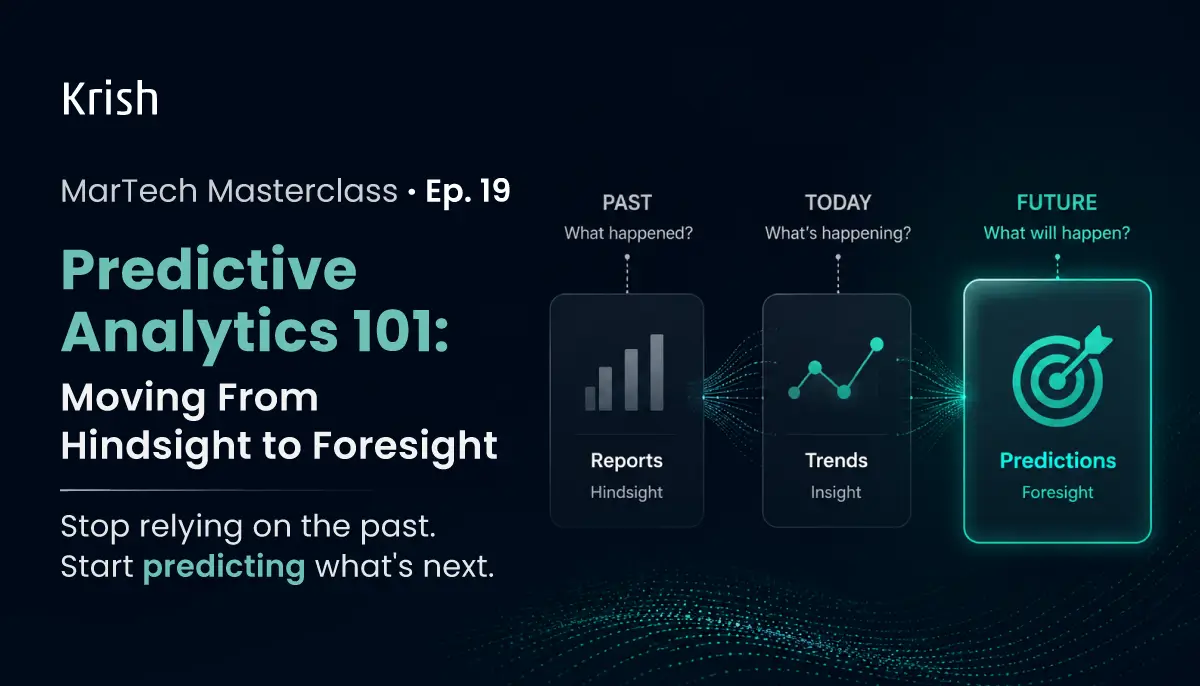
Predictive Analytics 101: Moving From Hindsight to Foresight – MarTech Masterclass Series Ep | 19
9 July, 2026 Most MarTech stacks are architecturally optimized for one thing: describing the past. Revenue last quarter, churn in the last 90 days, campaign performance last week - the dashboards are polished and the data looks clean. Yet every output from that stack is a response to something that has already happened. The customer already churned. The demand spike already passed. The high-value cohort already drifted before anyone noticed.
Subscribe with Us!
Never miss any post, stay tuned!
Trusted by leading brands


