The ‘more traffic = more revenue’ trap
Here’s a number that should bother most CMOs: the global average ecommerce conversion rate sits between 2% and 4%, according to Shopify’s Commerce Trends benchmarks. That means for every 100 people your paid campaigns bring in, 96 to 98 leave without converting.
Now look at what you paid to bring them.
According to WordStream’s industry benchmarks on Google Ads, average cost-per-click across industries has climbed steadily, with sectors like legal, finance, and retail often exceeding $5 to $10 per click.
Run that against a 2% conversion rate and the math turns uncomfortable fast: you may be paying $250 to $500 for every single customer acquired through paid search.
Increasing traffic doesn’t fix that. It scales it.
You are probably spending more to acquire visitors than you did two years ago. And somewhere in your revenue forecast, there’s a gap nobody can cleanly explain.
The answer isn’t in your media plan. It’s in what happens after the click.
Conversion efficiency beats volume, almost always
Consider two scenarios:
Company A spends an additional $50,000/month on paid traffic. Company B invests the same into a structured CRO audit and experimentation program.
Company A gets more visitors into a leaking funnel, while company B finds that one form field is causing 30% of users to abandon. Removes it. Revenue lifts without a single new visitor.
This is the core argument for conversion maturity: the ROI curve on CRO typically steepens faster than the ROI curve on acquisition, especially once you’ve hit traffic scale.
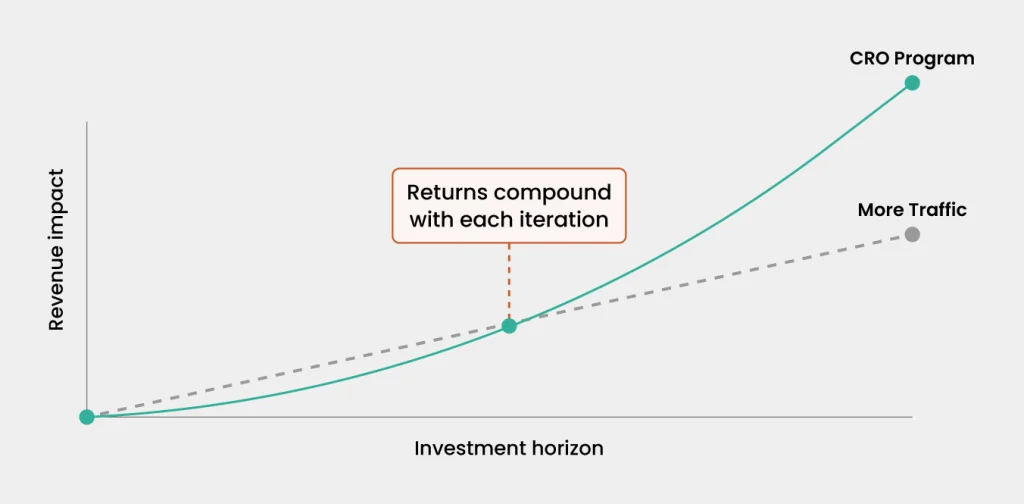
McKinsey research on commercial growth consistently finds that companies combining funnel optimization with acquisition outperform those relying on acquisition volume alone.
The much-needed funnel analysis
Most teams visualize their funnel as a clean sequence. The reality is messier. Visitors don’t march orderly toward checkout. They hesitate, second-guess, hit friction, and leave. The drop-off isn’t random either. It clusters predictably at the same points: first meaningful scroll, pricing page, checkout initiation.
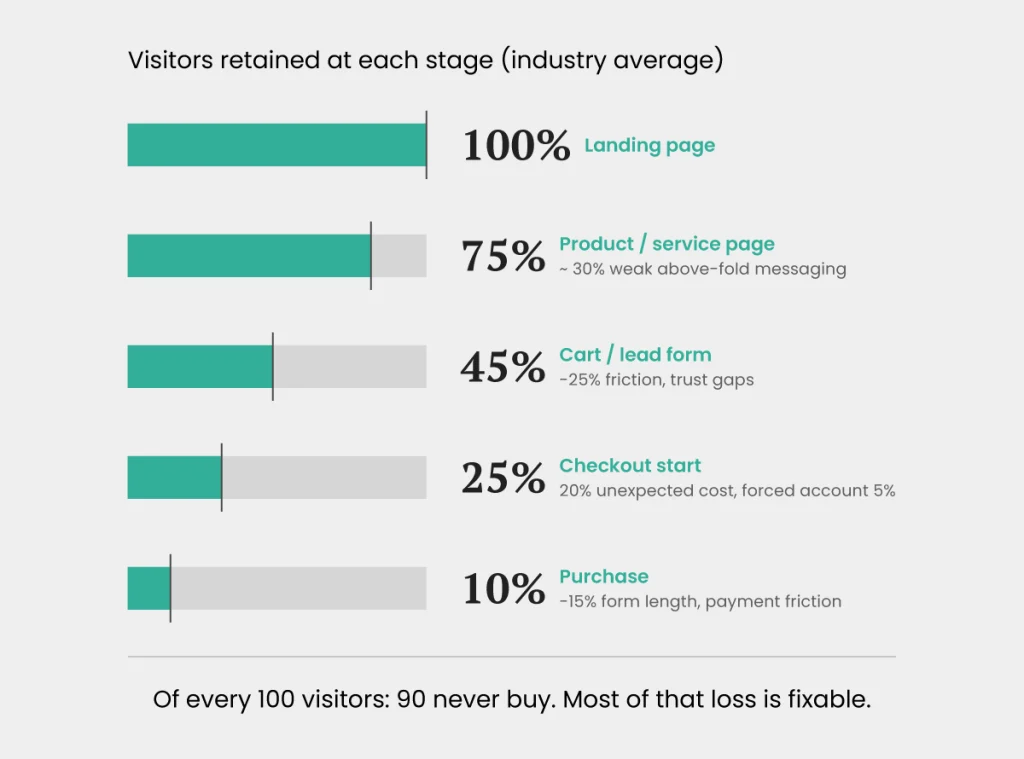
Notice where the steepest drops happen. Not at checkout. Earlier. By the time someone reaches cart initiation, you’ve already lost 55% of the visitors you paid for. Checkout optimization is important, but the funnel is bleeding long before that.
This is the pattern that makes acquisition-first thinking so expensive. You keep buying the top of the funnel while the middle quietly empties.
The three real culprits
When we at Krish conduct CRO audits, the same failure patterns recur across verticals:
- Friction: forms with eight fields when three would do, page load times that exceed three seconds on mobile, and CTAs that compete with each other on the same screen. Friction is rarely dramatic. It’s a 0.3-second delay, a required field that creates doubt, a checkout flow designed for a desktop user who arrived on a phone.
- Weak messaging: Messaging failure is subtler. Value propositions that describe what a product does instead of what it changes for the customer. Hero sections that answer the wrong question. Copy that passed legal review but lost the human reading it. Visitors arrive with intent and leave unconvinced.
- Confusing journeys: Journey confusion is the quietest killer. No clear next step. Too many options creating paralysis. A user who arrived at the pricing page and couldn’t find what to do after reading it.
None of these requires more traffic to fix. They require observation, hypothesis, and testing. That’s observable and strategic conversion rate optimization.
Conversion maturity changes the growth conversation
High-performing digital teams no longer treat CRO as button testing. They treat it as operational intelligence.
The focus shifts from:
- “How do we get more users?”
to - “Why are high-intent users not progressing?”
That single shift changes investment priorities across marketing, UX, analytics, experimentation, and commerce.
Brands with mature conversion programs continuously study:
- behavioral signals
- scroll depth and hesitation points
- rage clicks and abandonment patterns
- messaging resonance
- mobile interaction gaps
- checkout psychology
- content sequencing
This is where profitability compounds quietly. The implication is bigger than UX as it directly impacts margin quality.
The next era of CRO is cross-functional
Modern conversion optimization sits at the intersection of:
- behavioral analytics
- experimentation
- AI-driven personalization
- content intelligence
- commerce architecture
And companies that treat the CRO program as a growth discipline win. Because,
Sustainable growth is rarely about attracting more visitors first. It is about helping existing intent move forward with less resistance.
Where the Conversion Maturity Series goes
Conversion efficiency is a structural advantage,
Traffic can be bought, but a high-converting experience has to be built.
Companies that treat CRO as a program, not a project, accumulate something their competitors don’t: institutional knowledge of how their visitors actually behave, and a repeatable process for acting on it. Each test cycle either confirms a hypothesis or eliminates one. Both outcomes have value.
That compounding loop is what the Conversion Maturity Series (CMS) by Krish is all about. Not quick wins. Not “remove this button and increase revenue.” But the REAL talks. Over the 15 issues, we will try to cover the real cases for conversion maturity that help brands build better-converting funnels.
Stay tuned for issue 02: we’ll talk about what CRO actually is, beyond the textbook definition, in real sense.
Table of Content
Subscribe with Us!
Never miss any post, stay tuned!

Steny Christian helps brands unlock growth by making AI and MarTech practical, strategic, and easier to navigate. With a consultative and people-first approach, he works closely with businesses to simplify digital transformation and drive meaningful outcomes. Outside work, you’ll likely find him exploring emerging tech or sharing thoughtful conversations around innovation and growth.
Recommended Reading:
Personalization at Scale: Moving Beyond First Name Tokens – MarTech Masterclass Series Ep | 12
11 May, 2026 Most brands have already accepted that personalization matters. The numbers make that case clearly. McKinsey confirmed long back that personalization most often drives 10% to 15% revenue lift, with company-specific lift spanning 5% to 25%, driven by sector and ability to execute. Companies that grow faster even drive 40% more of their revenue from personalization than their slower-growing counterparts.
Subscribe with Us!
Never miss any post, stay tuned!
Trusted by leading brands


