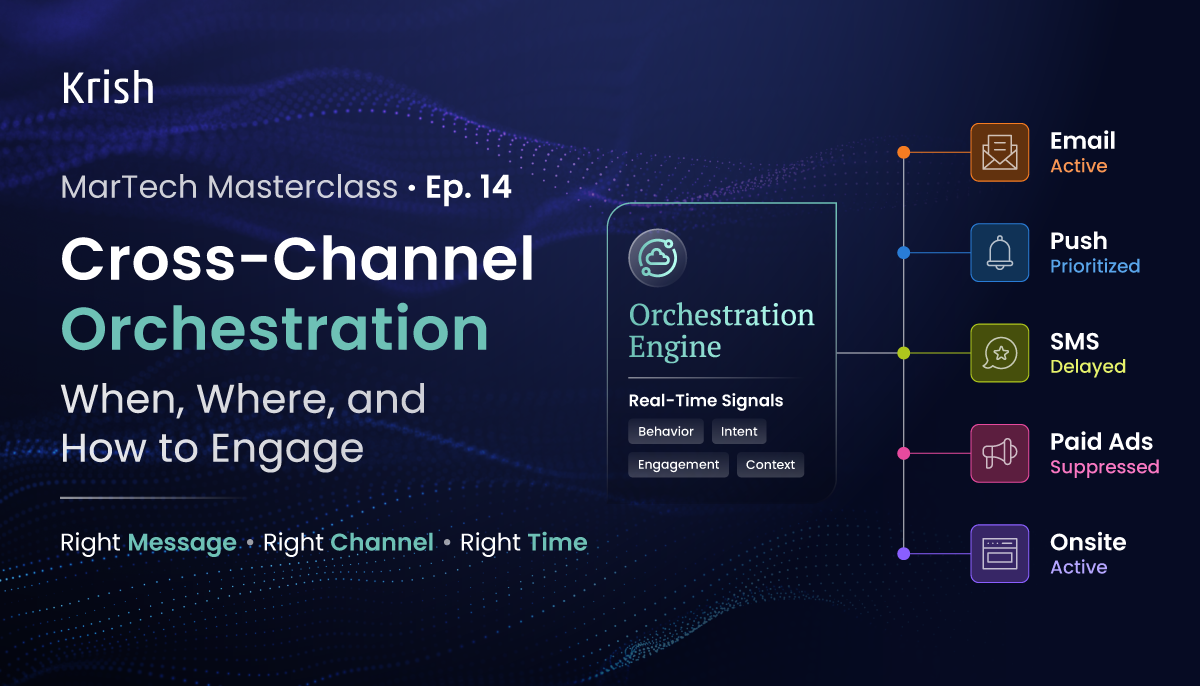
The Illusion of Multi-Channel Marketing
Most brands running five channels are not doing cross-channel marketing. They are doing single-channel marketing five times over.
The email team has its own calendar, its own KPIs, its own definition of a good week. Same for SMS, push, paid, and web. No shared view of what the customer has already received. No suppression logic that crosses a channel boundary. No agreed moment when one channel yields to another. The customer who buys on Monday is still getting a conversion-push on Wednesday because the paid retargeting audience sync runs nightly and someone forgot to check.
A Forrester Q3 2024 B2C Marketing CMO Pulse Survey found that 78% of US B2C marketing executives admit their marketing and loyalty technologies are siloed.
That number is the organizational reality underneath most cross-channel strategies. The tech stack is multi-channel, but the operating model is not.
A HBR study of 46,000 global consumers found that 73% use multiple channels throughout the shopping journey – that is a study of 2017. Imagine the impact of a multi-channel customer journey today.
They are moving across email, site, app, and ads in a single continuous experience. When those channels are run as separate operations, the customer feels every seam: duplicate messages, contradictory offers, re-targeting ads for a product they already bought. Channel silos do not just create friction. They signal to the customer that the brand does not know them.
This episode covers what it actually takes to fix that.
In episode 13, we covered who receives what and when, through the lens of segmentation and predictive scoring. Orchestration is the system that determines which channel delivers that message, in what sequence, and how the channels govern each other so the customer experiences coherence instead of noise.
Why Channel Silos Destroy Customer Experience
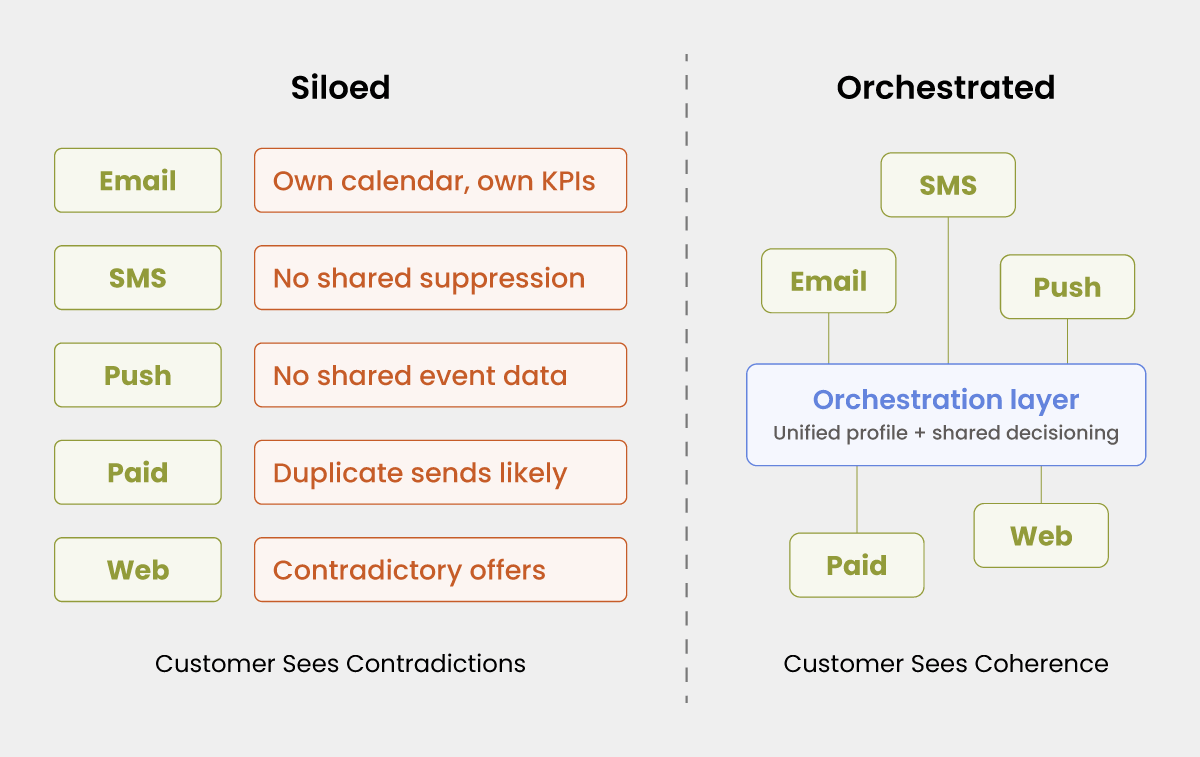
Siloed channels produce four failure modes, each measurable, each avoidable:
- Duplicate sends. Email fires at 9am. SMS fires at 11am with a near-identical message. The teams run off different lists with different trigger logic.
- Contradictory offers. A discount email on Tuesday. A full-price retargeting ad on Thursday. Both correct within their own channel logic. Together, incoherent.
- Post-conversion targeting. Customer converts Monday. Wednesday they are still receiving pre-conversion nurture because the purchase event never propagated to the paid suppression list.
- Invisible fatigue. No single channel exceeds its cap. But the customer receives nine touchpoints in a day across all channels combined, and the unsubscribe is the only signal any team picks up.
The root cause is always the same: channels measure their own sends in isolation. When each team optimizes for its own KPIs, over-sending is invisible until churn data arrives weeks later.
Building Connected Experiences: What Each Channel Is Actually Built For
Building connected experiences starts with a simpler discipline than most teams assume: stop using every channel for every message type, and assign each channel the work it is built for.
| Channel | Best-fit use | Response window |
|---|---|---|
| Email Deep consideration |
Nurture, editorial, complex offers | Hours to days |
| SMS Urgency + action |
Flash offers, confirmations, one CTA | Minutes |
| Push Real-time triggers |
Browse abandon, restock, reminders | Seconds to minutes |
| Web Intent capture |
Overlays, on-site recs, exit intent | In-session |
| Paid ads Reach + suppression |
Acquisition, retargeting, exclusion lists | Hours to days |
– Email is a deep channel. The inbox creates a reading context no other channel replicates. It belongs to content-rich nurture, complex offers, and editorial sequences. Its weakness is latency, so never use it for time-critical triggers.
– SMS has a 98% open rate and average read time under three minutes. It is an action channel, not a content channel. One message, one CTA, a hard close time. Every SMS that tries to do more is competing against a format it will lose.
– Push sits between email and SMS in intimacy and speed. It requires app installation and permission, making every push subscriber higher-intent than your average email contact. Use it for behavioral triggers: browse abandonment, restock alerts, session re-engagement.
– Web is the only channel where the customer is already present and actively engaged. Overlays, on-site recommendations, and exit-intent prompts are not interruptions here, they are contextual signals. What happens on-site should feed back into the cross-channel signal layer immediately.
– Paid ads serve two structurally different functions that most teams conflate:
- Acquisition: reaching audiences who have not yet entered your owned channels
- Suppression: excluding converters, recent purchasers, and high-value segments from generic retargeting
Brands that run both functions cleanly stop paying to re-acquire customers they already have.
The underlying principle that connects all five is that each channel should know what the others have done. A customer who clicked through your email to a product page does not need a push about that product 20 minutes later. Shared event data between channels is not a nice-to-have. It is what separates orchestration from broadcasting.
The Orchestration Framework: Right Message, Right Channel, Right Time
Right message, right channel, right time is the organizing principle of cross-channel orchestration. Each of those three dimensions needs a defined decision rule, not a judgment call at send time.
Right message is determined by the customer’s current intent state.
This links directly back to the segmentation and propensity layer from episode 13. A customer with a high purchase propensity score receives a conversion-oriented message. An at-risk customer receives a value reminder. A Champion receives access, not promotion. The segment determines the message logic before channel selection begins.
Right channel is a function of three inputs:
- Message urgency: a 4-hour flash sale belongs in SMS, not email
- Customer channel preference: if open rates across the last 90 days show this customer responds to push but ignores SMS, the channel selection engine should weight push higher
- Current frequency cap status: if the customer has already received two messages today, the channel may need to queue rather than send regardless of urgency
Right time operates at two levels.
The first is macro-timing: day of week and hour of day, calibrated to when this specific customer has historically engaged. Generic send-time optimization (“Tuesday at 10am is best”) misses the individual variation that behavioral data reveals. The second is micro-timing: sending within the relevance window of the triggering behavior. A browse abandonment trigger that fires 72 hours after the session is not a real-time trigger. It is a delayed message. The relevance window for most behavioral triggers is between 30 minutes and four hours. After that, the signal is stale.
What makes this framework operational rather than theoretical:
- A unified customer profile that holds every channel’s send history, engagement history, and suppression status in a single record
- A decisioning engine (usually the CDP or marketing automation platform) that evaluates all three dimensions before authorizing a send
- A real-time event feed from every channel back into the profile, so the profile reflects current state, not yesterday’s batch
Without all three, the framework is a slide rather than an operating system.
Frequency Capping Across Channels to Avoid Fatigue
Frequency fatigue is self-inflicted, and it is almost always invisible until it has already done damage. Teams that over-send do not see it in their send metrics. They see it six to eight weeks later in unsubscribe spikes that take months to recover.
The core error is channel-level capping. A customer who receives three emails, one SMS, two push notifications, and three retargeting impressions in a day has experienced nine brand touchpoints. No individual channel exceeded its cap. The customer hit a wall, and no single system caught it.
Cross-channel frequency capping works at the customer level, not the channel level.
Four parameters need explicit definition:
- Daily cap across all channels combined. Most brands should target two to three total, not two to three per channel.
- Weekly cap to prevent end-of-week burst patterns when multiple teams fire simultaneously.
- Rolling 30-day cap catching slow accumulation that daily limits miss.
- Post-conversion cooldown — a state-based suppression triggered by a conversion event, not a count, during which all non-transactional messages are held.
When the cap is hit, the orchestration engine needs a priority hierarchy:
- Transactional messages: always exempt
- High-propensity conversion triggers: highest priority
- Retention messages for at-risk segments: outrank acquisition messages
- Broadcast campaigns: first to hold when budgets are near
That hierarchy is a business decision, not a platform default. It needs to be documented and owned before the system goes live.
The suppression list is inseparable from this architecture. When a customer converts, they must exit every pending conversion-oriented queue in real time, not at the next batch cycle. The latency from conversion event to suppression confirmation across all active channels needs a named SLA and a named owner. Without both, a recently converted customer receives a discount offer the morning after they paid full price, and the relationship damage lands before anyone notices the data gap.
Measuring Cross-Channel Attribution and Incrementality
Attribution is the measurement problem that cross-channel orchestration makes harder before it makes better. With one channel, attribution is simple. With five coordinated channels, every conversion has multiple plausible causes, and the model you choose to resolve them drives systematically different budget decisions.
The attribution model problem, plainly:
- Last-click assigns 100% of conversion credit to the final touchpoint. The email that closed gets everything. The push that re-engaged a dormant session gets nothing. Teams on last-click consistently underinvest in upper-funnel and re-engagement channels, because those channels never win in the model.
- First-click has the inverse problem: it overvalues the channel that started the journey at the expense of channels that closed it.
- Linear distributes credit equally across all touchpoints, which is more honest, but treats a brand awareness impression as equally valuable as the behavioral trigger that drove the purchase session.
- Data-driven uses conversion path modeling to estimate each touchpoint’s actual contribution based on historical patterns. It is the most accurate available model and is now native in most enterprise platforms.
But even data-driven attribution cannot answer the most important question: would this customer have converted without the campaign at all?
A Champion-tier customer with an accelerating purchase interval may have converted regardless of your SMS trigger. Attributing that conversion to SMS overstates the campaign’s contribution. The true incremental lift is what actually justifies the spend.
Measuring incrementality requires holdout groups: a randomly selected portion of each segment that receives no campaign treatment. The conversion delta between treated and holdout is the true value the orchestration is adding. Without holdout measurement, every channel team claims credit for conversions that would have happened anyway, and budget decisions are made on inflated numbers.
The three measurement layers cross-channel orchestration requires:
- Channel-level engagement metrics: open rate, click rate, opt-out rate per channel. These diagnose creative and frequency issues within a channel.
- Journey-level conversion metrics: conversion rate by path, meaning which sequence of channels and messages preceded each conversion. These diagnose orchestration sequence quality.
- Incrementality metrics: conversion rate of treated vs holdout by segment. These diagnose the true business value of the orchestration system.
Running only the first layer, which is where most teams stop, tells you whether individual channels are healthy. It tells you nothing about whether the orchestration is working.
Finally: Orchestration as a Discipline, Not a Feature
Braze’s 2024 Global Customer Engagement Review found that transitioning to cross-channel customer journeys delivers a 6.5x uplift in purchases per user compared to single-channel in-product messaging.
That number is significant. So is the gap between brands achieving it and brands that are not.
The gap is not the platform. Every enterprise MarTech platform sold in the last five years lists cross-channel orchestration as a feature. Most of the brands using those platforms are still running siloed channels with a shared logo.
The gap is organizational: shared definitions of customer state across teams, agreed-upon suppression logic that every team honors, a single measurement framework attributing performance to the journey rather than to individual channels, and someone accountable for the feedback loop between measurement outcomes and orchestration rule changes.
MarTech services and omnichannel marketing capabilities that are built around CDP configuration, cross-channel journey design, suppression pipeline development, and measurement frameworks that connect channel-level sends to business-level outcomes win.
Because the question is never “are all our channels active?” The question is “do our channels know what each other has done, and does that knowledge change what we send next?”
If the answer is no, you are not orchestrating. You are broadcasting on multiple frequencies and calling it a strategy.
Table of Content
- The Illusion of Multi-Channel Marketing
- Why Channel Silos Destroy Customer Experience
- Building Connected Experiences: What Each Channel Is Actually Built For
- The Orchestration Framework: Right Message, Right Channel, Right Time
- Frequency Capping Across Channels to Avoid Fatigue
- Measuring Cross-Channel Attribution and Incrementality
- Finally: Orchestration as a Discipline, Not a Feature
Subscribe with Us!
Never miss any post, stay tuned!

Ankit helps brands navigate their digital maturity journey by bringing together analytics, CRO, ML, and AI in a practical, business-friendly way. Having worked with global teams across industries, he focuses on simplifying complex MarTech concepts and turning them into measurable outcomes. On weekends, you’ll likely find him deep in a reflective read or sharing a coffee with a client while simplifying MarTech in the most human way possible.
Recommended Reading:
Predictive Analytics 101: Moving From Hindsight to Foresight – MarTech Masterclass Series Ep | 19
9 July, 2026 Most MarTech stacks are architecturally optimized for one thing: describing the past. Revenue last quarter, churn in the last 90 days, campaign performance last week - the dashboards are polished and the data looks clean. Yet every output from that stack is a response to something that has already happened. The customer already churned. The demand spike already passed. The high-value cohort already drifted before anyone noticed.
Subscribe with Us!
Never miss any post, stay tuned!
Trusted by leading brands


