The Day after the CRO Audit
In our previous MarTech Masterclass Episode 15, we provided a detailed breakdown of how to run a CRO audit. We mapped where intent dies across landing pages, product pages, and checkout. None of those are traffic problems. They are funnel problems, and the audit is what exposes them.
But an audit that produces a findings doc and a 20-item backlog has not yet done the hard work. Findings without a structured plan to act on them are just expensive documentation. The hard work starts now: turning that diagnosis into a roadmap that leadership can read, evaluate, and fund.
That is what this episode is about.
From Findings to Backlog to Roadmap
When the audit ends, the team has data, someone opens a spreadsheet and lists every test idea that surfaced, and someone else sorts by estimated effort – The backlog is born.
- Three months later, the program is in trouble. Tests ran too short because no one calculated the required sample size. Results came back flat because the hypotheses were ideas, not arguments.
- The executive review covered a deck of percentage lifts disconnected from any revenue line anyone in finance recognized. Budget got questioned.
The backlog did not fail because the ideas were bad. It failed because a backlog is organized around what is easy to test, not what is worth testing.
A roadmap is organized around the second question. The difference in output is not incremental. Research shows that companies with lower experimentation maturity tend to start testing but never evolve their process: someone takes on the additional responsibility, runs a few tests, and struggles to get management buy-in. This creates a bottleneck where management never sees enough ROI to justify more investment, so the program stays stuck or decisions revert to gut feel.
The roadmap is what breaks that cycle. It converts audit findings into a document that leadership can evaluate using the same criteria they use for every other commercial investment.
Why Test Selection is where most Programs Lose?
Optimizely’s analysis of 127,000 experiments across 1,100 companies found that only 12% of experiments win on the primary metric. That number is often cited as a caution about win rates, but the more important takeaway is this: 88% of tests produce no primary metric improvement, and the majority of those tests were chosen from a backlog rather than designed from a structured hypothesis against a defined business objective.
The failure is upstream. Tests that were not selected for a clear reason tend not to answer a clear question, and results that do not answer a clear question cannot be used to build a better next hypothesis.
This is the compounding problem with backlog-driven programs. Each inconclusive test does not just waste two weeks of traffic. It wastes the organizational credibility that every future test request needs to draw from. When the executive team has seen six flat results in a row, the seventh test request, however well-designed, starts from a deficit.
A roadmap solves this by forcing prioritization before the test is built. The question is not “what should we test?” It is “given our Q3 objectives, available traffic, and current funnel data, which experiments have the highest probability of producing signal worth acting on?” Those are not the same question, and answering the second one requires a framework, not a brainstorm.
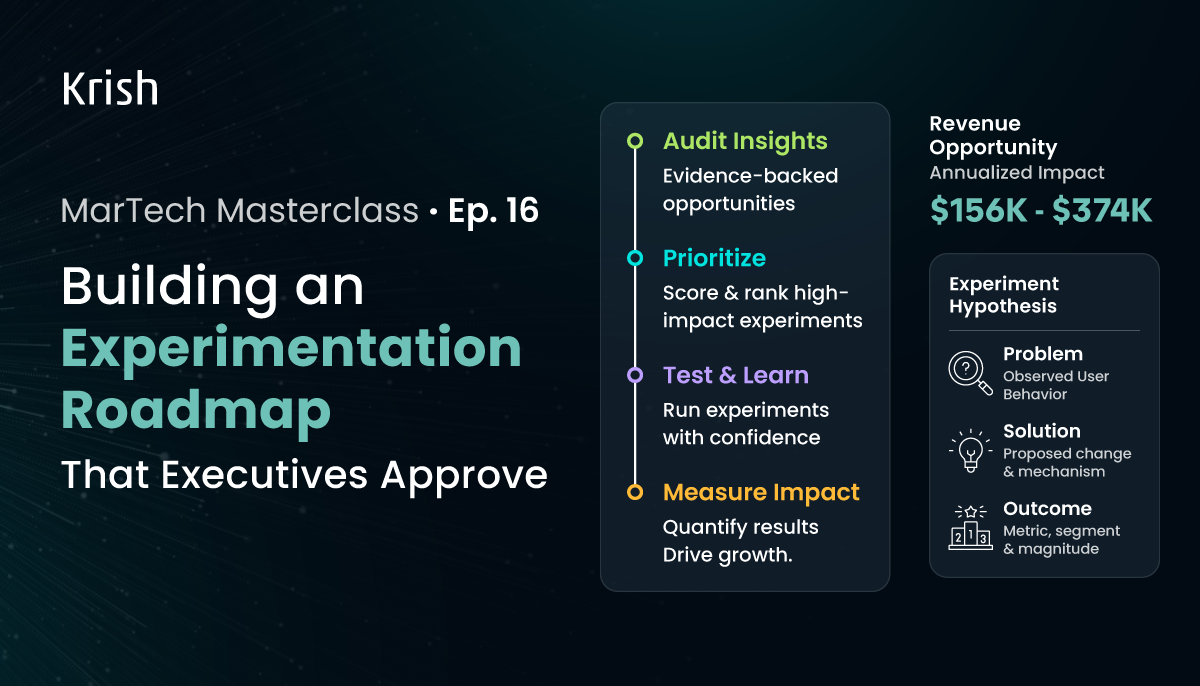
The Hypothesis Framework that Earns Budget
The most common hypothesis format in most teams’ backlogs looks like this: “Change the CTA text to see if it increases conversions.” That is not a hypothesis. It is a design decision with a measurement plan attached.
A hypothesis that earns executive approval has three specific components, each of which can be challenged and defended.
- Problem: stated as observed behavior, not assumed friction. Where is the data showing users are dropping, hesitating, or abandoning? The ecommerce CRO audit checklist covers the tool stack that surfaces this: GA4 funnel reports, Hotjar or Microsoft Clarity session recordings, on-site exit surveys. If the problem statement cannot be traced to one of these sources, it is a guess.
- Solution: with a stated mechanism, not just a variant. Why does the proposed change address the observed problem? The causal chain matters here. If GA4 shows a 58% mobile drop-off between product page view and add-to-cart, and session recordings show users scrolling below the CTA looking for delivery information that is not there, then adding estimated delivery dates near the CTA has a clear mechanism: it removes an identified information gap at the point of decision. Changing the CTA color has no mechanism. It has only a hope.
- Expected outcome: scoped to a metric, segment, and magnitude. “Improve conversions” is not measurable in a way that produces learning. “Increase mobile product-page-to-cart rate by 8-12% among users arriving from paid search, with no regression in average order value” is. The scope determines what you instrument, what you analyze, and whether the result teaches you anything usable.
Here is the format written out:
- Problem: GA4 funnel data shows 61% drop-off between product page view and add-to-cart on mobile. Session recordings show users scrolling past the CTA looking for shipping and return information not present on the page.
- Solution: Add estimated delivery date, return policy summary, and trust badge cluster adjacent to the add-to-cart button on mobile product page layouts.
- Expected outcome: Increase mobile product-page-to-cart rate by 8 to 12% with no regression in average order value.
When that lands on an executive’s desk, the chain from observed evidence to proposed change to expected business impact is traceable. That chain is what earns approval. Opinions do not get funded. Arguments do.
Aligning Testing Priorities with Quarterly Business Objectives
The most common reason experimentation programs lose executive support mid-year is not bad test results. It is misaligned test results. The team ran 14 tests and four won, but none of the wins connected to the Q3 objective of reducing checkout abandonment, because the tests were pulled from a backlog organized by effort rather than priority.
Before any roadmap is built for a quarter, the CRO team needs one clear input: what are the top two or three conversion-related business objectives this period? Those objectives become the roadmap’s organizing pillars. Every experiment maps to one. If it cannot, it waits.
A practical three-pillar structure:
- Paid media efficiency. Tests on landing pages and first-touch experiences. Primary metric: engagement rate and scroll depth past the first viewport. Business case: as IRP Commerce data shows, the average ecommerce conversion rate dropped to 1.70% in 2026, a 16% decline from 2023, meaning paid acquisition cost is rising against a falling conversion baseline. Tests that improve landing page relevance reduce that spread directly.
- Mid-funnel intent conversion. Tests on product pages and category pages. Primary metric: product-page-to-cart rate. Signal to look for: high-traffic pages with disproportionate behavioral drop-off, visible in GA4 funnel reports and confirmed by session recording scroll-stop patterns. This is exactly the friction layer the audit in EP15 was designed to expose.
- Checkout recovery. Tests on cart and checkout flows. Primary metric: checkout completion rate. Baymard Institute’s research identifies surprise extra costs at checkout as the single biggest abandonment trigger, affecting 48% of abandoning users. Tests that surface costs earlier, simplify form fields, or remove friction at the payment step directly attack the most documented abandonment cause in ecommerce.
Each pillar gets a defined budget of experiments per quarter based on available daily traffic. Nothing enters the roadmap without a hypothesis meeting the three-part standard above.
The structural benefit of pillars is as important as the prioritization itself. They create the quarterly narrative for leadership. Instead of presenting a list of test outcomes, the CRO team presents progress against three defined business objectives. That framing changes the nature of the executive conversation entirely.
How to Calculate Test Duration So Results Mean Something
The most underbuilt part of most experimentation roadmaps is the timeline. Teams estimate test duration by feel (we’ll run it for two weeks), rather than by traffic math. The result is tests called too early on insufficient samples, producing results that cannot be trusted and are frequently reversed at full rollout.
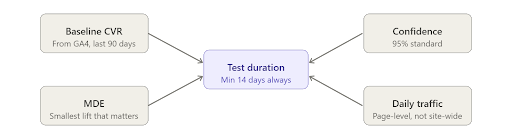
Test duration is a function of four variables:
- Baseline conversion rate for the specific step being tested: pulled from GA4 for the last 90 days, filtered to the exact device type and traffic source that will be in the test. Not site-wide averages.
- Minimum Detectable Effect (MDE): the smallest lift you actually care about detecting. Teams early in their program life typically use 10-15% relative MDE to get a faster signal. More mature programs with consistent traffic can go to 2-5%.
- Statistical confidence threshold: 95% is the industry standard, meaning a 5% chance the result is noise.
- Daily traffic to the specific page or flow, not total site visits.
Speero’s A/B test calculator and CXL’s sample size tool both run this math reliably. The output is minimum sessions per variant. Divide by daily traffic to the page, and you have a minimum test duration in days.
One hard floor sits below whatever the math produces: always run for a minimum of 14 days. A test running Monday through Wednesday misses weekend purchase behavior entirely. Day-of-week variation in ecommerce is significant enough that shorter windows produce segment-skewed data, even if the raw sample count looks adequate.
- If traffic to a key funnel step is below roughly 500 daily sessions, tests on that step will take 8-10 weeks to reach statistical significance at a 5% MDE. That is a capacity constraint, not a methodology problem, and it belongs explicitly on the roadmap so engineering and leadership see the timeline before it becomes a point of friction.
Presenting Experimentation as a Strategic Investment
Here is the real obstacle. A team can have rigorous hypotheses, quarterly alignment, and statistically sound duration estimates, and still fail to get executive approval. The reason is almost always a translation problem. The roadmap is written in testing language and presented to people who think in revenue language.
The fix is to reframe every experiment as a revenue range, not a conversion rate prediction.
- The structure: take your current baseline conversion rate for the step being tested, multiply by monthly traffic to that step, calculate the incremental conversions produced by the low end of your expected lift and the high end, then multiply both by average order value. What you have is a revenue opportunity range for this single experiment, annualized. That range belongs in the executive summary of every roadmap review.
- A working example: product page converts at 3.4% on 40,000 monthly sessions. A 0.5 percentage point improvement produces 200 additional monthly conversions. At a £65 average order value, that is £156,000 annualized from one test. The high end of the expected range, 1.2 percentage points of lift, is £374,400. Present those two numbers next to the test’s engineering cost and timeline, and the executive team can evaluate it the same way they evaluate any other commercial investment because it is framed as one.
Two objections will come up in any executive review of a new experimentation roadmap. Address them before they are raised.
- The first is risk: “What if the test hurts us?” Include the rollback plan for every experiment in the roadmap document. A CTA copy change reverts in under an hour. A checkout flow architecture change takes longer. Showing that you have mapped the rollback procedure for each test before a single line of code is written signals that the team manages experimentation as a controlled business process, not a series of gambles.
- The second is generalizability: “How do we know the wins will hold at full rollout?” The honest answer is that some will not, and the program should say so directly. Note which results will be validated at 100% traffic before being permanently shipped, and which will require a follow-up confirmatory experiment. At Spotify, 42% of experiments result in the team deciding not to ship after guardrail metrics detect problems, nearly half, and each of those decisions prevents a product regression from reaching hundreds of millions of users, according to Spotify’s Confidence platform blog. Prevented regressions are as much a part of the program’s value as wins. Leadership that understands this will fund a program differently than one that only sees win rates.
What the Roadmap Document Actually Contains
The document does not need to be long. It needs to be reviewable by a CMO in under 15 minutes and defensible by the team in the meeting that follows. Six sections cover everything required.
- Objective alignment. One paragraph connecting this quarter’s test priorities to stated business objectives. Names of the funnel stages are in focus and why.
- Experiment registry. A table with one row per test: experiment name, hypothesis summary in two sentences using the problem/solution/outcome structure, primary metric, target segment, traffic required per variant, estimated duration, planned start date, and pillar assignment.
- Prioritization scoring. Every test is scored before it enters the registry. The PXL framework from Speero and CXL is more rigorous than ICE because it weighs whether the change occurs above the fold, whether it affects the primary conversion action, and whether the evidence source is quantitative or qualitative. The score is not the final decision. It is evidence that the ordering is not arbitrary, which matters when a skeptical VP asks why test A is running before test B.
- Traffic and timeline validation. Total daily sessions available per pillar, maximum number of concurrent tests without contamination, and a quarter-view timeline showing when each test opens and closes. This section prevents the most common planning failure: two tests running on overlapping audiences at the same time.
- Revenue opportunity sizing. For the top five experiments, the calculation above: low-end and high-end annualized revenue impact. Not a forecast. A structured basis for prioritization that finance can engage with.
- Learning continuity. What did last quarter’s experiments produce as learnings, and how did those learnings shape this quarter’s hypothesis selection? This is the section that turns a sequence of individual tests into a compounding program. In 2025, 54% of companies sit at strategic or transformative experimentation maturity, up from 35% in 2021, but only 1 in 10 reaches transformative: the level where learning loops are genuinely embedded and the program improves its own hypothesis quality over time. Learning continuity is how you close that gap quarter by quarter.
The Executive-Ready Road (Map) Ahead
The hypothesis framework forces evidence-based reasoning before a test is built. The traffic calculation prevents inconclusive results from eroding the program’s credibility. The revenue frame provides leadership with a commercial basis for approval and prioritization. The learning continuity section makes next quarter’s roadmap better than this one.
That is what separates a testing team from an experimentation program. The individual tests are not that different. The infrastructure around them is entirely different, and that infrastructure is what earns sustained executive investment rather than tolerated indulgence.
Krish’s CRO and A/B Testing services are built around exactly this roadmap-driven approach. If the upstream problem is that the audit has not yet produced the evidence base to build from, the CRO Audit Services and the 28-point CRO audit checklist are the right starting point.
Table of Content
- The Day after the CRO Audit
- From Findings to Backlog to Roadmap
- Why Test Selection is where most Programs Lose?
- The Hypothesis Framework that Earns Budget
- Aligning Testing Priorities with Quarterly Business Objectives
- How to Calculate Test Duration So Results Mean Something
- Presenting Experimentation as a Strategic Investment
- What the Roadmap Document Actually Contains
- The Executive-Ready Road (Map) Ahead
Subscribe with Us!
Never miss any post, stay tuned!

Ankit helps brands navigate their digital maturity journey by bringing together analytics, CRO, ML, and AI in a practical, business-friendly way. Having worked with global teams across industries, he focuses on simplifying complex MarTech concepts and turning them into measurable outcomes. On weekends, you’ll likely find him deep in a reflective read or sharing a coffee with a client while simplifying MarTech in the most human way possible.
Recommended Reading:
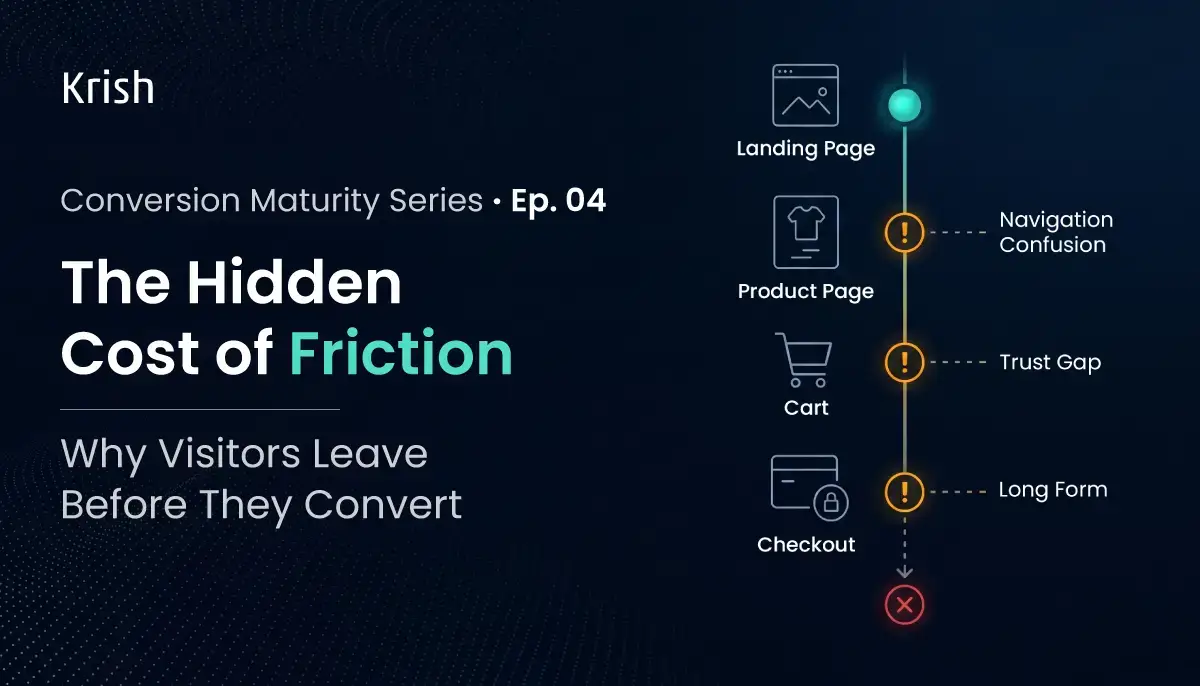
The Hidden Cost of Friction in Digital Journeys – Conversion Maturity Series | EP 04
5 June, 2026 Friction never sends you an invoice. It just costs unannounced. No visitor thinks "this experience has too much friction." They just leave. No complaint filed. No reason given. Just another exit your analytics logs without explanation.
Subscribe with Us!
Never miss any post, stay tuned!
Trusted by leading brands


