Introduction
Most ecommerce brands segment their customers. Very few do it well.
The typical approach: age brackets, geographic location, a purchase frequency filter, maybe an RFM tier built during a quarterly planning cycle. Static groups assigned once and left running until someone remembers to update them. The customer who bought once eighteen months ago sits in the same segment as the one who just completed their fifth order this month because nobody built the logic to separate them.
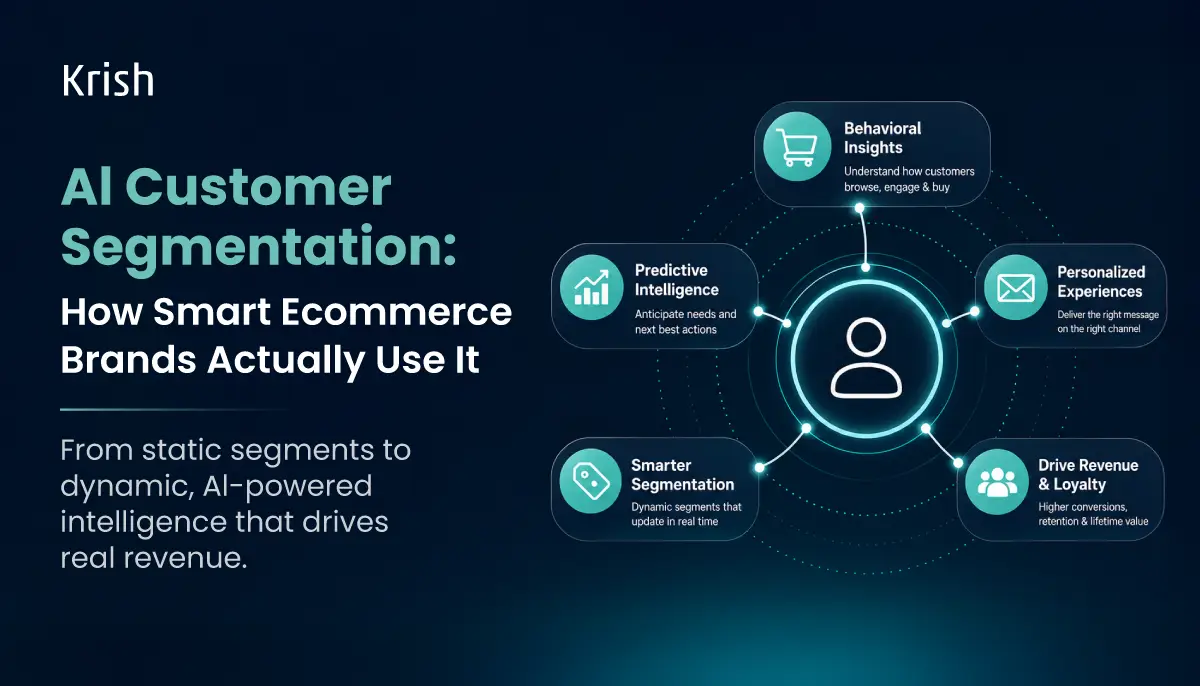
AI customer segmentation fixes this at the architecture level. Not by adding more manual rules, but by replacing static group logic with dynamic behavioral intelligence that updates continuously as customers act, browse, buy, and disengage.
This is how it works, where it outperforms conventional methods, and what it actually takes to implement it effectively.
What AI Customer Segmentation Actually Does Differently
Traditional segmentation is a classification problem solved with human judgment: someone decides which attributes matter, draws the segment boundaries, and assigns customers to groups. The segments are only as current as the last time someone updated them, which in most ecommerce businesses means they are perpetually out of date.
AI customer segmentation approaches the same problem differently. Machine learning algorithms analyze behavioral, transactional, and contextual data simultaneously, identify patterns that manual analysis would miss, and assign customers to segments that update in real time as new signals arrive.
The inputs that matter most:
- Behavioral data: pages visited, products viewed, browse depth, session frequency, time between visits
- Transactional data: purchase frequency, average order value, category preference, return behavior
- Engagement data: email open patterns, push notification response, loyalty program activity
- Contextual signals: device type, time of day, seasonal patterns, entry source
- Predictive indicators: churn probability, upsell receptivity, next-purchase timing
The critical difference is not the data itself; most ecommerce brands already have access to most of this. The difference is what the system does with it. A static segment uses one or two attributes to draw a line. An AI-driven segment uses all of them simultaneously, weights them dynamically, and redraws the line as behavior changes.
Where Traditional Segmentation Fails
The structural problem with rule-based segmentation is that it describes who a customer was, not who they are right now or what they are likely to do next.
A customer labeled “high-value” based on last year’s purchase history may have been quietly disengaging for three months. A customer sitting in a “new visitor” segment may have browsed the same product category six times in the last two weeks. A “low-frequency buyer” may be approaching an RFM inflection point that signals imminent churn or imminent repeat purchase. Static segments cannot make these distinctions. They can only reflect the attributes that existed when the segment was built.
The lag problem compounds this. Manual segments get refreshed quarterly, or when a team has bandwidth, or not at all. Customer behavior moves faster than this. By the time a segment update captures a behavioral shift, the intervention window for that shift has often already closed.
AI customer segmentation operates in real time. When a customer’s behavior changes, their segment assignment changes with it automatically, without a manual update cycle, and without waiting for the next campaign planning meeting, enabling real-time personalization across the customer journey.
The Five Segmentation Types That Drive Ecommerce Revenue
AI does not use a single segmentation method. It combines approaches based on available data and business objectives.
1. Behavioral segmentation
Behavioral segmentation groups customers by how they interact with the brand, not by demographic proxy. A customer who browses late at night, responds to urgency signals, and adds to cart without reading product descriptions belongs in a fundamentally different segment from one who reads every detail, saves products to a wishlist for two weeks, and purchases only after a price drop. Demographic data tells you nothing useful about this distinction. Behavioral data tells you everything.
2. Predictive segmentation
Predictive segmentation uses historical patterns to forecast future behavior. Which customers are showing early churn signals, declining session frequency, narrowing category exploration, lengthening purchase intervals before they go fully inactive? Which customers are approaching a replenishment window? Which first-time buyers have a behavioral profile consistent with high long-term LTV? Predictive segmentation answers these questions quantitatively rather than instinctively.
3. RFM-based segmentation
RFM-based segmentation recency, frequency, monetary value is one of the oldest frameworks in ecommerce retention. AI extends it by weighting RFM signals differently based on product category, seasonality, and lifecycle stage, and by updating scores continuously rather than in batch cycles. A customer whose recency score is declining while their monetary value remains high is a very different retention problem from one whose recency and frequency are both dropping simultaneously.
4. Psychographic segmentation
Psychographic segmentation goes beyond what customers do to infer why they do it. By analyzing browsing behavior, content engagement, review language, and affinity patterns, AI models build an understanding of customer values, motivations, and lifestyle orientation that demographic or transactional data alone cannot construct. A luxury-oriented customer and a value-driven customer can have identical purchase frequencies and AOVs while requiring completely different messaging, offer structures, and channel approaches.
5. Micro-segmentation
Micro-segmentation takes all of the above further building hyper-specific audience groups, sometimes approaching individual behavioral profiles, that power genuine one-to-one personalization across email, product recommendations, onsite experience, and paid retargeting. This is the architecture behind the personalization that high-performing ecommerce brands describe as a competitive moat. It is not a single capability. It is the compounded output of all the segmentation layers working together.
How AI Customer Segmentation Works in Practice
The pipeline that powers AI segmentation is worth understanding not because every ecommerce team needs to build it from scratch, but because knowing where each stage can break down is what separates implementations that deliver from ones that quietly underperform.
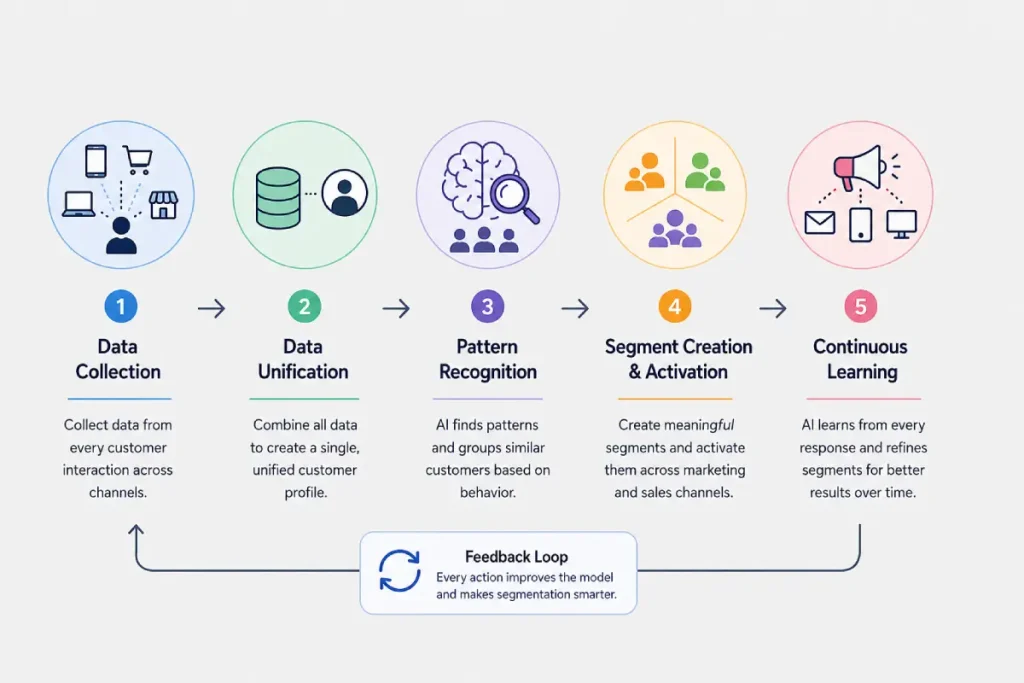
1. Data collection
Data collection is where retail brands have a structural advantage most do not fully exploit. Every session, every product view, every add-to-cart, every abandoned checkout, every post-purchase return this is behavioral data that most retail platforms generate and most brands fail to capture comprehensively. The gaps are usually in cross-device sessions, offline-to-online identity linkage for omnichannel retailers, and post-purchase behavior like returns and support interactions that rarely feed back into segmentation models.
2. Data unification
Data unification builds the unified customer profile that AI models actually need. A customer who browses on the app, adds to cart on mobile web, and completes the purchase on desktop is three separate sessions in a fragmented data architecture. In a unified one, she is one customer with a high-intent behavioral signal and a cross-device purchase pattern that should inform how and where she is messaged next. For retail brands with both digital and physical touchpoints, this unification challenge extends to POS transaction data, loyalty program activity, and in-store browsing behavior where available.
3. Pattern recognition
Pattern recognition is where the AI does the work human analysts cannot do at scale, identifying clusters of similar behavioral patterns across millions of customer records simultaneously, without the cognitive bias that shapes manual segmentation decisions. A clustering algorithm does not assume that age predicts purchase intent. It finds the actual behavioral patterns that do.
4. Segment creation and activation
Segment creation and activation is where most retail implementations stall. A well-labeled segment sitting in a CDP with no downstream activation logic is not a retention strategy. The segment needs to flow directly into journey triggers, campaign audiences, product recommendation engines, onsite personalization layers, and paid retargeting audiences, automatically, in real time, without a manual export and re-upload cycle that introduces lag.
5. Continuous learning
Continuous learning closes the loop. Every campaign response open, click, purchase, unsubscribe is a signal that feeds back into the model and refines the segment logic for the next cycle. Retail brands running seasonal catalogues benefit particularly from this: a model that learns how a customer’s purchase behavior shifts from regular season to sale season to gifting season builds a segmentation intelligence that static rules cannot replicate.
What It Takes to Implement AI Segmentation Effectively
This is where most implementations underperform not because the platform is wrong, but because the foundation underneath it is not ready.
AI customer segmentation depends entirely on data quality and data unification. A model that is fed fragmented, inconsistent, or incomplete behavioral data does not produce intelligent segments. It produces confident, automated mistakes. The first investment is not in the AI layer. It is in the data layer.
Data unification means building a single customer profile that consolidates behavioral signals from every touch point ecommerce platform, email tool, CRM, loyalty programme, paid media, onsite analytics. Without this unified view, the AI is segmenting partial versions of customers rather than whole ones. A customer who browsed on mobile and purchased on desktop is two different records in a fragmented data architecture. In a unified one, they are one customer with a richer behavioral signal.
Event tracking quality determines what the AI has to work with. Sparse or inconsistent event data produces sparse, inconsistent segments. Brands that invest in clean, comprehensive behavioral event tracking, every product view, every scroll depth, every cart interaction, every channel response give the AI the raw material to build segments that actually reflect customer reality.
Activation strategy is where most brands stop short. Segments mean nothing without a clear plan for how each one receives different messaging, different offers, different channel sequences, and different journey logic. The segment is intelligence. The activation is what converts that intelligence into revenue.
A practical implementation sequence: audit existing data sources and identify fragmentation, unify customer profiles into a single data layer, define four to six high-priority segments with clear business cases high-LTV customers, early churn signals, first-purchase converters, dormant reactivation candidates then build the activation logic before expanding segment complexity.
The Business Impact for Getting This Right
The revenue impact of effective AI customer segmentation is not marginal. It compounds.
Campaigns that reach customers at the moment of highest behavioral receptivity not at the moment of highest operational convenience convert at meaningfully higher rates. Churn interventions triggered by early predictive signals, before disengagement has become a conscious customer decision, recover customers that reactive reactivation campaigns cannot. Product recommendations built on genuine behavioral affinity, rather than catalogue proximity, grow basket size without requiring discounts to do it.
The efficiency gain matters as much as the revenue gain. Every campaign sent to a segment with low intent probability is budget spent on noise. AI segmentation reduces that noise systematically concentrating spend on audiences with demonstrated intent and reducing waste on audiences that are not ready to act.
The brands that treat AI customer segmentation as infrastructure rather than a campaign feature, building the data foundation, unifying the customer profile, and activating intelligently across the customer lifecycle are building a compounding advantage. Every interaction adds a signal. Every signal improves the segment. Every improved segment produces better outcomes than the last cycle.
That is not a marginal improvement on conventional segmentation. It is a different way of understanding customers entirely.
The Direction AI Customer Segmentation Is Moving
The trajectory is toward individual-level intelligence not better group segmentation, but the effective elimination of groups as the operative unit of personalization.
For retail brands, this has specific implications. Generative AI is beginning to enable dynamic content creation at the segment level where a single campaign brief produces hundreds of content variations, each matched to a specific behavioral profile, without proportional increases in production time or cost. The fashion retailer who today sends one email to a “high-affinity, premium-oriented, female, 28-40” segment will, in the near term, be able to send a version of that email that reflects each individual customer’s specific style signals, recent browse behavior, and current lifecycle stage automatically.
Real-time personalization engines are already moving in this direction responding to in-session behavioral signals rather than historical segment assignments. A customer who enters a session showing high purchase intent based on their navigation pattern receives a different onsite experience from one entering with low-intent browsing behavior, even if both customers sit in the same historical segment.
The post-cookie environment shapes how all of this evolves. Third-party data, the foundation of most retail audience targeting for the past decade is structurally declining. First-party behavioral data, collected directly through brand interactions and enriched through loyalty programmes, post-purchase engagement, and direct customer relationships, becomes the primary fuel for AI segmentation models. Retail brands that have invested in building direct customer relationships and in capturing the behavioral signals those relationships generate own a data asset that cannot be replicated by competitors who relied on third-party targeting, making a strong first-party data strategy a competitive necessity.
The brands building first-party data infrastructure and AI segmentation capability now are not just improving current campaign performance. They are constructing the retention architecture that will define competitive advantage in retail over the next several years.
At Krish, our data and personalization practice helps ecommerce brands implement AI customer segmentation that is grounded in clean data architecture and activated across the full customer lifecycle from the event taxonomy and identity resolution layer through to journey design, channel orchestration, and measurement. Because a segmentation strategy built on fragmented data does not produce intelligent marketing. It produces automated assumptions, and those compound in the wrong direction.
Table of Content
- Introduction
- What AI Customer Segmentation Actually Does Differently
- Where Traditional Segmentation Fails
- The Five Segmentation Types That Drive Ecommerce Revenue
- How AI Customer Segmentation Works in Practice
- What It Takes to Implement AI Segmentation Effectively
- The Business Impact for Getting This Right
- The Direction AI Customer Segmentation Is Moving
Subscribe with Us!
Never miss any post, stay tuned!

Minal Joshi is a content marketer at Krish with a flair for eCommerce and Digital Commerce aspects. She is a MarTech fanatic with a knack of writing with which, she helps brands to curate, create, & commence digital brand positioning. Sharing insights via articles, case studies, eBooks, Infographics, and other forms of content creation is what she lives for. Being an ardent traveler, when not writing, you'll find her sipping coffee into the mountains or petting a stray.
Recommended Reading:
Why Good Design Does Not Always Mean Good Conversion – Conversion Maturity Series | EP 06
22 June, 2026 The most frustrating CRO finding is a page with strong brand metrics and a broken conversion rate. The design team is proud of it. Users find it beautiful. And still, the majority of them leave before buying
Subscribe with Us!
Never miss any post, stay tuned!
Trusted by leading brands


