Introduction
Many organizations are advancing AI initiatives without resolving the underlying fragmentation in their data foundations. How effective can AI-driven decisions be when different teams cannot agree on the same numbers? When that happens, decisions lose authority before they ever reach execution.
Data silos have outgrown their reputation as technical debt. They now sit at the center of decision latency, shaping how performance is reported, interpreted, and acted upon. Revenue appears different by function. Customer health shifts by system. Strategy changes depending on which dashboard is reviewed.
A McKinsey survey states that 80% of organizations have divisions operating in silos, each managing data independently. The same business produces different truths to the same question.
This piece examines how those different truths form, where they fracture revenue flows, and what it takes to restore a shared truth that decision-making can rely on.
Why This Episode Matters
In our previous episode, we examined how dashboards can be structured to support decisions, not just visibility. It addressed structure, KPIs, and alerts, assuming the numbers feeding those dashboards were coherent and reliable. In practice, that assumption often breaks down. Well-designed dashboards still fail when different teams bring different versions of the same data into them.
This episode addresses what sits beneath the dashboard layer. Data silos create conflicting truths long before metrics reach an executive view. When that happens, dashboards stop being decision tools and start becoming negotiation tools. We’ve tried to answers on how those fractures form, why they persist, and what it takes to establish a shared truth that decisions can actually stand on.
Why Teams See Different Truths
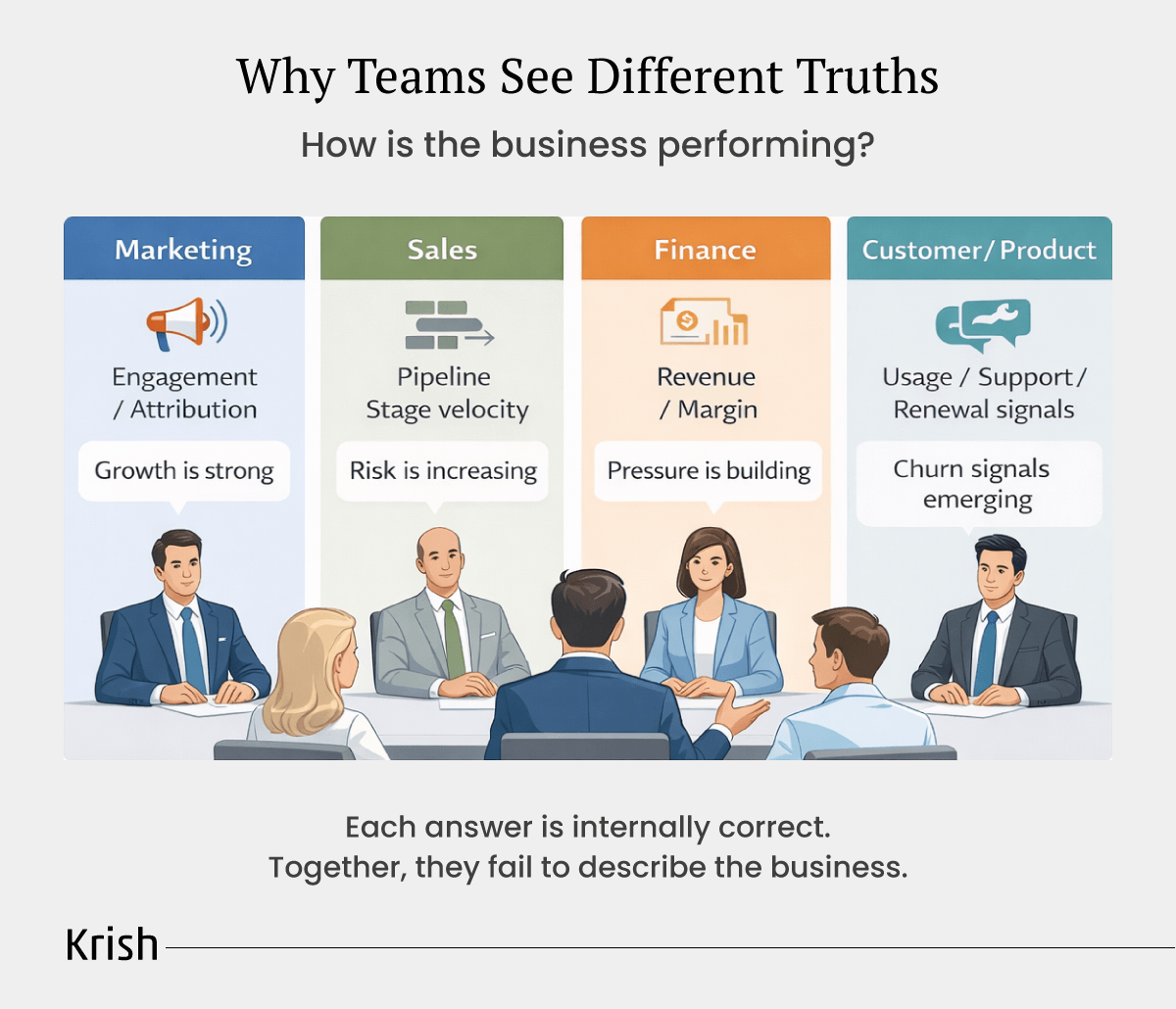
In many organizations, a single performance question produces different answers depending on who is asked. Marketing reports growth, sales flags pipeline risk, and finance highlights margin pressure. Each view is internally consistent, yet together they fail to describe the business as a whole.
These differences emerge because teams rely on systems built to serve functional needs rather than shared understanding. Marketing operates through engagement and attribution platforms, while sales, finance, and customer support teams focus on different signals. Each system captures a valid slice of reality, but none reconciles it end to end.
The impact becomes most visible at the leadership level. When executives ask straightforward questions, performance yields no single answer but competing explanations. Decisions are slow because agreement must precede action. This delay is often reinforced by distance from the data itself.
“According to The State of CRM Data Management in 2024, leaders at the VP level and above were 69% less likely than average to notice accelerating customer data decay, even as teams closer to execution flagged growing inconsistencies.”
Different truths take root inside organizations when systems and incentives fail to converge. The consequence extends beyond reporting. It reshapes how revenue is interpreted, forecasted, and acted upon.
How Siloed Data Turns Strategy into Arbitration
“With fragmented data, strategy is negotiated, not executed.”
Strategy discussions start with execution intent, but stall at interpretation.
Leadership reviews that should focus on priorities and trade-offs instead turn into debates over which numbers are accurate. Marketing, sales, and finance arrive with dashboards that present different performance metrics. Time is spent validating metrics before decisions can even be considered.
Execution slows because alignment must be rebuilt at every step. Cross-functional initiatives depend on shared assumptions about progress, risk, and outcomes. And teams hesitate to commit when metrics do not reconcile. Decisions are delayed because agreement on the underlying facts remains unresolved.
“Gartner consistently points to inconsistent data across systems as one of the most persistent and difficult data quality problems organizations face.”
Accountability weakens in this environment. Each function can defend results using its own definitions, systems, and reporting logic. Missed targets are explained as measurement differences rather than execution gaps. Ownership shifts from outcomes to narratives, making performance management less objective.
Over time, a strategy loses momentum as plans are revised more often than they are executed. Funding decisions favor what appears successful in isolation rather than what performs across the business.
As a result, fragmented data steadily converts strategy into arbitration. Leaders act as referees between competing versions of performance rather than drivers of execution, slowing progress even when direction is clear.
Arbitration can persist in strategy rooms for a while, but revenue cannot. Fragmented truth becomes visible once it reaches revenue.
Where Silos Hit Revenue First: Marketing, Sales, Customer
Revenue is where data fragmentation stops being a business problem and starts becoming a business risk. Unlike reporting or strategy debates, revenue exposes misalignment immediately. Numbers must reconcile across functions, timelines must align, and accountability must be unambiguous. When those conditions are missing, revenue performance begins to fracture in ways that are difficult to reverse.
Marketing to Revenue Disconnect
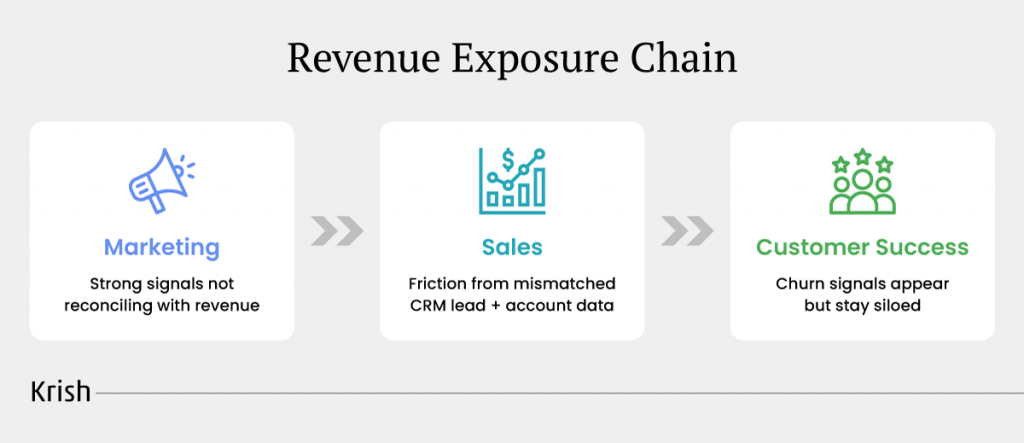
Marketing performance appears strong in isolation. Engagement rises, pipeline attribution signals momentum, and campaigns show clear traction. The disconnect emerges when those signals fail to reconcile with closed revenue.
- A visible example of this pattern was Quibi’s launch. Despite heavy promotion, celebrity-led content, and reported marketing spend of roughly $400 million, early traction failed to convert into sustained paid subscriptions. Awareness and engagement created momentum signals, but those signals never reconciled with finance-grade revenue outcomes, exposing the disconnect within months.
Sales Execution Friction
Sales execution slows when data lacks consistency across systems. Duplicate leads, fragmented account hierarchies, and missing context weaken routing and conversion. Pipeline stages suggest progress, but mapping intent to contracts and recognized revenue introduces uncertainty. Forecast confidence erodes as alignment breaks.
This friction often originates in CRM synchronization failures. Marketing may classify a lead as qualified based on engagement signals, while sync gaps cause sales systems to register the same lead as cold. Inconsistent matching rules create multiple records for the same account, distorting pipeline reality and slowing execution.
Customer Success and Retention Blindspots
Churn risk and expansion signals surface early, but only in fragments. Product usage, billing data, support interactions, and renewals rarely converge in time to act. Without a unified customer view, interventions come too late. By then, revenue impact is already locked in.
- The pattern was visible in Peloton’s subscription business. Declining engagement and subscriber churn became evident before revenue pressure fully materialized. But commercial response followed only after those signals appeared in financial results and earnings disclosures.
The cost of this fragmentation is material. Gartner estimates that poor data quality costs organizations an average of $12.9 million per year, reflecting missed revenue, delayed decisions, and operational inefficiencies that accumulate across functions.
When revenue data fragments across marketing, sales, and customer teams, performance appears defensible in isolation but deteriorates in aggregate. At that point, the issue shifts from measurement to exposure.
The Fracture Map: Common Integration Points that Break
Data silos do not fail uniformly; they fracture at predictable integration points where systems are expected to agree, but they rarely do. The breaks surface across the customer lifecycle, revenue operations, compliance, and reporting. Once these fractures take hold, even metrics designed to create alignment begin to diverge.
Customer and Revenue System Fractures
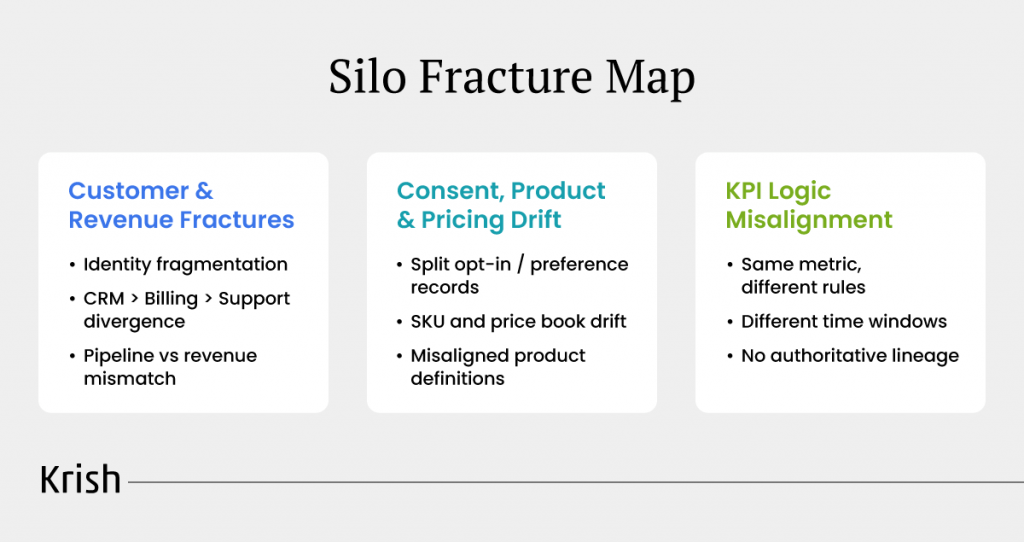
- Fragment customer identity when the same entity exists across marketing, sales, billing, and support systems.
- Teams apply different identity rules by tool and ownership, creating parallel customer records.
- Lifecycle continuity breaks when CRM pipeline signals diverge from billing, contract, entitlement, and revenue recognition data.
- Create conflicting performance narratives in which momentum appears in one system and exposure in another.
Consent, Product, and Pricing Drift
- Scatter consent and preference signals across marketing platforms, customer databases, and compliance tools.
- Systems expose regulatory and trust risk through split opt-in and opt-out records.
- Allows product and pricing definitions to drift across commerce, ERP, and finance systems with ownership.
- Undermine margin analysis, discount governance, and entitlement enforcement as SKUs, bundles, and price books fall out of sync.
Even where data appears aligned, KPI logic often is not. Teams calculate the same metric using different rules, filters, and time windows, leaving lineage unclear and numbers difficult to trace back to authoritative sources with confidence.
Besides technical rework, the fracture points increase reporting conflict, slow down operational execution, and erode leadership trust in metrics. Decisions are forced with caution or delayed altogether.
When truth fractures at this many points, leadership rarely pauses to ask who owns accuracy. The instinct is to integrate faster, assuming connection will produce consistency, but does it?
Why “More Tools” Doesn’t Fix “Different Truths”?
When organizations confront data silos, their first instinct is to add more tools. New platforms promise integration, visibility, and control. Eventually, systems become connected, dashboards increase, and data appears to move more freely. Yet the underlying problem often remains intact.
What doesn’t work here is tools connect systems, not meaning. Definitions, ownership, and accountability rarely move with the data, without agreement on what qualifies as accurate or decision-ready, integration efforts stall. Disputes persist because teams interpret the same data differently, and there is no mechanism to resolve those differences.
In some cases, additional platforms accelerate the issue. Inconsistent logic and unresolved ownership spread across more surfaces. And the same flawed assumptions now power more reports, dashboards, and automated decisions. Visibility expands, but confidence does not.
The result is predictable: leaders see more data but spend more time questioning it. Reviews stretch longer, alignment weakens, and decisions slow under uncertainty rather than a lack of information. Until ownership and governance are addressed, adding tools changes the surface area of the problem, not its substance.
What Restoring a Shared Truth Operating Model Looks Like
Fixing data silos does not start with integration projects or tooling decisions. It starts with deciding what the business will treat as a non-negotiable truth. Research from Bain, IBM, and PwC consistently points to the same conclusion: organizations fail not because data is unavailable, but agreement on what counts as “true” never forms.
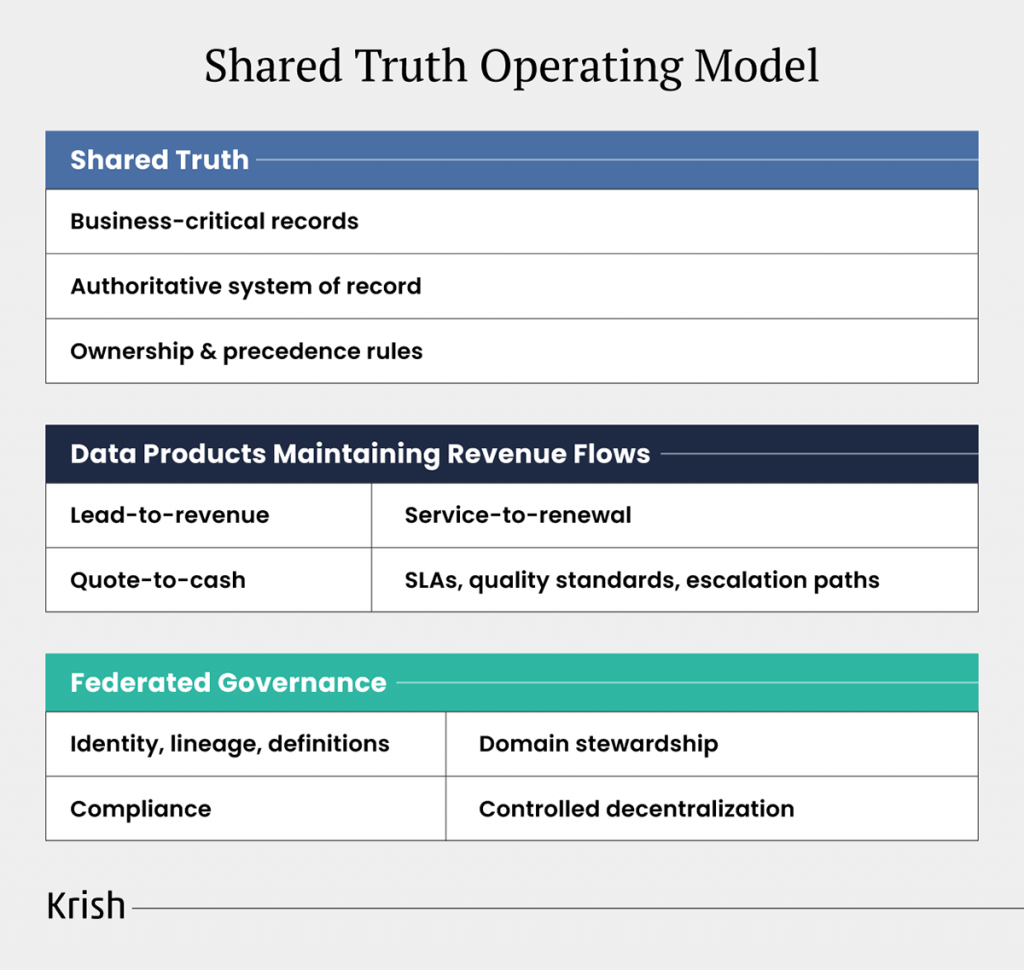
One Truth for Business-Critical Records
- Designate business-critical records as authoritative: customer, product, pricing, order, entitlement, and renewal status.
- Assign a single system of record and a named owner for each.
- Enforce precedence rules so downstream teams consume truth rather than redefine it.
- Prevent silent modification of canonical records, even when local convenience is affected.
Data Products Aligned to Revenue Flows
- Organize shared truth around revenue-critical flows such as lead-to-revenue, quote-to-cash, and service-to-renewal.
- Treat each flow as a data product with defined business ownership.
- Set quality standards in commercial terms, not technical thresholds.
- Establish SLAs and escalation paths tied to financial impact.
- Hold teams accountable when truth fractures disrupt revenue outcomes.
A Federated Model that Balances Speed and Control
- Centralize standards for identity, metrics, definitions, lineage, and compliance.
- Distribute stewardship and execution to the domains closest to the data.
- Preserve decision speed without allowing teams to invent local versions of truth.
- Prevent uncontrolled decentralization from weakening credibility at scale.
- Sustain trust as AI and automation increase the velocity of decisions.
Restoring shared truth is more about reliability than perfection. When leaders trust the numbers, execution accelerates and strategy starts getting delivered.
Building a Cross-Functional Data Governance Framework
“Governance exists to decide, not to observe.”
A framework that holds starts with clear decision rights. Ownership of business-critical data must be explicit, not implied. Someone owns the definition, someone stewards the quality, and someone has the authority to resolve conflicts when teams disagree. Shared definitions are set once, reviewed deliberately, and changed through a visible approval process. Disputes do not linger in meetings or dashboards. They are resolved quickly, with accountability that cuts across functions rather than being confined to them.
Operational governance also depends on visibility and enforcement. Quality monitoring, lineage transparency, and policy controls are not hygiene measures; they are risk controls. Leaders need to know where numbers come from, how they are transformed, and when they drift. That clarity prevents small inconsistencies from turning into revenue leakage, compliance exposure, or audit surprises.
When governance works, outcomes follow. Forecasts stabilize because inputs reconcile. CAC efficiency improves because attribution holds. Churn signals surface early enough to act. Audit readiness becomes routine instead of reactive. At that point, governance stops being overhead. It becomes a business advantage that leadership can rely on.
Final Thoughts
As organizations accelerate AI-driven decision-making, leaders need to be precise about what they demand first. Before scaling automation or advanced analytics, leadership must insist on consistent definitions, clear ownership of business-critical data, and enforceable truth across systems. Without those foundations, faster decisions lead to the wrong conclusions sooner.
There are simple truth checks leadership teams can apply. Do customer, revenue, and pipeline numbers reconcile across functions without explanation? Can every critical metric be traced back to an agreed system of record? When definitions change, is there a clear approval path and owner? And when teams disagree, is there a mechanism to quickly establish the truth rather than debate it indefinitely?
AI can accelerate decisions, but only shared, governed truth protects decision quality at scale. In the next episode, we examine the moment spreadsheets break down and what it takes to build a data warehouse that leaders can rely on.
Table of Content
- Introduction
- Why Teams See Different Truths
- How Siloed Data Turns Strategy into Arbitration
- Where Silos Hit Revenue First: Marketing, Sales, Customer
- The Fracture Map: Common Integration Points that Break
- Why “More Tools” Doesn’t Fix “Different Truths”?
- What Restoring a Shared Truth Operating Model Looks Like
- Building a Cross-Functional Data Governance Framework
- Final Thoughts
Subscribe with Us!
Never miss any post, stay tuned!

Ankit helps brands navigate their digital maturity journey by bringing together analytics, CRO, ML, and AI in a practical, business-friendly way. Having worked with global teams across industries, he focuses on simplifying complex MarTech concepts and turning them into measurable outcomes. On weekends, you’ll likely find him deep in a reflective read or sharing a coffee with a client while simplifying MarTech in the most human way possible.
Recommended Reading:
Predictive Analytics 101: Moving From Hindsight to Foresight – MarTech Masterclass Series Ep | 19
9 July, 2026 Most MarTech stacks are architecturally optimized for one thing: describing the past. Revenue last quarter, churn in the last 90 days, campaign performance last week - the dashboards are polished and the data looks clean. Yet every output from that stack is a response to something that has already happened. The customer already churned. The demand spike already passed. The high-value cohort already drifted before anyone noticed.
Subscribe with Us!
Never miss any post, stay tuned!
Trusted by leading brands


