Introduction
Across industries, organizations are competing to become more data-centric and AI-driven. Leadership teams often talk about faster decisions, predictive insights, real-time visibility, and unfair data advantages. Investments are approved, analytics teams expand, and transformation roadmaps point confidently toward advanced intelligence.
Yet, decision reality follows a different path!
Despite these ambitions, spreadsheets still play an important role in planning, forecasting, and performance reviews within many growing organizations. In particular, spreadsheets prove indispensable when speed matters and complexity appears manageable due to familiarity and flexibility. Early success hardens dependence, turning a tactical tool into the default decision support.
The reliance on these spreadsheets undoubtedly incurs a high cost, as they are not immune to errors. A study led by Prof. Pak-Lok Poon found that 94% of the business spreadsheets used in decision-making contain errors. Likewise, Gartner studies show that poor data used for decision-making costs organizations an average of $12.9 million per year.
Data-centric ambition cannot advance on foundations built for a different level of complexity. Spreadsheets that once accelerated growth now quietly become the constraint, limiting it. Moving to a data warehouse is not a reporting upgrade. It is the unavoidable step required to align decision foundations with the ambitions leadership teams already hold.
Why does the episode matter?
The previous episode examined the data silo problem, in which fragmented systems create competing versions of the truth across teams. Leaders lose confidence because definitions, ownership, and context differ across functions. Moreover, decisions slow when truth itself becomes negotiable.
In this episode, we address what sits beneath that problem. It is often spreadsheets that act as the final glue holding silos together. A data-centric, AI-driven decision-making process will remain out of reach until this foundation changes.
The Spreadsheet Ceiling
As organizations reach a particular scale, leadership discussions begin to change. Time that once went into evaluating options now goes into explaining numbers. Meetings open with context-setting, qualifiers, and reconciliations before decisions can even be framed. Progress slows because teams don’t feel confident in the data when making decisions.
Over time, teams arrive with their own spreadsheets to defend performance and justify outcomes. Slight differences in logic, assumptions, or timing produce multiple versions of truth that cannot be resolved quickly. Validation becomes a gate through which every decision must pass. Accountability weakens because alternative numbers are always available, allowing performance to be explained rather than owned.
Misalignment stops appearing as an exception and becomes structural. Leaders spend more effort arbitrating between competing narratives than strengthening the systems beneath them. The organization adapts by optimizing for explanation rather than execution. Momentum erodes quietly, not through visible failure, but through an inability to move quickly and with conviction.
Signs that you have Outgrown Spreadsheets
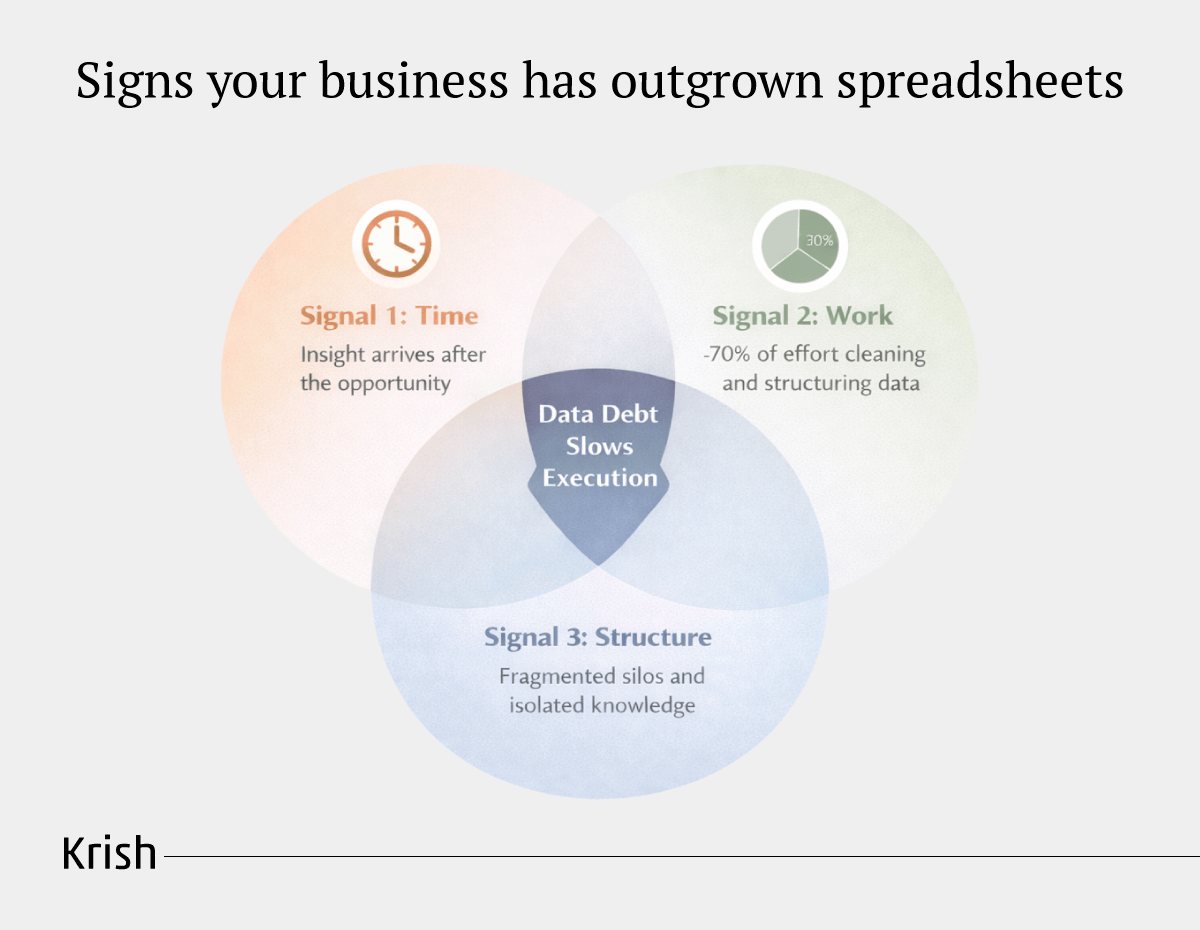
The first signal is time. Reporting cycles stretch as more systems, teams, and assumptions are fed into planning and forecasting. Questions that should be resolved in a single discussion spill across meetings. Insight often arrives after the opportunity is lost.
The second signal often appears in how the work gets done. Analysts spend more time cleaning and stitching data than interpreting it. Research from Forrester shows that knowledge workers spend around 30% of their time finding the correct data and information to do their jobs. Parallel sheets serve as a protection against upstream inconsistencies. Output increases, but the trust does not.
Over time, these signals compound into something more structural. As spreadsheets bloat, they create fragmented definitions, duplicated logic, and isolated pockets of knowledge. 8 in 10 decision-makers now prioritize reducing data and information silos as a top organizational priority, citing spreadsheets and disconnected tools as the main culprits. Large organizations typically operate hundreds of applications, locking data inside teams and functions. What begins as local workarounds accumulates into data debt, creating silos that leadership must constantly work around rather than eliminate.
At that point, spreadsheets are no longer supporting growth. They are quietly dragging down how the organization operates, how teams collaborate, and how decisions get made. Data debt does not announce itself through failure. It reveals itself through fractured visibility, slower execution, and an organization that cannot move as one.
What is a Data Warehouse?
When growth exposes the limits of spreadsheet-led decision-making, manual reconciliation stops scaling, and organizations turn to a data warehouse. A data warehouse is:
- A single, enforceable truth layer that replaces negotiated numbers with shared definitions
- A system that decouples decision-making from manual effort, removing reconciliation from the critical path
- A foundation that stabilizes metrics and logic across teams, so scale does not introduce ambiguity
And the advantages of implementing one? Not just theoretical but actual. In McKinsey’s research, data-driven organizations are 23 times more likely to acquire customers and 19 times more likely to be profitable. While competitors debate whose spreadsheet is correct, organizations with a data warehouse are already acting.
Business Outcomes that Change Once Data is Centralized
Centralizing data improves outcomes by eliminating the need for manual coordination in decision-making. When data stops living in fragments across spreadsheets and systems, leadership attention shifts toward action. The following outcomes reflect what changes once decision foundations are no longer negotiated but enforced.
Speed
Speed shows up first in how quickly leadership can move from signal to action. Decisions that were once delayed are now being resolved in the same conversation. Likewise, insights arrive when they matter, which leads to timely course corrections. The competitive advantage is not faster reporting; instead, a faster judgment.
Accuracy
Salesforce, in a global business survey, found that 73% of business leaders agree that data helps in reducing uncertainty. While leaders agree on the data usage, what happens in practice is different. And a data warehouse precisely changes that narrative. Accuracy stops being a debate and becomes an assumption. When definitions are enforced centrally, teams no longer defend their own numbers to protect performance. Forecasts feel sturdier because inputs are consistent across functions.
Scalability
Growth no longer multiplies reporting complexity. New systems, regions, and teams can be added without rebuilding decision logic each time. The organization expands without forcing leadership to relearn how performance is measured every quarter. What used to feel like fragile progress becomes repeatable execution. Scale stops introducing ambiguity, which is often the real tax on growth.
Historical Intelligence
History becomes an asset rather than an archive. Long-term trends stay intact even as systems change and teams reorganize. Planning conversations move beyond last quarter explanations toward pattern recognition and forward-looking judgment. Over time, this accumulated context becomes the foundation for more advanced analytics and AI, as a natural extension of how the business already thinks about its data.
Cloud vs On-Premise Data Warehouse
“The real risk is not the data warehouse you build, but the questions it cannot answer later.”
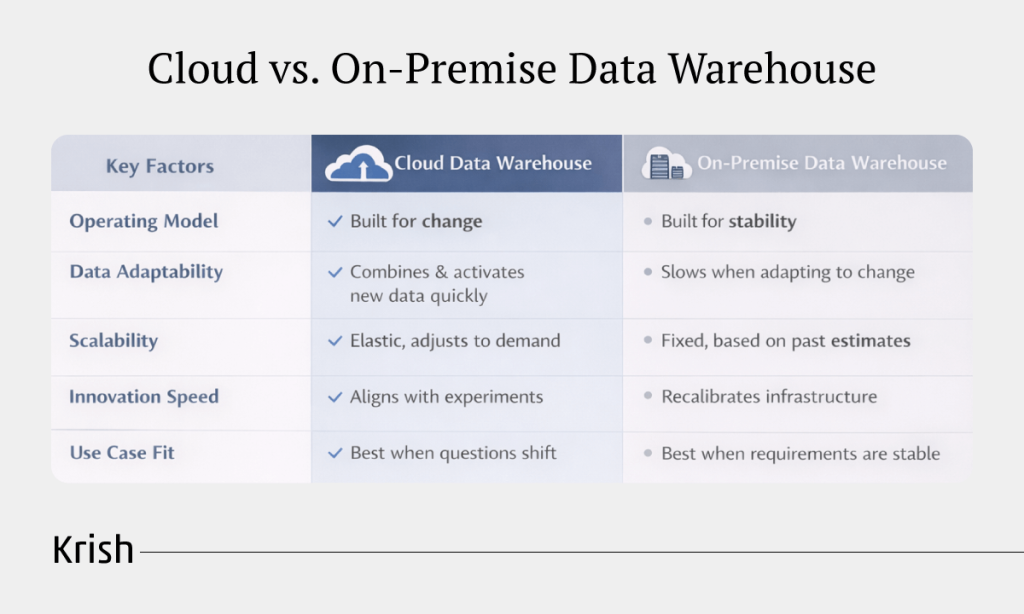
The difference between cloud and on-premises becomes apparent when businesses change faster than planned. Every data warehouse looks sufficient at launch, when workloads are known, questions feel familiar, and usage appears predictable. The divergence surfaces when growth, acquisitions, or external pressures force new questions that were never part of the original design.
On-premise data warehouses are built around predictability. The capacity is sized in advance of operations, and workloads are planned against historical demand. When questions evolve beyond those assumptions, organizations slow down to recalibrate infrastructure before decisions can move forward. Systems continue operating, but momentum weakens. Data remains available while becoming harder to adapt, combine, and activate quickly.
Cloud data warehouses assume a different operating reality. Change is expected rather than treated as an exception. As experimentation and analytical needs grow, questions evolve in parallel. By absorbing variability, the platform doesn’t have to pause decisions while the infrastructure catches up. Decision velocity aligns with the business, not with re-architecture cycles.
AI-driven environments make the distinction even sharper. Without the ability to quickly combine, explore, or activate data, it loses its value. Large portions of data warehouses remain unused because many organizations built them for historical reporting than evolving intelligence. Relevance erodes quietly as the business moves forward.
The choice is not about performance benchmarks or cost comparisons. The choice is about future optionality. On-premise aligns with environments where questions remain stable, and change is tightly controlled. Cloud aligns with organizations that expect questions, models, and competitive pressures to keep shifting.
Why Data Warehouse Programs Fail
“By 2027, 80% of Data and Analytics governance initiatives will fail due to a lack of a real or manufactured crisis.”
– Saul Judah, VP Analyst at Gartner
Organizations rarely abandon data warehouse initiatives outright. More often, expectations quietly adjust. Systems go live, reporting improves, and the pace of decision-making remains essentially unchanged.
Many spreadsheet migrations slow down before achieving a meaningful return on investment. Dashboards are delivered, pipelines stabilize, and teams still rely on manual reconciliation to move forward. Eventually, the data warehouse becomes nothing more than a reference point. More than a failed migration, the organization fails to change how decisions are made.
Looking back, the pattern is familiar. Migration is approached as a delivery exercise rather than a business shift. Executive attention peaks around launch and tapers once outputs are visible. Governance appears reactive or becomes restrictive. Data structures reflect available sources instead of evolving business questions. Each decision makes sense locally. Collectively, momentum fades.
The consequence is subtle but persistent—decision velocity plateaus. Data usage concentrates on historical reporting. Advanced analytics and AI struggle to gain traction. The organization continues operating with fragmented truth, despite having invested heavily to move beyond it.
A 4-Step Framework for Moving Beyond Spreadsheet-Led Decisions
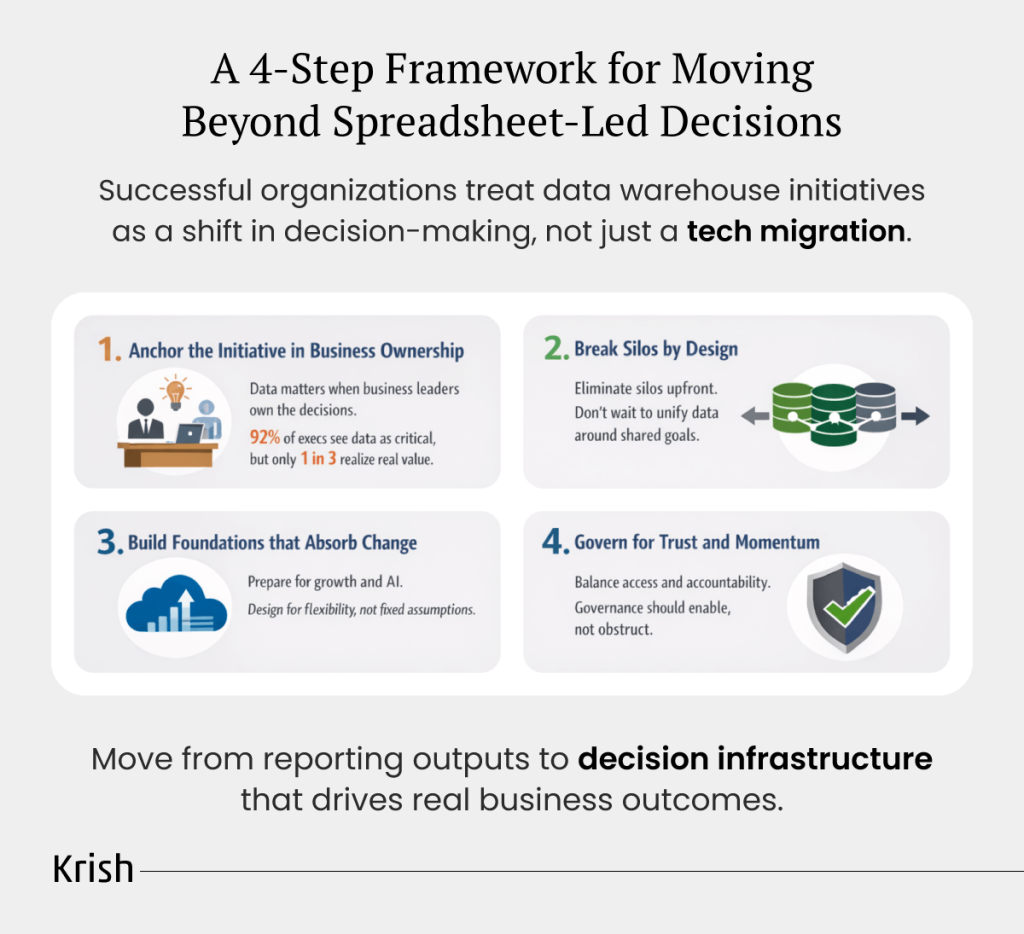
Organizations that succeed with data warehouse initiatives view the transition as a change in decision-making, not as a technology migration. The shift away from spreadsheets works only when leadership treats data as decision infrastructure rather than reporting output. The progression below reflects how mature organizations make that shift in practice.
1. Anchor the Initiative in Business Ownership
Data warehouse programs begin to matter only when business leaders own both the decisions and the definitions behind them. When ownership remains technical, success gets measured by delivery milestones. When ownership becomes business-led, success gets measured by decisions that move faster, align better, and require less explanation.
KPMG’s research clearly captures the consequences of this misalignment. While more than 90% of executives believe data products are critical to business objectives, only about a third see meaningful value realized. The difference is rarely access to data. Accountability for how data shapes decisions is usually what’s missing.
2. Break Silos by Design
Spreadsheet-driven organizations fragment truth because each team optimizes locally. It is better to design a data warehouse for shared definitions and cross-functional visibility before inconsistencies arise than to attempt reconciliation later.
Silos do not disappear through tools alone. They dissolve when data is structured around decisions that cut across functions, not reports owned by individual teams. Organizations that delay this alignment often end up recreating spreadsheet sprawl in more expensive systems.
3. Build Foundations that can Absorb Change
Relevant warehouses are designed for questions that do not yet exist. A company’s growth, acquisitions, regulatory shifts, and AI-driven analysis introduce unexpected demands. Hence, adaptability becomes a challenge for architectures based on fixed assumptions.
Organizations that get this right prioritize flexibility over optimization. They expect data usage to evolve, not stabilize. As a result, data remains usable as business models change, rather than aging into historical reference material.
4. Govern for Trust and Momentum
Governance determines whether data becomes a constraint or an enabler. When introduced reactively, governance slows adoption. When imposed rigidly, it encourages workarounds. Effective governance balances access, accountability, and trust from the start.
Mature organizations treat governance as a way to sustain momentum. Clear ownership, consistent definitions, and transparent rules reinforce confidence in decisions. Over time, governance becomes invisible because teams no longer question the integrity of the data they rely on.
Closing Thoughts
Spreadsheets rarely trigger an alarm. They feel familiar, flexible, and under control, even as decision cycles stretch and teams spend more time validating numbers than acting on them. The slowdown is gradual, which is why it often goes unchallenged. By the time the gap becomes obvious, competitors have already moved.
The shift to a data warehouse is not about becoming more data mature. It is about becoming more decisive. Organizations cross a threshold when truth stops being assembled on demand and starts existing by default. From that point on, decisions move faster, not because people work harder, but because the organization no longer debates its own reality.
That is the real trade-off. Every dollar spent reconciling numbers is a dollar not spent building shared truth. Leaders who recognize this early stop financing explanation and start investing in alignment. The rest keep optimizing effort, while others compound advantage.
Table of Content
- Introduction
- The Spreadsheet Ceiling
- Signs that you have Outgrown Spreadsheets
- What is a Data Warehouse?
- Business Outcomes that Change Once Data is Centralized
- Cloud vs On-Premise Data Warehouse
- Why Data Warehouse Programs Fail
- A 4-Step Framework for Moving Beyond Spreadsheet-Led Decisions
- Closing Thoughts
Subscribe with Us!
Never miss any post, stay tuned!

Ankit helps brands navigate their digital maturity journey by bringing together analytics, CRO, ML, and AI in a practical, business-friendly way. Having worked with global teams across industries, he focuses on simplifying complex MarTech concepts and turning them into measurable outcomes. On weekends, you’ll likely find him deep in a reflective read or sharing a coffee with a client while simplifying MarTech in the most human way possible.
Recommended Reading:
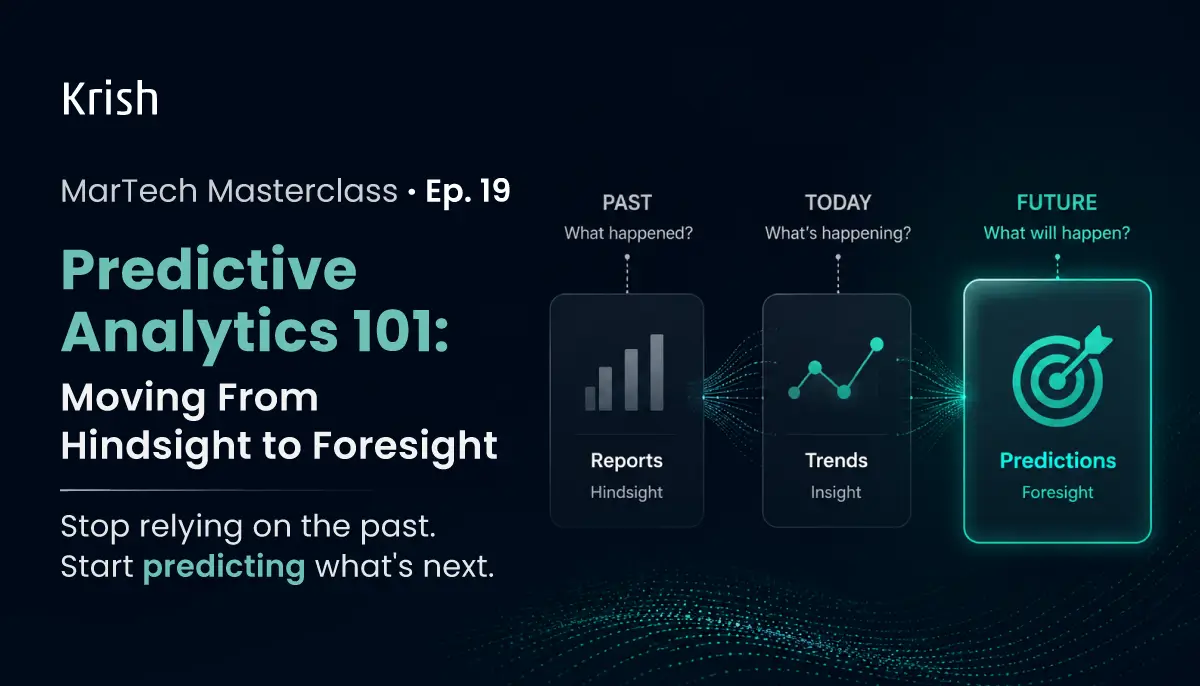
Predictive Analytics 101: Moving From Hindsight to Foresight – MarTech Masterclass Series Ep | 19
9 July, 2026 Most MarTech stacks are architecturally optimized for one thing: describing the past. Revenue last quarter, churn in the last 90 days, campaign performance last week - the dashboards are polished and the data looks clean. Yet every output from that stack is a response to something that has already happened. The customer already churned. The demand spike already passed. The high-value cohort already drifted before anyone noticed.
Subscribe with Us!
Never miss any post, stay tuned!
Trusted by leading brands


