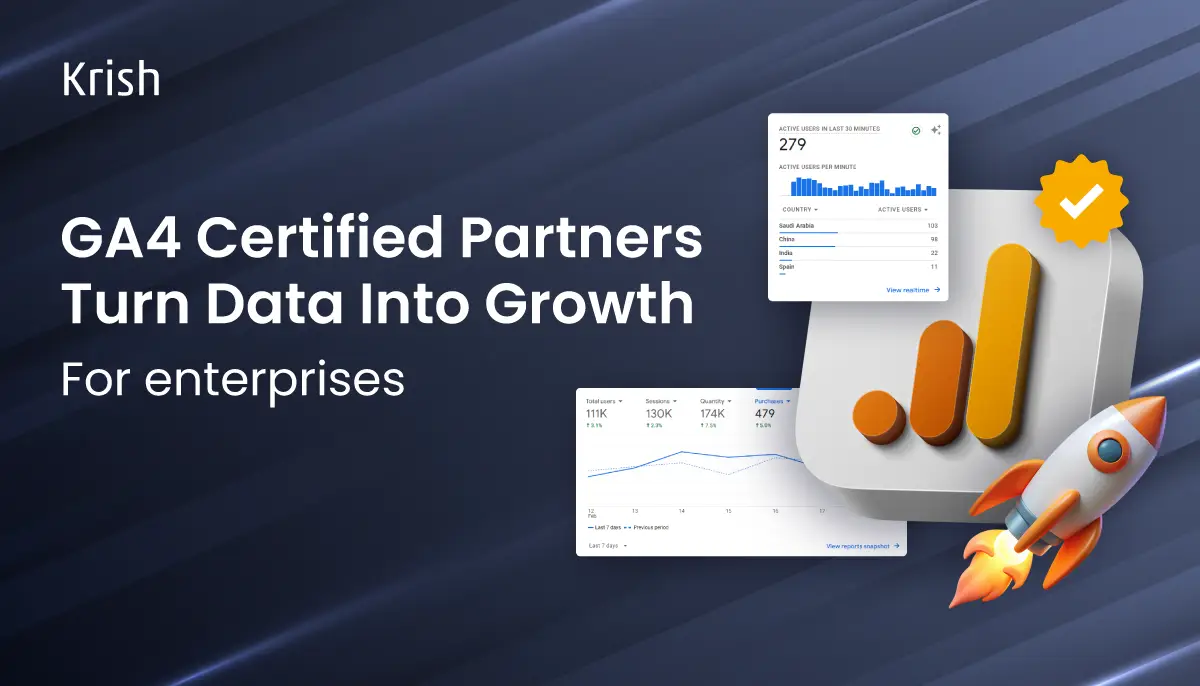
Introduction: Enterprises Have Data, Not Clarity
Every day, enterprise marketing teams watch dashboards populate with millions of data points. Website sessions stream in from dozens of countries. Mobile app interactions pile up across iOS and Android. Campaign platforms pump engagement metrics from search, social, display, and video channels. Multiple brands and business units generate their own analytics streams.
Yet when leadership asks straightforward questions-“Which campaigns actually drive revenue?” “Where are customers dropping out of our funnel?” “Should we shift the budget from channel A to channel B?”-the answers get murky. Reports show activity but not clarity. Different teams present conflicting numbers. Attribution feels like guesswork. Decision-makers find themselves choosing directions based on incomplete information or gut instinct rather than confident data analysis.
The problem isn’t lack of data. Enterprises drown in data. The problem is turning that data into reliable insights that drive growth decisions. Many organizations adopted Google Analytics 4 expecting it would solve their measurement challenges. Instead, they discovered that GA4’s power comes with complexity-and without proper implementation and governance at enterprise scale, that complexity creates new problems rather than solving old ones.
This is why enterprises increasingly partner with Google Analytics 4 certified experts who understand how to transform GA4 from a reporting tool into a genuine growth engine. When implemented strategically within the broader Google Marketing Platform and Cloud ecosystem, GA4 becomes the measurement backbone that enables confident, data-driven decisions across the entire organization.
What Makes GA4 Different-And Harder for Enterprises
Google Analytics 4 represents a fundamental rethinking of web analytics, not just an incremental upgrade from Universal Analytics. Understanding why requires looking at what’s actually different under the hood.
GA4 uses an event-based data model rather than the session-based approach that defined analytics for the past two decades. Every interaction becomes an event with associated parameters. This flexibility allows much richer tracking of user behavior, but it also means enterprises need to design comprehensive event taxonomies rather than relying on default tracking.
Cross-device and cross-platform measurement becomes possible in ways Universal Analytics never supported. GA4 can track a user’s journey from mobile app to desktop web to tablet, creating unified customer views across platforms. This capability is transformative for enterprises with complex digital ecosystems-but only if implemented correctly.
Privacy-first tracking addresses the regulatory realities enterprises face today. Google’s Consent Mode framework lets GA4 maintain measurement capabilities even when users decline cookies, using modeling to fill gaps while respecting privacy choices. For global enterprises managing GDPR, CCPA, and region-specific regulations, this matters enormously.
Predictive metrics and audiences use machine learning to forecast revenue potential and churn likelihood, enabling proactive rather than reactive marketing. BigQuery export opens GA4 data to advanced analysis in cloud data warehouses, connecting analytics with broader business intelligence infrastructure.
These capabilities create genuine competitive advantages-but they also introduce complexity that breaks down in typical enterprise environments. Multiple digital properties across different domains need consistent tracking. Regional compliance requirements vary. Conversion funnels span weeks and multiple touchpoints. Integration requirements multiply across CRMs, customer data platforms, and advertising systems. Different stakeholder teams need different views of the same underlying data.
GA4’s power scales with proper implementation. Without it, enterprises end up with sophisticated analytics infrastructure that produces unreliable outputs-expensive complexity without corresponding value.
Common GA4 Challenges Enterprises Face
Fragmented Measurement Strategy
Walk into most enterprise organizations and you’ll find different teams tracking different things in different ways. The paid search team measures clicks and conversions based on last-click attribution. The content team tracks engagement metrics that don’t connect to revenue. Product teams monitor app-specific events that don’t align with web tracking. Regional marketing teams implement their own event structures that can’t be compared across markets.
Nobody planned this fragmentation. It emerged organically as teams solved their immediate measurement needs without enterprise-wide coordination. The result: massive data volumes that can’t answer fundamental business questions because the measurement framework never aligned with unified KPIs.
Poor Data Quality and Inconsistent Events
Data quality issues undermine even well-intentioned GA4 implementations. Events fire multiple times for single interactions, inflating metrics. Critical events fail to capture required parameters, making analysis impossible. Naming conventions vary across teams-one uses “purchase_complete,” another “checkout_confirmed,” a third “transaction_final” for essentially the same business event.
Conversion tracking becomes unreliable when different properties define conversions differently or when technical issues cause silent failures that nobody notices until someone questions why numbers look strange. By then, weeks of corrupted data have already influenced decisions.
This is exactly what a GA4 audit is designed to uncover before bad data spreads into reporting and budget decisions.
Attribution and ROI Blind Spots
Enterprise customer journeys rarely follow simple paths. A customer might see a YouTube ad, click a paid search result weeks later, visit via organic search multiple times, interact with email campaigns, and finally convert through a retargeting ad. Which touchpoint deserves credit? How much credit?
GA4’s default attribution models don’t reflect the complex reality of enterprise marketing. Connecting GA4 data with actual revenue, particularly for businesses with offline sales components or long consideration cycles, creates additional complications. Many enterprises end up over-relying on last-click models because they’re simple, even though everyone knows they misrepresent campaign value.
The consequence: marketing budgets flow toward channels that appear to drive conversions but may simply capture demand created elsewhere. Truly effective channels get underfunded because their contribution isn’t properly measured.
Privacy, Compliance, and Consent Challenges
Privacy regulations continue evolving, and enforcement intensifies. Enterprises operating globally face different requirements in different markets. European operations need GDPR compliance. California requires CCPA adherence. Other regions have their own frameworks.
Consent Mode implementation isn’t straightforward. Misconfigure it, and you either lose measurement capabilities unnecessarily or expose the organization to compliance risk. Different user consent choices create different data collection scenarios that need proper handling. Cookie restrictions and browser tracking prevention features create data gaps that need addressing through modeling and alternative measurement approaches.
Many enterprises implement privacy frameworks that check legal boxes but severely degrade measurement quality-or they maintain measurement quality while creating compliance exposure they don’t fully recognize.
Underutilized GA4 Features
Perhaps the most frustrating challenge: enterprises invest in GA4 migration but barely scratch the surface of its capabilities. Predictive audiences that could identify high-value prospects remain unconfigured. BigQuery exports that could unlock advanced analysis sit unused. Machine learning insights that could drive marketing optimization go ignored.
The gap between GA4’s potential and typical enterprise utilization represents missed opportunity. Teams treat GA4 like Universal Analytics with a different interface rather than leveraging the fundamentally new capabilities it offers.
What Is a Google Analytics 4 Certified Partner?
Google Analytics 4 certification demonstrates validated expertise in the platform, but the term means different things depending on context. Individual GA4 certifications verify that someone understands platform fundamentals-how to configure properties, set up events, build reports, and use standard features.
Google Marketing Platform partner status represents organizational capability. Partners in this program have proven experience implementing GA4 at enterprise scale, demonstrated technical expertise across the platform ecosystem, and established track records helping complex organizations achieve measurement objectives.
For enterprises, this distinction matters significantly. Individual certification shows platform knowledge. Partner credentials indicate systematic expertise in enterprise measurement challenges-experience designing measurement frameworks that align with business strategy, building governance structures that maintain data quality across large organizations, and implementing technical architectures that scale reliably.
Organizations like Krish Technolabs, as a certified Google Marketing Platform partner, bring structured methodologies for enterprise GA4 implementation. They’ve solved the same challenges your organization faces across multiple enterprise clients. They understand not just GA4’s technical capabilities but how to deploy those capabilities within complex organizational environments where multiple teams, competing priorities, and legacy systems create constraints that generic implementation approaches don’t address.
Certified partners don’t just “set up GA4”, they start with a Google Analytics 4 audit, then design measurement architectures that align analytics infrastructure with enterprise growth goals, ensuring that implementation serves business strategy rather than becoming a technical exercise disconnected from actual decision-making needs.
How a GA4 Certified Partner Helps Enterprises Unlock Real Value
Enterprise-Grade Measurement Framework
Effective GA4 implementation starts with strategy, not configuration. Partners work with enterprise stakeholders to define KPIs that actually matter-not vanity metrics that look good in dashboards but don’t drive decisions.
For e-commerce enterprises, this means connecting analytics to revenue, average order value, customer acquisition costs, and lifetime value. For SaaS companies, it means tracking activation, feature adoption, expansion, and churn indicators. For content publishers, it means measuring engagement quality, subscription conversion, and retention.
Event taxonomy design becomes the foundation. Rather than letting teams create events reactively as needs arise, partners establish comprehensive taxonomies that capture business-critical interactions consistently across all properties. Standardized naming conventions ensure that “purchase” means the same thing whether it happens on your US e-commerce site, European mobile app, or Asian regional portal.
Governance frameworks maintain quality over time. Clear ownership, approval workflows, and documentation requirements prevent the gradual degradation that turns well-implemented GA4 properties into unmaintainable messes.
Accurate GA4 Implementation and Validation
Technical implementation determines whether your measurement framework works in practice. Partners ensure clean event structure – properly configured events with consistent parameters, including GA4 custom dimensions, that enable meaningful analysis.
Conversion setup requires particular attention. What counts as a conversion? How should micro-conversions in the customer journey be tracked? How do you handle scenarios where conversions happen across multiple sessions or devices?
Cross-domain tracking becomes critical for enterprises with multiple web properties. When customers move from your marketing site to your product site to your support portal, GA4 needs to maintain identity continuity rather than treating each domain visit as a separate user.
Data layer strategy provides the stable foundation that makes tracking resilient to website changes. Rather than having GA4 scrape page elements directly-which breaks whenever developers modify the site-proper data layer implementation creates a contract between your digital properties and analytics that survives technical changes.
Ongoing QA and audits catch issues before they corrupt data. Automated validation verifies that critical events continue firing correctly. Regular audits identify optimization opportunities and ensure implementations stay aligned with evolving business needs.
Advanced Attribution and Reporting
Default attribution models rarely reflect enterprise marketing reality. Partners configure custom attribution approaches that appropriately credit touchpoints throughout complex customer journeys.
Channel performance analysis becomes more sophisticated when you move beyond last-click thinking. Which channels initiate customer journeys? Which nurture consideration? Which capture demand created by other marketing activities? Proper attribution modeling answers these questions, enabling smarter budget allocation.
Executive-ready dashboards translate GA4’s granular data into strategic insights that business leadership can act on. Rather than overwhelming executives with analytics terminology and raw metrics, partners create reporting that connects measurement to business outcomes-revenue impact, efficiency gains, growth opportunities.
Aligning GA4 insights with broader business reporting ensures analytics integrates with existing decision-making processes rather than existing as a separate analytics silo that business stakeholders don’t fully trust or understand.
GA4 and Google Cloud Integration
BigQuery export unlocks GA4’s most powerful capabilities. Every event, with complete parameter detail, flows into your cloud data warehouse where you can combine it with CRM data, offline sales information, customer service interactions, and other business data sources.
Data warehousing strategies determine how effectively you leverage this integration. Partners design schemas that make GA4 data accessible to analysts while maintaining query performance at enterprise scale. They build data pipelines that keep your warehouse current without overwhelming cloud costs.
Advanced analytics and modeling become possible when GA4 data lives in BigQuery. You can build custom attribution models, create predictive scores, segment customers using machine learning, and generate insights that GA4’s interface alone couldn’t produce.
Feeding GA4 insights into business intelligence tools connects web analytics with enterprise reporting infrastructure. When marketing metrics appear in the same BI dashboards as financial performance and operational KPIs, analytics influences strategic decisions more effectively.
Krish Technolabs specializes in these cloud integrations, helping enterprises build data infrastructure where GA4 serves as the behavioral measurement layer within comprehensive data ecosystems that span marketing, sales, product, and customer success analytics.
Activation, Not Just Reporting
The most sophisticated analytics infrastructure fails if insights don’t drive action. Partners help enterprises activate GA4 data through marketing platforms and customer engagement tools.
Audience building in GA4 creates segments based on behavior, predictive scores, and business value. These audiences then flow into Google Ads for smarter targeting, into personalization platforms for customized experiences, into email marketing for relevant messaging.
Retention and lifecycle campaigns become more effective when informed by GA4 behavioral data. Identify customers showing churn signals and trigger re-engagement campaigns. Find high-value prospects and accelerate their journey with targeted content.
The difference between enterprises that succeed with GA4 and those that struggle often comes down to activation. Successful implementations close the loop from measurement to insight to action.
Enterprise Use Cases: Where GA4 Partners Create the Most Impact
Marketing Performance Optimization
When properly implemented, GA4 helps marketing teams identify underperforming channels and campaigns faster. Rather than waiting for month-end reports, marketers can detect issues within days and reallocate budget toward what’s working.
Multi-channel attribution reveals which marketing investments drive genuine business value versus which ones simply capture existing demand. This clarity transforms budget planning from political negotiation into data-driven optimization.
Customer Journey Optimization
Understanding how customers actually move through your digital ecosystem-across devices, across properties, over days or weeks-reveals optimization opportunities that single-session analytics miss.
Where do high-value customers engage differently than low-value ones? Which content drives progression toward conversion versus which creates engagement without business impact? GA4’s cross-platform measurement, when implemented correctly, answers these questions.
Product and UX Optimization
Product teams use GA4 to identify friction points in conversion funnels and feature adoption flows. Where do users abandon signup processes? Which features correlate with long-term retention? What user behaviors predict upgrade likelihood?
These insights guide product roadmap priorities, ensuring development resources focus on changes that improve business outcomes.
Global Analytics Governance
Multi-brand, multi-region enterprises need consistent analytics across markets while accommodating regional differences. Partners design governance models that maintain data quality and comparability without stifling regional flexibility.
Standardized global measurement frameworks with configurable regional parameters let headquarters understand performance across markets while regional teams get the specific insights they need.
Data-Driven Budget Allocation
Perhaps the highest-impact use case: using GA4 insights to guide strategic budget decisions. Which customer segments justify acquisition investment? Which marketing channels deserve expansion? Which product categories drive profitable growth?
When GA4 data connects to revenue and integrates with broader business intelligence, these decisions shift from subjective judgment to data-backed strategy.
How This Fits Into Your Broader Google Cloud and Marketing Platform Strategy
Google Analytics 4 doesn’t operate in isolation-it serves as the measurement backbone of enterprise marketing infrastructure, connecting digital interactions to the systems that drive business growth.
GA4 integration with Google Tag Manager provides the implementation layer, ensuring that tracking deploys consistently and performs efficiently. Connection to Google Ads closes the loop from advertising investment to customer behavior to optimization, enabling automated bidding strategies informed by actual business outcomes rather than proxy metrics.
BigQuery integration positions GA4 data within enterprise cloud infrastructure, where it combines with data warehouse assets to power comprehensive analytics. Cloud-based analytics pipelines process GA4’s event stream alongside other business data, creating unified customer views that inform decisions across marketing, product, sales, and service organizations.
The strategic insight: GA4 alone doesn’t drive growth. It becomes powerful when implemented as part of a connected ecosystem where measurement informs activation, where insights flow into optimization, and where analytics supports rather than exists separate from business decision-making.
How to Choose the Right GA4 Certified Partner for Your Enterprise
Evaluating potential GA4 partners requires looking beyond platform knowledge to organizational capabilities that matter for enterprise success.
Proven enterprise GA4 experience indicates partners who understand challenges at your scale. Ask about similar implementations-number of properties, data volumes, organizational complexity, integration requirements. Generic GA4 knowledge doesn’t prepare partners for enterprise-specific challenges.
Strong data governance approaches separate partners who can maintain quality over time from those who deliver initial implementations that degrade. How do they establish ownership? What documentation standards do they follow? How do they prevent the sprawl that undermines typical enterprise analytics?
Ability to align analytics with business outcomes determines whether implementation serves strategy. Partners should ask about your business model, revenue drivers, customer journey, and strategic priorities before proposing technical solutions. Analytics architectures should reflect business requirements, not generic best practices applied universally.
Experience with cloud and marketing platform integrations matters for enterprises leveraging the full Google ecosystem. GA4 delivers maximum value when connected to Tag Manager, Ads, BigQuery, and cloud analytics infrastructure. Partners who understand these integrations design more effective solutions.
Ongoing optimization and support models indicate whether partners view implementation as a project with an endpoint or as establishing infrastructure that needs continued attention. Your business evolves, marketing strategies change, new measurement needs emerge-partners should support evolution, not just initial setup.
Conclusion
Google Analytics 4 represents a genuine opportunity for enterprises to transform measurement from a reporting exercise into a growth driver. The platform’s capabilities-cross-platform tracking, predictive analytics, cloud integration, privacy-first measurement-address real enterprise needs when implemented strategically.
The gap between having GA4 and using GA4 strategically determines which enterprises extract value and which ones simply migrate to a new analytics platform that creates similar frustrations as the old one. Strategic implementation requires expertise that most enterprises don’t build internally-understanding event-based data models, designing measurement frameworks aligned with business strategy, configuring attribution appropriately, integrating with cloud infrastructure, and maintaining governance at scale.
This is why certified GA4 expertise matters. Partners who’ve solved these challenges across multiple enterprise clients bring systematic approaches that accelerate implementation, avoid common pitfalls, and ensure analytics infrastructure serves business growth rather than becoming another technology investment that fails to deliver expected returns.
The question isn’t whether to implement GA4-that decision is largely made for most enterprises. The question is whether your GA4 implementation will become a strategic asset that enables confident, data-driven decisions across your organization, or just another analytics tool that teams reference occasionally without truly trusting or leveraging.
Table of Content
- Introduction: Enterprises Have Data, Not Clarity
- What Makes GA4 Different-And Harder for Enterprises
- Common GA4 Challenges Enterprises Face
- What Is a Google Analytics 4 Certified Partner?
- How a GA4 Certified Partner Helps Enterprises Unlock Real Value
- Enterprise Use Cases: Where GA4 Partners Create the Most Impact
- How This Fits Into Your Broader Google Cloud and Marketing Platform Strategy
- How to Choose the Right GA4 Certified Partner for Your Enterprise
- Conclusion
Subscribe with Us!
Never miss any post, stay tuned!

As Director - Marketing, Zenul leads the marketing and branding at Krish. He brings with him an in-depth understanding of the evolving digital ecosystem and has a proven expertise and experience in strategic planning, market and competition analysis, creating and implementing client-centered, lead-gen and brand marketing campaigns. He has a heart for technology innovation and has been a keynote speaker on various platforms.
Recommended Reading:
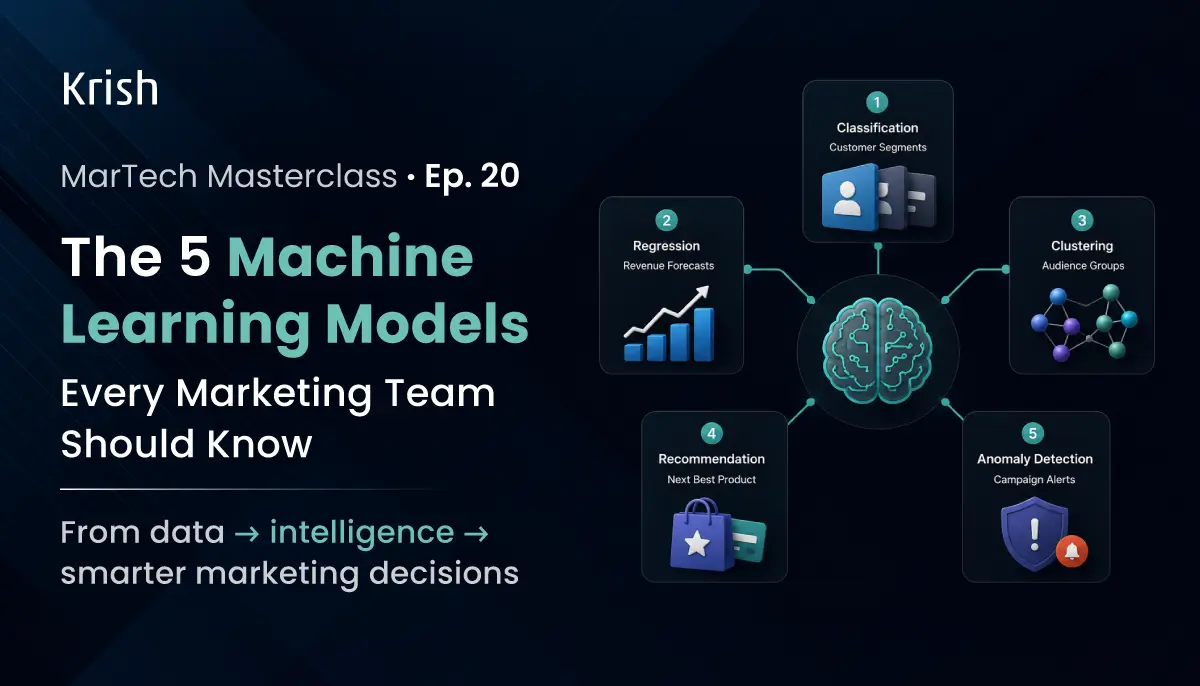
The 5 Machine Learning Models Every Marketing Team Should Know – MarTech Masterclass Series Ep | 20
17 July, 2026 Most marketing conversations about machine learning (ML) collapse it into a single capability. Teams talk about "using AI" or "adding ML to the stack" as though it were one tool with one function. It is not, and treating it that way is why most ML initiatives either overreach and fail or underdeliver and disappoint.
Subscribe with Us!
Never miss any post, stay tuned!
Trusted by leading brands


