Overview
Companies are optimizing experiences they designed for themselves, not experiences customers are actually having.
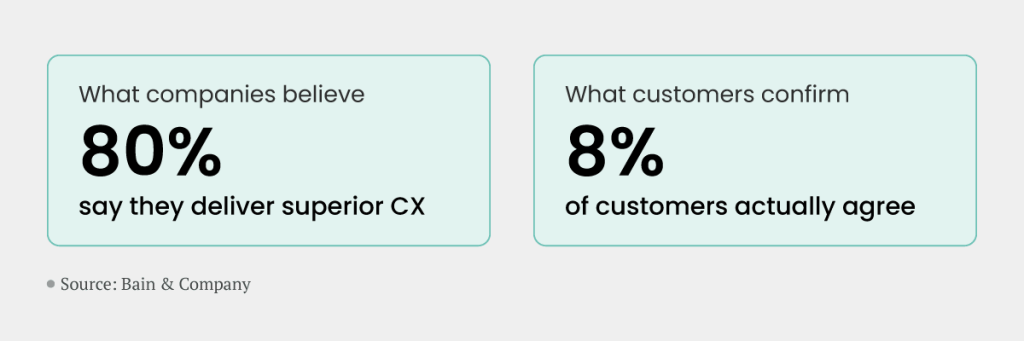
Journey mapping is the diagnostic layer that makes everything else accurate: your segmentation logic, your automation triggers, your personalization rules, everything! Build it wrong and every downstream execution compounds the error. In Episode 9, we covered CDP activation and signal-led execution. This episode is about the blueprint that makes activation logic actually correct.
What journey mapping actually is (and what it's not)
Journey mapping is not a persona exercise. It is not a content calendar organized by funnel stage. It is not a flowchart of your internal processes relabeled as “the customer experience.”
A journey map is a structured view of what a real customer thinks, feels, and does from the moment they recognize a problem through the moment they become a loyalist or leave. It captures the gap between what you intend to deliver and what the customer actually experiences.
Most journey maps are built inside-out. Teams list their own touchpoints, call it the customer journey, and use it to plan campaigns. That is a process map dressed as a CX strategy.
A real journey map is built outside-in. It starts with what customers actually think, feel, and do, and works backward to reveal where the business is helping, invisible, or actively creating friction.
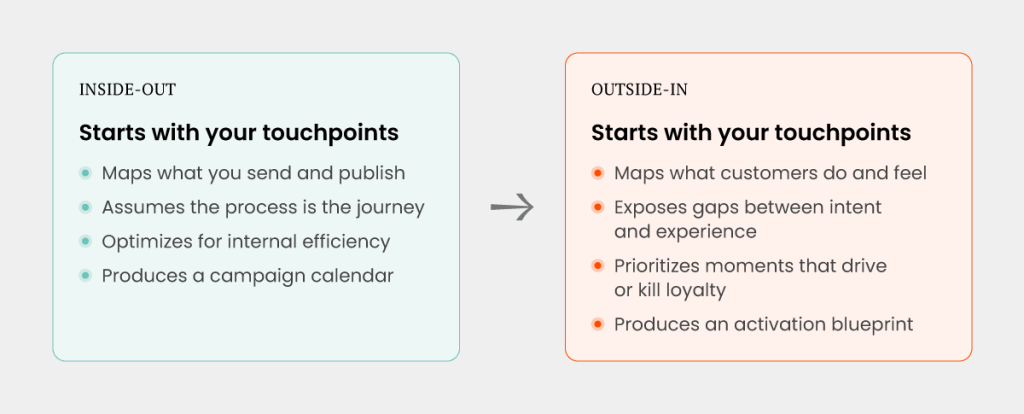
The distinction is operational, not semantic. A map built inside-out tells you what you are doing. A map built from the outside in tells you what you need to fix. Those two things are rarely the same, and the delta between them is where revenue leaks.
The 5 Core Customer Lifecycle Stages Every Business Should Map
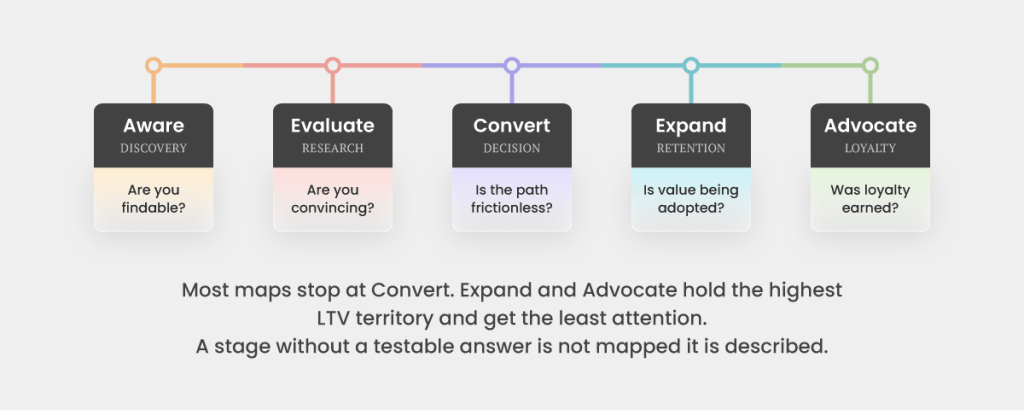
Every business has some version of these five stages. The names change. The channels change. The timelines change. The structure does not.
Aware: The customer encounters your brand, category, or solution for the first time. Your job here is not to convert. It is to be findable, credible, and relevant enough to earn the next step.
Evaluate: The customer is actively assessing options. This stage has the highest information-seeking behavior and the most friction points. Most purchase decisions are won or lost here before a sales conversation ever starts.
Convert: The decision moment. This is rarely a single event. It is a series of micro-commitments: booking a demo, starting a trial, approving a contract. Each one is a conversion point that can be mapped, measured, and optimized.
Expand: Post-purchase behavior defines your LTV. This stage covers onboarding quality, feature adoption depth, satisfaction signals, and the conditions under which customers grow their relationship with you or plateau.
Advocate: Customers who actively refer, review, and defend your brand. This does not happen because you asked for it. It happens because the experience at every prior stage earned it.
The governing principle: map all five before designing a single automation. A journey map with only the Awareness and Convert stages is not a journey map. It is a funnel diagram with better branding.
Conversion is rarely a single event; it is a sequence of micro-commitments. And the Expand stage is where acquisition spend either compounds into LTV or drains into churn.
Identifying Key Touchpoints, Pain Points, and Moments of Truth
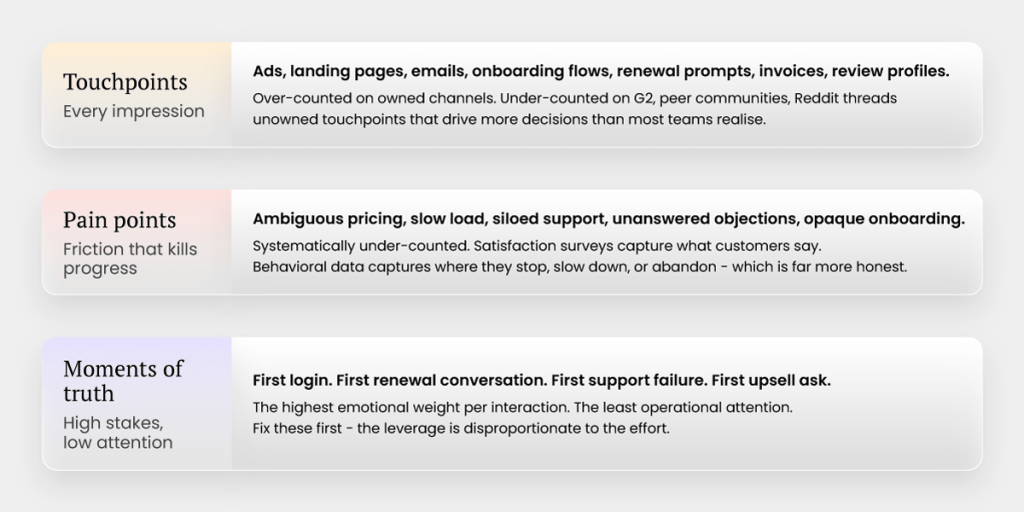
The three layers operate simultaneously. A single touchpoint can surface all three: a customer’s first login email can be a touchpoint (the interaction), a pain point (confusing link structure), and a moment of truth (do they get in successfully or not?).
The diagnostic question at each stage: what does the customer need to know, feel, and do to move forward? If your touchpoints are not answering that question, they are not functioning as touchpoints. They are noise.
Where most teams go wrong:
Touchpoint logs are almost always over-counted on owned channels and under-counted on unowned ones. Your review page, your G2 profile, your LinkedIn comments section, the Slack community where your customers talk to each other: these are touchpoints you do not control but that significantly shape the journey. Map them.
Pain points are almost always undercounted. Teams tend to document what customers say in satisfaction surveys. They underweight what customers do: where they stop, where they slow down, where they search for help that never arrives.
Moments of truth are chronically under-prioritized. These are the interactions with the highest emotional weight and the lowest operational attention. Fix the moments of truth first.
McKinsey research shows personalization drives 5-15% revenue lift alongside 10-30% improvement in marketing ROI, and that leverage concentrates at these high-stakes stages.
The Data That Makes the Map Accurate
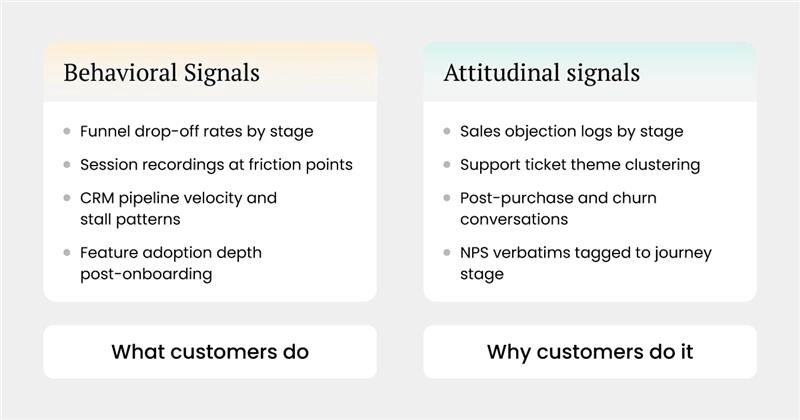
The sequencing matters more than the volume.
Start with behavioral data to locate problems. Layer attitudinal data to understand why those problems exist. Running them in reverse: starting with qualitative richness and then looking for pattern confirmation produces maps that are vivid but unrepresentative.
Two chronically underused sources that sit inside the organization already:
- Sales objection logs document exactly where and why prospects stall during the Evaluate stage, conversation by conversation. Most CRMs hold this data. Almost no journey map uses it.
- Support ticket clusters tagged by lifecycle stage expose the most common post-purchase failure points more honestly than any NPS survey. When clustered by stage rather than product category, they reveal the shape of your Expand-stage experience with clinical precision.
76% of consumers expect companies to understand their needs and expectations, per Salesforce. The gap between expectation and reality does not close through more channels. It closes through better map fidelity. But that precision requires map fidelity that most teams never achieve because they are working from survey data and session averages, not stage-tagged behavioral signals.
Where Journey Intelligence Connects to Execution
A journey map without triggers is a research document. The operational leap requires that each stage define four things before a single automation is built.
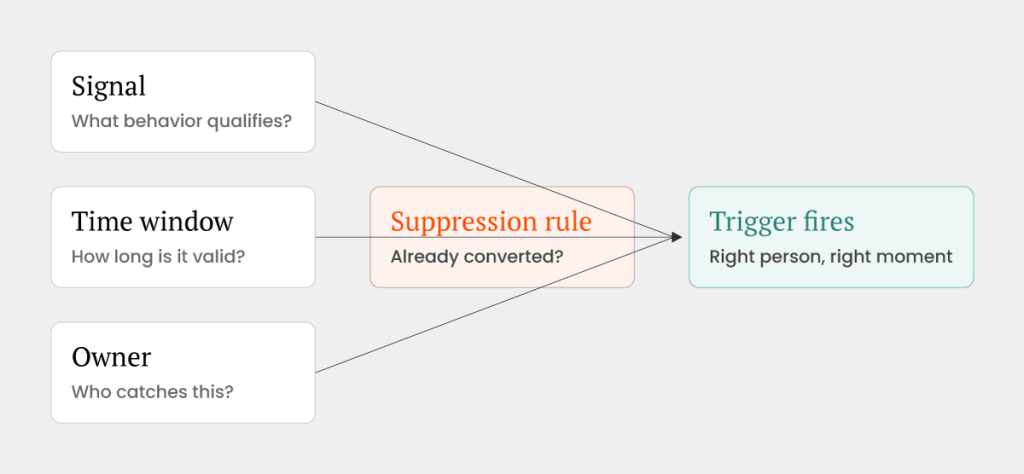
Suppression logic matters as much as targeting logic. If a customer converts between when the signal fires and when the automation executes, an uncoordinated follow-up is worse than no follow-up. This is where strategic marketing automation and omnichannel marketing plays the main character – translating journey stage logic into triggered campaign architecture, lifecycle segmentation, and CRM workflows is the operational layer between strategy and measurable outcomes.
A map tells you what should happen. The right MarTech stack is what makes it happen at the right moment, for the right segment, across the right channel.
What this looks like across stages, in practice, and where the automation opportunity lies:
| Stage | Signal | Automation Opportunity/ Trigger Type |
|---|---|---|
| Evaluate | Pricing page: 3 visits, no CTA click | Sales alert or intent email |
| Convert | Onboarding step skipped at day 3 | Re-engagement sequence |
| Expand | Feature usage drops 40% by week 6 | Churn risk: CS intervention flag |
| Advocate | NPS 9–10 at 90 days post-close | Referral or case study ask |
| Rentention | Support ticket 2+ within 30 days | Escalation flag + proactive outreach |
The test for a map that is ready to activate: every stage should have at least one defined signal, one defined response, and one team member who owns the execution. If a stage on your map has no automation attached to it, it is not mapped. It is described.
A journey map does not create better customer experiences. The execution it enables does.
Journey mapping works when:
- Stages reflect actual customer behavior, not internal process logic
- Pain points are sourced from customer evidence, not internal assumptions
- Moments of truth are explicitly identified and operationally prioritized
- Automation triggers are tied to stage-specific signals
- The map is treated as infrastructure, not a deliverable
From Map to Motion: Making Journey Mapping Stick
Activation works when signals are current, stage definitions reflect real behavior, and each trigger has a named owner. Individually, these are solvable problems. Together, they define what MarTech maturity actually looks like in practice.
According to Gartner, 55% of customer service and support leaders currently do some form of customer journey analytics, and they anticipate it will become one of the top five most valuable technologies for their function within two years.
The trajectory is clear. The operational requirement is a map that is maintained, not merely produced.
Build a review cadence into the process from the start: quarterly for structural stage updates, monthly for signal threshold reviews, continuous for behavioral data feed. Feed new signals from sales, support, and analytics back into the map as they emerge. Every time a new friction point appears in the data, it belongs on the map before it enters a backlog.
A journey map does not create better customer experiences. The execution it enables does.
Table of Content
- Overview
- What journey mapping actually is (and what it's not)
- The 5 Core Customer Lifecycle Stages Every Business Should Map
- Identifying Key Touchpoints, Pain Points, and Moments of Truth
- The Data That Makes the Map Accurate
- Where Journey Intelligence Connects to Execution
- From Map to Motion: Making Journey Mapping Stick
Subscribe with Us!
Never miss any post, stay tuned!

Ankit helps brands navigate their digital maturity journey by bringing together analytics, CRO, ML, and AI in a practical, business-friendly way. Having worked with global teams across industries, he focuses on simplifying complex MarTech concepts and turning them into measurable outcomes. On weekends, you’ll likely find him deep in a reflective read or sharing a coffee with a client while simplifying MarTech in the most human way possible.
Recommended Reading:
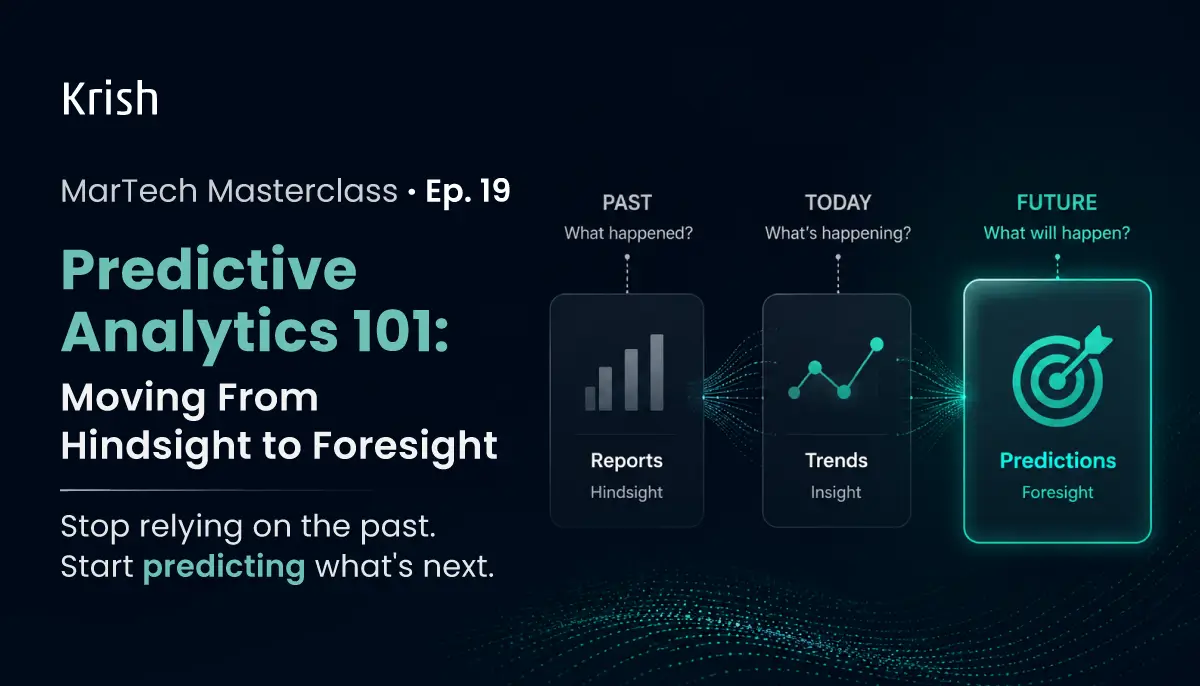
Predictive Analytics 101: Moving From Hindsight to Foresight – MarTech Masterclass Series Ep | 19
9 July, 2026 Most MarTech stacks are architecturally optimized for one thing: describing the past. Revenue last quarter, churn in the last 90 days, campaign performance last week - the dashboards are polished and the data looks clean. Yet every output from that stack is a response to something that has already happened. The customer already churned. The demand spike already passed. The high-value cohort already drifted before anyone noticed.
Subscribe with Us!
Never miss any post, stay tuned!
Trusted by leading brands


