Introduction
Every magento to shopify plus data migration raises the same anxious question from store owners: will my data actually survive the move? The good news is that most of what matters, products, customers, order history, transfers with the right process. The part that catches teams off guard is what doesn’t transfer cleanly, and why. This guide walks through exactly what happens to your data during a shopify plus data migration, so you know what to expect before the project starts.
Quick Answer: During a Magento to Shopify Plus migration, products, customer profiles, and order history move over with proper mapping, but customer passwords cannot be migrated due to differing encryption, and some Magento-specific data (custom attributes, complex pricing rules, legacy order states) needs manual reconciliation before it’s usable on Shopify Plus.
Further reading
Magento to Shopify Plus Migration Guide for Enterprise Brands
Adobe's end-of-support deadlines and rising costs are forcing the decision, this complete migration guide covers why enterprise brands are moving to Shopify Plus, what actually changes, and how to protect SEO through the transition.
Read the full blog →What Data Actually Moves From Magento to Shopify Plus
Product Catalog
SKUs, variants, and configurable products: Magento’s configurable products map to Shopify’s variant structure, though complex configurations with many attribute combinations often need manual review to make sure every variant lands correctly.
Images and product metadata: product images, alt text, and metadata generally transfer well when the migration follows a proper field-mapping process.
Customer Records
Profiles, addresses, and order association: customer profiles move over along with their associated addresses and order history links, keeping the customer’s full purchase context intact.
Customer groups and segmentation: Magento’s customer groups can be mapped to Shopify’s customer tags or segments, though the underlying logic sometimes needs to be rebuilt rather than directly imported.
Order History
Full history vs. last 12–24 months: many brands choose to migrate only the last 12-24 months of order history into the live store, archiving older records separately, since this keeps the new store lean without losing access to historical data entirely.
CMS Content & Blog Posts
Static pages and blog content migrate as structured content, though formatting and embedded elements often need manual cleanup to match Shopify’s content editor.
Reviews and User-Generated Content
Product reviews typically need to be exported from the current review platform and re-imported into a Shopify-compatible review app, since review data structures aren’t identical across platforms.
A data migration services partner handles exactly this kind of field-by-field mapping so nothing gets lost in translation between platforms.
What Doesn't Transfer Cleanly (and Why)
Customer Passwords: Why They Can’t Be Migrated
This is the one surprise almost every merchant runs into: passwords simply can’t move between platforms.
Custom Attributes & Legacy Order States
Magento stores allow highly custom product attributes and order statuses that often have no direct Shopify equivalent, requiring a decision on how to represent that data going forward.
Complex Pricing Rules & Customer Group Logic
Tiered pricing, customer-group-specific discounts, and catalog price rules are usually the most labor-intensive parts of a data migration, since Shopify’s pricing model works differently under the hood.
Magento-Specific Extensions Without a Shopify Equivalent
Any data generated by a Magento extension without a matching Shopify app needs a plan, either a custom build or a decision to leave that functionality behind. Our Magento migration services team maps this extension by extension before a single record moves.
Customer passwords can’t move between platforms because Magento and Shopify Plus use different hashing algorithms, every customer resets their password on first login post-launch.
Further reading
eCommerce Audit Checklist: Technical, SEO & CRO Steps Explained
Don't audit blindly, this step-by-step guide covers all 15 critical ecommerce audit areas, from technical SEO and site speed to CRO and navigation, so you can identify what's costing you sales.
Read the full blog →The Data Migration Process: Step by Step
Step 1 – Data Audit & Business Logic Discovery
Before anything moves, every data type needs to be documented, not just what exists, but the business logic behind it, like why certain pricing rules exist or how customer groups are structured. A clean analytics baseline, like the one built through our GA4 audit services, also helps confirm that nothing gets lost in translation once the new store is live.
Step 2 – Data Cleanup & Deduplication
Old, duplicate, or corrupted records get cleaned up before migration, since importing messy data into a new platform only carries the problem forward.
Step 3 – Field Mapping (Old Platform → Shopify Plus)
Every field in Magento gets mapped to its Shopify Plus equivalent, with a clear plan for fields that don’t have a direct match.
Step 4 – Staged Test Migrations
Rather than one final push, data is migrated to a staging environment multiple times, refining the mapping with each pass.
Step 5 – Validation & Reconciliation
Migrated data is checked against the original source, record by record where necessary, to confirm nothing was lost or altered in transit.
Step 6 – Final Cutover
Only once validation is complete does the final migration to the live store happen. For a realistic sense of how long this entire process takes, see our breakdown of the Magento to Shopify Plus migration timeline.
Staged, repeated test migrations with reconciliation give far better validation and rollback confidence than a single one-pass cutover, especially for stores with complex order and customer relationships.
Not sure what data will survive your migration?
Data Risks to Plan For
Data Loss or Corruption During Transfer
The most obvious risk is the reason staged test migrations and full backups matter so much.
Duplicate or Mismatched Customer Records
Without careful deduplication, the same customer can end up with multiple accounts post-migration, fragmenting their order history.
Broken Product-to-Category Relationships
Category structures don’t always map one-to-one, and a broken relationship can mean products disappearing from collections they should belong to.
Integration Data (ERP/PIM) Falling Out of Sync
If connected systems aren’t migrated and tested in parallel with the storefront, data can drift out of sync shortly after launch.
Migrations that treat data movement as a simple platform swap, rather than accounting for how customer accounts, reviews, and historical records live across different connected systems, are consistently the ones that lose the most data along the way.
Our Magento to Shopify Plus migration services are built around planning for these risks before they become live-site problems.
How to Protect Your Data During Migration?
Full Backup Before Touching Anything
A complete backup of the existing store is the non-negotiable first step of any migration project.
Parallel/Swing Environment Instead of a “Forklift” Migration
Running a migration through a staging environment that mirrors production, rather than moving data directly into the live Shopify store, gives room to catch problems before customers ever see them.
Multiple Test Migrations Before Final Cutover
Each test run refines the mapping and surfaces edge cases that a single migration attempt would miss.
Post-Migration Data Reconciliation Checklist
A structured checklist for verifying record counts, spot-checking customer accounts, and confirming order history integrity after go-live.
Further reading
How Kitchen Company Achieved Lightning-Fast Load Times and Drove Triple-Digit Growth in Traffic, AOV, and ROI
What Happens to Your Order History Specifically?
Full History Migration vs. Archiving Older Orders
Some brands choose to migrate their entire order history into Shopify Plus, while others bring over only the last 12-24 months and archive the rest separately.
Why Some Brands Keep Historical Orders in Their ERP Instead
For stores with a connected ERP system, historical order data often already lives there in a more structured, reportable form, making it reasonable to leave deep history in the ERP and keep the Shopify store focused on active, recent orders.
Do Customer Accounts and Passwords Transfer to Shopify Plus?
What Happens to Customer Profiles
Customer profiles, addresses, and order associations transfer with proper mapping, keeping each customer’s history intact and accessible in their new account.
The Password Reset Requirement Explained
Passwords themselves are the one exception, every customer needs to set a new password the first time they log in after launch, a requirement rooted in how differently the two platforms encrypt that data, not a flaw in the migration itself.
For platform-specific technical details on how URLs and account-related pages are handled during this transition, see our guide on URL fixes in Adobe Commerce. And since password resets tie directly into customer-facing SEO pages like account and login URLs, our SEO migration guide is worth reviewing alongside this.
Need a secure Magento to Shopify Plus migration strategy?
Frequently Asked Questions
Table of Content
- Introduction
- What Data Actually Moves From Magento to Shopify Plus
- What Doesn't Transfer Cleanly (and Why)
- The Data Migration Process: Step by Step
- Data Risks to Plan For
- How to Protect Your Data During Migration?
- What Happens to Your Order History Specifically?
- Do Customer Accounts and Passwords Transfer to Shopify Plus?
Subscribe with Us!
Never miss any post, stay tuned!

Manthan is the Director of Solutions at Krish, specializing in solution architecture, strategy, and client engagement. With expertise in eCommerce, Enterprise CMS, cloud solutions, and integrations, he is passionate about bridging technology and business to drive innovation and efficiency. As a techno-functional consultant and SME, he helps brands optimize technology stacks, streamline operations, and scale effectively, enabling sustainable digital transformation in an ever-evolving landscape.
Recommended Reading:
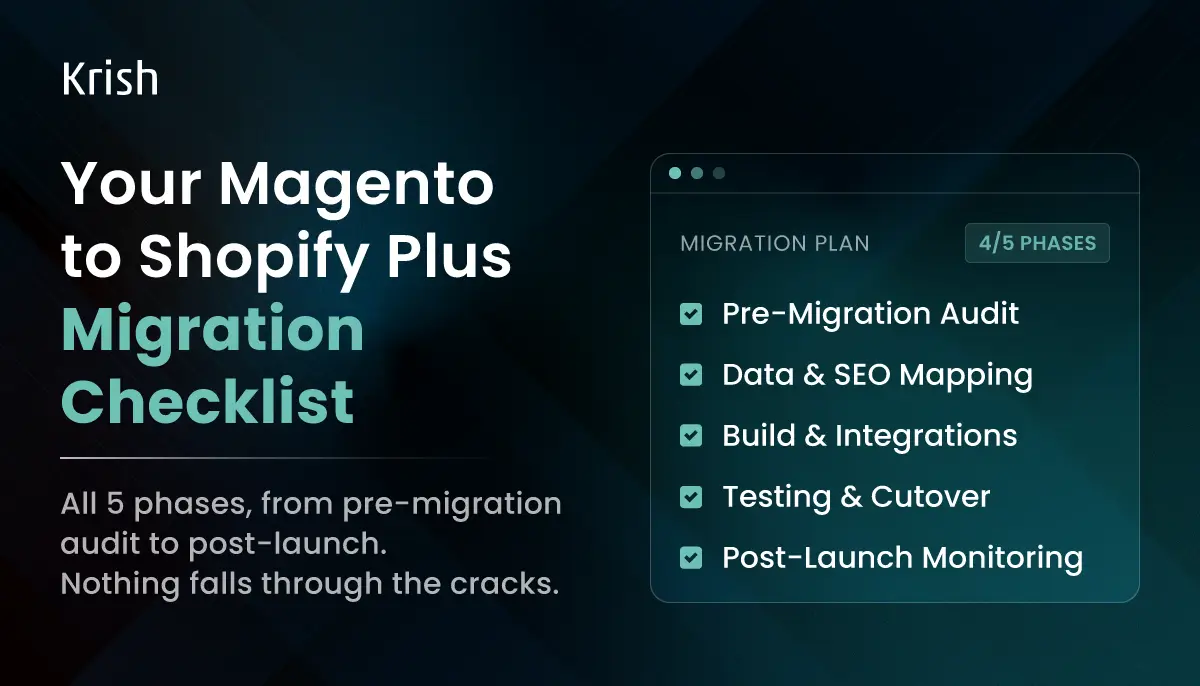
Magento to Shopify Plus Migration Checklist
16 July, 2026 Planning a magento to shopify plus checklist before you start is what separates a smooth migration from a chaotic one. Most migration problems aren't technical failures, they're missed steps that nobody flagged early enough. This guide lays out a complete shopify plus migration checklist across all five phases, so whether you're managing this in-house or working with a shopify plus migration services partner, nothing falls through the cracks.
Subscribe with Us!
Never miss any post, stay tuned!
Trusted by leading brands


