Introduction
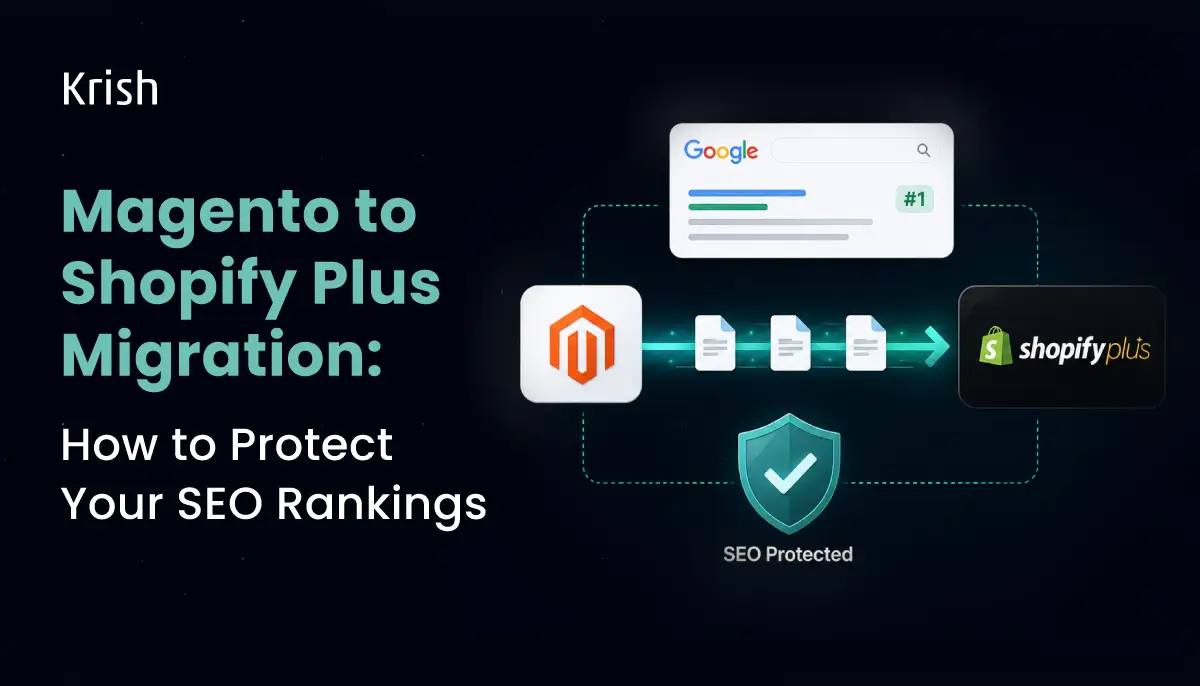
A magento to shopify plus seo transition is one of the highest-risk technical projects an ecommerce team can run, and one of the most common places rankings quietly disappear. Whether you’re planning shopify plus seo migration work in-house or bringing in a shopify plus migration agency, the difference between a clean move and a traffic disaster almost always comes down to preparation.
Quick Answer: A Magento to Shopify Plus migration doesn’t have to hurt SEO rankings. With complete 301 redirect mapping, preserved metadata and schema, and daily Search Console monitoring for the first 14–60 days, most stores see only a temporary 10–20% traffic dip that recovers within 4–6 weeks.
Further reading
Magento to Shopify Plus: Why Brands Are Migrating in 2026 (and What to Expect)
Adobe's end-of-support deadlines and rising costs are forcing the decision, this complete migration guide covers why enterprise brands are moving to Shopify Plus, what actually changes, and how to protect SEO through the transition.
Read the full blog →Why Magento to Shopify Plus Migrations Put SEO Rankings at Risk
URL Structure Differences (Magento /catalog/product/ vs. Shopify /products/)
Magento typically generates product URLs like /catalog/product/product-name.html, while Shopify uses a fixed /products/product-name structure. This mismatch means an exact one-to-one URL match is rarely possible, which is exactly why a deliberate redirect strategy matters from day one.
Lost Metadata & Schema During Platform Switch
Title tags, meta descriptions, and structured data don’t transfer automatically between platforms, each has to be exported, mapped, and re-implemented in Shopify’s framework.
Crawl Budget & Indexing Disruption
When a large volume of URLs changes at once, Google needs time to re-crawl and re-index the new site structure, temporarily disrupting how efficiently your pages get discovered.
Magento to Shopify migrations are widely considered among the most complex platform moves because of how differently the two platforms structure product and category URLs.
For migration planning that accounts for these risks from the outset, our Magento to Shopify Plus migration services build SEO protection into the technical roadmap, not as an afterthought.
Pre-Migration SEO Audit: What to Document Before You Touch DNS
Export Google Search Console Data
Pull at least 16 months of clicks and impressions by URL before you migrate anything. This becomes your baseline for spotting real problems versus normal fluctuation after launch.
Crawl Your Current Site
Tools to use: Screaming Frog and Sitebulb are the standard choices for a full site crawl before migration.
What to capture: titles, meta descriptions, H1s, canonical tags, and existing schema markup for every indexed page.
Backlink Audit: Prioritizing High-Authority URLs
Not every URL needs the same level of care. Identify which pages carry the most external links and flag them for manual verification after launch, since these are the pages most likely to hurt rankings if a redirect breaks.
Our detailed walkthrough on how to perform an ecommerce audit covers this process step by step.
| SEO Element | Magento | Shopify Plus | Migration Action |
|---|---|---|---|
| Product URLs | Customizable | Fixed /products/ | Redirect |
| Category URLs | Customizable | Collections | Redirect |
| Schema | Custom | Rebuild & validate | |
| Metadata | Exportable | Import required | |
| Canonicals | Custom | Validate after migration |
Further reading
eCommerce Audit Checklist: Technical, SEO & CRO Steps Explained
Don't audit blindly, this step-by-step guide covers all 15 critical ecommerce audit areas, from technical SEO and site speed to CRO and navigation, so you can identify what's costing you sales.
Read the full blog →301 Redirect Mapping: The Technical Core of SEO-Safe Migration
Categorizing URLs by Type
Separate your URL inventory into product pages, category/collection pages, blog and content pages, and image URLs, each type needs its own mapping logic.
Pattern-Based Mapping vs. Manual Mapping for Exceptions
Most URLs in a migration follow a transformable pattern for example, stripping Magento’s /catalog/product/ prefix and .html extension, then applying Shopify’s /products/ prefix. This automatic approach typically covers the majority of a catalog. URLs that don’t follow the standard pattern, discontinued products, merged categories, and restructured content require manual, case-by-case mapping.
Common Redirect Mistakes to Avoid
- Redirect chains: stacking multiple redirects instead of pointing directly to the final URL
- Bulk redirecting to homepage: a homepage redirect for every dead URL leaks trust and confuses both users and search engines
- Using 302 instead of 301: a 302 signals a temporary move and won’t properly pass on ranking value
Standalone stat: According to a 2026 technical SEO guide on ighenatt.es, Google typically needs two to four weeks to fully process 301 redirects on an ecommerce site with under 10,000 URLs.
For platform-specific URL and canonical handling, see our guide on URL fixes in Adobe Commerce, which covers many of the same structural issues that carry over into a migration.
Preserving On-Page SEO Signals During Migration
Title Tags & Meta Descriptions
Transfer these exactly as they were, this isn’t the moment to test new copy. Once traffic stabilizes post-launch, that’s the time for optimization experiments.
Structured Data / Schema Markup (Product, BreadcrumbList, FAQ)
Every schema type your Magento site uses, Product, BreadcrumbList, FAQ, needs to be rebuilt and validated on Shopify Plus before launch, since missing schema means missing rich results.
Internal Linking Structure
Update every internal link to point directly to new URLs rather than relying on redirects to catch them. Internal redirects waste crawl budget and slow recovery.
Image Alt Text & Image URL Redirects
Images carry SEO value too. Alt text needs to transfer, and image URLs need their own redirect mapping, separate from page-level redirects.
Further reading
How Kitchen Company Achieved Lightning-Fast Load Times and Drove Triple-Digit Growth in Traffic, AOV, and ROI
What's Included in a Professional SEO-Safe Migration
- Discovery & URL Inventory: a full catalog of every indexed URL before migration begins
- SEO Redirect Mapping: 301s, metadata, and schema planned and documented in advance
- Post-Launch Monitoring & Search Console Checks: active tracking in the weeks immediately following go-live
This is core to what our SEO services deliver alongside any migration project. And if cost is part of your planning conversation, our breakdown of Magento to Shopify Plus migration cost covers exactly where SEO work fits into the overall budget.
Planning your migration?
Post-Launch SEO Monitoring
Daily Search Console Checks (First Few Weeks)
Check crawl errors, indexing status, and ranking movement daily in the first two weeks this is when problems are cheapest to catch and fix.
Crawl Stats & Indexing Verification
Confirm Google is actually crawling and indexing your new URLs at the expected pace, not just that redirects are technically in place.
Comparing Organic Traffic to Pre-Migration Baseline
Use the Search Console export from your pre-migration audit as the yardstick for every comparison you make post-launch.
What a “Normal” Ranking Dip Looks Like vs. a Red Flag
A temporary 10–20% dip that recovers within 4–6 weeks is typical. A dip that keeps deepening past week three, or one concentrated on your highest-traffic pages, is a signal that something in the redirect or metadata mapping needs attention.
A best practice recommends building a spreadsheet that tracks each redirect with its HTTP status code, grouped by content type, so issues are easy to isolate during this monitoring window.
Our magento to shopify plus migration guide walks through this post-launch phase as part of the broader migration timeline.
How Long Does It Take to Recover SEO Rankings After Migration?
Typical Recovery Timeline (4–6 weeks)
For most mid-sized stores with a properly executed redirect map, organic traffic returns to baseline within 4–6 weeks of launch.
Factors That Slow Recovery
Catalog size, the number of redirect rules required, and how much of the URL structure changed all affect recovery speed. Per the 2026 SEO migration guide, Magento to Shopify migrations are considered particularly complex because of how differently the two platforms structure product and category URLs, which can extend recovery time if the mapping isn’t thorough.
Does Migrating from Magento to Shopify Plus Hurt SEO Rankings?
When SEO Rankings Drop (and Why)
Rankings drop when redirects are incomplete, metadata isn’t transferred, or Google simply needs time to re-crawl a restructured site. Most of this is temporary and expected.
When Rankings Stay Protected (or Improve)
Stores that go into migration with a complete URL inventory, a validated redirect map, and preserved metadata tend to see only a minor, short-lived dip, and some see improvement once Shopify Plus’s faster performance and cleaner technical foundation start working in their favor.
What Actually Causes SEO Traffic Loss During a Magento to Shopify Migration?
- Missing redirects
- Redirect chains
- Lost metadata
- Missing schema
- Internal linking errors
- Canonical tag issues
- Noindex mistakes
- XML sitemap issues
- Orphaned pages
Magento SEO Elements That Must Be Preserved During Migration
Checklist:
✅ URL mappings
✅ Canonicals
✅ Meta titles
✅ Meta descriptions
✅ H1s
✅ Structured data
✅ XML sitemaps
✅ Robots.txt rules
✅ Internal links
✅ Pagination rules
✅ Product reviews
✅ Image alt text
This is highly citation-worthy.
Our data migration services work alongside SEO mapping to make sure content, metadata, and redirects move together, not as separate, disconnected efforts.
Don’t risk your organic traffic during migration.
Frequently Asked Questions
Table of Content
- Introduction
- Why Magento to Shopify Plus Migrations Put SEO Rankings at Risk
- Pre-Migration SEO Audit: What to Document Before You Touch DNS
- 301 Redirect Mapping: The Technical Core of SEO-Safe Migration
- Preserving On-Page SEO Signals During Migration
- What's Included in a Professional SEO-Safe Migration
- Post-Launch SEO Monitoring
- How Long Does It Take to Recover SEO Rankings After Migration?
- Does Migrating from Magento to Shopify Plus Hurt SEO Rankings?
- What Actually Causes SEO Traffic Loss During a Magento to Shopify Migration?
- Magento SEO Elements That Must Be Preserved During Migration
Subscribe with Us!
Never miss any post, stay tuned!

Minal Joshi is a content marketer at Krish with a flair for eCommerce and Digital Commerce aspects. She is a MarTech fanatic with a knack of writing with which, she helps brands to curate, create, & commence digital brand positioning. Sharing insights via articles, case studies, eBooks, Infographics, and other forms of content creation is what she lives for. Being an ardent traveler, when not writing, you'll find her sipping coffee into the mountains or petting a stray.
Recommended Reading:
Magento to Shopify Plus Migration Checklist
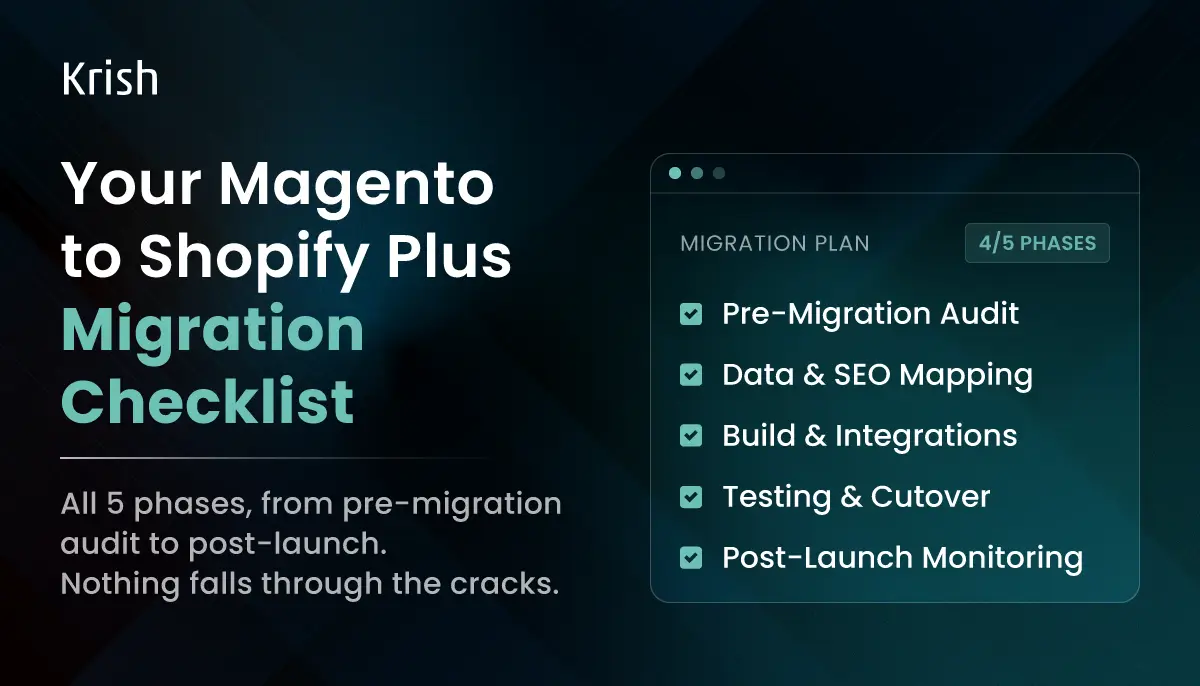
16 July, 2026 Planning a magento to shopify plus checklist before you start is what separates a smooth migration from a chaotic one. Most migration problems aren't technical failures, they're missed steps that nobody flagged early enough. This guide lays out a complete shopify plus migration checklist across all five phases, so whether you're managing this in-house or working with a shopify plus migration services partner, nothing falls through the cracks.
Subscribe with Us!
Never miss any post, stay tuned!
Trusted by leading brands


