The Zero UI Shift in eCommerce
Your next customer might not visit your website. They will send an agent instead.
That agent will research, compare, and buy on their behalf without clicking through your homepage, reading your PDPs, or experiencing your brand the way you designed it to be experienced. And when it is done, it will report back as “purchased”.
This is not a 2028 scenario. In the 2025 holiday season, 1 in 5 orders globally was touched by an AI agent, representing roughly $70 billion in GMV. Traffic to retail sites from generative AI sources grew 4,700% YOY as of July 2025, per Adobe data cited by BCG. That traffic converts at 7 to 8 times the rate of social. Those visitors spend 32% more time on-site with a 27% lower bounce rate.
This is a more honest starting point than most introductions to agentic commerce will give you. The shift is real, it is happening now, and it is also messier and more nuanced than the hype cycle suggested.
The real question is,
Whether your business is structurally built to be found, trusted, and bought with ‘Zero UI’ framework or by a system that does not browse?
This is the first blog in Krish’s ten-part series on agentic commerce. The goal of this pillar is to establish a clear, honest foundation: what agentic commerce is, how it works technically and commercially, what is already live in the market, and what it means for your ecommerce business right now.
Time to Move Beyond the Modern eCommerce Model
Every layer of digital commerce investment built over the last 20 years assumes one thing: a human is present at every step. A person opens a browser, types a query, scrolls results, clicks a PDP, and decides. SEO, CRO, UX, PDP copywriting, retargeting, all of it is built on that model.
That model is not disappearing. But it is no longer the only model, and for a growing segment of high-intent buyers, it is no longer the primary one.
What is changing is not consumer motivation. Shoppers still want the best product at the right price, delivered reliably. What is changing is the mechanism. Intent used to arrive at your storefront. Increasingly, it arrives at an agent.
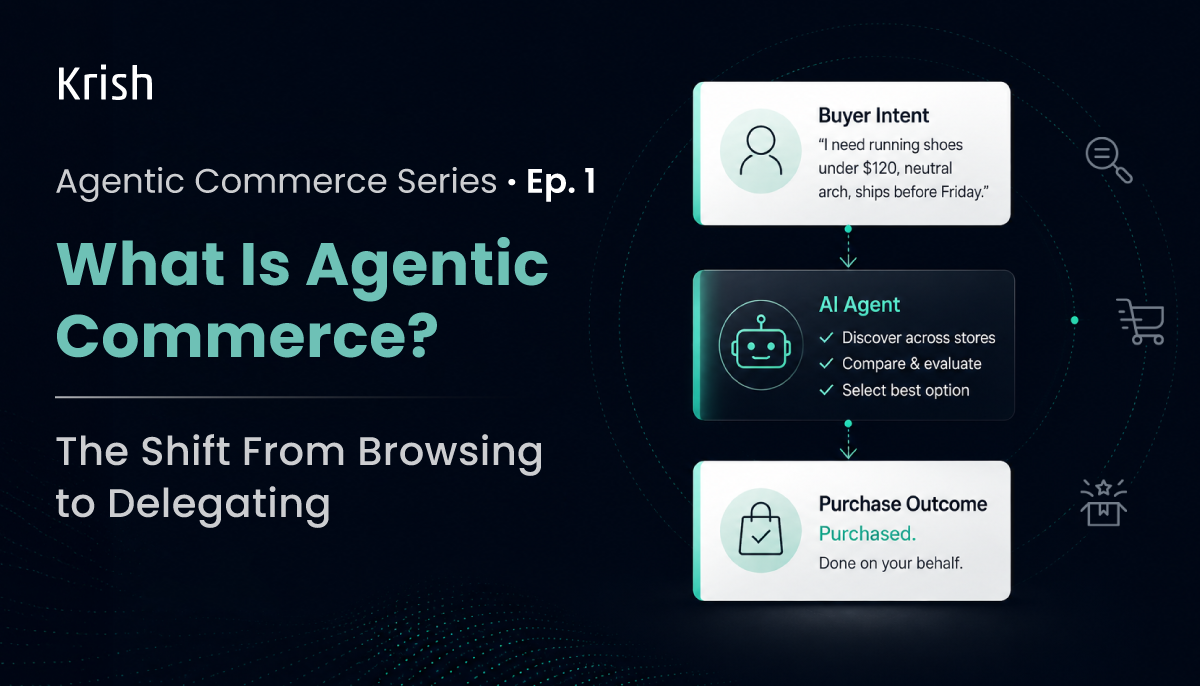
When a buyer tells ChatGPT “I need running shoes under $120, neutral arch, ships before Friday,” they are not searching. They are delegating. The agent handles discovery, comparison, and checkout. Your website may not be visited. Your brand story may not be read. You either appeared in the output or you did not, and that determination was made entirely by how well your product data answered the agent’s query.
— Emily Glassberg Sands, Head of Information and Data Science, Stripe
This is the shift from a UX problem to a protocol problem. Generative AI in retail has moved well past the chatbot phase, but most brands are still optimizing for a buyer who browses. The buyer who delegates is already here.
What Agentic Commerce Actually Is?
The textbook definition
Agentic commerce is digital retail mediated by autonomous AI systems that act on behalf of buyers. The buyer sets intent once. The agent executes the full purchase flow, from discovery through checkout, without requiring human input at each step.
The word “autonomous” is doing real work here. It means the agent is not answering a question. It is completing a task.
To understand what that means practically, you need to understand what came before it and why each generation was structurally different. How AI Agents are different from Chatbots and Recommendation Engines.
| Generation | What it did | What it could not do |
|---|---|---|
| Recommendation engines | Suggested products based on browsing signals | Required human navigation to generate those signals |
| Chatbots | Answered questions, handled support queries | Required humans to execute every action |
| AI agents | Receive a goal, plan, execute, and deliver an outcome | Nothing – this is the generation that closes the loop |
The operational difference between a chatbot and an AI agent
It is not sophistication. It is what the system actually does in the world. A chatbot tells you there are running shoes in stock. An agent checks your size from past purchases, finds options across merchants that match your budget and delivery window, scores them against your preferences, and buys the one that scores highest.
The interface for that interaction might be voice, chat, or a background trigger from a wearable. There may be no screen involved at all. This is what the industry calls Zero UI commerce: not that screens disappear, but that intentional navigation disappears. The buyer delegates intent. The system handles everything else.
| Dimension | AI chatbot | AI agent |
|---|---|---|
| Mode of operation | Responds to input | Acts toward a goal |
| Steps required from buyer | Many: click, compare, decide, confirm | One: state the goal |
| Execution | Human executes every action | Agent executes the sequence |
| Scope | Single conversation interface | Crosses tools, APIs, and systems |
| Output | Information and suggestions | Completed tasks and transactions |
| Memory | Within the session | Persistent preferences and history |
When that delegation becomes habitual and happens in the background of daily life, ordering protein powder when a sensor detects it is low, replenishing household staples without a deliberate shopping session, that is ambient commerce. The purchase happens around the buyer, not in front of them.
Forrester documented this shift in October 2025, noting that zero-click search applied to shopping means consumers can now buy directly from AI answer engines without being redirected to merchant sites. The interface between buyer intent and merchant checkout is being occupied by an AI layer.
The fix: Ensuring your product catalog is structured in a way where it’s easy for agents to discover and surface your products; optimizing checkout flows for agents, not just humans; and implementing customer modelling purpose-built for agent-initiated transactions, where traditional signals no longer apply.
How Autonomous Decision-Making Works in Commerce?
Agentic systems operate on a perception-reasoning-execution loop.
Understanding it operationally matters because it determines how agents evaluate your catalog, your pricing, and ultimately whether they select you.
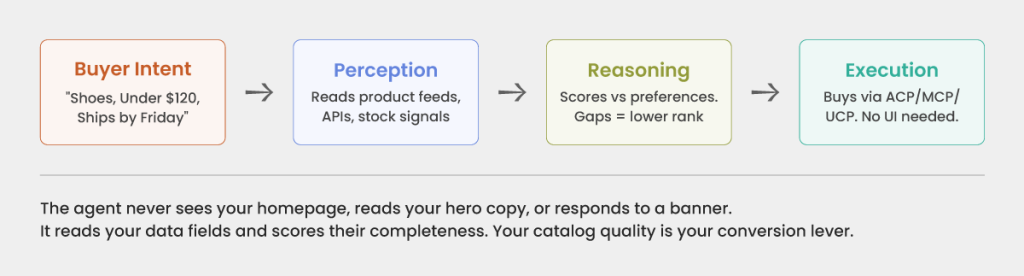
- Perception: the agent reads your data, not your design
- Ingests natural language from the buyer (intent, constraints, context)
- Queries structured product feeds, pricing APIs, inventory signals
- Reads merchant policies, delivery windows, return terms
- Does not scroll your homepage, read your hero copy, or see your brand visuals
- Cannot parse information that is not machine-readable or structurally complete
This is why catalog data quality is no longer a logistics consideration. It is a discoverability lever. A product with incomplete attributes, missing category mappings, or inconsistent inventory signals registers as lower-confidence to the agent’s scoring system. Incomplete data does not just hurt conversion. It removes you from consideration before the decision is even made.
- Reasoning: the agent scores, not browses
- Weights product attributes against stored buyer preferences
- Cross-references price against budget parameters
- Evaluates delivery feasibility against stated deadlines
- Synthesises review signals and merchant trust scores
- Applies prior purchase history and standing preferences
The agent does not experience your brand. It processes your data fields and scores their completeness and relevance against the buyer’s stated intent. This is why PIM strategy and headless, API-first infrastructure are the baseline requirements for agent discoverability — not optional upgrades.
- Execution: the agent acts, not waits
- Adds to cart and completes checkout via ACP, MCP, or UCP protocols
- May confirm with the human buyer before final purchase (supervised mode)
- May complete silently based on standing preferences (autonomous mode)
- Reports outcome to the buyer rather than requesting approval at each step
- Manages post-purchase interactions including tracking and returns in advanced deployments
The protocols that make agent transactions possible
The protocols that make agent transactions possible
Before mid-2025, connecting to any AI shopping platform required custom engineering per platform. That excluded most mid-market merchants. What changed it was the emergence of shared open standards – protocols that any merchant with an API-first, headless commerce stack can connect to.
4 Protocols that Matter to Build the Agent-Ready eCommerce Techstacks:
- ACP: Agentic Commerce Protocol: developed by OpenAI and Stripe, launched September 2025. ACP is the checkout handshake between an AI platform and your store. When a buyer confirms a purchase inside an AI interface, ACP routes the order, payment, and confirmation through your existing commerce infrastructure. Stripe handles the payment processing. You do not build a separate checkout for AI platforms. Your store needs to be ACP-compatible and the connection is live. Merchants pay a small fee for access to the high-intent audience; fulfilment and customer service remain the merchant’s responsibility.
- MCP: Model Context Protocol: developed by Anthropic and now widely adopted across the industry. MCP is the live data bridge between an AI agent and your backend systems. It allows agents to query your real-time inventory, current pricing, and product catalog directly, rather than working from a static export. Without MCP, agents are evaluating stale data and producing recommendations that may not reflect reality, which degrades the buyer experience and erodes merchant trust scores. With MCP, agents get accurate, live answers every time. As covered in our guide to headless architecture as a MACH component, this kind of composable, API-first architecture is precisely what enables MCP compatibility without full platform rebuilds.
- UCP: Universal Commerce Protocol: developed by Google alongside Shopify, Etsy, Walmart, Target, Macy’s, American Express, and Visa, launched at NRF 2026. UCP is designed to cover the entire commerce journey, from discovery through checkout and post-purchase, across all participating platforms through a single merchant integration. Rather than engineering separate connections to Google, Shopify’s agent channels, and other platforms, UCP creates a single access point that works across all participating surfaces. Early retailer participants include Ulta Beauty, Wayfair, and Chewy.
- AGNTCY: Agent interoperability standard: an open standard launched November 2025 that defines how agents from different systems securely discover each other, communicate, and hand off tasks. In a multi-agent commerce environment, a buyer’s personal AI assistant, a merchant’s order management agent, and a carrier’s delivery coordination agent all need to communicate without being engineered by the same company. AGNTCY provides that common language. Its importance grows as commerce moves toward Tier 3 and Tier 4 agent capability, where cross-system coordination is the baseline expectation.
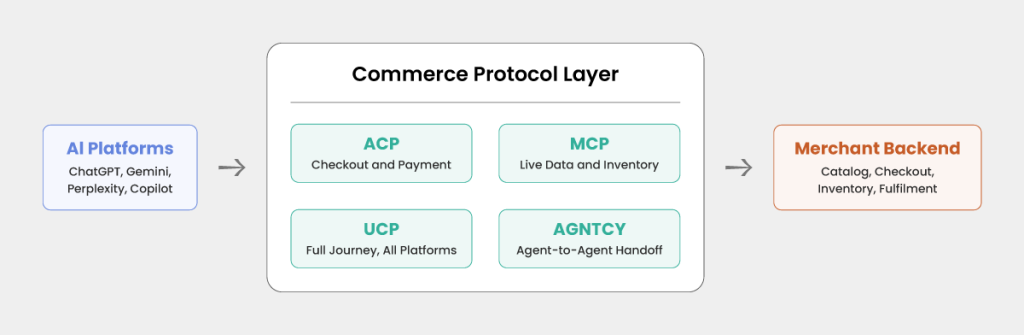
The prerequisite for all four protocols is the same: an API-first, headless architecture that exposes commerce services through documented endpoints. Merchants on monolithic platforms that do not surface inventory, pricing, and order management through clean APIs cannot connect to these protocols without significant re-engineering. For those brands, evaluating replatforming is not a long-term strategic question. It is a current-cycle MarTech audit and readiness question.
Where the Industry Sits on the Maturity Curve
BCG’s October 2025 report on agentic commerce defines four tiers of agent capability. Knowing where the industry currently sits — and where it is heading — shapes where investment makes sense now versus in future cycles.
| Tier | What agents can do | Examples live today | Timeframe |
|---|---|---|---|
| 1 | Surface recommendations and answer questions. Human executes all actions. | Most branded chatbots and AI search | Current default for most brands |
| 2 | Complete purchases within the AI chat interface without redirecting buyers to merchant sites. | Perplexity Buy with Pro, Google AI Mode checkout | Active transition, industry in early Tier 2 |
| 3 | Orchestrate across multiple workflows, manage reorders, compare across categories, handle multi-merchant sessions. | Vertical agents: Gensmo, Daydream, Motormia | 2026 to 2027 |
| 4 | Multi-agent coordination: buyer agent, merchant agent, and carrier agent communicate and resolve exceptions autonomously. | Experimental only | 2027 and beyond |
BCG assessed the industry as sitting in early Tier 2 as of late 2025. The infrastructure being built for Tier 2 readiness, clean catalog data, headless APIs, protocol compatibility, is the same infrastructure that unlocks Tier 3 and 4 over time. There is no shortcut through the tiers. The sequence matters.
Latest Industry Stats on Agentic Commerce
| Metric | Figure | Source |
|---|---|---|
| Agentic AI retail market size, 2025 | $46.7B, projected $218B by 2031 at 29% CAGR | Mordor Intelligence |
| US orchestrated retail revenue from agentic commerce, 2030 | Up to $1 trillion | McKinsey |
| US agentic commerce market, 2030 | $300B to $500B (15 to 25% of total ecommerce) | Bain via Commercetools |
| Share of digital commerce transactions via AI platforms, 2030 | 20% | Gartner via Commercetools |
| Consumers using AI to search online | 50% | McKinsey AI Discovery Survey |
| Adults already shopping on ChatGPT | 18% | Forrester |
| Retailers who say brands without agent strategies will fall behind in two years | 63% | Envive |
What gives these numbers credibility is not the projections themselves but the infrastructure underpinning them. The protocols are live and processing transactions. Platform integrations are in production.
The consumer adoption curve is not gradual. The 18% of adults already using ChatGPT to shop was zero in 2023. The step change is already behind us.
What Agentic Commerce Actually Looks Like in Production
The quickest way to get past the abstraction is to look at what is already running.
- Amazon Rufus and “Buy for Me”
Amazon’s AI shopping assistant Rufus now serves approximately 250 million shoppers. Interactions grew over 200% YOY, and Rufus users were around 60% more likely to purchase, with Amazon expecting over $10 billion in incremental annualised sales.
The “Buy for Me” feature, launched April 2025, goes further: it purchases from third-party sites on behalf of users from inside the Amazon app. Amazon is simultaneously building agents and legally challenging competitor agents attempting to access its marketplace. That tension tells you exactly how valuable the agent-to-merchant interface has become.
- ChatGPT Instant Checkout
Product discovery via chat is already happening at scale, with ChatGPT holding approximately 60% share of AI-driven shopping queries. Instant Checkout lets users shop from curiosity to checkout without leaving ChatGPT; no redirect to the merchant’s site, no funnel. Etsy and Shopify-integrated merchants are live. AI-originated traffic converts 7 to 8 times better than social and approximately 2 times better than other digital referral channels.
- Perplexity Buy with Pro
Perplexity handles over 435 million queries per month. Its Buy with Pro feature enables in-chat checkout powered by PayPal. Merchant fee: zero. Perplexity earns on subscription revenue, not transaction commission — a direct structural challenge to two decades of affiliate-and-advertising-funded ecommerce traffic economics. Free shipping on all Buy with Pro orders. This is not a small experiment.
- Google AI Mode
Google brought checkout into AI Mode at NRF 2026, with purchases via Google Pay and eventually PayPal, without leaving Google’s chat interface. Wayfair, Chewy, and Etsy are early participants. Google’s Shopping Graph contains over 50 billion product listings, updated at 2 billion entries per hour. Given Google’s existing position as the primary discovery channel for most retailers, AI Mode is simultaneously the largest structural threat to organic traffic, this is what practitioners now call Google Zero, the condition in which websites can no longer rely on search engines to pass referral traffic because AI handles the query end-to-end, and the largest opportunity for brands whose catalog data is ready for agent scoring.
The pattern across every platform is the same: the interface between buyer intent and merchant checkout is being intermediated by an AI layer.
The merchants who prepare their data, their architecture, and their discovery strategy for that layer will be found. Those who do not will simply not appear.
What this Means for your eCommerce Strategy (Moving Ahead)
The strategic implications of agentic commerce fall into three categories that challenge assumptions most eCommerce teams are currently operating on.
1. Your website is no longer your primary customer experience for every buyer segment
For buyers who browse, your storefront remains the experience. For buyers who delegate, your product data is the experience. The agent reads your catalog fields, not your homepage copy. Brands that have invested years in storefront design and months in PDP optimisation and nothing in data completeness will find the agent channel entirely indifferent to their investment. AI-powered commerce applications, from recommendations to search to agent transactions, run on the same foundation: structured, accurate, complete product data. The gap between brands that have this and those that do not is now a commercial gap, not just a data quality gap.
2. SEO strategy needs a new layer: Agent Optimization
Traditional SEO targets keyword ranking in a search index built for human navigation. Agent Optimization, or AO, targets the inputs agents use to evaluate products: attribute completeness, schema markup, structured data quality, and API availability.
These are different disciplines with different tooling and different ownership within eCommerce organisations. BCG documents the direct impact clearly: the growth of zero-click search and agent-driven interactions is eroding direct traffic and the retailer’s ability to observe, influence, and understand consumer behaviour at scale. Organic traffic from Google will not return to brands that are invisible to agents. Both disciplines are now necessary. AO is additive, not a replacement.
3. Brand loyalty is no longer solely a marketing and creative problem
When buyers delegate purchasing to agents, the relationship between buyer and brand is mediated by the agent’s default preferences and trust scores. An agent recommends merchants it trusts: those with complete data, reliable inventory, consistent fulfilment, and accurate delivery promises. Creative quality, brand voice, and visual identity are part of building customer preference. Data reliability and fulfilment consistency are part of building agent preference. Both now matter. Growth management in 2026 requires fluency in both dimensions.
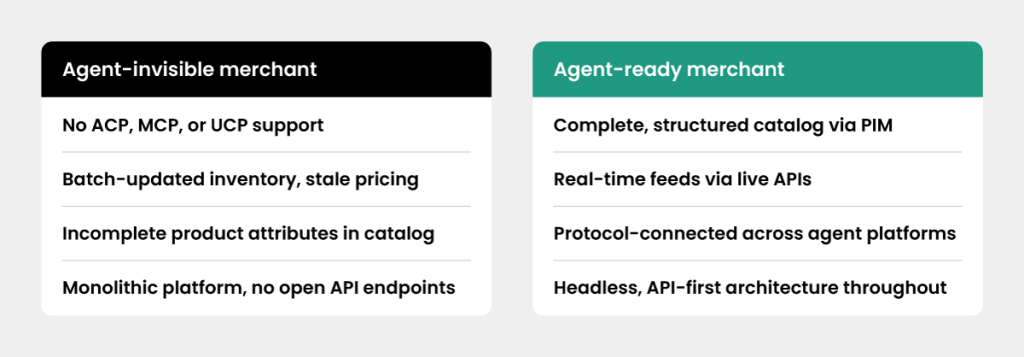
Agentic commerce does not ask brands to build a different product or communicate a different value. It asks them to make the same product and value legible to systems that do not browse. The brands that treat this as an infrastructure question and move on it now are not speculating on the future. They are closing a present gap in discoverability on the highest-converting channel in digital commerce.
— BCG, Agentic Commerce Is Redefining Retail, October 2025
Staying competitive will require more than incremental change. Retailers must fight to reclaim relevance by asserting their presence within AI ecosystems, launching proprietary agents that showcase their brand’s unique edge, and building the technical and organisational foundations to operate at AI speed and scale.
What this Series Covers Next
This pillar establishes the conceptual and definitional foundation. Each of the nine issues that follows drills into a specific, operational dimension of the shift. In the next we cover ‘Why Traditional eCommerce Is Becoming Interface-Led Commerce?’ If agents bypass your UI, what is your website actually for? The role of the storefront is being redefined — from transaction surface to brand trust signal and data source for agents.
Hint: the brands winning this transition are the ones treating their storefront as a product feed, not a showroom.
Stay with us for the next.
Table of Content
- The Zero UI Shift in eCommerce
- Time to Move Beyond the Modern eCommerce Model
- What Agentic Commerce Actually Is?
- How Autonomous Decision-Making Works in Commerce?
- The protocols that make agent transactions possible
- What Agentic Commerce Actually Looks Like in Production
- What this Means for your eCommerce Strategy (Moving Ahead)
- What this Series Covers Next
Subscribe with Us!
Never miss any post, stay tuned!

As Director - Marketing, Zenul leads the marketing and branding at Krish. He brings with him an in-depth understanding of the evolving digital ecosystem and has a proven expertise and experience in strategic planning, market and competition analysis, creating and implementing client-centered, lead-gen and brand marketing campaigns. He has a heart for technology innovation and has been a keynote speaker on various platforms.
Recommended Reading:
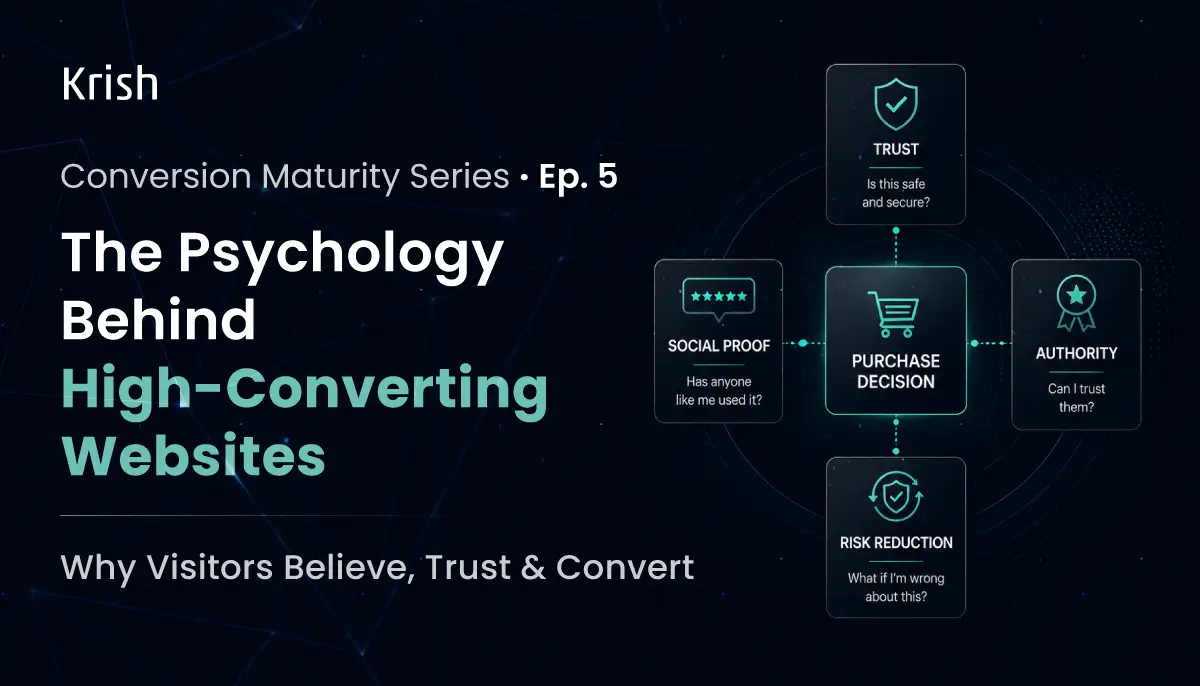
The Psychology Behind High-Converting Websites – Conversion Maturity Series | EP 05
11 June, 2026 Friction never announces itself, but psychology never even gets noticed. A visitor can hit zero friction, fast load, clean form, single CTA, and still walk away unconvinced. Something quieter than friction decided that outcome before the visitor consciously registered the page at all.
Subscribe with Us!
Never miss any post, stay tuned!
Trusted by leading brands


