Introduction
Today, people judge a brand by the complete experience they receive, not by a single interaction or touchpoint. Consumers switch between digital and physical worlds without difficulty while expecting all their experiences to maintain a fast and relevant connection. If a company doesn’t make its customer experiences smooth and connected, customers lose interest due to friction. This can lead to fewer sales and higher costs.
According to PwC, 55% would leave after several bad experiences, 8% after just one, and 32% if experiences are inconsistent.
Achieving this requires omnichannel marketing automation, a system that unifies data and technology across devices, channels, and touchpoints for a frictionless journey. Companies can create a seamless customer journey across all their channels by implementing real-time data solutions that adapt to customer behavior and service process advancements.
It is not just a marketing tool for leaders. The solution enables business expansion through efficient customer communication management and operational improvements, which result in consistent revenue growth throughout extended periods.
In this article, we explain how marketing automation works across different channels, how to automate customer journeys, the business results it can deliver, and why it is important for long-term growth.
The Strategic Shift Toward Orchestrated Customer Journeys
The cost of customer acquisition is increasing, and companies are finding it difficult to develop lasting loyalty and retention. This requires companies to move from handling the marketing process as a distinct activity to manage the entire omnichannel customer journey.
Research highlights that omnichannel consumers shop 70% more frequently than single-channel shoppers.
Modern businesses require a single integrated system that connects emails, texts, ads, websites, apps, calls, and offline communication channels. Brands need to identify customers through all interaction points because customers expect complete recognition of their identity throughout their entire journey.
The current change represents a larger industry movement that establishes personalized customer experience methods that use omnichannel marketing strategies as their foundation.
The complete engagement system of omnichannel marketing automation combines customer data with decision-making rules and real-time activation triggers into a single unified system. Businesses develop interconnected customer experiences that adapt to customer behavior, intent, and lifecycle events instead of relying on separate customer interactions.
This change in marketing could take it from a broadcast activity into a broad revenue orchestration capability.
How Marketing Automation Works in an Omnichannel Context?
In an enterprise environment, marketing automation is no longer limited to email workflows. It functions as an integrated system that connects multiple channels, including email, SMS, paid media, web personalization, mobile apps, and customer support touchpoints.
An omnichannel marketing automation framework operates on three foundational layers:
1. Unified Data Layer
Data from CRM, web analytics, eCommerce, mobile, and customer service needs to be integrated into a single profile. This helps in creating a consistent customer identity that keeps changing with every interaction and helps in having an overall omnichannel commerce strategy that is based on a seamless cross-channel buying experience.
Without identity resolution and unified data, cross-channel coordination is not possible.
2. Decisioning and Orchestration Engine
The system uses a foundational rules-based system, which receives increasing support from artificial intelligence technology. The engine monitors customer activities through its ongoing assessment of site visits and cart abandonment, product viewing, and service interactions to establish optimal follow-up steps.
For example:
- Visiting a pricing page again might show the user helpful content that explains products or services.
- A lapsed customer might receive a retention incentive.
- High-value customers may be routed toward premium support pathways.
The operational system of cross-channel marketing automation works by managing marketing activities through their complete sequence of email and SMS, push notifications, advertising, sales outreach, and website personalization.
3. Channel Execution Layer
Execution occurs simultaneously across channels, but under centralized logic. Messaging is coordinated, not duplicated. Timing is optimized. Frequency is controlled.
The outcome provides customer engagement that remains consistent throughout time without creating problems of overexposure or conflicts between different channels.
Our eBook provides a complete examination of omnichannel marketing automation frameworks together with strategic implementation details, which businesses can use to develop customer journey automation systems.
Further reading
Free ebookThe Complete Guide to Omnichannel Marketing Automation for eCommerce
For ecom managers and CMOs looking to unify their customer experience across every channel — and automate it at scale.
Aligning Automation with Business Objectives Across the Customer Journey
Executives often underestimate the difference between campaign automation and customer journey automation.
Campaign automation is event-based and time-bound. Customer journey automation is lifecycle-driven and dynamic, aligning engagement with key business stages such as acquisition, onboarding, cross-selling, retention, and loyalty.
Many businesses start by implementing structured automation workflows across multiple channels, from email to SMS and app notifications, before expanding to full omnichannel orchestration. These workflows cover scenarios like cart recovery, welcome journeys, post-purchase follow-ups, and VIP customer programs.
For example, in a journey-driven approach:
- A prospect downloads a whitepaper.
- The system scores intent and customizes content sequencing.
- Website experiences adjust dynamically.
- Sales is alerted when readiness thresholds are reached.
- Post-purchase onboarding flows activate automatically.
Each stage of the customer journey builds on the previous one. The process of automating customer journeys should be executed to drive revenue growth instead of achieving better communication results.
Business Impact: Revenue, Efficiency, and Scalability
The benefits of omnichannel automation extend well beyond marketing productivity. When implemented strategically, it influences core business performance metrics.
-
Revenue Acceleration
The business raises its revenue through omnichannel engagement because customers receive seamless instant shopping access at every contact point. The combination of personalized follow-ups, intelligent offers, and scheduled messages increases the average order value (AOV) and customer lifetime value (CLV) of the business.
Omnichannel marketing automation allows companies to gain insights into consumer purchasing habits. The company uses data to identify customers who will stop purchasing from them and implements retention solutions through preemptive action.
-
Operational Efficiency
Manual campaign management is not scalable. As product offerings grow and customer segments increase, the complexity of operations grows exponentially.
Customer journey automation eliminates manual segmentation and reactive campaign planning. Marketing professionals move from executing to optimizing and refining.
A study by Nucleus Research found that marketing automation boosts sales productivity by 14.5% and reduces marketing overhead by 12.2%.
For mid-market and enterprise businesses, this means:
- Reduced dependency on manual list management
- Lower error rates in messaging
- Faster time-to-market for new initiatives
-
Scalable Growth Infrastructure
Commonly, growth initiatives get stuck as systems are unable to accommodate growing complexity; omnichannel marketing automation allows businesses to scale, so everyone has a place.
- Geographic expansion
- Multi-brand portfolios
- Increased traffic volumes
- Diverse product categories
Instead of rebuilding processes with each expansion phase, organizations scale on top of an established orchestration framework.
Implementation Considerations for Leadership Teams
The transition to omnichannel marketing automation is organizational as much as technological.
-
Data Governance and Architecture
Automation quality depends on data integrity. Fragmented or poorly governed data results in inconsistent engagement. Executive sponsorship is required to prioritize data unification initiatives.
This may involve:
- Master data management alignment
- Identity resolution strategies
- Real-time data pipelines
- Clear data ownership models
Without these foundations, even the most advanced system underperforms.
-
Process Redesign
The practice of automating ineffective processes creates more operational problems for organizations. Organizations need to map their existing customer journeys and find all friction points before they start using cross-channel marketing automation.
-
Organizational Capability
Customer journey automation is a cross-functional effort, needing collaboration across marketing, IT, analytics, and operations. Governance frameworks must articulate:
- Journey ownership
- KPI accountability
- Testing protocols
- Optimization cycles
Marketing automation best practices require businesses to begin their implementation process through incremental deployment, which begins with their most valuable customer journeys and expands from there.
Measurable Outcomes and Performance Metrics
For CXOs, investment justification depends on quantifiable results, particularly in marketing automation, where performance is closely linked to revenue growth and the speed of converting prospects into customers. Conversion rate improvement
- Reduced churn rates
- Increased customer lifetime value
- Faster campaign deployment cycles
- Lower cost per acquisition
- Higher retention and repeat purchase rates
Beyond marketing metrics, operational indicators also improve. Fewer manual interventions reduce overhead costs. Predictive triggers lower service escalation rates. Data-driven targeting reduces wasted media spend.
The cumulative effect is improved revenue predictability.
If you want to explore how these outcomes apply specifically to B2B businesses, read our guide on Marketing Automation for B2B Businesses – Benefits and Key Trends.
Marketing Automation Best Practices for Enterprise Scale
Those that get the most out of omnichannel marketing automation operate on a shared set of principles:
Prioritize Lifecycle Mapping Over Channel Planning
Customer stages start with strategic customer stages and then advance through customer awareness, customer consideration, customer purchase, customer onboarding, and customer retention. The journey needs to use channels because channels do not exist to serve the journey.
Design for Real-Time Responsiveness
Batch campaigns limit agility. Real-time triggers and behavioral scoring enable contextual engagement that reflects immediate customer intent.
Integrate Analytics into Journey Design
Journey orchestration must be measurable. Embedding performance tracking into every touchpoint ensures continuous optimization rather than static workflows.
Enable Continuous Experimentation
A refined customer engagement platform enables A/B testing and multivariate analysis. Improvement adds up over time.
To understand the application of these marketing automation best practices to enterprise-level results, explore our omnichannel marketing services and learn how to leverage scalable, cross-channel customer engagement.
The Future of Omnichannel Marketing Automation
The future of omichannel marketing automation is leaning towards autonomous decisions with support from more advanced AI and predictive analytics. Three developments are shaping the next stage:
1. AI-Driven Orchestration
Systems increasingly determine optimal channel, timing, and content without manual rule configuration.
2. Privacy-Centric Architecture
With strict data regulations, organizations require consent management systems together with first-party data strategies, which they need to develop sustainable automated operations.
3. Revenue-Oriented KPIs
Marketing metrics are converging with financial performance indicators. Automation strategies will be evaluated on profitability impact, not engagement volume.
Conclusion: Omnichannel Marketing Automation as a Growth Enabler
Omnichannel marketing automation is not a short-term marketing enhancement. It is a growth infrastructure investment.
By aligning data analytics, decisioning, and operations across channels, companies can gain:
- Revenue scalability without corresponding cost investments
- Operational efficiency in complex product environments
- Consistency in customer engagement
- Predictable retention and lifetime value growth
From an executive perspective, the decision is not whether to automate, but how to effectively utilize the automation abilities that will help facilitate growth.
Those who understand the value of customer journey automation as a core business system, not just a marketing vehicle, are poised for success in a competitive marketplace.
Successful companies will be the ones that fully include cross-channel marketing automation in the way they run their business. The company will develop its customer engagement system through continuous improvements, which will lead to its business growth.
At Krish, we work with enterprises to design and implement omnichannel marketing automation solutions as a strategic growth driver. Our strategy is to use data, technology, and business goals to provide scalable customer journey automation with business outcomes. Our aim is to develop marketing automation architectures for various channels to enhance customer engagement and drive sustainable growth.
Get in touch with our experts and start building connected customer journeys that drive measurable revenue growth.
Table of Content
- Introduction
- The Strategic Shift Toward Orchestrated Customer Journeys
- How Marketing Automation Works in an Omnichannel Context?
- Aligning Automation with Business Objectives Across the Customer Journey
- Business Impact: Revenue, Efficiency, and Scalability
- Implementation Considerations for Leadership Teams
- Measurable Outcomes and Performance Metrics
- Marketing Automation Best Practices for Enterprise Scale
- The Future of Omnichannel Marketing Automation
- Conclusion: Omnichannel Marketing Automation as a Growth Enabler
Subscribe with Us!
Never miss any post, stay tuned!

As Director - Marketing, Zenul leads the marketing and branding at Krish. He brings with him an in-depth understanding of the evolving digital ecosystem and has a proven expertise and experience in strategic planning, market and competition analysis, creating and implementing client-centered, lead-gen and brand marketing campaigns. He has a heart for technology innovation and has been a keynote speaker on various platforms.
Recommended Reading:
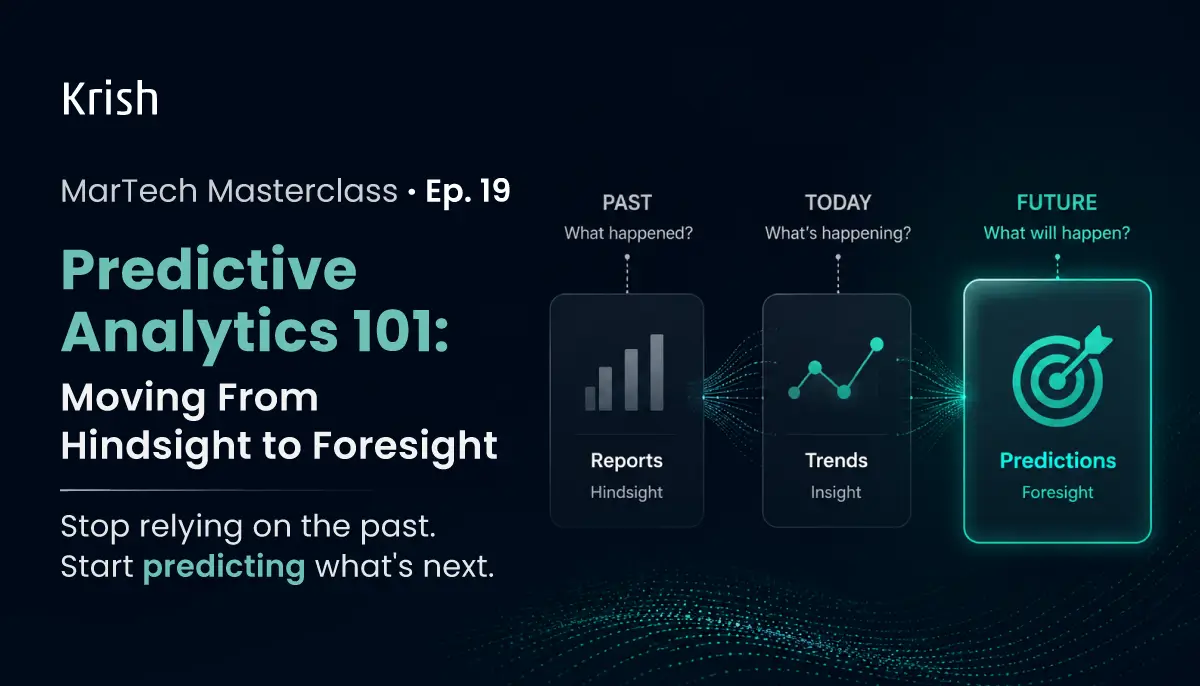
Predictive Analytics 101: Moving From Hindsight to Foresight – MarTech Masterclass Series Ep | 19
9 July, 2026 Most MarTech stacks are architecturally optimized for one thing: describing the past. Revenue last quarter, churn in the last 90 days, campaign performance last week - the dashboards are polished and the data looks clean. Yet every output from that stack is a response to something that has already happened. The customer already churned. The demand spike already passed. The high-value cohort already drifted before anyone noticed.
Subscribe with Us!
Never miss any post, stay tuned!
Trusted by leading brands


