Introduction
Most ecommerce brands that run WebEngage are not running WebEngage.
They are running a more expensive version of what they were doing before, cart abandonment reminders, newsletter blasts, discount broadcasts, and audience filters built on demographic logic that was outdated the moment it was created.
The platform has the capability. The data exists. The use cases are live in production at brands that are outperforming their category. The gap is not access. It is operationalization.
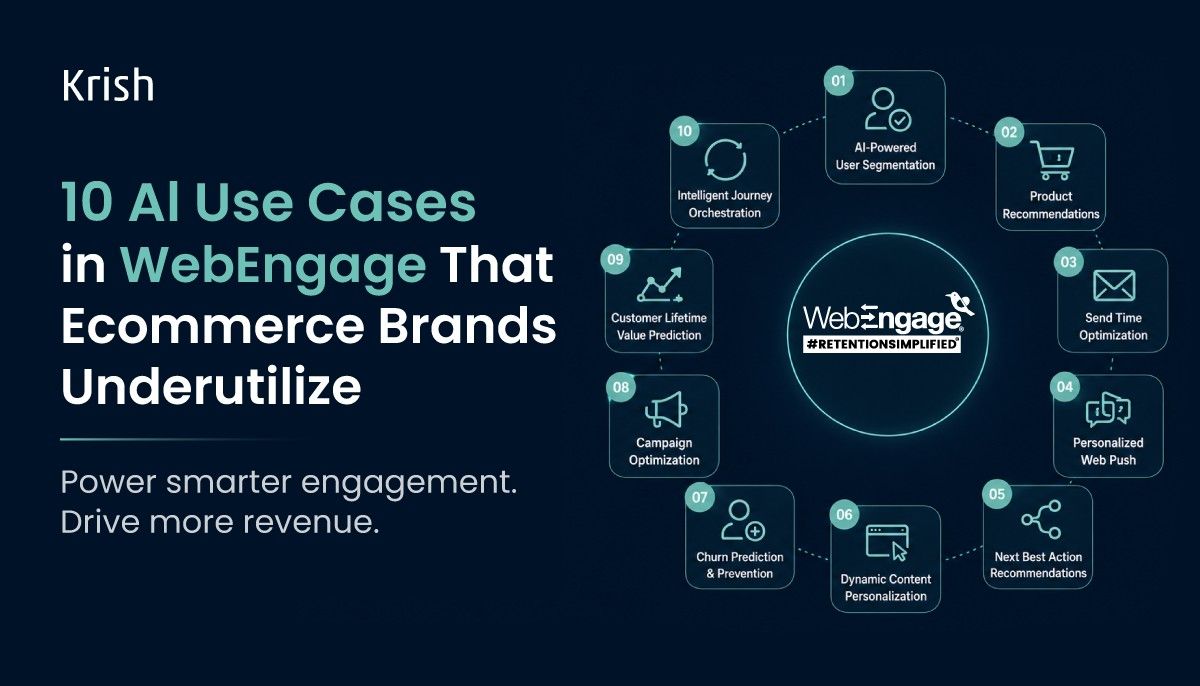
This article covers 10 AI use cases in WebEngage that most ecommerce brands have access to but are not using with any seriousness and what it actually takes to make each one work.
Why This Gap Exists
Before the list, it is worth naming the real problem.
Most ecommerce marketing teams are organized around campaign output. Campaigns sent. Open rates achieved. Discounts deployed. The measurement frame rewards activity, not intelligence. In that environment, AI features get used when they are easy to configure and ignored when they require a data foundation or a change in how the team thinks about customers.
The result is that the same platform produces wildly different outcomes across brands: not because of feature access, but because of how deeply the team is willing to instrument their customer data and trust behavioral signals over intuition.
That context matters for every use case below.
1. Next-Best-Product Recommendations
Most recommendation logic in production today is still rule-based: recently viewed, frequently bought together, trending in category. These are fine. They are also leaving significant conversion probability on the table.
AI-driven next-best-product models work differently. They analyze purchase history, browsing sequences, category affinity, price sensitivity, and lifecycle stage together, not as separate filters, but as a combined behavioral signal. The output is not just a product the customer might want. It is a product the customer is statistically likely to purchase next, at this moment in their journey.
The use cases that benefit most: skincare and personal care (routine sequencing), electronics (accessory attachment), fashion (styling combinations), and any category with replenishment cycles.
The operational requirement most brands skip: the model needs feedback. Recommendation performance must flow back into the system to refine future predictions. A recommendation engine running without a feedback loop is a static model wearing the label of AI.
2. Predictive Churn Detection
The standard retention playbook triggers a win-back campaign when a customer has been inactive for 60 or 90 days. By that point, the customer has already formed a habit of not purchasing from you. Recovery at that stage costs more and converts less.
AI churn models detect the leading indicators before behavior goes dark: declining session frequency, reduced email engagement, lengthening purchase intervals, narrowing category exploration, reduced browsing depth. These signals appear weeks before a customer enters the technical definition of “inactive.”
The intervention window that predictive churn opens is significantly more valuable than the win-back window most brands are targeting. A customer showing early disengagement signals is still reachable through a relevant product recommendation or a loyalty prompt. A customer who has been inactive for three months needs a significantly stronger reason to return.
The practical requirement: the churn model needs a defined threshold and a mapped intervention for each risk tier. Identifying at-risk customers without a clear next action is just a more expensive way to watch churn happen.
Further Reading
How to Track Funnel Drop-Offs in GA4: Step-by-Step Guide for Ecommerce
Predictive churn models detect disengagement signals before customers go dark. But you first need to know where users are dropping off. This GA4 guide walks through how to build that visibility into your funnel — step by step.
Read the full blog →3. Send-Time Optimization
Timing is not a small variable. A message sent outside a customer’s active window competes with everything else that has arrived since, and in most inboxes and notification trays, it loses.
AI send-time optimization analyzes individual-level patterns: when each customer opens, clicks, browses, and transacts. It then schedules delivery for the window with highest engagement probability for that specific user, not for the segment average.
The distinction matters. Segment-level send-time logic says “our best open window is Tuesday at 11am.” Individual-level optimization says “this customer opens on weekday evenings, this customer responds on Saturday mornings, this customer is active during lunch hours.” These are not the same audience and they should not receive the same send schedule.
The brands that use this feature correctly see open rate improvement not because of creative changes, but because the message arrived when the customer was actually present.
4. Frequency Optimization
Message fatigue is a slow, invisible form of list decay. It does not announce itself. Open rates drift down. Unsubscribes tick up. Notification permissions get revoked. By the time the team notices, the engagement baseline has already shifted.
AI frequency optimization determines how often each customer should receive communication based on their demonstrated responsiveness, not based on campaign calendar logic. High-engagement customers can tolerate and may benefit from frequent contact. Low-engagement customers need reduced frequency and higher relevance per message, not more volume.
The default state at most brands is the opposite: the same cadence for everyone, calibrated to whatever the marketing calendar demands. That approach serves the team’s workflow, not the customer’s attention span.
5. Predictive Cohort Creation
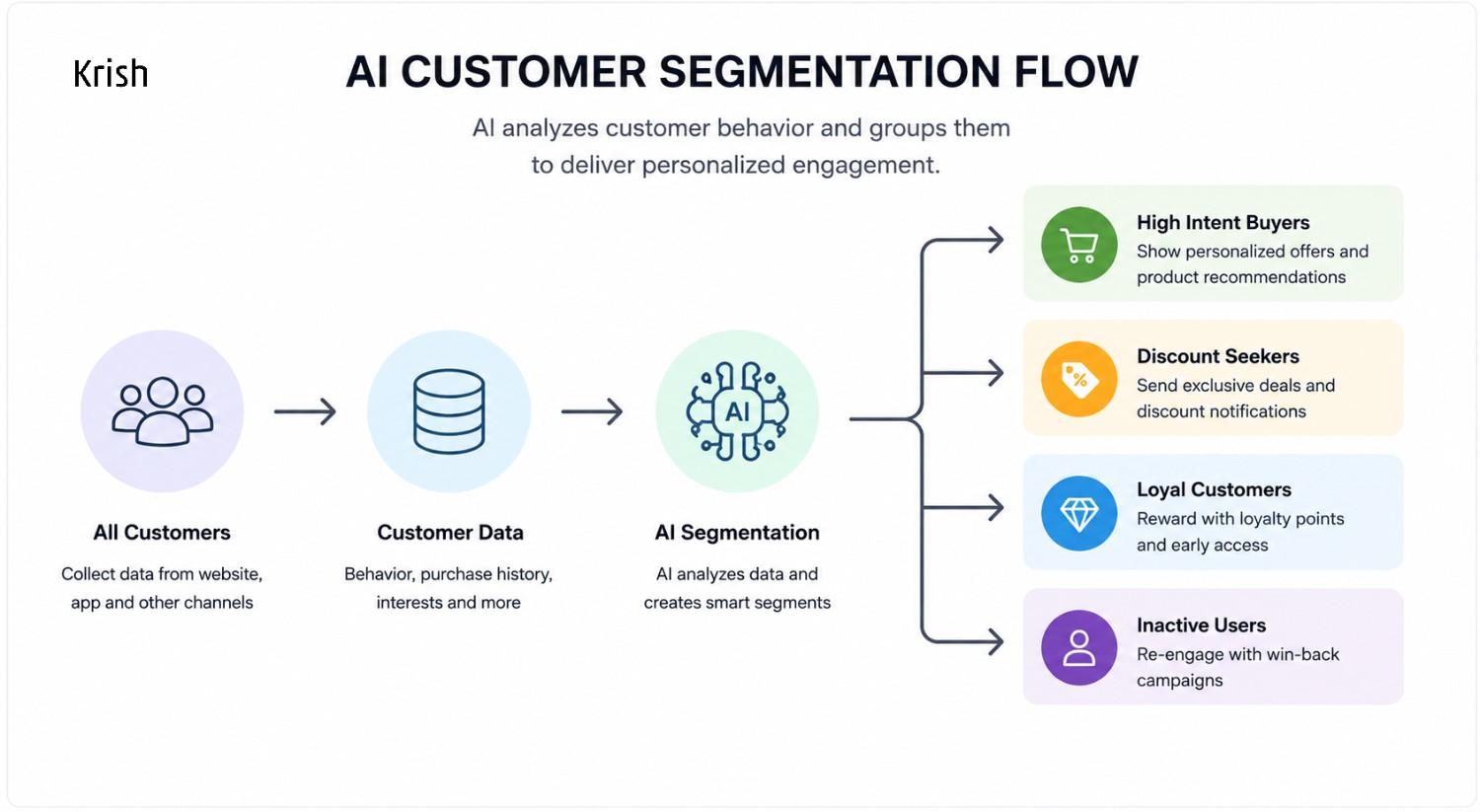
Traditional segmentation answers the question: who is this customer? AI-powered predictive cohorts answer a different question: what will this customer do next?
The segments that drive real campaign performance are behavioral and forward-looking. Users likely to purchase in the next 14 days. Users showing early churn signals. High-intent visitors who have not yet transacted. Discount-sensitive buyers who respond to urgency framing. Premium buyers who disengage when messaging feels mass-market.
These cohorts update automatically as behavioral signals shift. A customer moves out of the high-intent segment the moment they convert. A customer enters the at-risk segment when their engagement pattern changes. The campaign eligibility is always current.
The failure mode: predictive cohorts built once and not connected to exit logic. A customer who converted last week should not still be receiving high-intent conversion messaging. Dynamic membership requires dynamic suppression.
6. Intelligent Channel Selection
Different customers respond to different channels. This is not a new insight. What AI changes is the ability to act on it at scale without manual rules for every combination.
AI channel selection in WebEngage analyzes each customer’s historical response across push notifications, email, SMS, WhatsApp, and onsite messaging. It determines not just the best channel for a given customer, but the right escalation sequence when the primary channel does not produce a response.
Push ignored, send WhatsApp. Email unopened after a defined window, trigger an onsite message at next session. The logic adapts to customer behavior rather than defaulting to a fixed channel hierarchy that applies equally to everyone.
The operational dependency: this only works if cross-channel event data is being captured cleanly. Channel selection AI fed by incomplete engagement data will optimize toward the wrong conclusions.
7. AI-Powered Product Affinity Modeling
Customers reveal their preferences through behavior. The problem is that most brands only read explicit signals, what was purchased, rather than the fuller behavioral picture of how customers explore, compare, and engage across categories.
Affinity modeling captures the implicit signals: which categories a customer repeatedly returns to, which price points they consistently engage with, which product attributes appear across their browsing history. A customer who repeatedly views luxury skincare but has only purchased mid-tier products may have an unmet aspiration that the right offer can close.
This has direct application in WebEngage journeys. Affinity-based personalization changes the products shown in recommendations, the creatives deployed in campaigns, and the offers that trigger in high-intent moments. Brands using this effectively move beyond “what did they last buy” to “who is this customer commercially.” and that shift starts with getting multichannel personalization right.
8. Dynamic Customer Lifecycle Scoring
A customer who was a Champion six weeks ago may be showing early disengagement signals today. A first-time buyer who looked like a one-time purchaser may have just shown a behavior pattern that indicates high repeat probability.
Static lifecycle labels miss both of these. AI-driven lifecycle scoring evaluates customers continuously, engagement depth, purchase probability, churn risk, loyalty strength, revenue potential, and updates their score as signals change.
The operational payoff is resource allocation. High-value at-risk customers get aggressive retention treatment. Low-intent or low-value customers get lighter engagement. The marketing spend follows the actual commercial opportunity rather than being distributed equally across a list that has very different revenue potential sitting inside it.
9. Automated Experimentation
Manual A/B testing has real limits: it is slow, it tests one variable at a time, and the insights it generates take weeks to produce and longer to implement. For brands sending campaigns across multiple segments and channels, the testing backlog grows faster than the team can clear it.
AI-assisted experimentation in WebEngage can run concurrent tests across subject lines, send times, creative variations, channel combinations, and offer structures. The system learns what works for different customer groups and shifts traffic toward higher-performing variants without waiting for a manual review cycle.
The cultural requirement is the harder one: teams need to trust the system’s conclusions even when they conflict with intuition. Automated experimentation that gets overridden whenever results feel surprising is not experimentation. It is confirmation bias with extra steps.
Further Reading
MarTech Maturity: Why It's Your Competitive Advantage
Automated experimentation works best inside a mature MarTech ecosystem. This article explains what MarTech maturity actually means — and how brands at different stages should think about testing, orchestration, and AI activation.
Read the full blog →10. Real-Time Intent Detection
This is the use case with the highest ceiling and the widest gap between capability and actual deployment.
AI real-time intent detection reads behavioral signals as they happen: repeated product views within a session, rapid comparison browsing across similar SKUs, checkout entry followed by hesitation, wishlist activity on high-margin products, return visits to a page viewed days earlier. Each of these is a signal about where the customer is in their decision process right now — not where they were last week.
The intervention can be immediate: a personalized urgency message, a low-inventory alert, an assistance prompt, a targeted offer that addresses the specific friction point the behavior suggests. The window is short. A customer in active consideration who receives a relevant nudge converts at a significantly higher rate than the same customer who receives a scheduled campaign tomorrow morning.
Most brands are not using this because it requires real-time event streaming and a trigger architecture that operates in seconds, not in batch cycles. That infrastructure investment is the actual barrier, not the absence of the feature.
The Common Thread
Across all ten use cases, the difference between brands using AI effectively and brands that are not comes down to three things.
Data quality. AI produces intelligent outputs when it is fed clean, comprehensive behavioral data. Poor event tracking, disconnected catalog data, and unresolved identity graphs all limit what the system can actually see. The AI is not the investment. The data foundation is.
Feedback loops. Every AI model improves through outcome data. Recommendation performance, churn intervention results, channel response rates, send-time lift — all of this needs to flow back into the system. AI running without feedback loops does not improve. It calcifies.
Exit logic and suppression. The use cases above all involve triggering on behavioral signals. The part most teams underinvest in is removing customers from those triggers when the triggering condition no longer holds. A customer who converted should not receive the conversion campaign. A customer who reactivated should not receive the win-back sequence. Without suppression architecture, AI-driven campaigns create exactly the kind of experience they were supposed to prevent.
WebEngage has the capability for all of this. The question for most ecommerce brands is not whether these use cases are available.
The question is whether the data foundation, the campaign architecture, and the team’s measurement frame are built to support intelligence — or just to support activity.
That distinction is worth spending time with before the next campaign planning cycle begins.
Further Reading
Top 20+ eCommerce Marketing Automation Tools
Once your data foundation is solid and feedback loops are in place, tool selection matters. This guide breaks down 20+ ecommerce marketing automation tools — organized by business size and use case — to help you build the right stack.
Read the full blog →Table of Content
- Introduction
- Why This Gap Exists
- 1. Next-Best-Product Recommendations
- 2. Predictive Churn Detection
- 3. Send-Time Optimization
- 4. Frequency Optimization
- 5. Predictive Cohort Creation
- 6. Intelligent Channel Selection
- 7. AI-Powered Product Affinity Modeling
- 8. Dynamic Customer Lifecycle Scoring
- 9. Automated Experimentation
- 10. Real-Time Intent Detection
- The Common Thread
Subscribe with Us!
Never miss any post, stay tuned!

Minal Joshi is a content marketer at Krish with a flair for eCommerce and Digital Commerce aspects. She is a MarTech fanatic with a knack of writing with which, she helps brands to curate, create, & commence digital brand positioning. Sharing insights via articles, case studies, eBooks, Infographics, and other forms of content creation is what she lives for. Being an ardent traveler, when not writing, you'll find her sipping coffee into the mountains or petting a stray.
Recommended Reading:
The Hidden Cost of Friction in Digital Journeys – Conversion Maturity Series | EP 04
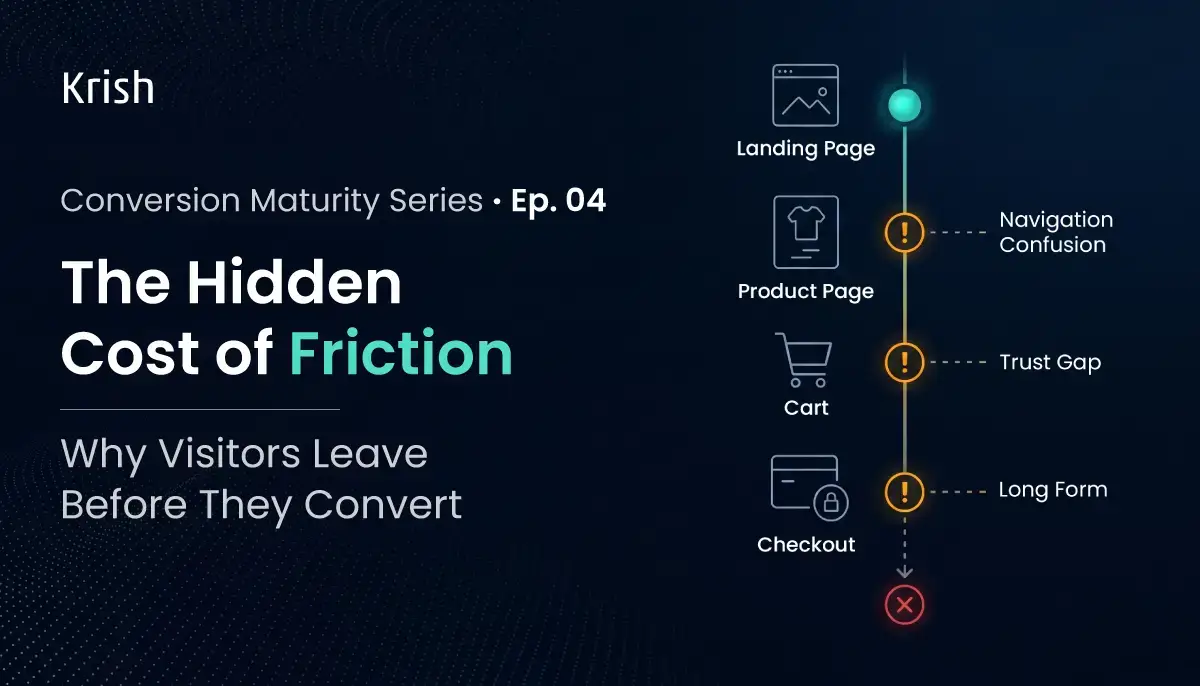
5 June, 2026 Friction never sends you an invoice. It just costs unannounced. No visitor thinks "this experience has too much friction." They just leave. No complaint filed. No reason given. Just another exit your analytics logs without explanation.
Subscribe with Us!
Never miss any post, stay tuned!
Trusted by leading brands


