
Quick Answer
Brands are moving off Magento to Shopify Plus in 2026 because Adobe Commerce 2.4.4 support ended in April 2026 (2.4.5 ends August 2026), Shopify Scripts fully retired on June 30, 2026, and self-hosted Magento’s total cost of ownership ($4,000–$15,000+/month) is now 2–5x higher than Shopify Plus’s managed SaaS pricing (~$2,300–$2,500/month). A typical migration takes 3–6 months, costs $20,000–$250,000+ depending on complexity, and, done correctly, preserves SEO rankings while improving site speed, checkout conversion, and B2B scalability.

Why Ecommerce Brands Are Moving from Magento to Shopify Plus in 2026
A Magento to Shopify Plus migration used to be a niche move for small stores outgrowing WooCommerce. In 2026, it’s become the default replatforming path for mid-market and enterprise sellers. Magento has always been praised for flexibility, but that flexibility comes bundled with infrastructure ownership, hosting, patching, PCI compliance, and a dedicated dev team just to keep the lights on. That cost curve has gotten steeper this year, and three hard deadlines are forcing the decision rather than just encouraging it.
Global ecommerce is also scaling fast enough that platform choice now has real competitive weight: global ecommerce sales are projected to reach $6.88 trillion by the end of 2026, accounting for 21.1% of all retail worldwide, according to eMarketer’s Worldwide Retail Ecommerce Forecast, as referenced by Shopify. Brands competing at that scale can’t afford a platform that slows down every new initiative, which is exactly the gap Shopify Plus migration services are built to close.
What's Actually Driving the Magento Exodus in 2026 - 5 Trigger Points
1. Adobe’s licensing squeeze on Magento Open Source
Adobe has spent 2026 steadily pushing Magento Open Source users toward paid Adobe Commerce Cloud licensing. According to Conversion Design’s 2026 Magento-to-Shopify migration guide, Adobe’s April 2026 push to consolidate Magento Open Source users into Adobe Commerce Cloud licensing is quietly making merchants check the door for brands that chose Magento because it was free, that shift changes the cost math entirely.
2. Hard end-of-support deadlines and PCI risk
Per No7 Software’s 2026 replatform timeline, Adobe Commerce 2.4.4 regular support ended April 2025; extended security support ended April 2026. For 2.4.5, regular support ended August 2025, with extended support ending August 2026. Merchants on either version face real PCI compliance risk. Bemeir’s Magento 1 replatforming analysis adds that roughly 14% of Magento-based stores are still running Magento 1, which has been end-of-life since June 2020.
3. Shopify Scripts sunset even for existing Shopify Plus brands
This one cuts both ways. Per Shugert’s Shopify migration timeline, Shopify Scripts (the older Ruby-based checkout tool) was removed from the App Store for new merchants in August 2024, frozen from editing on April 15, 2026, and hit full end-of-life on June 30, 2026. Any custom checkout logic, discount rules, “Buy X Get Y,” bundled shipping, now has to be rebuilt in Shopify Functions, and that rebuild is standard scope in any 2026 migration.
4. Rising total cost of ownership on self-hosted Magento
Shopify Plus pricing starts around $2,300–$2,500/month on a multi-year contract. A comparable self-hosted Magento setup runs $4,000–$15,000+/month once hosting, security patching, and dev resources are counted, per Suplex’s Magento to Shopify Plus migration breakdown. For most merchants under ~$25M in annual revenue, that gap alone tips the decision.
5. Migration volume is already proving the trend out
This isn’t theoretical, it’s happening at scale right now. Shopping Cart Migration’s March 2026 momentum report recorded a single Magento-to-Shopify transfer of 267,626 data entities in one month, with 46% of all migrations that month coming from mature stores 8+ years old, signaling what the report calls a “Great Replatforming” among established brands.
Further reading
How Kitchen Company Achieved Lightning-Fast Load Times and Drove Triple-Digit Growth in Traffic, AOV, and ROI
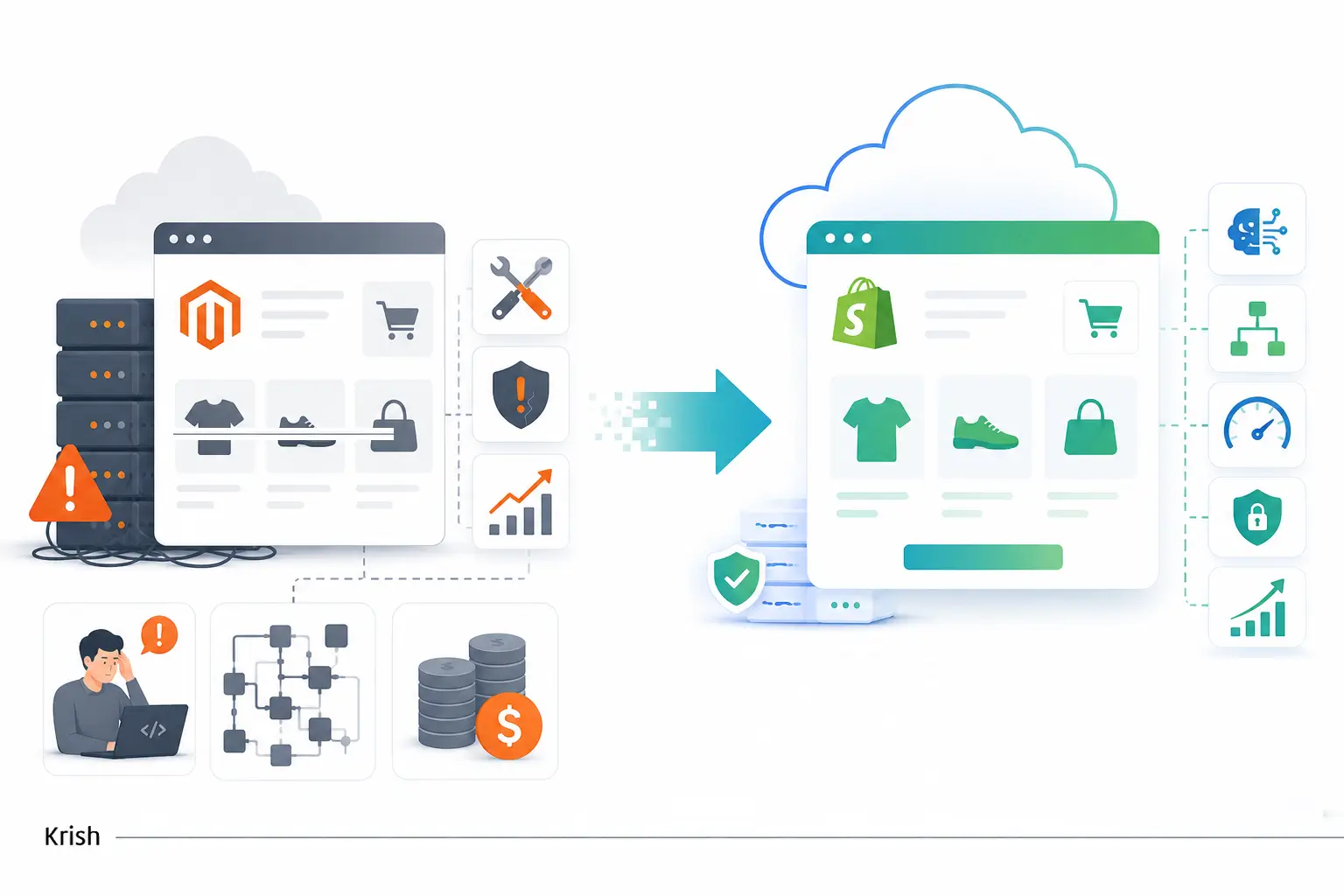
Magento vs. Shopify Plus: What Actually Changes (Architecture Mapping)
A Magento-to-Shopify-Plus move is not a lift-and-shift, it’s an architectural translation. Here’s what maps to what:
- EAV attributes → Metafields & Metaobjects: Magento’s Entity-Attribute-Value database structure doesn’t exist in Shopify. Custom product attributes get remapped onto metafields and metaobjects, which handle merchandising flexibility differently but achieve the same outcome.
- Multi-store setup → Shopify Markets: Magento’s multi-website structure is replaced by Shopify Markets, handling regional pricing and currency from one Shopify Plus org up to nine expansion stores under shared reporting and billing.
- Customer groups → Native B2B catalogs: Company accounts, custom price lists, net payment terms, and a dedicated B2B storefront now come native, no third-party apps required.
- Custom checkout scripts → Checkout Extensibility & Shopify Functions: Checkout logic moves to Shopify’s Checkout Extensibility framework, built on Rust/JavaScript, replacing what used to live in Magento’s backend.
- Fixed URL structure: Shopify uses a fixed /products/ and /collections/ structure that rarely matches Magento’s URL patterns, which is why 301 redirect mapping is non-negotiable during cutover, per Web-Systems Solutions’ 2026 replatforming guide.
The Migration Process: 7 Steps From Magento to Shopify Plus
- Discovery & audit: Catalog complexity, EAV attribute count, integration map (ERP, 3PL, ESP, loyalty), and a documented rollback plan before anything moves.
- Strategy & scoping: Decide Liquid theme vs. headless Hydrogen build, and map every Magento extension to its closest Shopify app equivalent (don’t assume feature parity, audit it).
- Data migration: Products, customers, order history, blog posts, and CMS pages get transferred with full validation.
- SEO redirect mapping: 301 redirects for every legacy URL, preserved meta titles/descriptions, and schema markup carried over intact.
- Storefront & checkout build: Theme development targeting Core Web Vitals (LCP under 2.5s, INP under 200ms on mobile), plus Checkout Extensibility configuration.
- Soft cutover: Route a small percentage of traffic to the new store first, keeping Magento live for a short overlap window (commonly ~2 weeks) to catch order-routing or webhook issues.
- Post-launch monitoring: Daily Search Console checks for the first 14 days (crawl errors, indexing, Core Web Vitals), then a full 60-day performance review against pre-migration benchmarks.
For a full point-by-point breakdown of this process, Krish’s own 18-point eCommerce migration checklist covers what most guides skip, especially around search-ranking protection.
Results Brands Can Expect After Migrating to Shopify Plus
- Faster sites, no DevOps overhead. Shopify Plus removes server management entirely, no patching, no scaling decisions, which compounds directly into conversion since speed is one of the most reliable levers in conversion rate optimization.
- Native B2B and multi-store scalability, without the third-party apps Magento required, is now built into Shopify Plus itself.
- Faster checkout completion via Shop Pay and mobile-first checkout, one of the single biggest conversion levers available post-migration.
- Real client outcomes on record: Southern Season saw a 200% rise in store footfall, 166%+ higher average order value, and 150% ROI growth after moving from Magento Cloud to Shopify Plus.
Brands that pair the platform switch with a structured conversion funnel analysis tend to catch new-platform friction points faster than teams that assume the migration alone fixes everything.
Real-world result
How Southern Season Revived Foot Traffic and Boosted Revenue Through Smart Digital Strategy
2026-Specific Trends Shaping These Migrations
- Agentic commerce & MCP support. Per Shugert’s 2026 timeline, migrations now increasingly prioritize UI extensions and the Model Context Protocol (MCP) so AI-driven shopping assistants can interact directly with a storefront’s product-discovery layer from day one, no longer a future add-on, but a launch requirement.
- Headless builds on Hydrogen. High-volume brands moving off Magento are choosing Shopify’s Remix-based Hydrogen framework for sub-second load times while keeping Shopify Plus’s backend and checkout, a natural next step once advanced Shopify Plus features on a themed store aren’t enough.
- SEO-first migration discipline. 2026 playbooks treat SEO as a parallel workstream, not an afterthought, redirect mapping, schema preservation, and alt-text audits run alongside the technical build, tying directly into Shopify Plus SEO offerings.
- Analytics continuity. Brands are pairing platform migrations with a parallel move to GA4 so historical performance data isn’t lost in the same window as the platform switch.
- Checkout logic rebuilt as WebAssembly Functions. With Shopify Scripts gone by June 30, 2026, migrating brands are required to rewrite legacy Ruby-based logic into Shopify Functions before DNS cutover, this is now a hard technical dependency, not optional polish.
- Regional/market-specific replatforming. Per Suplex’s UAE-focused analysis, regional brands are building Shopify Markets, local payment gateways, and mobile-first design into migration scope from day one rather than as a post-launch add-on.
Further reading
What Does "A Conversion" Actually Mean?
Most ecommerce teams only measure purchases as conversions and overlook the customer actions that drive them. Learn the difference between macro and micro conversions, how to track both, and build a stronger CRO strategy.
Read the full blog →How Krish TechnoLabs Helps Brands Migrate From Magento to Shopify Plus
Krish runs Magento-to-Shopify-Plus migrations end-to-end, discovery and audit, SEO-safe data migration, storefront rebuild, checkout and B2B configuration, and post-launch monitoring. As a Shopify Plus partner with over two decades in eCommerce, the team also supports brands through broader Shopify migration services, general platform replatforming, and ongoing storefront work via its Shopify development agency once the new store is live.
Further reading
Shopify Plus CRO Audit Checklist for 2026
Most Shopify Plus stores have hidden conversion bottlenecks that traditional audits overlook. Follow this comprehensive CRO audit checklist to identify optimization opportunities and drive long-term ecommerce growth.
Read the full blog →Frequently Asked Questions
Table of Content
- Quick Answer
- Why Ecommerce Brands Are Moving from Magento to Shopify Plus in 2026
- What's Actually Driving the Magento Exodus in 2026 - 5 Trigger Points
- Magento vs. Shopify Plus: What Actually Changes (Architecture Mapping)
- The Migration Process: 7 Steps From Magento to Shopify Plus
- Results Brands Can Expect After Migrating to Shopify Plus
- 2026-Specific Trends Shaping These Migrations
- How Krish TechnoLabs Helps Brands Migrate From Magento to Shopify Plus
Subscribe with Us!
Never miss any post, stay tuned!

Manthan is the Director of Solutions at Krish, specializing in solution architecture, strategy, and client engagement. With expertise in eCommerce, Enterprise CMS, cloud solutions, and integrations, he is passionate about bridging technology and business to drive innovation and efficiency. As a techno-functional consultant and SME, he helps brands optimize technology stacks, streamline operations, and scale effectively, enabling sustainable digital transformation in an ever-evolving landscape.
Recommended Reading:
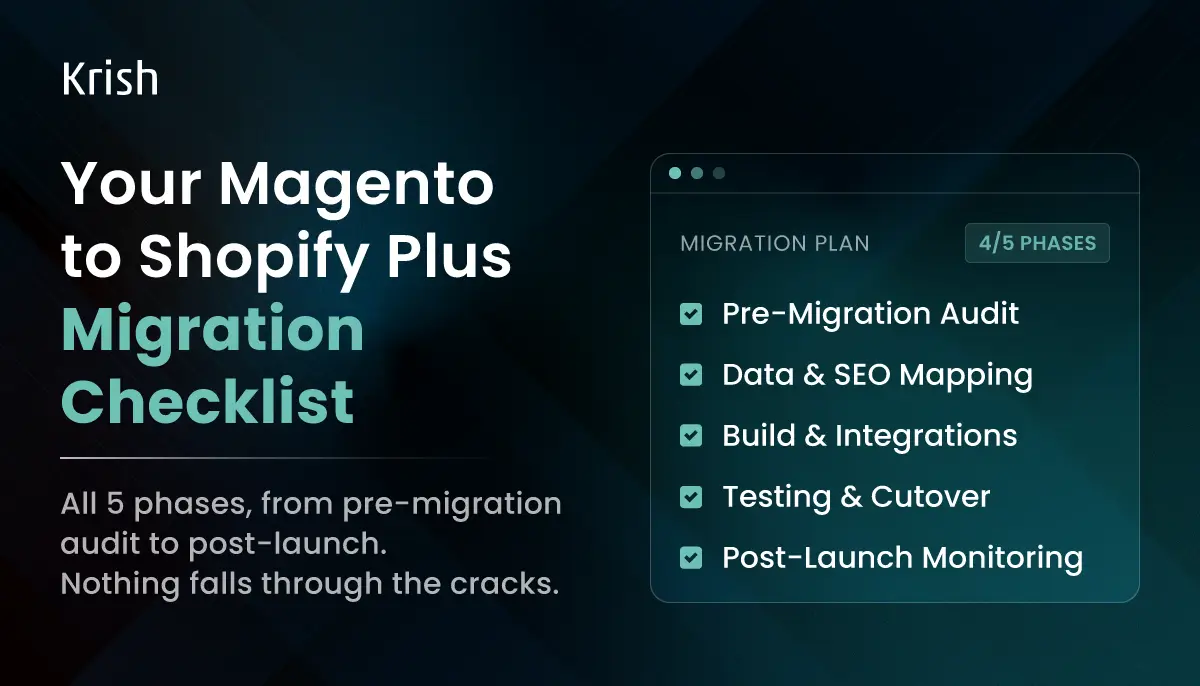
Magento to Shopify Plus Migration Checklist
16 July, 2026 Planning a magento to shopify plus checklist before you start is what separates a smooth migration from a chaotic one. Most migration problems aren't technical failures, they're missed steps that nobody flagged early enough. This guide lays out a complete shopify plus migration checklist across all five phases, so whether you're managing this in-house or working with a shopify plus migration services partner, nothing falls through the cracks.
Subscribe with Us!
Never miss any post, stay tuned!
Trusted by leading brands


