Introduction
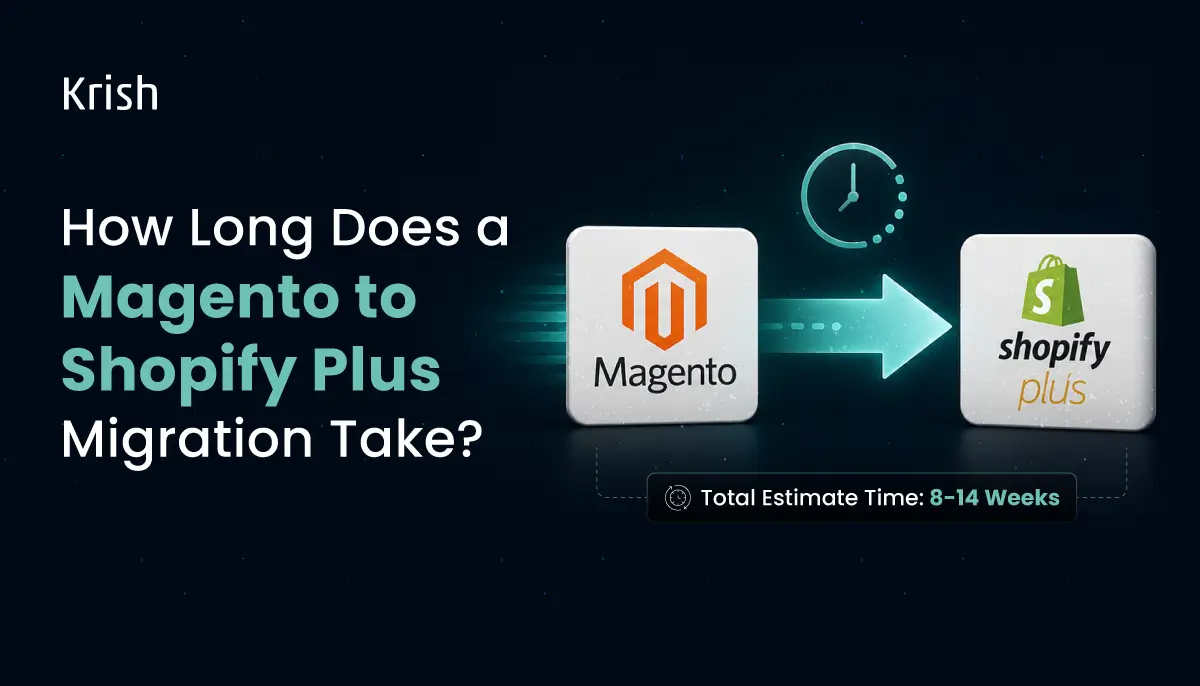
If you’re planning a Magento to Shopify Plus migration timeline, the honest answer varies more than most guides admit.
A single-store rebrand and an ERP-integrated B2B replatform are both technically “a migration,” but they live on completely different calendars. Teams that go in expecting a fixed number, “8 weeks, done,” are usually the ones who end up frustrated three months later, not because the migration failed, but because the original estimate never accounted for their actual complexity.
This guide breaks down the real 2026 shopify plus migration timeline by store complexity, phase by phase, so you know what to expect before you sign off on a project plan with any shopify plus migration services provider.
Quick Answer: A Magento to Shopify Plus migration typically takes 6-8 weeks for a simple store, 3-4 months for mid-complexity catalogs, and 6-9 months for enterprise, B2B, or ERP-integrated stores. Discovery and data cleanup, not the technical build, are usually what determine whether you land at the short end or the long end.
Further reading
Magento to Shopify Plus: Why Brands Are Migrating in 2026 (and What to Expect)
Adobe's end-of-support deadlines and rising costs are forcing the decision, this complete migration guide covers why enterprise brands are moving to Shopify Plus, what actually changes, and how to protect SEO through the transition.
Read the full blog →Magento to Shopify Plus Migration Timeline by Store Complexity
| Store Type | Timeline | Key Drivers |
|---|---|---|
| Simple/straightforward | 6-8 weeks | Clean data, off-the-shelf theme, minimal integrations |
| Mid-complexity | 3-4 months | Custom theme, 2–3 integrations, moderate catalog |
| Enterprise/B2B/ERP-integrated | 6-9 months | Multi-store, ERP/PIM, B2B pricing tiers, custom workflows |
What Pushes You to the Short End: clean, deduplicated data going in, a pre-built theme instead of custom design, and one or two straightforward integrations at most. Stores in this bucket usually have a single storefront, a manageable SKU count, and no B2B-specific requirements to rebuild.
What Pushes You to the Long End: multiple third-party systems that need rebuilding, custom B2B workflows, any store running multiple regions or storefronts, and very commonly, data that hasn’t been cleaned up in years. A migration has a way of surfacing every shortcut a store took on its old platform, and untangling that history takes real time regardless of how skilled the technical team is.
For a scoped, realistic plan built around your specific catalog, our Magento to Shopify Plus migration services start with exactly this kind of complexity assessment before any timeline commitment is made.
The 5 Phases of a Magento to Shopify Plus Migration
Phase 1 – Discovery & Audit
Data inventory: a full count of products, customers, orders, and CMS content before anything moves. This isn’t just a headcount, it means identifying duplicate SKUs, orphaned customer records, and content that’s been sitting unused for years.
Integration mapping: documenting every connection to ERP, PIM, and CRM systems that needs to be rebuilt, including which ones are business-critical and which could actually be retired during the move.
URL & SEO audit: capturing your current URL structure and search performance as a baseline, so you have something concrete to measure recovery against post-launch.
Phase 2 – Data Cleanup & Mapping
Deduplication and SKU restructuring: cleaning up years of accumulated data debt before it gets carried into the new platform, this step alone is often where a rushed timeline first goes wrong.
Redirect mapping strategy: planning how every old URL will map to its Shopify equivalent, categorized by product, category, blog, and image URLs so nothing gets missed.
Phase 3 – Build (Theme, Storefront, Integrations)
Off-the-shelf theme vs. custom build: a major fork in both cost and timeline, a pre-built theme can be configured in days, while a fully custom Liquid or headless build can take several weeks on its own.
App stack configuration: setting up the Shopify apps that replace Magento extensions, one for one where possible, and flagging any functionality that has no direct equivalent and needs custom development.
Phase 4 – Data Migration & QA Testing
Moving the cleaned, mapped data into Shopify Plus and testing every workflow, checkout, payment, redirect, and integration before anyone sees it live. This phase usually includes at least one full dry-run migration on staging, so issues surface before go-live rather than after.
Phase 5 – Cutover & Post-Launch Stabilization
The go-live itself is followed by the critical stabilization window, where most real issues surface. Teams that treat cutover as the finish line consistently underestimate how much work remains in the two weeks that follow.
First-time migrators tend to underestimate their timeline by roughly 30–50%, mostly because of scope creep outside the technical build.
Our detailed walkthrough on how to perform an ecommerce audit covers exactly what Phase 1 discovery should include and is worth reading before you scope your own project plan.
What Actually Slows Down a Migration Timeline
1. Catalog Size & Data Quality
A large catalog with messy, undocumented data takes far longer to clean than a small, well-maintained one. Two stores with the same SKU count can have wildly different timelines purely based on how organized their underlying data is.
2. Custom Theme vs. Pre-Built Theme
Custom design work is often the single biggest timeline variable in Phase 3, every additional custom page template, interactive element, or brand-specific interaction adds development and QA time on top of the base build.
3. Number of Third-Party Integrations
Each integration ERP, ESP, loyalty, tax, shipping adds its own testing and reconciliation cycle. It’s rarely the integration itself that takes time; it’s confirming that data flows correctly in both directions without silent failures.
4. B2B Requirements (Company Accounts, Net Terms)
Wholesale-specific configuration takes meaningfully longer to build and test than a standard B2C setup, especially when pricing tiers, quantity rules, and approval workflows are involved.
5. Multi-Store or Multi-Region Configuration
Running more than one storefront multiplies nearly every phase of the project, since data mapping, theme configuration, and QA all need to happen per store rather than once.
Our data migration services and B2B wholesale commerce solutions are built to handle exactly these complexity factors without derailing your timeline. If cost planning is part of this conversation too, see our full breakdown of Magento to Shopify Plus migration cost, since cost and timeline tend to move together.
How to Reduce Your Magento to Shopify Plus Migration Timeline Without Cutting Corners
1.Clean Your Data Before the Clock Starts:
Deduplication and SKU restructuring done before the project kicks off save real weeks later, this is arguably the single highest-leverage thing a team can do before signing off on a start date.
2.Use a Pre-Configured Theme Instead of Custom Design:
Skipping custom theme work is the fastest way to shorten Phase 3, and Shopify’s theme ecosystem has matured enough that many brands no longer need a fully bespoke build to get a strong on-brand storefront.
3.Run Workstreams in Parallel (Data, Content, Redirects):
Treating data migration, content prep, and redirect mapping as parallel tracks instead of sequential steps compresses the overall calendar significantly. The teams that struggle most are usually the ones that treat every step as strictly sequential when much of it can happen simultaneously with the right coordination.
According to a 2026 report, customer passwords can’t be migrated between platforms due to differing encryption, every returning customer resets their password at first login post-launch, which is why contact volume typically spikes 10-30% (and for some stores, 2-4x normal volume) in the first two weeks.
Want a realistic timeline for your store?
The Post-Launch Phase: Why It's Not the Finish Line
The First 14 Days After Go-Live:
This is when password-reset confusion, redirect gaps, and integration mismatches actually surface, not on launch day itself. Customer support volume is almost always higher in this window than on any other day of the year, and teams that don’t plan for it get caught off guard.
What Normal Stabilization Looks Like vs. a Red Flag:
A temporary support spike and a brief traffic dip are expected. Traffic that keeps declining past week three, or redirects that are still generating 404s at that point, are signs that something in the technical build needs attention rather than something that will resolve on its own with more time.
Our guide to URL fixes in Adobe Commerce covers many of the same canonical and redirect issues that resurface during this stabilization window. For the SEO side of this monitoring period specifically, our Magento to Shopify Plus SEO Migration guide walks through exactly what to check in Search Console during those first 14 days.
Further reading
How Roomours Boosted Conversions, Cut Load Time to 2 Seconds, and Grew Revenue with a Faster, Smarter Storefront
How Long Does an Enterprise Magento to Shopify Plus Migration Take?
Why Enterprise Timelines Stretch to 6-9 Months:
The combination of ERP integration, multi-store configuration, and B2B-specific workflows compounds across every phase, not just one. A delay in ERP data mapping in Phase 1, for example, cascades into every phase that follows, since integration testing in Phase 4 can’t be finalized until the connection itself is confirmed stable.
ERP & Multi-Store Complexity Factors:
According to a 2026 migration checklist, treating a migration as a simple platform swap rather than a full-stack migration, where customer accounts, loyalty points, subscriptions, and historical data all live on different systems with different migration schedules, is what causes enterprise projects to lose 30-60% of compounding assets and blow past their original timeline. The lesson generalizes well beyond any one platform: enterprise migrations fail their timeline when a single “move the store” project plan is used for what’s actually five or six interdependent migrations happening at once.
Working with a Shopify Plus partner experienced in enterprise-scale migrations is what keeps these interdependent workstreams from cascading into delays, largely because they’ve already mapped out where the dependencies typically live.
Get a phase-by-phase migration timeline built around your store’s complexity.
Frequently Asked Questions
Table of Content
- Introduction
- Magento to Shopify Plus Migration Timeline by Store Complexity
- The 5 Phases of a Magento to Shopify Plus Migration
- What Actually Slows Down a Migration Timeline
- How to Reduce Your Magento to Shopify Plus Migration Timeline Without Cutting Corners
- The Post-Launch Phase: Why It's Not the Finish Line
- How Long Does an Enterprise Magento to Shopify Plus Migration Take?
Subscribe with Us!
Never miss any post, stay tuned!

Manthan is the Director of Solutions at Krish, specializing in solution architecture, strategy, and client engagement. With expertise in eCommerce, Enterprise CMS, cloud solutions, and integrations, he is passionate about bridging technology and business to drive innovation and efficiency. As a techno-functional consultant and SME, he helps brands optimize technology stacks, streamline operations, and scale effectively, enabling sustainable digital transformation in an ever-evolving landscape.
Recommended Reading:
Magento to Shopify Plus Migration Checklist
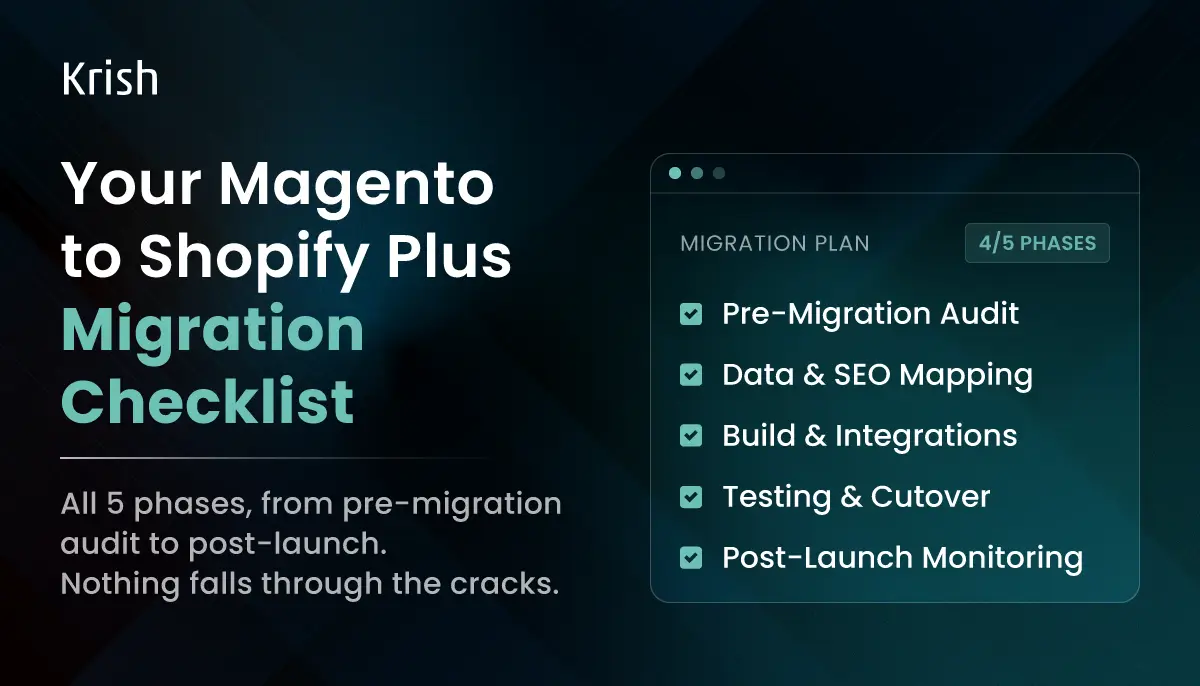
16 July, 2026 Planning a magento to shopify plus checklist before you start is what separates a smooth migration from a chaotic one. Most migration problems aren't technical failures, they're missed steps that nobody flagged early enough. This guide lays out a complete shopify plus migration checklist across all five phases, so whether you're managing this in-house or working with a shopify plus migration services partner, nothing falls through the cracks.
Subscribe with Us!
Never miss any post, stay tuned!
Trusted by leading brands


