When GA4 Stops Telling the Truth
Earlier, inaccurate analytics used to be a reporting inconvenience. Today, it is an operational liability.
Executives do not lose revenue because a marketer misreads a dashboard. They lose revenue when the underlying data feeding every downstream decision becomes structurally unreliable. GA4 amplifies this risk because its data model controls the inputs to your media bidding, experimentation frameworks, product analytics, audience activation, and marketing automation systems.
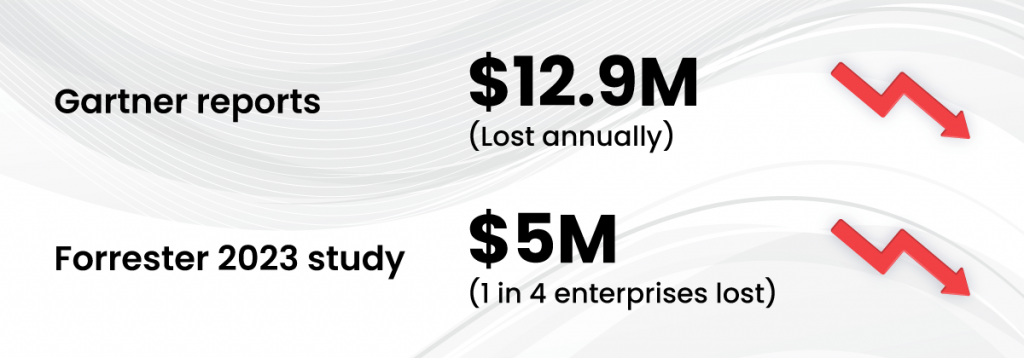
- Gartner reports that poor data quality costs organizations an average of $12.9 million per year.
- Forrester’s 2023 study found that one in four enterprises lost more than $5 million annually due to data integrity breakdowns, and 7% lost $25 million or more.
These are not abstract data governance failures. In digital businesses, they originate at the first breakpoint in the pipeline: the analytics implementation.
This is where GA4 configuration becomes a revenue-critical issue. Every decision your teams make is only as trustworthy as the identity stitching, domain controls, event schemas, and conversion design that determine the truth inside your dashboards and models. If those elements are misconfigured, consider that every optimization, attribution model, budget reallocation, and forecast built on that data is compromised. Most C-suites underestimate this failure pattern because GA4 can appear stable on the surface even when it is functionally miscalibrated underneath.
The shift from Universal Analytics to GA4 introduced an event-based architecture. That architecture is flexible but unforgiving. Errors in referral exclusions distort acquisition gaps in cross-domain linking split sessions. Even broken conversion definitions inflate or deflate performance. In an environment where marketing budgets have already dropped to 7.7% of overall company revenue according to Gartner’s 2024 CMO survey, leaders cannot afford to operate with corrupted visibility.
This Masterclass episode focuses on ten configuration failures that undermine the financial integrity of your GA4 data. Each one creates blind spots that influence decisions at a scale far greater than the tracking issue that caused them. Let’s go one level deeper into the structural risks that hide inside GA4 setups at even the most mature organizations.
The 10 Critical GA4 Configuration Mistakes Most Teams Overlook
Most analytics failures inside large digital organizations are not caused by missing tags. They are caused by configuration decisions that alter how GA4 interprets identity, sessions, parameters, and attribution. These issues do not produce obvious symptoms. They distort the truth quietly.
Below is a breakdown of the 10 structural configuration failures that consistently appear in GA4 audits. Each of them affects the way GA4 constructs its data model. When these are misconfigured, the platform does not just capture an accurate version of the customer journey. It captures the wrong journey entirely!
1. Domain and Referral Misconfiguration
The most common source of corrupted acquisition data is the incorrect configuration of domains and referral sources. GA4 treats every domain hop as a potential new source. If payment gateways, authentication domains, or microservices properties are not declared correctly, GA4 resets sessions, assigns conversion credit to the wrong channel, and inflates direct traffic. Most enterprises diagnose this late because the symptoms appear only in attribution and cohort analysis.
Impact: Incorrect referral settings distort source attribution. This leads to overfunded channels, underfunded channels, and multi-touch journeys that appear to convert through direct traffic. Media budgets shift in the wrong direction, and bidding systems optimize toward invalid signals.
2. Internal Traffic Contamination
GA4 allows teams to define internal traffic rules, but many organizations only implement IP-based filters or partial rule sets. As working models shift globally and VPN usage grows, these filters fail quietly. Internal and QA traffic enters production data, inflates user counts, creates false engagement patterns, and contaminates funnel accuracy. This is one of the primary reasons GA4 conversion rates appear lower than expected while “engagement” looks healthy.
Impact: Inflated user and session counts create artificially low conversion rates and misleading engagement metrics. Leadership sees efficiency problems that do not exist and triggers unnecessary channel or product changes that hurt performance.
3. Broken Conversion Architecture
Most teams configure conversions at the event level without validating event parameter completeness. GA4 counts the event as a conversion even when critical parameters are empty or in inconsistent formats. This leads to misaligned revenue attribution, inconsistent goal counts between GA4 and backend systems, and significant gaps in BigQuery exports. The failure is not at the conversion toggle. It is in the design of the event schema beneath it.
Impact: Conversion totals stop representing real customer actions. Revenue reporting becomes misaligned with actual sales, and forecasting loses integrity. This is one of the fastest ways to compromise ROAS and CAC models.
4. Unstructured Event Parameter Design
GA4’s event model depends on parameter integrity, including how custom dimensions in GA4 are defined and used. When parameter names vary across environments, when product metadata is missing, or when teams use inconsistent naming conventions across GTM, hard-coded events, and server-side containers, GA4 stitches incompatible data into one schema. This destroys the reliability of exploration reports, funnels, and any machine learning based audience generation.
Impact: When parameters are inconsistent, GA4 cannot produce reliable funnels, product analytics, or segment breakdowns. Teams cannot diagnose why growth stalls, and experiments run on noisy data deliver false positives.
5. Identity Resolution Failures
Incorrect configuration of user_id, device_id, and session_id logic causes GA4 to treat the same user as multiple unique identities. The most frequent cause is incorrect cross-domain linking or the absence of proper linker configuration. This splits customer journeys, reduces user lifetime accuracy, and overstates new user growth. It also weakens downstream personalisation and retargeting programs that depend on identity stability.
Impact: User journeys fragment into multiple identities. This leads to overstated new user counts, understated returning user value, and loss of visibility into long-term behavior. Retargeting costs increase because audiences fail to resolve correctly.
6. Cross-Domain Session Fragmentation
Payment gateways, booking engines, and multi-domain architecture require explicit cross-domain linking. GA4 resets sessions whenever the gclid, client ID, or session context fails to persist across domains. This produces inflated session volume, fragmented paths, and inaccurate funnel step attribution. Most enterprises discover this only when they analyse drop-offs that appear artificially high on transition steps that seem benign.
Impact: Checkout, payment, or booking flows appear to have severe drop-offs that are not real. Product teams chase phantom issues across funnels, and engineering resources are spent solving problems created by configuration, not customer behavior.
7. Attribution Misalignment
GA4 attribution models are sensitive to configuration choices such as lookback windows, conversion definition logic, and channel mapping. If these are not aligned with the organization’s media investment logic, GA4 reports conversions on the wrong channels, undervalues upper funnel activity, and misdirects budget. The impact compounds because most bidding systems import conversion signals directly from GA4.
Impact: Media investment models become untrustworthy. If GA4 attributes conversions to the wrong channels, budget reallocations drift further from reality each quarter. Paid search and paid social algorithms begin optimizing toward inaccurate goals.
8. GTM Container Drift
Enterprises often run multiple GTM containers across environments. When versions are not synchronized, environments run different event schemas. This causes inconsistent parameter structures, payload mismatches, duplicate event firing, or extended latency in updating conversion logic. GA4 then receives a mixed dataset that cannot be reconciled reliably in reporting or BigQuery exports.
Impact: Different environments fire different events and parameters. This destabilizes the underlying data model and creates discrepancies between staging, production, and mobile properties. Data scientists and analysts cannot replicate results or validate accuracy.
9. Incomplete Server-Side Tagging Configuration
As more organizations move to server-side tagging, gaps in configuration, such as missing client logic, incorrect forwarding rules, or unverified transformations, lead to missing parameters or altered identifiers. GA4 receives partial event payloads and produces incomplete reports, particularly in e-commerce and revenue-based events.
Impact: Missing identifiers or partial payloads reduce the reliability of revenue events. Data signals reaching Google Ads, Meta, or internal BI platforms become incomplete. Personalization, remarketing, and bidding systems lose data richness and degrade in performance.
10. BigQuery Export Inconsistency
GA4’s daily export to BigQuery becomes unreliable when events are misconfigured, names drift, or parameters exceed recommended limits. Incomplete schema fields, null values, or inconsistent types break downstream analytics pipelines. This is one of the highest risk areas because BigQuery is often used to feed predictive models and enterprise decision systems.
Impact: Data pipelines that depend on BigQuery become unreliable. Predictive models train on incomplete or inconsistent fields, and enterprise dashboards produce contradictory insights. Strategic reporting loses credibility because the data foundation is unstable.
Before moving forward, it is important to understand the pattern emerging across these failures. None of these mistakes is cosmetic. They change the structure of the GA4 dataset. Once the structure is compromised, every insight, attribution model, forecast, audience, and optimization built on top of GA4 becomes compromised as well.
What makes this dangerous for leadership is not the volume of the errors. It is the confidence they create. GA4 continues to show stable trends even when the underlying architecture is misconfigured. This produces a false sense of accuracy that leads teams to trust and act on misleading signals.
This brings us to the question of how poor implementation creates executive-level risk by fostering confidence in data that is fundamentally invalid.
The False-Confidence Effect: How Invalid GA4 Data Misleads Teams
GA4 will continue to populate dashboards, maintain trends and generate familiar patterns even when the underlying configuration is compromised. This creates the most dangerous outcome in digital analytics: the illusion of stability.
Executives assume the data must be accurate because it behaves predictably. Analysts trust their reports because nothing appears “broken”. Media teams optimize based on trends that look consistent. CRO teams run experiments that appear statistically valid. All of this is happening on top of a dataset that is structurally incorrect.
The false-confidence effect emerges because GA4 does not fail the way traditional systems fail. It does not crash. It does not produce errors. It produces data that is internally coherent but externally misaligned with reality. This means every stakeholder sees the same story, even when the story is wrong.
How false confidence becomes a business problem
- Budgets get allocated in the wrong direction
When attribution models are misconfigured, channels appear to overperform or underperform. Executives shift budgets based on these signals, and the business begins optimizing toward inaccurate truths.
- Product and UX teams chase the wrong problems
Funnel drop-offs, engagement metrics, and journey paths built on fragmented sessions push teams toward phantom issues. Engineering effort is spent correcting symptoms instead of structural issues.
- AI and bidding systems become biased
Modern ad platforms and automated marketing campaigns optimize against GA4-reported conversions. When the inputs are wrong, algorithms reinforce a feedback loop that accelerates the error over time.
- Forecasting and demand modeling lose integrity
Revenue projections, cohort analysis, and LTV models require consistent identity and conversion data. Misconfiguration introduces noise that cannot be corrected downstream.
The core issue is not data inaccuracy. It is a decision inaccuracy. Once leadership trusts compromised analytics, the organization becomes confident in decisions that move performance away from its potential. This is where misconfiguration evolves from a technical flaw into an enterprise-level risk.
As we move to the next point, we focus on one of the most widespread and invisible failures. Most teams believe their conversions are tracking correctly simply because they see counts in GA4. The reality is more complex and significantly more damaging.
The Conversion Tracking Gap Most Teams Don’t Know Exists
Conversion reporting in GA4 is not a simple mapping of events. It is an alignment of event architecture, schema integrity, identity context, and parameter completeness. GA4 will count a conversion even when critical business data is missing, inconsistent, or misaligned. This is the conversion tracking gap that most organizations do not detect.
Where the conversion gap originates
- Events fire, but parameters do not
A purchase event may fire without product-level parameters, a missing transaction_id, empty value fields, or inconsistent currency formats. GA4 still counts the conversion, but the data is incomplete for attribution, ROAS, LTV, or product analytics. - GTMs and server-side setups create silent mismatches
When a parameter or event name differs between environments, GA4 treats it as a separate entity. Leadership sees “stable” conversion numbers, but every other downstream metric becomes unreliable. - Conversion toggles do not verify data quality
GA4 only confirms the presence of the event, not the validity of the payload. This is the single biggest misconception among teams with legacy UA habits. - Checkout and payment domains break identity continuity
If client_id or user_id is not preserved, GA4 records a purchase without the preceding journey. This destroys funnel accuracy and removes the ability to link revenue back to channels correctly.
How the conversion gap distorts business decisions
- CAC and ROAS models report incorrect efficiency because revenue is assigned to the wrong touchpoints.
- Media optimization systems receive incomplete or biased conversion signals.
- Funnel bottlenecks appear at the wrong steps, leading product teams to prioritize issues that do not exist.
- Finance and growth teams operate with conflicting revenue numbers from backend systems, GA4, and BigQuery exports.
The most concerning part is that teams rarely know this gap exists. GA4 produces conversion counts consistently, so nothing appears broken. This gap often becomes visible only during a formal audit when schema mismatches, missing parameters or broken identity flows are traced back to their sources.
Before advancing to the point, it is important to understand the pattern: GA4 errors do not look like errors. They look like valid data that is quietly misrepresenting user behavior. Now we expand this concept across a broader structural issue: the fragmentation of customer identity in cross-domain environments.
Cross-Domain Tracking Pitfalls That Fragment the Customer View
Most enterprise digital ecosystems are not confined to a single domain. They span marketing sites, commerce engines, authentication layers, payment providers, booking flows, and third-party service modules. GA4 relies on consistent identity and session continuity across all of these surfaces. When any link in that chain breaks, the customer journey fractures.
This fragmentation does not appear as an error. It appears as an incomplete story. GA4 shows the start of a journey, the end of a journey, or disconnected pieces of the same session, but cannot reconstruct them into a unified path. The business loses the ability to understand high-value behaviors, friction points, and conversion drivers.
Where cross-domain failures originate
- Incorrect linker configuration
GA4 uses linker parameters to carry identity across domains. When linker settings are missing, misaligned, or deployed inconsistently, sessions are split on every domain transition.
- Payment gateways are treated as external referrals
If return URLs from payment providers are not added to the referral exclusion list or cross-domain configurations, GA4 reassigns credit to payment gateways instead of the actual acquisition source.
- Client ID and User ID are not preserved across domain hops
Even small mismatches in cookie storage, domain precedence, or script execution order cause GA4 to generate new identifiers. This destroys continuity in LTV modeling, attribution, and high-value pathing.
- Tracking is deployed in different modes across domains
Some flows use GTM, some use hardcoded tags, and others use server-side endpoints. If versions drift or events vary in naming conventions, GA4 cannot merge them into a coherent user timeline.
Why cross-domain fragmentation is strategically harmful
- High-intent customers appear to abandon flows they actually complete.
- Remarketing pools shrink because identity is lost mid-journey.
- Multi-touch attribution undervalues the channels that initiate journeys.
- Funnel diagnostics report incorrect drop-offs at domain boundaries.
- LTV models degrade because user-specific revenue cannot be stitched over time.
This is one of the most damaging GA4 failures because it targets leadership’s most critical question: how do customers actually convert? Once cross-domain identity fails, the organization ceases to analyze customer behavior. It is analyzing the architecture of its tracking implementation.
With this understanding of identity fragmentation, we move to the next pointer, which elevates the discussion from technical misconfiguration to strategic operational maturity. The patterns below are the issues that appear even in organizations with otherwise advanced analytics investments.
Advanced Misconfigurations C-Suites Rarely Hear About (But Should)
Some GA4 configuration failures are obvious. Others require a level of architectural awareness that most teams do not develop until the damage becomes visible in decision systems. These advanced misconfigurations are not errors of omission. They are structural issues that emerge from scale, team fragmentation, and evolving data pipelines.
1. Event schema drift across teams and environments
Enterprises with multiple agencies, product squads, or platform owners often introduce unintended schema variations. A purchase event from the mobile app does not match the purchase event from the web layer. GA4 merges these inconsistent payloads into a single event name, corrupting every report that depends on parameter fidelity.
2. Unversioned or unsynchronized GTM containers
Teams ship updates in staging and forget to propagate them to production. GA4 receives two different versions of the same architecture depending on where the user originated. Attribution, funnels, product analytics, and forecasting become inconsistent because the foundation is not uniform.
3. Overreliance on recommended events without required parameters
GA4 encourages standardized events for e-commerce and lead generation. Many teams adopt the event name but ignore mandatory or contextual parameters. GA4 then registers the event but loses the detail required for meaningful analysis. Leaders see the event volume but not the missing intelligence behind it.
4. Incorrect identity hierarchy configuration
User ID, device I, and client ID must be prioritized correctly. When platforms override each other or trigger in the wrong order, GA4 randomly selects an identifier. Cross-device behavior becomes impossible to analyze, and first-party audience quality declines.
5. BigQuery export anomalies that go unnoticed
BigQuery exports are often assumed to be the “source of truth” for advanced analytics. But when event volume exceeds recommended thresholds or schema inconsistencies appear, fields become null or irregular. Predictive models that depend on these exports train on incomplete or distorted inputs, producing unreliable recommendations.
6. Server-side tagging logic that modifies payloads unintentionally
Transformation rules, proxy clients, or custom headers inside server-side tagging pipelines can alter or drop essential fields. The payload reaches GA4 intact in structure but not in business meaning. Attribution, revenue mapping, and LTV analysis degrade subtly over time.
The strategic impact of these advanced failures
- Enterprise-wide dashboards become inconsistent because datasets diverge.
- Experimentation loses validity because event definitions shift mid-test.
- Personalization quality collapses as identity and audience rules degrade.
- Forecasting and BI pipelines produce contradictory or unstable outputs.
- Leadership begins to distrust analytics, slowing down decision velocity.
These advanced mistakes are rarely caught internally because they require architectural literacy and operational governance, not tagging skills. This sets the stage for how these failures translate directly into financial leakage across media, CRO, product, and retention programs.
Quantifying the Revenue Impact of Misconfigurations
By this stage, it is clear that GA4 misconfiguration introduces structural distortion into the dataset. Section 7 focuses on the financial implications of those distortions. Most organizations underestimate this because GA4 does not fail visibly. It fails in the decision layer.
How misconfiguration alters financial performance metrics
- Misattributed conversions inflate or deflate ROAS
When referral exclusions, identity stitching, or conversion parameters are broken, channels that deserve credit lose i,t and channels that do not deserve credit gain it. ROAS and CAC calculations shift by double-digit percentages even though campaign performance has not changed.
- False funnel drop-offs drive unnecessary UX investment
Cross-domain fragmentation creates artificial bottlenecks that UX teams respond to with redesigns, experiments, and engineering investment. This drains resources from actual high-impact initiatives.
- Ineffective remarketing increases acquisition cost
When identity is not preserved across domains or devices, audiences shrink. Paid acquisition systems spend more per conversion because signal quality deteriorates. Optimizers respond by raising bids to maintain volume.
- Revenue forecasting becomes unstable
CLTV (Customer Lifetime Value), repeat purchase behavior, and cohort performance can no longer be trusted. Finance teams lose confidence in predictive models and revert to manual or backward-looking forecasts.
- Data pipelines amplify inconsistencies
When GA4 exports corrupted data to BigQuery, every modeling or BI system built downstream inherits the distortion. Correction requires reprocessing or rebuilding entire pipelines, not adjusting a tracking tag.
How misconfiguration compounds over time
GA4 metadata issues do not produce linear loss. They produce compounding loss. For example:
- If conversion events lose critical parameters, bidding platforms like Google Ads or Meta receive degraded signals.
- These platforms then adjust bids based on incomplete data.
- This adjustment produces further distortion in acquisition patterns.
- GA4 then captures those distorted journeys and embeds them into reporting.
This feedback loop is how minor configuration errors turn into multi-quarter revenue erosion. Leadership sees the symptoms as channel volatility, dropping efficiency, or inconsistent performance. The root cause sits in the analytics infrastructure, not in the market.
Why enterprises discover the impact late
Organizations detect GA4 misconfiguration only when the inconsistency becomes impossible to ignore. This usually happens at one of three moments:
- A discrepancy between GA4 revenue and backend revenue triggers an audit.
- A new team inherits the analytics architecture and notices schema drift.
- Finance discovers that forecasts consistently miss actual performance.
The financial impact is not theoretical. It accumulates silently until a formal audit exposes the underlying structural issue.
Once you understand the scale of financial leakage caused by misconfiguration, the natural question is: how often does this happen? We answer that by showing recurring patterns across real-world GA4 audits. These patterns appear in mature environments just as often as in early-stage setups, which is why they are strategically important for leadership to recognize.
Real-World Failure Patterns Observed Across GA4 Audits
Across enterprise audits, the most damaging GA4 failures rarely look like “tracking bugs.” They manifest as structural inconsistencies that quietly distort the shape of customer behavior. These are the patterns that appear with surprising consistency, even in mature teams.
1. Identity breaks that hide high-intent behavior
In multi-domain and multi-platform ecosystems, users often appear as multiple identities. The result is overcounted new users, undercounted return users, and a journey map that no longer resembles how customers actually buy.
2. Conversion events that look correct but carry incomplete intelligence
GA4 records a conversion even when the payload is missing value, currency, product data, or identifiers. Audits reveal that “conversion stability” often masks the absence of business-critical details.
3. Inconsistent event definitions between app, web, and server layers
Teams align on event names, not event meaning. When parameter structures diverge, GA4 blends inconsistent records into one dataset. Funnel interpretation and product analytics degrade immediately.
4. Parallel tagging infrastructures are creating conflicting signals
Hardcoded events persist long after GTM or server-side tagging is deployed. GA4 receives multiple interpretations of the same action. This creates non-reconcilable discrepancies between reports, dashboards, and BI systems.
5. BigQuery exporting a “version” of events that does not match the interface
Schema drift between environments leads to BigQuery data that does not match what analysts see in GA4. Teams trust different datasets without realizing they originate from inconsistent upstream structures.
Why these patterns matter
All these failures collapse confidence in analytics. When teams cannot reconcile GA4 reports with backend systems or BigQuery, leadership eventually treats analytics as directional rather than definitive, which directly slows down organizational decision velocity.
These patterns show where GA4 instability originates. But before a full audit is initiated, leaders often need a quick reality check: is the current implementation already drifting? Next up, we provide the rapid diagnostic.
Quick GA4 Audit Checklist: 10 Things to Verify Today
This is a precision diagnostic, not a full audit framework. The goal is to expose high-risk misconfigurations quickly.
| 1 | Confirm all journey domains are included in cross-domain settings. |
| 2 | Inspect referral exclusions for payment gateways and external tools. |
| 3 | Validate that internal traffic filters cover VPN and remote teams. |
| 4 | Check whether key conversion parameters (value, currency, IDs) are consistently populated. |
| 5 | Compare staging and production GTM containers for version drift. |
| 6 | Validate identity hierarchy and confirm IDs persist across journeys. |
| 7 | Examine server-side transformations for parameter loss. |
| 8 | Ensure attribution settings and lookback windows match current media strategy. |
| 9 | Review BigQuery export completeness for the past 30 days. |
| 10 | Run a synthetic journey test to detect session breaks or attribution resets. |
If multiple items raise concerns, the issue is structural, not incidental. That is the point where teams should shift from diagnosis to stabilization.
Identifying symptoms is useful only if the organization can prevent them from recurring. So here’s how you keep GA4 stable over time without falling back into fragmentation.
How to Stabilize Your Analytics Infrastructure for 2025
Stability in GA4 is not produced by “better tagging.” It is produced by operational practices that ensure consistency across environments, teams and data pipelines.
- Enforce a unified event schema
A centrally owned schema prevents teams from introducing slight variations that break reporting, attribution or BigQuery alignment.
- Treat analytics like product releases
Every analytics update should move through version control, QA and environment parity checks. Staging must match production. This prevents drift.
- Maintain shared ownership across engineering, marketing and data
GA4 stability requires alignment across identity logic (engineering), event meaning (product/analytics) and measurement strategy (marketing). When any one of these functions operates in isolation, GA4 destabilizes.
- Validate data quality continuously
Automated checks for parameter completeness, session stability, referral anomalies and export consistency catch problems before they compound.
- Standardize server-side logic across domains
When transformations vary across containers or clients, the payload structure becomes unpredictable. Standardization preserves consistency in attribution and revenue mapping.
- Keep attribution aligned with business strategy
Most GA4 misinterpretation originates not from tracking errors, but from the default attribution logic that does not reflect the actual media strategy. Attribution must be intentionally configured.
- Document every schema and identity decision
Documentation is the single most effective safeguard against regression. Teams change. Vendors change. Domains change. The analytics architecture must remain consistent.
Outcome
When these practices are adopted, GA4 becomes predictable and trustworthy. When they are not, misconfigurations return in cycles, and the organization continues operating on partial truth.
The Future Belongs to Organizations With Trustworthy Data
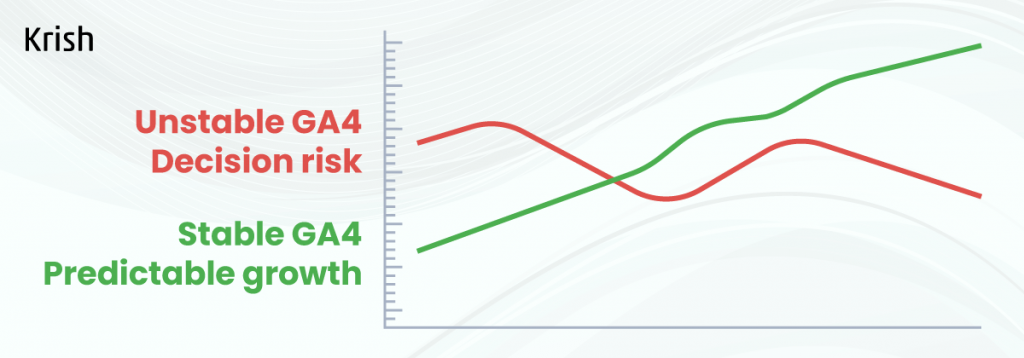
GA4 is now the nervous system of digital decision-making. When its configuration is unstable, every downstream decision becomes unstable with it. The real risk is not missing data. The real risk is acting on data that appears reliable but is structurally wrong.
The organizations that win in the next phase of digital maturity will be the ones that treat analytics as infrastructure, not instrumentation. They will build systems where identity, attribution and event design are engineered with the same rigor as product architecture.
This masterclass exposed where GA4 fails silently, and how you can overcome. Stay tuned for what the next episode holds!
Table of Content
- When GA4 Stops Telling the Truth
- The 10 Critical GA4 Configuration Mistakes Most Teams Overlook
- The False-Confidence Effect: How Invalid GA4 Data Misleads Teams
- The Conversion Tracking Gap Most Teams Don’t Know Exists
- Cross-Domain Tracking Pitfalls That Fragment the Customer View
- Advanced Misconfigurations C-Suites Rarely Hear About (But Should)
- Quantifying the Revenue Impact of Misconfigurations
- Real-World Failure Patterns Observed Across GA4 Audits
- Quick GA4 Audit Checklist: 10 Things to Verify Today
- How to Stabilize Your Analytics Infrastructure for 2025
- The Future Belongs to Organizations With Trustworthy Data
Subscribe with Us!
Never miss any post, stay tuned!

Ankit helps brands navigate their digital maturity journey by bringing together analytics, CRO, ML, and AI in a practical, business-friendly way. Having worked with global teams across industries, he focuses on simplifying complex MarTech concepts and turning them into measurable outcomes. On weekends, you’ll likely find him deep in a reflective read or sharing a coffee with a client while simplifying MarTech in the most human way possible.
Recommended Reading:

From Test Results to Business Impact: The Attribution Challenge – MarTech Masterclass Series Ep | 18
2 July, 2026 A variant reaches statistical significance. The team celebrates, ships the winner, and moves on to the next experiment. Weeks later, the metrics leadership actually tracks have not moved. Revenue per session is flat. The number the finance team questions every quarter shows no change that can be credited to the test. The experiment was run correctly. The result was real. And somehow, nothing changed.
Subscribe with Us!
Never miss any post, stay tuned!
Trusted by leading brands


