The Shopping Agent’s Scorecard
An AI agent just recommended your competitor instead of you. Nothing was wrong with your product. You simply lost on a scorecard you have never seen.
Here is how real that scorecard is:
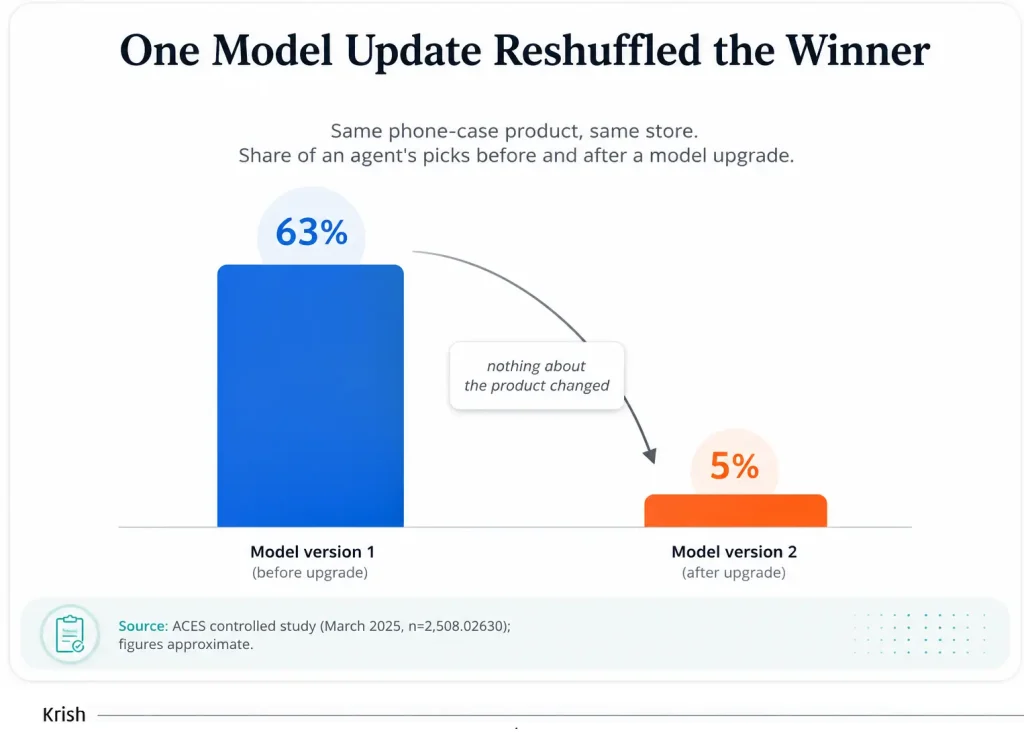
In late 2025, a team of researchers built an online store, showed it to the major AI models thousands of times, and recorded exactly which product each model chose. The project is called ACES, and because the researchers controlled every detail of that store, they could measure precisely what changed an agent’s mind. One result stands out. In a phone-case category, one model picked a particular brand about 63% of the time. When that model was upgraded to its next version, the same brand was chosen only about 5% of the time. The products did not change. No price cut, no new reviews, no better photos. The model updated, and the shelf reshuffled. You can read the full study at arXiv, and a clear plain-English breakdown at AgentMint.
That is the reality this episode unpacks. Not “how AI thinks” in the abstract, but the specific, nameable signals that decide which of two comparable products an agent picks.
A quick recap of where the series has taken us:
- In Episode 01, we defined agentic commerce and why it rewrites the rules.
- In Episode 02, we showed how the storefront stops being your decision layer.
- In Episode 03, we covered how agents discover and shortlist your products.
This episode is the moment after the shortlist. Your product is one of the finalists. The agent has to choose. Here is what it reads to make that call.
The One Idea to Hold Onto: It Reads a Scorecard, Not Your Reputation
A human shopper leans on memory. They reach for the brand they have heard of. An AI agent does not do that. It reads the structured facts in front of it and scores them.
Across every model the ACES researchers tested, the things that moved a choice were all attributes: how well the product matched the request, its price, its rating, its review count, whether it carried a trusted badge, and how its description was written. Brand fame was not on the list.
The implication: a smaller brand with clean, complete product data can beat a household name that a person would always pick from memory. That is the threat for large brands and the open door for everyone else.
As Tom Burke, CEO of At Data, put it, consumers will not browse anymore, they will delegate. And the thing they delegate to is not impressed by your logo.
The 5 Signals an AI Shopping Agent Actually Scores
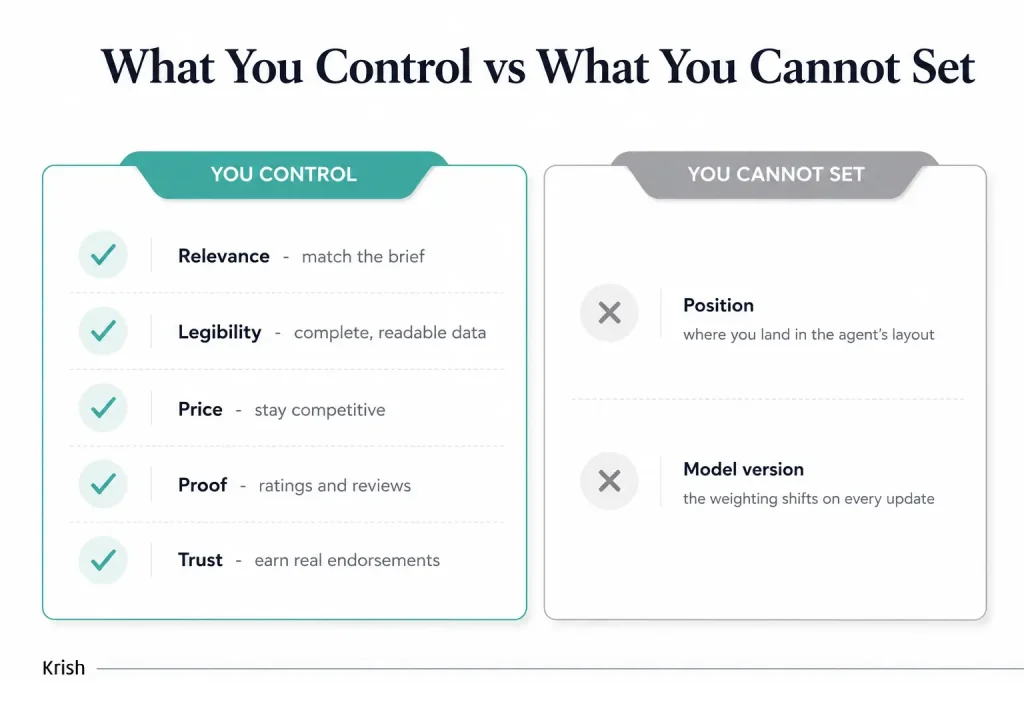
Think of it as a scorecard. These are the five things the agent reads and weighs before it picks.
1. Relevance: How Completely You Match the Brief
Shoppers no longer type keywords. They hand the agent a full brief. For example: “wireless headphones for running that block wind noise, under $120, delivered by Friday.” That single sentence carries a use case, a feature need, a budget, and a delivery window, all at once.
The agent breaks that brief into separate requirements and checks each product against every one of them. A product that satisfies four of the five requirements loses to one that satisfies all five.
Kaare Wesnaes, head of innovation at Ogilvy North America, describes the new default: shoppers ask an agent to weigh price, delivery, sustainability, return policy, and past purchases, then hand back a recommendation they can trust.
What this means for you: your product data has to describe use cases, not just specifications. A listing that says “noise-isolating, sweat-resistant, designed for outdoor running” can be matched to that brief. A listing that only says “IPX4, 40mm drivers” cannot.
2. Legibility: Whether You Can Be Scored at All
Before the agent can weigh anything, it has to be able to read your data. If a field is missing, the agent does not guess. It skips you.
Common gaps that quietly remove products from the running:
- Missing product identifiers, such as the GTIN barcode number that agents use to match a product to a request.
- Sizes or specs written as “see description” instead of as a clear, separate value.
- A return policy that lives only as a paragraph in your website footer, rather than as a structured field the agent can read.
- Prices or stock levels that are hours out of date.
This is exactly why product information management (PIM) has become a commercial function rather than a cataloguing chore. The brands that win keep every attribute complete and consistent, then push that clean data to every channel at once. The plumbing underneath, your data engineering and feeds, is what makes legibility possible in the first place.
3. Price: Competitive, but Weighted Differently Everywhere
The ACES study found that a lower price improved a product’s odds on every model, all else being equal. The catch is that the size of that effect changes from one model to the next. The same discount buys more of a lift on some engines than on others.
What this means for you: price competitiveness is a real lever, but there is no single magic price. Treat it as one input among several, not the whole game.
4. Proof: Ratings and the Depth of Your Reviews
Small changes in your rating move a lot of selection. In the study, nudging a product’s rating up by just 0.1 stars lifted its chance of being chosen from a baseline of about 10% to somewhere between 15% and 20%, depending on the model.
Review count mattered on its own, separately from the average score. More genuine reviews raised the odds even when the star rating stayed the same. Depth of proof counts, not just the headline number.
What this means for you: a steady, honest flow of reviews is one of the few signals you can influence directly and ethically. It pays off in agent selection, not only in human trust.
5. Trust: Endorsements Lift You, “Sponsored” Tags Sink You
This is the counterintuitive one. The study found two opposite effects sitting side by side:
- A trusted editorial badge, such as an “Overall Pick” label, lifted a product’s chance of selection from a baseline of about 10% to as high as 24% to 43%, depending on the model.
- A “Sponsored” tag did the reverse. It pushed that same baseline down to around 8%. Agents treat a paid-looking label as a reason for suspicion, not preference.
What this means for you: earn legitimate endorsements and third-party credibility. Do not try to manufacture badges or dress up paid placement as organic. The agents are increasingly built to see through it.
The 2 Forces You Cannot Set (but Must Respect)
Two things shape the outcome that no merchant controls directly. Ignoring them is how good products still lose.
Position and presentation. Where your product appears inside the agent’s result layout was the single largest effect the study measured. Move a product from the bottom corner into the top row and its selection rate jumped several times over. You cannot set this slot yourself. What you can do is stay eligible to appear, which loops back to legibility and clean data.
The model behind the agent. The weighting of every signal above changes when the underlying AI model is updated. Recall the phone case that fell from 63% of picks to 5% after a single model upgrade. The study also found that position preferences could reverse completely between versions.
This is the honest version of “behavioral learning loops.” The loop that costs you money is not the agent learning about the shopper. It is the platform quietly re-tuning the scorecard beneath you.
Trust Is a Second Gate, and Shoppers Still Guard It
Winning the scorecard gets you recommended. It does not get you bought. Trust is a second filter, and it lives with the human, not the machine.
The numbers are sobering, per IAB research reported by eMarketer:
- Only 46% of shoppers say they fully trust AI recommendations.
- 89% still verify the information themselves before buying.
- 88% want clear sourcing, 87% want verified reviews, and 75% want to understand how the AI reached its answer.
As Collin Colburn, VP of commerce at IAB, summarised it, AI will drive discovery in 2026, but trust will decide whether it also drives transactions. This is why transparent sourcing and real reviews are not soft extras. They clear the gate that a good scorecard alone cannot.
“Agentic AI will drive product discovery in 2026, but trust will determine whether it also drives transactions.” Collin Colburn, VP of Commerce, IAB
What You Can Control This Week - Practical Steps
You cannot set your position or force an endorsement. You can own the inputs that every one of those signals is built from. Start here:
- Complete your product data. Every attribute a shopper might state as a requirement must exist as a clear, separate, machine-readable value. This is what makes you eligible to be scored at all, and it is best enforced through PIM.
- Add structured markup. Schema, the hidden labels that tell a machine what each piece of your page means, is the layer agents trust when your page and feed disagree. Go beyond the basics to cover delivery time and return policy.
- Write for use cases, not keyword stuffing. Describe who the product is for and when to use it, in the language a real shopper would use in a brief.
- Test your descriptions, do not assume. The study found that rewriting a description lifted selection on most models but did nothing on one of the newest ones, and across all tests, about two-thirds of rewrites produced no significant change. Copy is a real lever, but an uneven one, so treat it the way you treat any change worth money: measure it. This is the same discipline behind CRO and A/B testing, and it is exactly why so many teams get it wrong, as we covered in Why Most A/B Testing Programs Fail.
- Build genuine reviews at volume. Honest ratings and review depth are among the few trust signals you can grow directly.
- Keep agent access open and your data fast. If an agent cannot reach or quickly read your data, none of the above counts.
A Quick Diagnostic Before Episode 05
Run these five checks on your own catalogue. If most answers stay “untick,” the gap is technical, and technical gaps are the ones that close fastest when addressed directly.
- Do your listings describe use cases, or only technical specifications?
- Does every product carry its identifiers, sizes, and specs as separate, readable values rather than buried in prose?
- Are your price and stock feeds updating in real time, or on an overnight batch?
- Are you generating a steady flow of genuine reviews across your range, not just your hero products?
- Are you tracking agent-referred traffic as its own channel in your digital analytics, with its own benchmarks?
The Bottom Line
An AI shopping agent is not remembering your brand. It is reading a scorecard of five signals, relevance, legibility, price, proof, and trust. It weighs them differently on every engine, re-tunes them with every model update, and then hands the result to a shopper who still checks before they buy.
That is bad news for anyone relying on reputation to carry the sale. It is genuinely good news for anyone willing to make their product data the most complete, legible, and trustworthy option on the shelf. The scorecard is one of the few parts of agentic commerce you can actually influence, and most of your competitors are not touching it yet.
If you want help turning your catalogue into data an agent can read, score, and trust, our AI and Data and AI consulting teams do exactly this. For the wider picture, see our take on the role of AI in retail transformation.
Table of Content
- The Shopping Agent’s Scorecard
- The One Idea to Hold Onto: It Reads a Scorecard, Not Your Reputation
- The 5 Signals an AI Shopping Agent Actually Scores
- The 2 Forces You Cannot Set (but Must Respect)
- Trust Is a Second Gate, and Shoppers Still Guard It
- What You Can Control This Week - Practical Steps
- A Quick Diagnostic Before Episode 05
- The Bottom Line
Subscribe with Us!
Never miss any post, stay tuned!

As Director - Marketing, Zenul leads the marketing and branding at Krish. He brings with him an in-depth understanding of the evolving digital ecosystem and has a proven expertise and experience in strategic planning, market and competition analysis, creating and implementing client-centered, lead-gen and brand marketing campaigns. He has a heart for technology innovation and has been a keynote speaker on various platforms.
Recommended Reading:
Why Most A/B Testing Programs Fail – Conversion Maturity Series | EP 09
22 July, 2026 In 2007, President Obama’s campaign's analytics lead, Dan Siroker, was certain that a video of the candidate would beat a plain photo on the sign-up page. He tested it anyway. Every video lost to every image. The winning combination, a family photo paired with a button that read "Learn More," lifted sign-ups from 8.26% to 11.6%. That 40.6% jump was later tied to roughly 2.9 million extra email addresses and about $60 million in donations, as Siroker documented for Optimizely. The expert was wrong, and only a disciplined test caught it.
Subscribe with Us!
Never miss any post, stay tuned!
Trusted by leading brands


