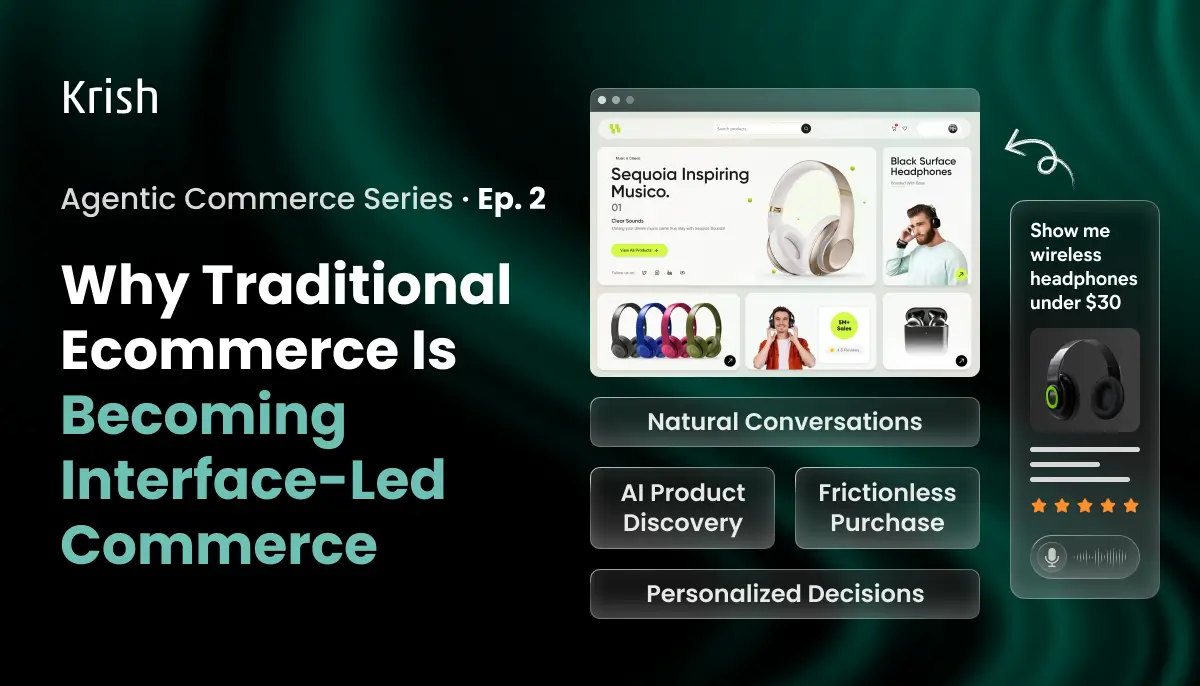
Carefully “Designed” Storefront vs. AI Agents
Your storefront was built for a buyer who walks in. More of them are calling ahead and never showing up.
The ecommerce interface, as brands have known it, the homepage, category pages, the PDP, the search bar, was designed around a specific human behaviour: arrive, browse, discover, decide, buy. Every pixel of it is optimised for that journey.
That journey is not disappearing. But it is no longer the only one. And the one replacing it for high-intent purchases does not need your carefully “designed” or fancy interface at all.
This is the shift from storefront-led to interface-led commerce. The interface is still there, but it now belongs to an AI agent.
In Episode 01 of this series, we established what agentic commerce is and why it changes the rules. Now, let us talk about what it is doing to the interface your entire business is built around.
What "Interface-Led Commerce" Actually Means
The term “interface-led commerce” describes what happens when the discovery and decision layer is no longer your storefront. It belongs to an AI platform. You are still the merchant. You just no longer control the moment of consideration.
Here is what that looks like in technical terms:
In the traditional model, a buyer types “standing desk height adjustable” into Google. The query hits an index built on keywords, backlinks, and on-page signals. Your category page ranks based on how well it has been optimised for that keyword cluster. The buyer arrives at your site with partial intent and a lot of browsing left to do. Your UX does the work of converting that partial intent into a decision.
In the interface-led model, a buyer types: “I need a height-adjustable desk for a 60cm deep alcove, needs to hold two monitors and a laptop arm, budget £500, needs to ship to Edinburgh this week.” That is not a keyword query. It is a structured brief.
Traditional search engines struggle to differentiate intents without further clicks and filtering. LLMs utilise in-context learning to narrow down intent through dialogue. This shift from keywords to conversational inference is the defining feature of commerce in 2026.
The AI breaks down every dimension of that brief simultaneously: spatial constraint, peripheral load, budget ceiling, location, and delivery window. It queries structured product data from multiple merchants, applies those constraints as hard filters, and returns two or three options that actually fit every parameter. The buyer sees a shortlist. They confirm one. Your storefront may receive a buyer who has already made up their mind.
The work your category filters, your comparison tables, and your buying guides used to do has been done upstream, by the AI, before the buyer arrived.
Why Discovery Journeys Are Collapsing Into a Single Moment
The traditional buying journey had stages: awareness, research, consideration, intent, and conversion. Brands invested in each one separately. Top-of-funnel content. Category pages for consideration. CRO for intent. Checkout optimization for the final push.
Conversational AI collapses that funnel by handling every stage in a single query.
“Find me a thermal flask that keeps coffee hot six hours, fits a car cup holder, under $50, highly rated” is not a search query. It is a completed brief. The buyer has already handled awareness, consideration, and intent in one sentence. The AI processes it in seconds. The 20-minute multi-tab journey just became a 90-second conversation.
What that means practically: every piece of content, every email, every retargeting ad built for stages two, three, and four of that funnel may never reach the buyer. The AI handled it before they got there.
Proof that AI is quietly retiring the Search Bar built for modern ecommerce
For 25 years, the search bar was the front door of ecommerce. Buyers typed intent. Merchants optimized for it. The whole discipline of SEO exists because of that one box.
That box is losing ground in ways that are now statistically confirmed.
- The AI Agents in ecommerce Market size is expected to be worth around $282.6 Billion By 2034, from $3.6 billion in 2024, growing at a CAGR of 54.7% during the forecast period from 2025 to 2034.
- A Bain & Company study found that 80% of consumers now rely on zero-click results in at least 40% of their searches.
- 60% of Google searches end without a single click. In Google’s AI Mode, that zero-click rate reaches 93%. When AI answers the question before the buyer needs to go anywhere, the storefront visit simply does not happen.
- Ahrefs analyzed 300,000 keywords and found organic CTR on top-ranking pages drops 58% when an AI Overview is present.
That is not a rounding error. That is more than half of the clicks that a number-one position used to reliably deliver, gone.
The search bar still works for navigational and branded queries. But for the considered, research-heavy purchase decisions where ecommerce margins are made, buyers are increasingly routing around it entirely.
The Next Steps for the Brands
Here is the commercial implication of conversational AI that most ecommerce teams have not fully internalised.
A search bar captures keywords. It does not understand what a buyer actually needs.
A conversational AI understands intent. “I need trail running shoes for a beginner, mostly soft ground, EU size 42, knees are a bit dodgy so I need good cushioning, under $100” is a brief. Not a query. The AI maps every dimension: use case, experience level, physical constraint, size, budget, and returns options that genuinely fit all of it.
The implication: buyers are finally able to articulate their real needs, not translate them into keyword language. Systems that read real intent win. Systems that read keywords are increasingly the secondary layer.
Your product data needs to meet buyers where they actually are. A description written for keyword density does not help an AI understand that your shoe is “ideal for beginners with joint sensitivity on trail surfaces.” A structured attribute that says “cushioning level: maximum, terrain: trail, experience level: beginner, joint support: enhanced” does.
This is why product information management (PIM) is now a commercial function, not a cataloguing one. The brands winning in conversational interfaces are the ones whose product data speaks in intent language, not just spec language.
The practical checklist for making your product data agent-readable:
Incomplete attributes, inconsistent pricing across channels, missing schema markup, and outdated descriptions are no longer just SEO problems. They are agent exclusion events.
When an agent queries your product feed and finds an empty attribute field, it does not guess. It excludes. A size field that reads “see description” instead of a discrete value eliminates your product from any query with a size constraint. A delivery window field that has not been updated since this morning fails the buyer who needs delivery by Thursday. A return policy that exists only as prose in a footer is unreadable to an agent expecting a structured field.
Brands must implement structured data and enhanced schema so AI assistants can easily interpret their offerings and update product pages with AI-friendly copy rich in natural language and intent signals.
- Attribute completeness: every field that a buyer might state as a constraint must exist as a discrete, machine-readable value, not buried in prose
- Schema markup: Product, Offer, and AggregateRating schema are the baseline; DeliveryTime and MerchantReturnPolicy schema are now commercially material
- Live feeds: price and inventory updated in real time via API, not batch exports on a schedule
- Intent-language descriptions: product copy that reflects actual use cases (“ideal for trail running on wet surfaces”) alongside technical specs, so LLMs can match contextual queries
- Cross-channel consistency: price and availability that match across your site, your Google Shopping feed, and your agent channel feeds, discrepancies erode trust scores
What Brands and Marketplaces Should Do Differently
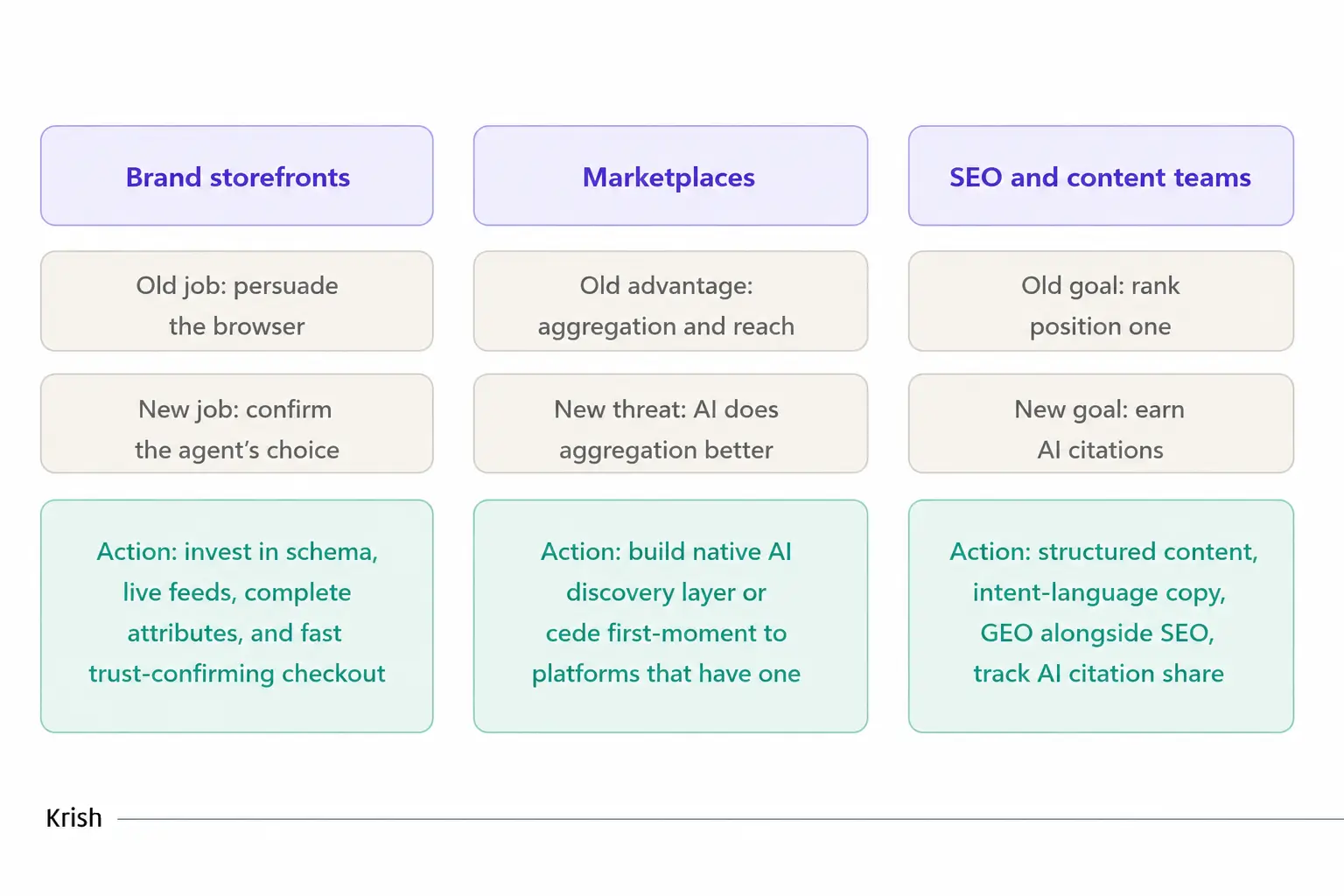
For brand storefronts: buyers arriving via AI have already decided. The storefront’s job is now to confirm, not to convert. That means fast-loading product pages with clear stock confirmation, transparent delivery dates, and frictionless checkout. CRO investment for AI-referred visitors is not about persuasion. It is about not breaking a sale that has already been made upstream.
For marketplaces: aggregation was the moat. AI assistants aggregate better, faster, and several do it without charging transaction fees. DTC brands with UCP and ACP compatibility can now bypass Amazon entirely. If AI-powered shopping assistants route high-intent customers directly to your checkout, you reduce dependence on Amazon’s marketplace and its commission structure. Marketplaces that are not building their own AI discovery layer are accelerating that migration.
For SEO and content teams: Generative Engine Optimisation (GEO) is the parallel discipline that now runs alongside traditional SEO. Where SEO targets keyword ranking, GEO targets AI citation. The tactics differ: authoritative structured content wins citations where keyword-optimised pages do not. Both disciplines are necessary. Only one of them is currently receiving meaningful investment at most ecommerce brands. Brands cited in AI Overviews earn 120% more organic clicks per impression than uncited brands on the same queries. GEO is not a future consideration. The citation gap is already commercial.
The Questions to Answer Before Episode 03
Before the next episode on how agents actually find and surface products, run these diagnostics on your current setup:
- Does your product schema include DeliveryTime and MerchantReturnPolicy markup, or just the basic Product and Offer fields?
- Are your inventory and pricing feeds updating in real time via API, or on a batch schedule that leaves stale data in agent queries?
- Do your product descriptions contain use-case and context language that an LLM can match to a buyer’s conversational brief, or only technical specifications?
- Have you implemented PIM infrastructure that enforces attribute completeness across your full catalogue, including your long tail?
- Are you tracking AI-referred traffic as a separate channel in your analytics, with its own conversion benchmarks?
- Have you audited which of ACP, MCP, and UCP your current platform supports natively versus which require integration work?
If most of these are no, the gap is not strategic. It is technical. And technical gaps are the ones that close fastest when addressed directly.
Up next in Episode 03: The search bar is losing ground. So what actually replaced it? We go inside how AI agents find and surface specific products, what signals they read that your current SEO does not address, and why catalogue architecture is now a discovery function.
Table of Content
Subscribe with Us!
Never miss any post, stay tuned!

As Director - Marketing, Zenul leads the marketing and branding at Krish. He brings with him an in-depth understanding of the evolving digital ecosystem and has a proven expertise and experience in strategic planning, market and competition analysis, creating and implementing client-centered, lead-gen and brand marketing campaigns. He has a heart for technology innovation and has been a keynote speaker on various platforms.
Recommended Reading:
Why Good Design Does Not Always Mean Good Conversion – Conversion Maturity Series | EP 06
22 June, 2026 The most frustrating CRO finding is a page with strong brand metrics and a broken conversion rate. The design team is proud of it. Users find it beautiful. And still, the majority of them leave before buying
Subscribe with Us!
Never miss any post, stay tuned!
Trusted by leading brands


