Introduction
For a decade, marketing blogs have preached that Tuesday at 10 AM is the undisputed king of email engagement. But for an enterprise brand with half a million subscribers spanning multiple time zones, shift-patterns, and buying habits, “Tuesday at 10 AM” isn’t a strategy. It is a blind guess.
Machine learning email marketing is the use of predictive algorithms to automatically determine the exact time, frequency, and content of emails based on individual subscriber behavior.
Static scheduling leaves millions in revenue on the table. Treating your entire database as a monolith actively damages deliverability and trains your audience to ignore you. In this operational breakdown, we map the math behind predictive send times and frequency capping so you can stop guessing and start orchestrating at scale.
By integrating these models into your broader AI-powered marketing automation strategy, your team shifts from pushing manual campaigns to managing autonomous revenue channels.
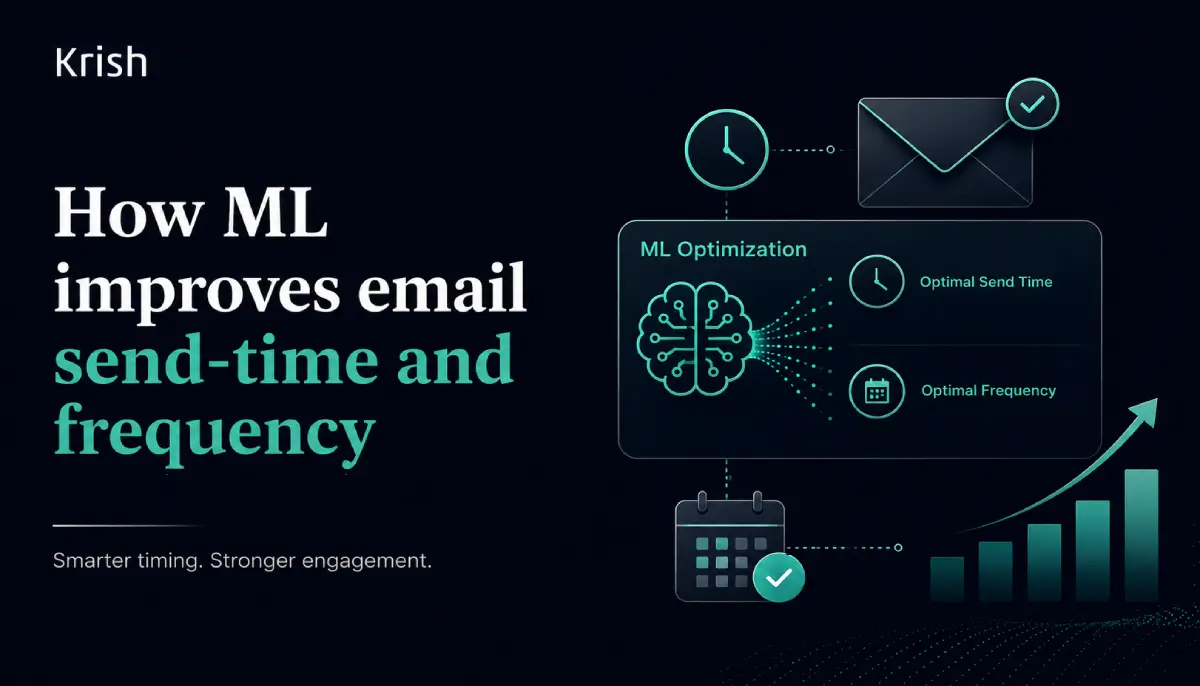
How do machine learning algorithms calculate optimal send-time?
Machine learning algorithms calculate optimal send-time by analyzing historical open times, click-throughs, and purchase timestamps over a rolling 90-day window to score individual subscriber readiness.
Analyzing historical engagement data
Predictive models do not guess. They weigh specific user actions. The algorithm analyzes precisely when a user interacts with your brand across multiple touchpoints. It looks at the timestamp of their last purchase, the exact minute they typically open promotional emails versus transactional ones, and how their behavior aligns with similar cohorts.
This creates a dynamic profile. If a user consistently engages with omnichannel retailing messages on Thursday evenings, the system overrides your scheduled campaign time and holds their specific email until 7:15 PM on Thursday.
Continuous learning vs. rules-based automation
Rules-based automation is rigid. If you build a flow that dictates “send if timezone is EST,” that rule breaks when the user travels or changes their reading habits.
Machine learning models adapt continuously. If a user shifts from morning commuting to late-night browsing, the algorithm detects the pattern change after a few interactions and recalibrates their optimal deployment window without any human intervention.
Predictive frequency capping: finding the threshold
Hitting the inbox at the right time matters. Hitting it too often destroys trust. Machine learning solves the volume problem through algorithmic frequency capping.
Balancing revenue goals with churn risk
Every subscriber has a breaking point. Predictive frequency capping calculates the exact number of messages a specific user can tolerate before their likelihood of unsubscribing spikes.
Instead of setting a global rule like “max three emails per week,” the algorithm throttles volume individually. Highly engaged VIPs might receive five highly personalized touches. At-risk churn candidates might receive one tightly focused offer every two weeks.
Real brand outcomes validate this approach. According to McKinsey, personalized algorithmic marketing drives a 10 to 15% revenue lift and drastically lowers acquisition costs. When Sephora deployed predictive analytics to manage frequency and tailor touchpoints, they effectively reduced generic blast volumes while increasing overall cross-channel engagement. They stopped overwhelming their database and started protecting their most valuable asset: subscriber attention. This precision directly aids in preventing shopping cart abandonment by ensuring the reminder hits exactly when the user is most receptive.
Talk to Our marketing automation Experts
Scale Your Frequency Capping with Smarter Marketing Automation
Frequency capping decisions are only as good as the automation layer executing them. Explore how Krish designs and implements marketing automation systems from segmentation and behavioral triggers to cross-channel orchestration, that give your ML models a reliable delivery infrastructure to act on.
Book a Free Consultation →Why static email scheduling destroys enterprise engagement
The concept of a universal best time to send an email breaks down entirely at the enterprise level. A single static deployment time ignores the mathematical reality of your audience’s diverse behavioral patterns.
Further reading
How XLFeet turned qualified traffic into repeat revenue — with email automation, predictive segmentation, not guesswork.
The illusion of the “best time to send”
Batch-and-blast logic relies on averages. Averages lie. When you schedule an email for thousands of users simultaneously, you optimize for a narrow slice of your list while actively alienating the rest. According to a recent report by Gartner, 84% of marketing leaders report that their static, generic emails fail to generate meaningful engagement.
If half your list opens emails during their morning commute and the other half browses while watching Netflix at 9 PM, sending at noon guarantees terrible visibility for both groups. The inbox is intensely competitive. Timing is everything.
The hidden cost of list fatigue
Sending too many emails to an active buyer dilutes your message. Sending the same volume to a passive user drives them straight to the unsubscribe button. We quantify this risk using the proprietary Krish Predictive Engagement Matrix, which maps subscriber threshold limits against lifetime value (LTV).
List fatigue is a mathematical problem, not a creative one. When you send emails blindly, you incur invisible costs: reduced domain reputation, lower placement rates in primary inboxes, and permanent churn.
Want to know if your MarTech stack is ready for AI agents?
[Download Krish’s Enterprise MarTech Audit Framework] — 12 technical questions that tell you exactly where you stand, where revenue is leaking, and what to fix first.
Machine learning email marketing: choosing the right platform
Migrating to predictive delivery requires evaluating your current technology stack. Not all machine learning capabilities are engineered equally.
Native ESP ML vs. Composable AI layers
The first architectural decision is whether to rely on built-in features within your existing Email Service Provider (ESP) or to implement dedicated composable AI layers via MACH architecture. Monolithic ESPs offer convenience. Composable tools offer raw predictive power for highly complex data models. Enterprise growth solutions often blend both.
Salesforce Marketing Cloud (Einstein STO)
Best for: Massive enterprises deeply embedded in the Salesforce ecosystem. Einstein Send Time Optimization analyzes 90 days of email engagement data to predict the best hour to send to each contact. It requires high data volumes to become accurate but seamlessly integrates with existing Salesforce data extensions.
Klaviyo (Predictive Analytics)
Best for: High-growth eCommerce brands. Klaviyo excels at rapid deployment. Its predictive suite automatically generates expected date of next purchase, churn risk scoring, and customer lifetime value predictions natively. It shines in fast-moving D2C environments where product catalogs turn over quickly.
AWS Personalize (Custom Composable Layer)
Best for: Highly complex, custom data models where native ESPs fail. If you run a bespoke marketplace with extreme variability, native tools often fall short. AWS Personalize allows data engineering teams to build fully custom algorithmic layers that sit outside the ESP, calculating scores and feeding dynamic parameters into your delivery engines via API.
Data privacy, compliance, and the algorithmic fail-state
Technology is only as effective as the data feeding it. Predictive algorithms require vast amounts of historical behavior to function, which introduces strict operational guardrails.
Algorithmic delivery does not work for complex enterprise B2B sales with long relationship cycles and low transaction volumes. If a user only buys from you once every three years, the model starves. Predictive send times also fail spectacularly when built on legacy tech debt. If your data warehouse syncs out-of-date segment lists to your ESP, the algorithm will confidently deploy emails based on incorrect assumptions. Conducting a thorough eCommerce audit is mandatory before turning these systems on.
Privacy regulations dictate how these systems operate. Under GDPR and CCPA, users must be able to opt out of automated profiling. Enterprise teams must ensure their data pipelines anonymize personally identifiable information (PII) before feeding it into third-party composable AI layers. Algorithms must be trained on behavior, not personal identity.
The Krish 90-Day Implementation Timeline
Deployment requires a phased, disciplined approach. You cannot flip a switch and expect immediate predictive accuracy.
Phase 1: Data hygiene and pipeline integration (Days 1–30) We audit the existing ESP, resolve tracking pixel gaps, and ensure purchase timestamps are flowing perfectly. Clean data is non-negotiable.
Phase 2: Model training and shadow deployment (Days 31–60) The algorithm runs in the background. It analyzes historical data and builds predictive profiles without actually altering send times. We validate its predictions against actual user behavior.
Phase 3: A/B testing and full rollout (Days 61–90) We split the audience. 50% receives standard batch deployments. 50% receives algorithmic delivery. We monitor engagement lift, churn reduction, and revenue metrics before expanding the model to the entire database.
Conclusion
Machine learning is transforming email marketing from static batch campaigns into intelligent, real-time decision systems. With predictive send-time optimization and dynamic frequency capping, brands can finally move beyond guesswork and deliver messages when each subscriber is most likely to engage.
This shift not only improves open rates and conversions but also strengthens long-term deliverability and customer retention by respecting user attention at an individual level.
At Krish, we help enterprises operationalize this shift through AI-led digital experiences, marketing automation, and data-driven MarTech strategies. By combining AI, analytics, and modern commerce capabilities, we enable brands to build scalable, personalized customer journeys that go far beyond email, turning every interaction into a measurable growth opportunity.
Talk to Our ai consultant Experts
Is Your MarTech Stack Ready to Run on AI?
Most enterprise MarTech stacks collect the right data but lack the architecture to act on it predictively. Krish's AI consulting team assesses your current setup and builds the roadmap to operationalize ML across every marketing channel, starting with email.
Book a Free Consultation →Frequently Asked Questions
Table of Content
- Introduction
- How do machine learning algorithms calculate optimal send-time?
- Predictive frequency capping: finding the threshold
- Why static email scheduling destroys enterprise engagement
- Machine learning email marketing: choosing the right platform
- Data privacy, compliance, and the algorithmic fail-state
- The Krish 90-Day Implementation Timeline
- Conclusion
Subscribe with Us!
Never miss any post, stay tuned!

Minal Joshi is a content marketer at Krish with a flair for eCommerce and Digital Commerce aspects. She is a MarTech fanatic with a knack of writing with which, she helps brands to curate, create, & commence digital brand positioning. Sharing insights via articles, case studies, eBooks, Infographics, and other forms of content creation is what she lives for. Being an ardent traveler, when not writing, you'll find her sipping coffee into the mountains or petting a stray.
Recommended Reading:
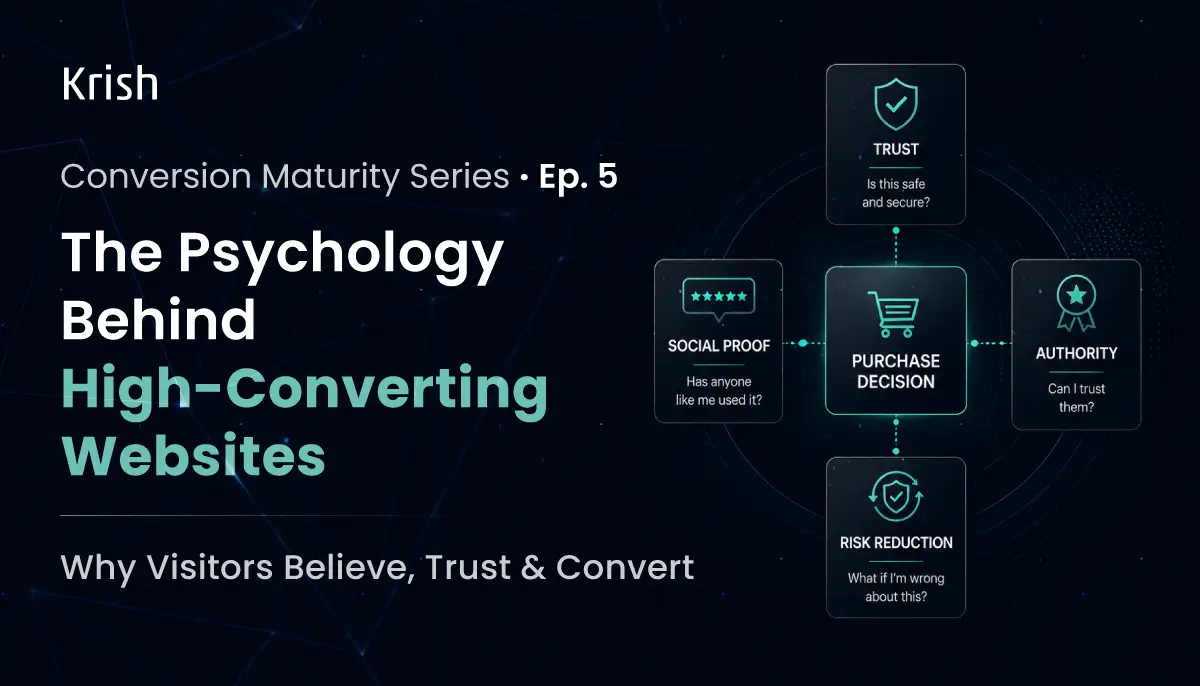
The Psychology Behind High-Converting Websites – Conversion Maturity Series | EP 05
11 June, 2026 Friction never announces itself, but psychology never even gets noticed. A visitor can hit zero friction, fast load, clean form, single CTA, and still walk away unconvinced. Something quieter than friction decided that outcome before the visitor consciously registered the page at all.
Subscribe with Us!
Never miss any post, stay tuned!
Trusted by leading brands


