Prelude
Most ecommerce brands diagnose growth problems incorrectly. When revenue slows, the instinct is predictable:
- increase ad spend,
- launch new campaigns,
- expand channels, and
- drive more traffic.
The assumption is simple: more traffic equals more revenue. But what if the problem isn’t traffic?What if your customers are already showing up and quietly leaving?
The issue isn’t acquisition. It’s conversion.
This article introduces a CRO Diagnostic Framework that helps Shopify brands identify exactly where revenue is being lost.
Your Shopify Store Doesn't Have a Traffic Problem
Imagine running a retail store in a busy shopping district. Every month, 100,000 people walk through your doors. They browse, look around, interact with products, and then they leave. Almost all of them.
Would your first reaction be, “Let’s get another 100,000 people into the store”?
Or would it be, “Why aren’t the existing visitors buying?”
The answer seems obvious in a physical retail environment. Yet online, brands do the opposite every day.
Revenue slows, conversion rates stagnate, and customer acquisition costs rise, yet the immediate response is still predictable: increase ad budgets, launch more campaigns, add new channels, buy more traffic.
The assumption remains that more traffic equals more sales. Unfortunately, ecommerce doesn’t work that way.
A Shopify store can generate high traffic, strong engagement, and significant ad spend and still struggle to grow revenue, because traffic is only the beginning of the customer journey. Revenue is created when visitors successfully navigate that journey. When they don’t, something is broken. The challenge is figuring out what.
This is where most brands fail. They diagnose a conversion problem as a traffic problem and continue pouring more visitors into a funnel that is already leaking revenue.
The Ecommerce Growth Myth
The ecommerce industry is obsessed with acquisition.
Scroll LinkedIn, attend conferences, listen to growth podcasts and the advice is remarkably similar: scale Meta Ads, increase Google budgets, invest in SEO, expand influencer partnerships, add new channels.
All of these tactics can work, but they assume something important: that your website is already converting effectively.
In reality, many Shopify stores are trying to scale broken systems. Imagine adding more water to a leaking pipe.
The leak doesn’t disappear; you simply lose more water. The same thing happens with ecommerce traffic. If visitors aren’t converting today, sending more visitors tomorrow rarely solves the underlying issue.
It simply makes the problem more expensive.
The Leaky Funnel Problem
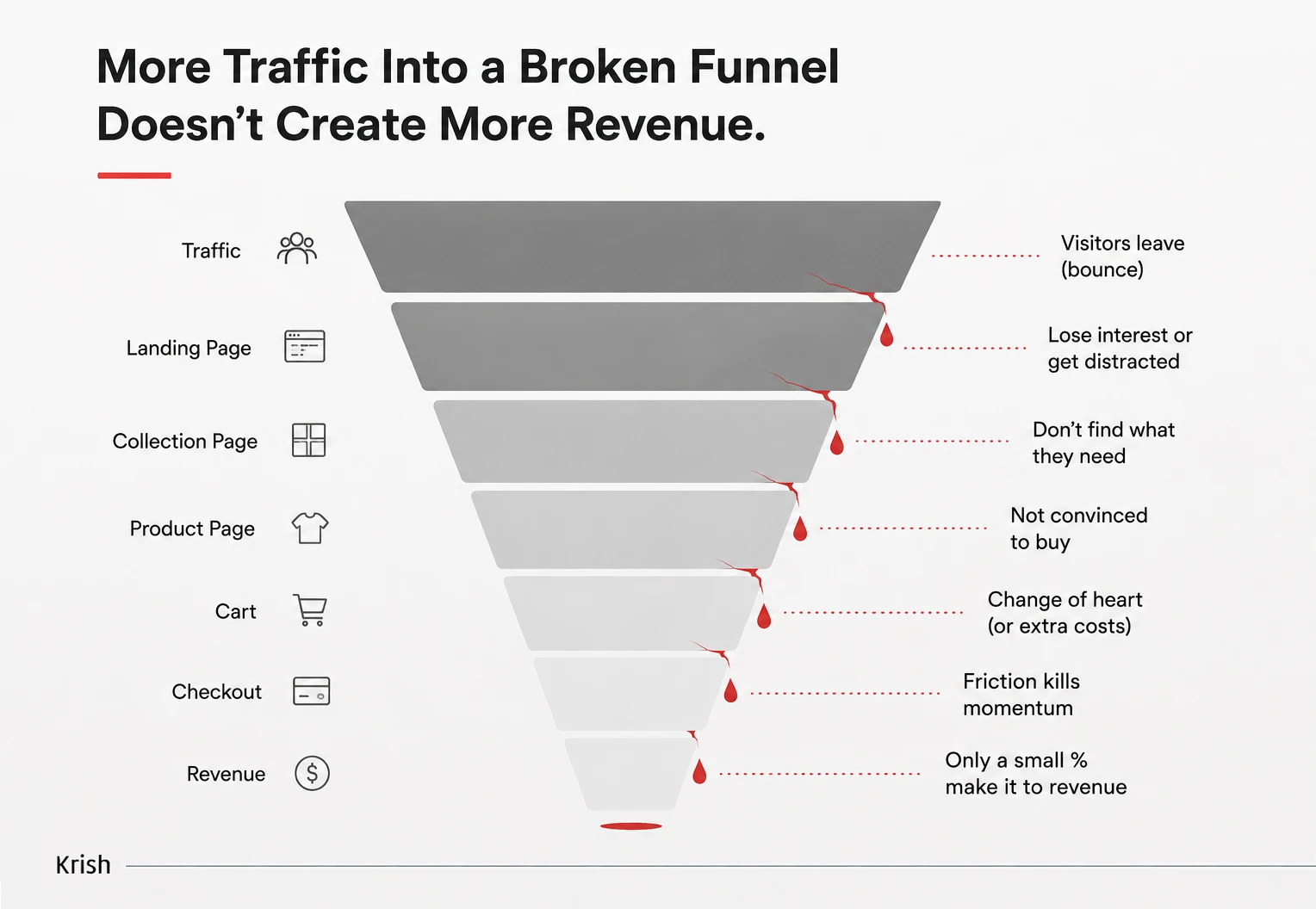
Most ecommerce teams view performance through a simplistic lens: Traffic In, Sales Out. But customer journeys are far more complex. Visitors pass through multiple stages before becoming customers, and at every stage, some leave.
The question isn’t whether customers are leaving, because they always will.
The question is: where are they leaving, and why?
This is the foundation of effective Conversion Rate Optimization. Not changing button colors. Not running random A/B tests. Not copying competitors. Understanding where confidence is lost and friction is introduced.
More Traffic Into a Broken Funnel Doesn’t Create More Revenue
The Shopify CRO Diagnostic Framework
One of the biggest mistakes ecommerce teams make is treating CRO as a collection of tactics: change a button, add urgency, install an app, launch a test.
The result? Lots of activity and very little insight.
The highest-performing ecommerce teams approach optimization differently: they diagnose before they prescribe. Over time, we’ve found that when a Shopify store generates traffic but struggles to convert, the problem usually falls into one of four categories.
The Four Questions Framework
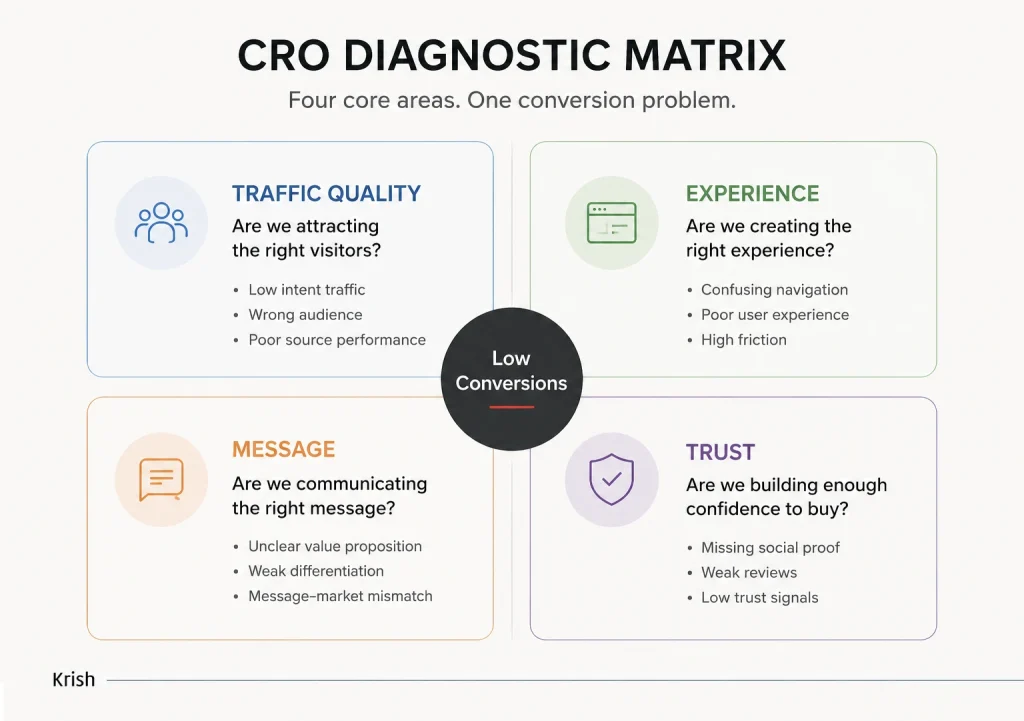
When traffic isn’t producing revenue, ask four questions:
- Are we attracting the right visitors? (Traffic Quality Problem)
- Are we creating the right experience? (UX Problem)
- Are we communicating the right message? (Positioning Problem)
- Are we creating enough confidence? (Trust Problem)
Every conversion challenge can usually be traced back to one or more of these areas. This framework transforms CRO from guesswork into diagnosis.
Diagnostic Area #1: Traffic Problem or Conversion Problem?
Before optimizing a store, you need to determine whether the problem exists before visitors arrive or after they arrive. Many brands assume traffic volume equals opportunity, but it doesn’t. Traffic quality matters more than traffic quantity. Consider two stores: Store A receives 100,000 monthly visitors at a 0.6% conversion rate, while Store B receives 35,000 monthly visitors at a 3.2% conversion rate. Most executives focus on traffic, but the smarter question is: which store generates more revenue per visitor? The answer often reveals the real growth opportunity.
Not All Traffic Is Created Equal
One of the most common findings during CRO audits is traffic-source mismatch, where visitors arrive but never intended to buy. Examples include broad-match search campaigns, poor audience targeting, misaligned influencer partnerships, and low-intent content traffic. These channels generate volume, not necessarily revenue. The result? Great-looking dashboards and disappointing sales numbers.
The Trafic Quality Audit
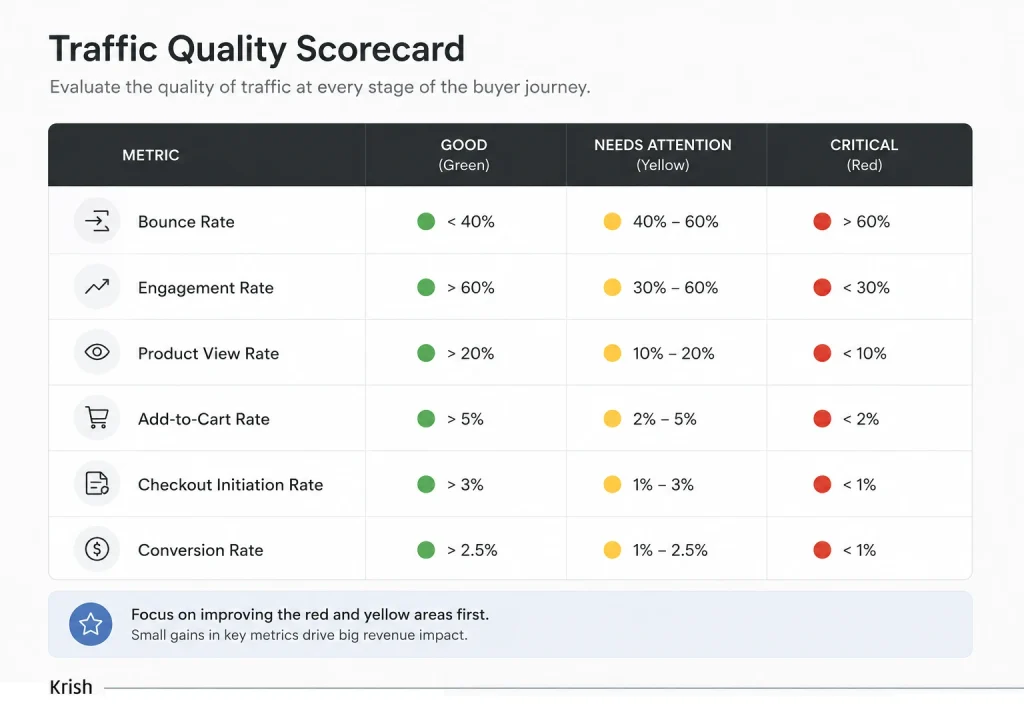
Before changing anything on your Shopify store, evaluate the quality of incoming traffic with these questions: Are visitors engaging? (Low engagement often indicates audience mismatch.) Are visitors viewing products? (If product page views are low, the issue may be relevance, not conversion.) Are visitors adding products to cart? (This helps isolate where intent begins to disappear.) Are visitors reaching checkout? (If checkout initiation is strong but purchases are weak, the issue may exist further down the funnel.)
Metrics That Actually Matter
Many brands obsess over vanity metrics: sessions, clicks, impressions, reach. These metrics are useful, but they don’t explain conversion problems. Instead, focus on metrics that reveal where leakage occurs: Product View Rate (percentage of visitors reaching product pages), Add-to-Cart Rate (percentage of visitors expressing purchase intent), Checkout Initiation Rate (percentage of visitors entering the buying process), and Purchase Completion Rate (percentage of visitors completing transactions).
Consider two campaigns: Campaign A drives 10,000 visitors at a 0.5% conversion rate, generating 50 orders. Campaign B drives 3,000 visitors at a 3% conversion rate, generating 90 orders. Less traffic, more revenue. This is why diagnosing traffic quality is critical. The objective isn’t attracting everyone; it’s attracting the right people.
Further Reading
Stop Counting Sessions. Start Measuring Intent.
High session counts with low revenue is a measurement problem before it's a conversion problem. This post breaks down the ecommerce metrics that reveal actual buyer intent, Product View Rate, Add-to-Cart Rate, Checkout Initiation Rate, and Purchase Completion Rate, so you can isolate exactly where qualified visitors are dropping out of the journey.
Read the full blog →Diagnostic Area #2: Landing Page Failure
Many Shopify brands lose customers before product discovery even begins, which is one of the most overlooked conversion problems in ecommerce. Visitors arrive, they evaluate, they decide, and they leave. Often within seconds. Not because they dislike your products or your pricing, but because they never found a reason to continue.
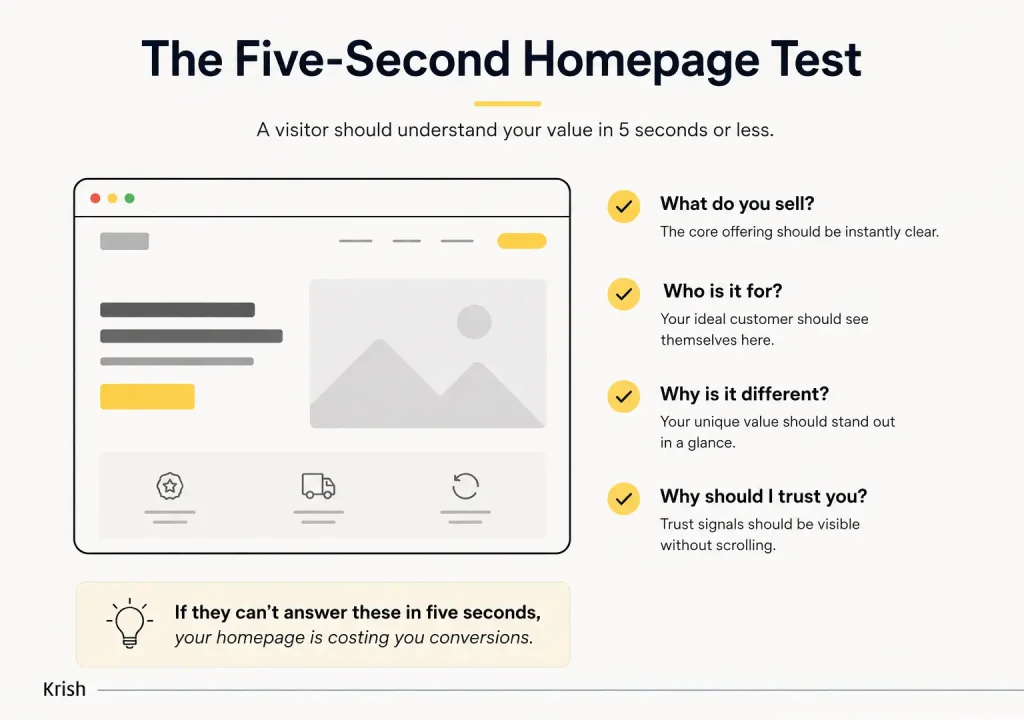
The Five-Second Test: Imagine showing your homepage to a stranger for five seconds, then asking: What does this company sell? Who is it for? Why is it different? Why should I trust it? If they can’t answer those questions, your homepage has a conversion problem, not a traffic problem.
Failure #1: Weak Value Proposition. Most ecommerce messaging is painfully generic. Phrases like “Premium Quality Products,” “Shop the Latest Collection,” or “Designed for Modern Living” sound impressive but communicate almost nothing. Strong value propositions answer three questions immediately: What do you sell? Who is it for? Why should customers care? Clarity consistently outperforms cleverness.
Failure #2: Slow Experiences. Customers don’t compare your site against competitors; they compare it against expectations, and those expectations are rising. Every delay creates friction, every friction point increases abandonment. Speed isn’t merely a technical metric; it’s a conversion metric.
Failure #3: Visual Clutter. Many Shopify stores attempt to communicate everything at once, piling on multiple banners, popups, promotions, announcements, carousels, and videos, with the result that customers understand nothing. When everything is important, nothing is important. Great landing pages simplify decision-making, not complicate it.
Failure #4: Weak Trust Signals. Trust isn’t earned at checkout; it’s earned immediately. Customers arriving from search engines, ads, or social platforms often have no prior relationship with your brand, so they need reassurance in the form of reviews, ratings, media mentions, guarantees, certifications, customer counts, and industry recognition. Trust signals reduce perceived risk, and reduced risk increases conversion.
Failure #5: Poor Mobile Experience. Most ecommerce traffic is mobile, yet many stores are still optimized primarily for desktop. Common issues include small text, tiny buttons, slow-loading images, intrusive popups, and poor navigation. Mobile optimization isn’t a feature; it’s a requirement.
Expert Perspective: Customers do not abandon because they dislike your brand. Most never spend enough time evaluating your brand to reach that conclusion. They abandon because they haven’t found a compelling reason to trust it. Trust is rarely built through one element; it is accumulated through dozens of small signals: every review, every guarantee, every product image, every testimonial, every design decision. Together, they answer one critical question: “Can I confidently buy from this company?” Stores that answer this question quickly convert more traffic. Stores that don’t continue searching for traffic solutions when the real problem is confidence.
By this point in the framework, we’ve isolated two major causes of traffic-without-sales: wrong visitors and a weak landing experience. The next stage is where most purchase decisions are ultimately won or lost. Even highly qualified visitors with strong intent will abandon if they encounter uncertainty, friction, or lack of confidence when evaluating products.
Further Reading
Does Your Store's Design Actually Convert?
A landing page can pass every speed test and still lose visitors in the first five seconds, because clarity, visual hierarchy, and mobile-first layout are design decisions, not technical ones. Explore how Krish's experience design practice builds ecommerce UX that answers the five-second test: what you sell, who it's for, and why a first-time visitor should trust you enough to keep going.
Explore the service →Diagnostic Area #3: Product Page Failure
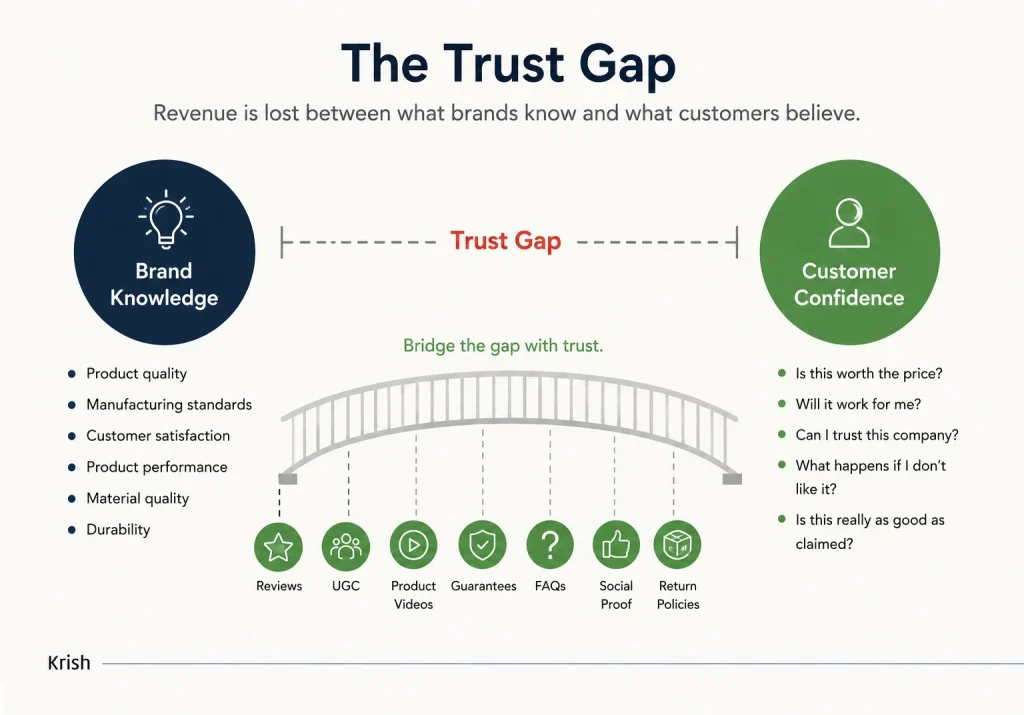
By the time a visitor reaches a product page, something important has already happened. They’ve survived your ads, engaged with your landing page, explored your collection pages, and demonstrated intent. Yet this is where many Shopify stores lose the sale. Product pages are where customers move from curiosity to commitment, and commitment requires confidence. The problem is that brands and customers don’t start from the same place. Brands know everything about their products while customers know almost nothing. Revenue is lost in the gap between those two realities.
The Trust Gap Framework
One of the most useful ways to diagnose product-page performance is through what we call the Trust Gap Framework. On one side is What the Brand Knows: product quality, manufacturing standards, customer satisfaction, product performance, material quality, and durability. On the other side is What the Customer Believes: Is this worth the price? Will it work for me? Can I trust this company? What happens if I don’t like it? Is this really as good as claimed? The distance between these two realities is the Trust Gap, and every unanswered question widens it.
Diagnostic #1: Weak Product Imagery. In ecommerce, customers cannot touch products, so photography becomes the substitute for reality. Yet many Shopify stores rely on low-resolution images, limited viewing angles, inconsistent photography, poor lighting, and missing detail shots. Customers are trying to reduce uncertainty, and every missing image creates another question. Every question creates friction. Elite ecommerce brands treat product imagery as one of their most important sales assets, not creative assets.
Diagnostic #2: Missing Product Videos. Product videos accelerate trust faster than almost any other content format because video answers questions customers haven’t yet articulated. Customers can see scale, functionality, texture, fit, movement, and real-world usage, resulting in reduced uncertainty that increases conversion.
Diagnostic #3: Generic Product Descriptions. Many ecommerce descriptions sound like technical documentation. “100% Cotton T-Shirt” is technically correct but commercially weak. Customers don’t buy features; they buy outcomes. A stronger description explains why it matters, who it’s for, what problem it solves, and what experience it creates. The best product descriptions answer “Why should I care?” rather than “What is this made of?”
Diagnostic #4: Weak Review Strategy. Many brands collect reviews but few strategically use them. The objective isn’t displaying stars; it’s reducing objections. Great reviews answer questions such as: Is sizing accurate? Is quality worth the price? How fast is delivery? Does it perform as advertised? Customers trust customers, making reviews one of the most powerful confidence-building tools available.
Diagnostic #5: Missing User-Generated Content. Professional photography builds aspiration; user-generated content builds trust. Customers know marketing images are carefully curated, so they want proof from real people. UGC provides authenticity, social proof, and real-world validation. When customers see others successfully using a product, perceived risk declines dramatically.
Diagnostic #6: Hidden Shipping Information. One of the fastest ways to lose trust is forcing customers to hunt for critical information. Customers shouldn’t have to search for answers to questions like: How much is shipping? How long does delivery take? Is international shipping available? Transparency accelerates purchasing decisions; opacity delays them.
Diagnostic #7: Weak Return Messaging. Customers don’t buy products; they buy confidence. A strong return policy reduces perceived risk. Many customers never return products, but they still want to know they can, and that’s what creates confidence.
Diagnostic #8: Weak Call-to-Action Experience. Many product pages unintentionally bury the most important action on the page. The Add-to-Cart button should be visible, obvious, accessible, and persistent. Customers shouldn’t have to search for the next step.
Diagnostic #9: Missing Urgency. Not artificial urgency, but authentic urgency such as limited inventory, seasonal availability, sale expiration dates, and production schedules. Urgency helps customers make decisions. Without it, many purchases become future purchases, and future purchases often never happen.
Diagnostic #10: Missing FAQs. Every unanswered question creates doubt. The best ecommerce stores answer questions before customers ask them, covering shipping, returns, warranty, compatibility, product care, and sizing. Every answer reduces uncertainty, and every reduction in uncertainty increases confidence.
The Real Job of a Product Page: Most brands believe product pages exist to explain products. The best brands understand something different: product pages exist to eliminate reasons not to buy. That’s a very different objective, and it changes everything.
Further Reading
Conversion Funnel Analysis: How to Identify and Fix Drop-Offs
Your funnel is leaking revenue at every stage you haven't analyzed yet. This guide shows you how to run a conversion funnel analysis, spot exactly where visitors drop off, and apply targeted fixes that move the needle.
Read the full blog →Diagnostic Area #4: Friction Analysis
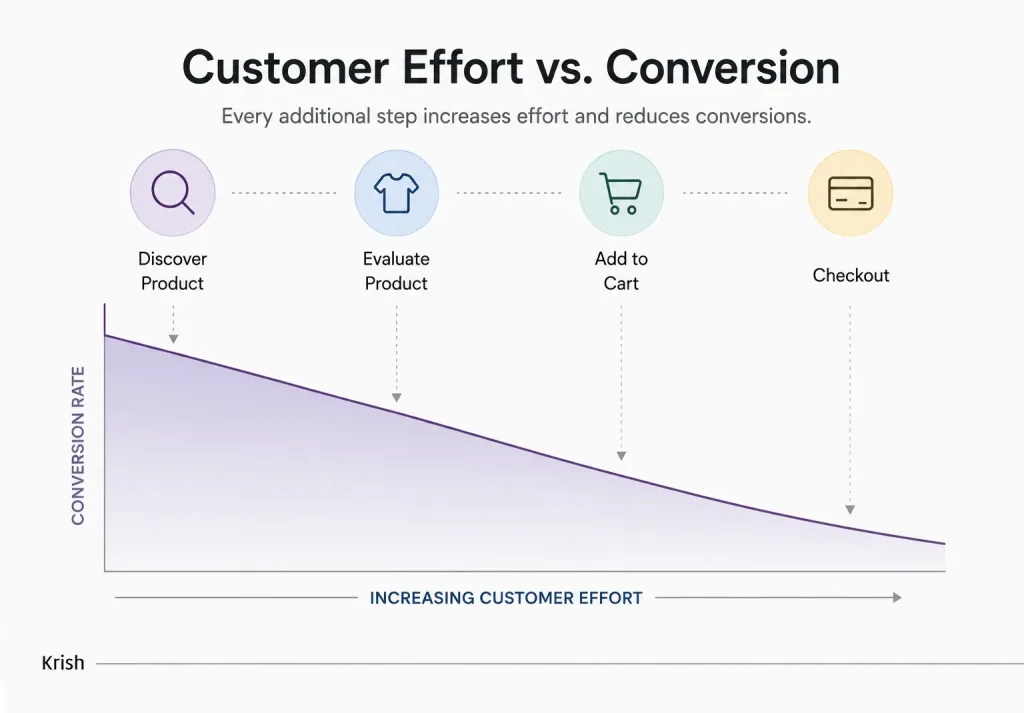
Not all conversion problems are trust problems; many are effort problems. Customers arrive with intent, then the website makes purchasing difficult. Every additional click, every unnecessary step, every moment of confusion creates friction, and friction creates abandonment.
The Customer Effort Principle
One of the most overlooked concepts in ecommerce is customer effort. Customers rarely abandon because one issue is catastrophic; they abandon because multiple small annoyances accumulate. Imagine entering a supermarket with confusing signage, narrow aisles, missing price tags, and long checkout lines. Individually, each issue seems manageable, but collectively they create frustration. The same principle applies online.
Friction #1: Poor Search Experience. Search is one of the highest-intent activities on any ecommerce website. A customer using search is effectively saying, “I know what I want. Help me find it.” Yet many stores provide poor relevance, no autocomplete, weak typo correction, and limited suggestions. Search isn’t navigation; it’s revenue infrastructure.
Friction #2: Weak Filtering. Filters reduce effort. Without them, customers are forced to manually browse, and the larger the catalog, the more damaging this becomes. Effective filters include price, size, color, availability, brand, and product type. Finding products should feel effortless.
Friction #3: Confusing Navigation. Navigation should answer one question: “Where should I go next?” Unfortunately, many Shopify stores create complexity rather than clarity through too many categories, poor naming conventions, multiple menu layers, and unclear hierarchy. Customers shouldn’t need to think about navigation; they should simply use it.
Friction #4: Cart Obstacles. Customers who reach the cart have demonstrated intent, yet many stores introduce new friction through surprise shipping fees, coupon distractions, poor upsell experiences, and hidden delivery timelines. Momentum matters. The cart should accelerate purchasing decisions, not interrupt them.
Friction #5: Checkout Complexity. Many stores ask for too much information. Every field creates work and every additional step creates risk. The best checkout experiences prioritize speed, clarity, and simplicity. The easier checkout becomes, the more revenue is captured.
Diagnostic Area #5: Mobile Revenue Diagnostics
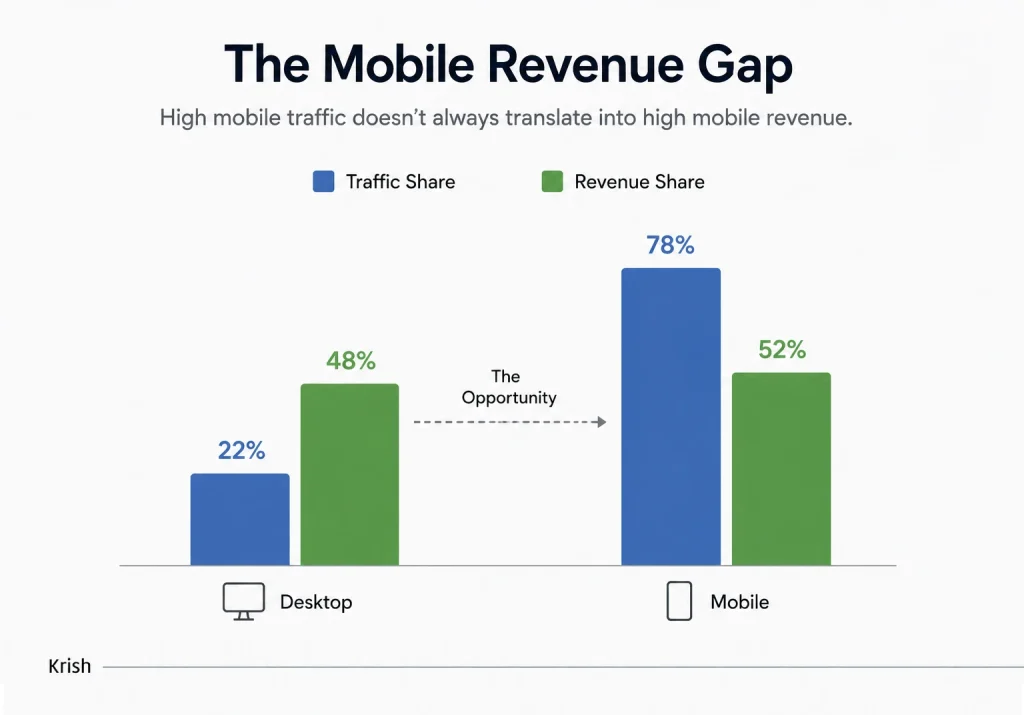
Mobile traffic dominates ecommerce, but mobile revenue often lags behind, creating one of the largest optimization opportunities for Shopify brands. Most businesses monitor traffic share but few monitor revenue share, and the difference often reveals substantial opportunity. Consider this scenario: mobile traffic is 78%, but mobile revenue is only 52%. This gap signals friction. Customers want to buy but something is preventing them.
Mobile Diagnostic #1: Poor Performance. Mobile users are less patient, and slower connections amplify performance issues caused by heavy imagery, third-party scripts, app bloat, and poor optimization. Performance is no longer a technical issue; it’s a commercial issue.
Mobile Diagnostic #2: Tiny Tap Targets. Customers should never struggle to interact with your website. Small buttons, crowded layouts, and tiny navigation elements all increase friction. Good mobile experiences feel effortless; bad ones feel exhausting.
Mobile Diagnostic #3: Sticky Element Overload. Mobile screens are small and every pixel matters, yet many stores stack announcement bars, chat widgets, discount popups, and sticky CTAs until the content becomes secondary and the user experience suffers.
Mobile Diagnostic #4: Weak Mobile Search. Mobile users rely heavily on search, and when search performs poorly, discovery becomes difficult. Difficult discovery reduces conversion. The fastest path to purchase should never be the hardest path to navigate.
Mobile Diagnostic #5: Checkout Friction. This is where mobile revenue is most commonly lost through long forms, poor autofill, limited payment methods, and complex validation. Customers who reach checkout are already convinced. The goal is helping them finish, not testing their patience.
Key Takeaway
By this stage of the diagnostic framework, we’ve uncovered three major causes of Shopify traffic without sales: traffic quality issues, trust deficiencies, and friction problems. Most stores suffer from a combination of all three. The challenge is identifying which creates the largest revenue impact, and that requires something most brands overlook: better behavioral insights. Because analytics dashboards tell you what happened, but they rarely explain why it happened.
Diagnostic Area #6: Analytics Blind Spots
One of the most surprising discoveries during CRO audits is this: most ecommerce brands don’t have a data problem; they have an interpretation problem. Modern Shopify stores have access to more data than ever before: GA4, Shopify Analytics, advertising platforms, customer data platforms, heatmaps, session recordings, and customer feedback. Yet despite having more data, many brands still struggle to answer a simple question: “Why aren’t visitors converting?” The reason is simple. Most analytics tools tell you what happened, but very few tell you why it happened. And the “why” is where revenue opportunities are hidden.
Further Reading
GA4 Shows the Drop. It Doesn't Show the Cause.
The five-layer analytics stack only produces actionable insight when the data beneath it is being read correctly. This post explains why standard funnel drop-off metrics consistently mislead optimization decisions, and which behavioral signals to layer on top of GA4 data to find what actually caused the revenue leak.
Read the full blog →The Analytics Illusion
Many ecommerce dashboards create an illusion of understanding. Teams monitor sessions, users, bounce rates, revenue, and conversion rates. All are useful metrics, but none reveal customer behavior. Imagine discovering a 1.2% conversion rate and a 62% bounce rate. Interesting, but not actionable. The critical questions remain unanswered: Why did customers leave? What confused them? What created friction? What prevented trust? Numbers identify symptoms; behavior reveals causes.
What GA4 Won’t Tell You
GA4 is incredibly valuable, but it has limitations. It can tell you that users visited a page, exited a page, or abandoned a funnel, but it often cannot tell you what frustrated them before they left. A customer may repeatedly click a non-clickable image. A shopper may struggle to find sizing information. A visitor may attempt to interact with a broken filter. A mobile user may not be able to find the Add-to-Cart button. Analytics often misses these insights entirely.
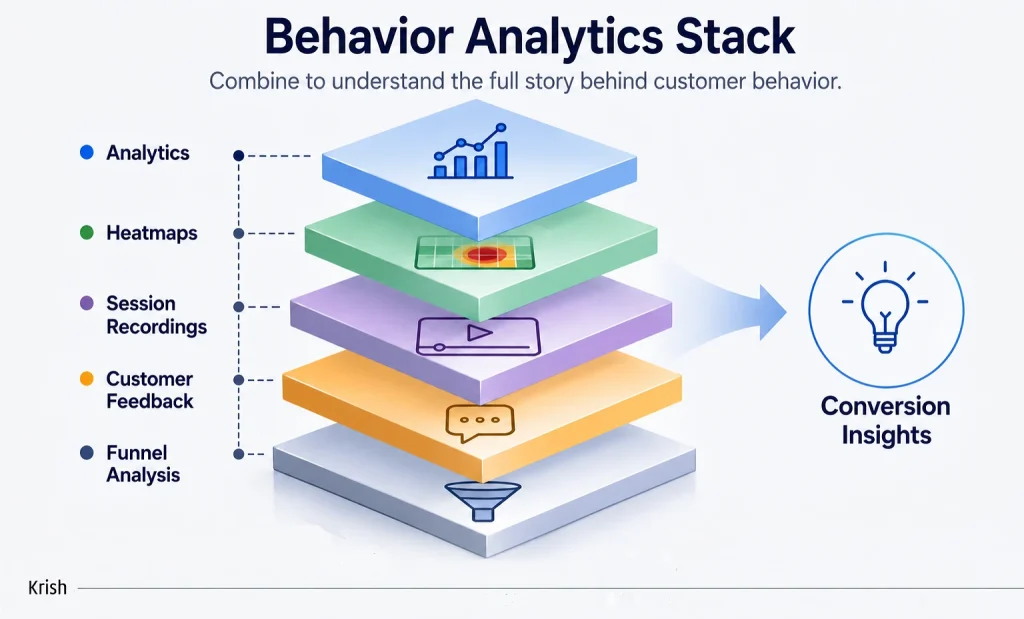
The Behavior Analytics Stack
The most effective CRO programs combine multiple sources of insight across five layers:
- Layer 1: Analytics (GA4, Shopify Analytics): Answers “What happened?”
- Layer 2: Heatmaps (Hotjar, Microsoft Clarity, Lucky Orange): Answers “Where are users focusing attention?”
- Layer 3: Session Recordings: Answers “What are customers actually doing?” This often reveals surprising friction.
- Layer 4: Customer Feedback (surveys, reviews, interviews, support tickets): Answers “What are customers thinking?”
- Layer 5: Funnel Analysis: Answers “Where is revenue leaking?”
The combination of all five creates a complete diagnostic picture.
The Most Valuable Question in CRO: Most optimization efforts begin with solutions. The best programs begin with a question: “What is preventing customers from completing the purchase?” That question changes everything. Instead of guessing, instead of copying competitors, instead of following generic best practices, you start solving actual customer problems. And actual customer problems produce measurable business outcomes.
The CRO Prioritization Framework
One of the biggest mistakes ecommerce teams make is trying to fix everything at once. A typical CRO audit uncovers 20, 50, or sometimes 100+ opportunities. The challenge isn’t identifying issues; it’s deciding where to start. Great CRO programs prioritize; average CRO programs react.
Why Most Optimization Roadmaps Fail
Imagine discovering slow pages, weak reviews, checkout friction, mobile issues, and poor navigation all at once. Should all of them be fixed immediately? No, because not all opportunities create equal impact.
The Impact vs. Effort Matrix
Every optimization opportunity should be evaluated using two dimensions: impact (how much revenue can this improvement influence?) and effort (how difficult is implementation?):
- Quick Wins (High Impact, Low Effort): Improve CTA visibility, add trust badges, surface shipping information, optimize mobile buttons. Address these immediately.
- Strategic Wins (High Impact, High Effort): Site architecture redesign, checkout optimization, personalization programs, search improvements. These create long-term competitive advantages.
- Low Priority (Low Impact, Low Effort): Nice to have, not urgent.
- Future Considerations (Low Impact, High Effort): Avoid unless supported by strong evidence.
Real-World Diagnostic Scenario
Let’s apply the framework. A fashion brand with 120,000 monthly visitors, a 1.3% conversion rate, and a $95 average order value was generating $148,200 in monthly revenue. The leadership team believed the problem was traffic and proposed increasing advertising spend. Before increasing acquisition budgets, a diagnostic audit was conducted.
What we found:
- Traffic Quality: Healthy. Visitors demonstrated strong intent with no major acquisition issues.
- Homepage: Weak trust signals, minimal social proof, and limited credibility indicators.
- Product Pages: Major issues including limited product imagery, no video content, weak reviews, and hidden shipping information.
- Collection Pages: Poor filtering, weak merchandising, and difficult product discovery.
- Mobile Experience: Slow page speed, small tap targets, and difficult navigation.
- Checkout: Strong, with no major concerns.
The Outcome: With zero increase in traffic and zero increase in advertising, conversion rate improved from 1.3% to 2.1%, a 61% revenue increase. The lesson? The business didn’t need more visitors. It needed fewer obstacles.
Why Most CRO Programs Fail
After reviewing hundreds of optimization initiatives, the same mistakes appear repeatedly.
Mistake #1: Treating CRO as A/B Testing. Many teams assume CRO equals testing. Testing is important, but testing without diagnosis creates random activity. Optimization begins with understanding, not experimentation.
Mistake #2: Copying Competitors. Competitors don’t share your customers, traffic, products, pricing, or brand positioning. Copying what works elsewhere rarely guarantees success. The best CRO programs are customer-driven, not competitor-driven.
Mistake #3: Ignoring Customer Research. Many teams optimize based on assumptions; customers optimize based on reality. Whenever possible, incorporate surveys, interviews, feedback, and reviews. The answers are often surprisingly obvious.
Mistake #4: Focusing on Tactics Instead of Systems. The internet loves tactical advice: change your button color, add urgency, move the CTA. Sometimes these tactics help, but sustainable growth comes from improving systems: traffic, experience, trust, messaging, and friction together.
Mistake #5: Chasing More Traffic Before Fixing Conversion. This is the most expensive mistake. Acquisition costs continue rising and every visitor becomes more valuable. Before buying more traffic, ask: “Are we maximizing the value of the traffic we already have?”
Further Reading
Is Your Marketing Stack Diagnosing the Right Problems?
The brands that fix conversion problems sustainably start with a structured audit, not a test backlog. Krish's digital marketing audit and strategy practice maps your full funnel against business objectives, identifies where revenue is leaking, and builds a prioritized roadmap before a single optimization is touched.
Explore the service →The New CRO Mindset
Most ecommerce brands approach CRO incorrectly. They ask “How do we improve conversion rates?” High-performing brands ask a fundamentally different question: “What is preventing customers from buying?” The difference is subtle but powerful. The first question focuses on metrics; the second focuses on customers. And customers create metrics, not the other way around.
Executive Summary
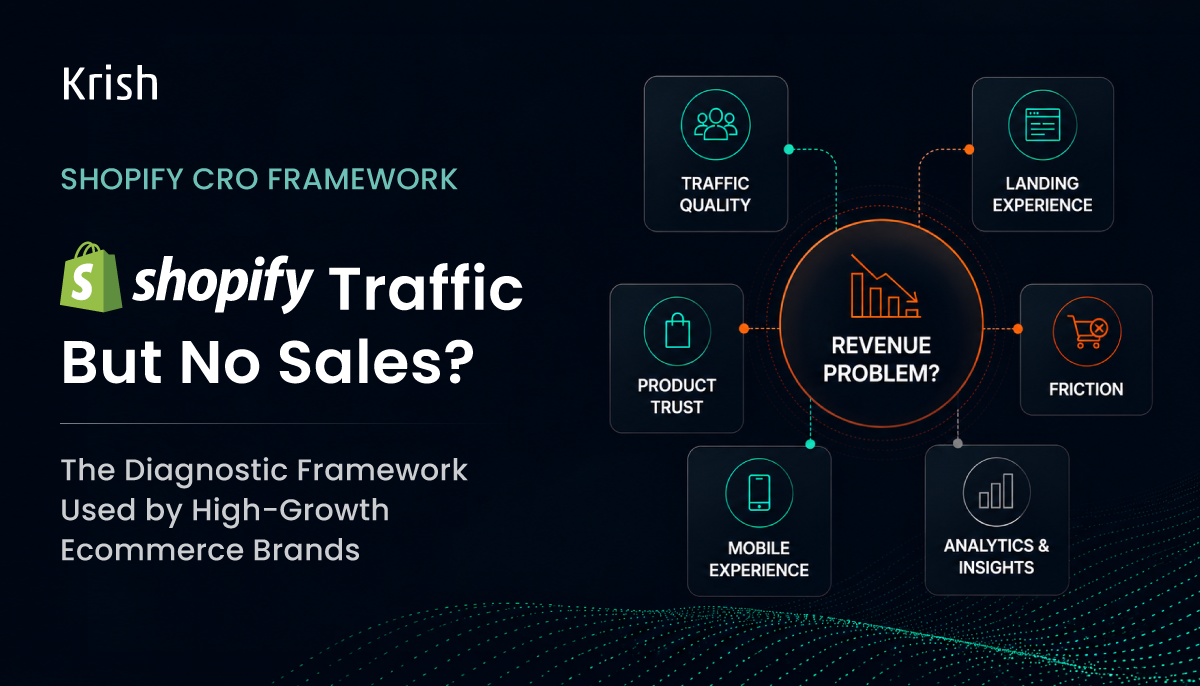
If your Shopify store generates traffic but struggles to produce sales, the problem usually falls into one or more of six diagnostic categories:
- Traffic Quality Issues: Wrong audience, low intent, poor acquisition strategy.
- Landing Page Problems: Weak messaging, poor trust signals, low clarity.
- Product Page Failures: Trust gaps, weak imagery, missing proof, insufficient information.
- Friction Issues: Poor navigation, search challenges, checkout complexity.
- Mobile Experience Problems: Performance issues, usability issues, mobile conversion barriers.
- Analytics Blind Spots: Insufficient behavioral understanding, limited customer insights, poor prioritization.
Traffic Is a Vanity Metric. Revenue Is the Goal.
Many Shopify brands believe growth requires more traffic, more ads, more channels, and more campaigns. Sometimes that’s true. But often, the fastest path to growth is understanding why existing traffic isn’t converting. Every visitor who leaves your website without purchasing tells a story. The challenge is listening carefully enough to understand it. The brands that win aren’t always the ones with the biggest budgets. They’re the ones with the clearest understanding of customer behavior. Because growth isn’t created by attracting more visitors; growth is created by removing obstacles from the path to purchase. And that’s exactly what great CRO is designed to do.
Get a Shopify CRO Diagnostic Audit
If your store is attracting visitors but struggling to generate sales, the solution isn’t always more traffic. Sometimes it’s a better diagnosis. Our Shopify CRO specialists analyze:
✓ Traffic Quality
✓ Homepage Experience
✓ Product Pages
✓ Collection Pages
✓ Cart & Checkout
✓ Mobile Experience
✓ Behavioral Analytics
✓ Revenue Opportunities
Receive a prioritized roadmap designed to uncover hidden conversion barriers and identify the highest-impact opportunities for profitable growth. Because the fastest way to increase revenue isn’t always attracting more visitors; it’s converting more of the visitors you already have.
Frequently Asked Questions
Table of Content
- Prelude
- Your Shopify Store Doesn't Have a Traffic Problem
- The Ecommerce Growth Myth
- The Leaky Funnel Problem
- The Shopify CRO Diagnostic Framework
- The CRO Prioritization Framework
- Real-World Diagnostic Scenario
- Why Most CRO Programs Fail
- The New CRO Mindset
- Executive Summary
- Traffic Is a Vanity Metric. Revenue Is the Goal.
- Get a Shopify CRO Diagnostic Audit
Subscribe with Us!
Never miss any post, stay tuned!

As Director - Marketing, Zenul leads the marketing and branding at Krish. He brings with him an in-depth understanding of the evolving digital ecosystem and has a proven expertise and experience in strategic planning, market and competition analysis, creating and implementing client-centered, lead-gen and brand marketing campaigns. He has a heart for technology innovation and has been a keynote speaker on various platforms.
Recommended Reading:
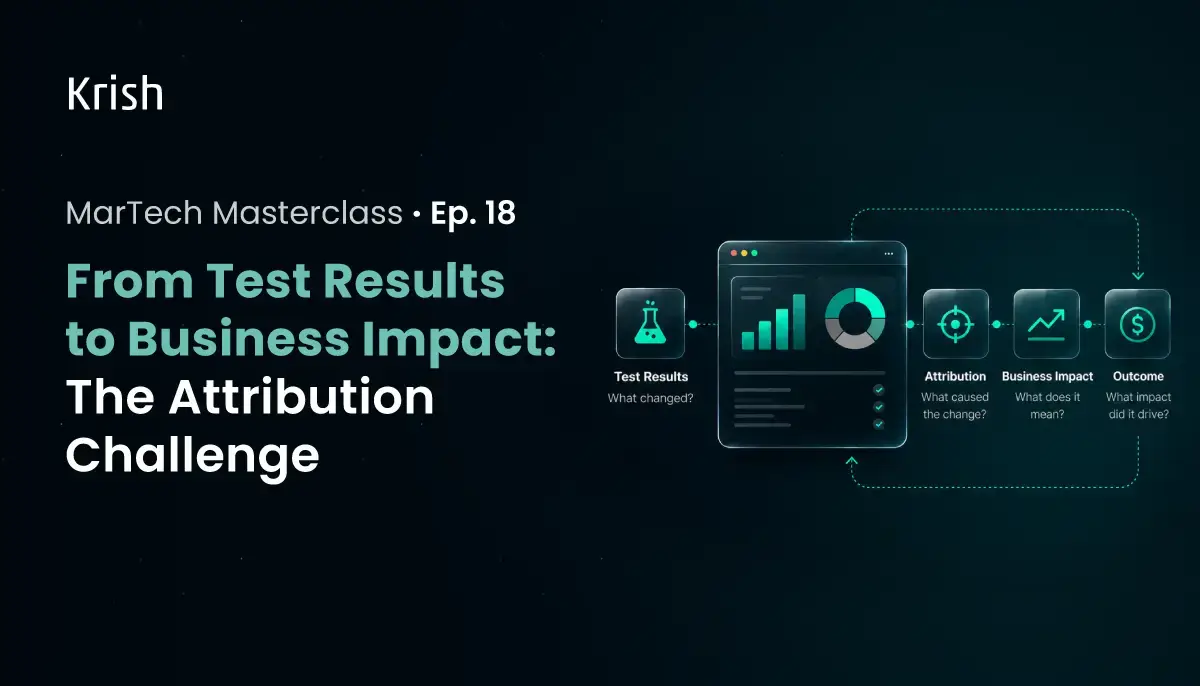
From Test Results to Business Impact: The Attribution Challenge – MarTech Masterclass Series Ep | 18
2 July, 2026 A variant reaches statistical significance. The team celebrates, ships the winner, and moves on to the next experiment. Weeks later, the metrics leadership actually tracks have not moved. Revenue per session is flat. The number the finance team questions every quarter shows no change that can be credited to the test. The experiment was run correctly. The result was real. And somehow, nothing changed.
Subscribe with Us!
Never miss any post, stay tuned!
Trusted by leading brands


