The Data Problem in Modern Marketing
57% of organizations now have unified customer databases. 43% still don’t.
That’s from the CDP Institute’s 2024 Member Survey of 400+ companies. The gap reveals a critical infrastructure divide in modern marketing: teams operating from conflicting truths, personalization engines contradicting each other, and strategic decisions delayed because no one can agree on which customer data is accurate.
This is the data problem in modern marketing. Not a scarcity of information, but rather the fragmentation of truth.
Let’s understand it this way: Your customer visited your pricing page 5 times last week. Your marketing automation platform doesn’t know that. Your CRM shows they haven’t engaged in 30 days. Your product team thinks they’re a new prospect. Your retargeting pixels are serving them ads.
Same person. Four systems. Zero shared truth – that’s not a technology gap; that’s a revenue leak.
In episode 7, we covered moving from spreadsheets to data warehouses – aligning customer information, standardizing definitions, and building reporting infrastructure. But you can’t warehouse what you can’t identify.
A data warehouse doesn’t solve identity resolution. It doesn’t connect anonymous browsing to known customers. It doesn’t unify behavioral signals across devices. It doesn’t make twelve fragmented records become one coherent profile. That’s what this episode tackles.
What’s Ahead
We now talk about the foundation beneath the warehouse.
- Unified customer identity,
- how it is established across systems,
- why CRM and DMP architectures cannot deliver it,
- what Customer Data Platforms do differently, and
- how this infrastructure translates into retention lift, LTV expansion, and acquisition efficiency.
Let’s begin…
Why CRM and DMP Can't Create a Single Customer View
Most enterprises believe they already own the systems required to unify customer data. They have a CRM managing relationships. They have analytics tracking behavior and marketing automation set up to target audiences.
Yet customer experience remains fragmented:
- Personalization contradicts itself across channels.
- Attribution produces conflicting conclusions.
- Retention programs react after decisions are made.
The issue is not tool absence. It is an architectural mismatch.
The Design Intent Problem
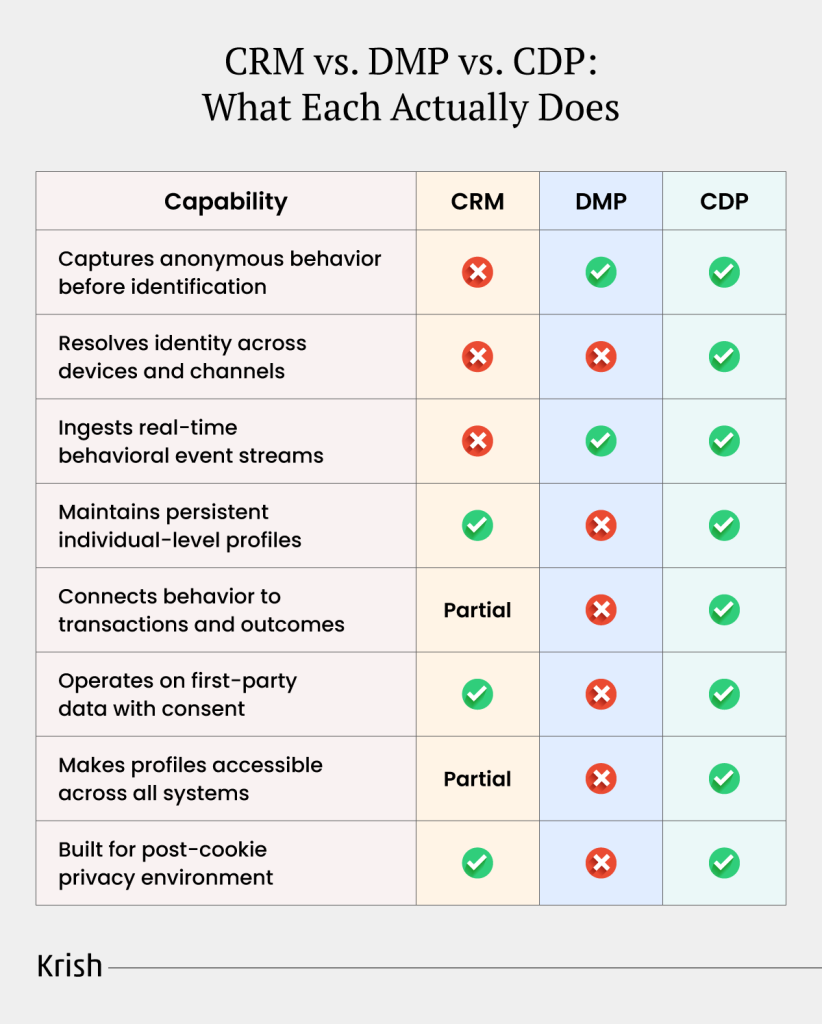
Let’s first understand the core capabilities of these platforms, because CRM, DMP, and CDP are built to solve fundamentally different problems.
CRM (Customer Relationship Management) systems manage sales relationships: They track pipeline progression, lead to opportunity to closed deal. They store account hierarchies and log sales activities. The data model optimizes for transactional records: contacts, accounts, deals. CRMs excel at what they are designed for: managing known customer relationships through explicit, logged interactions.
What they cannot do:
- Capture anonymous behavioral signals before someone identifies themselves.
- Ingest real-time event streams at scale.
- Resolve identity across devices and channels.
- Connect pre-sale research behavior to post-sale product usage to renewal signals.
A forrester research says that a typical B2B buyer conducts 27 research interactions before engaging sales (both digital and physical). CRMs see the final interaction like form submission, while the preceding 26 touchpoints revealing actual intent remain invisible.
DMPs (Data Management Platforms) optimize advertising by aggregating third-party cookie data across publisher networks to build targetable audiences for programmatic media.
That foundation collapsed years ago. Safari eliminated third-party cookies in 2020. Firefox followed. Chrome’s deprecation affects 65% of browser usage. Privacy regulations like GDPR, CCPA, and emerging state laws all restrict persistent tracking without consent.
When third-party identifiers erode, audience-based systems lose the persistence they were built on. DMPs cannot pivot to first-party identity resolution because they were architecturally designed for anonymous audience targeting, not known customer relationship tracking.
Then comes CDPs (Customer Data Platforms)
CDPs unify first-party customer identity:
- They ingest behavioral event streams in real time across all touchpoints.
- They resolve identity dynamically, connecting anonymous browsing sessions to known customer records across devices.
- They build persistent, unified profiles accessible to every downstream system requiring customer context.
Let’s decode core functions at a glance for better understanding because the architectural difference is structural, not incremental.
The Evidence of Fragmentation
According to Salesforce, 79% of customers expect consistent interactions across departments. Yet 55% say it feels like sales, service, and marketing do not share information.
That disconnect reflects system architecture, not campaign execution. When customer data lives in platforms designed for different purposes, unification through integration alone cannot close the gap.
McKinsey research on personalization demonstrates that companies excelling at personalization generate 40% more revenue from those activities than average players. Personalization at that scale requires identity continuity across every touchpoint: web, mobile, email, product, support.
Without a unified identity,
- attribution breaks across fragmented touchpoints.
- Retention triggers fire after customers have decided to leave.
- Predictive models train on incomplete profiles.
- Media optimization targets audiences instead of managing customer relationships.
What This Establishes
CRM cannot create unified behavioral profiles. DMP cannot persist first-party customer identity. The architectural gap between what these systems were designed to do and what unified customer intelligence requires is where CDP emerged as a distinct category.
Next up we’ll examine how CDPs operationalize identity resolution, the technical mechanics that transform fragmented touchpoints into coherent customer profiles, and what changes when personalization operates from a complete customer context instead of partial system views.
How a CDP Establishes a Single Source of Truth
We established that CRMs and DMPs cannot unify customer identity due to architectural constraints. Now we examine how CDPs actually solve it.
Three core mechanisms: identity resolution, profile unification, and real-time ingestion.
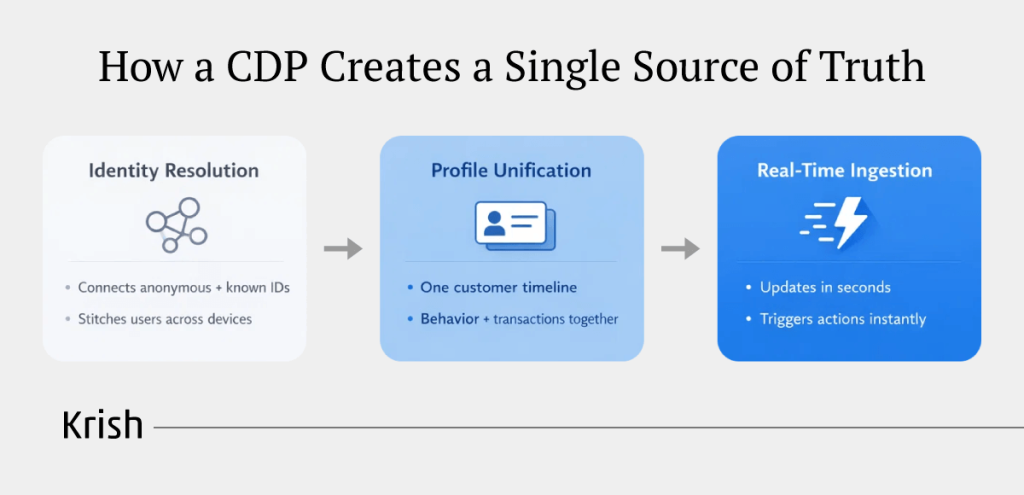
1. Identity Resolution: Connecting the Fragments
A single customer generates multiple identifiers. Mobile device ID. Desktop cookie. Email hash. CRM contact ID. Product user ID. Billing account number.
Without resolution, these remain separate records. With resolution, they become one customer.
Deterministic matching links identities through known shared identifiers: email, phone, customer ID. When someone logs in, the CDP connects their anonymous session to their known profile. High accuracy, limited to authenticated interactions.
Probabilistic matching connects identities through behavioral patterns: device fingerprints, IP addresses, timing patterns, geographic consistency. Forrester research shows advanced algorithms achieve 85-92% precision.
These methods are not alternatives. They are layers. Deterministic provides high-confidence links. Probabilistic fills gaps. Together, they capture far more behavior than either alone.
2. Profile Unification: From Events to Intelligence
Identity resolution establishes who. Profile unification establishes what they’ve done and what they’ll likely do next.
Four profile layers:
Identity and attributes: Name, email, account ID, demographics. The persistent identifier linking all data.
Behavioral history: Every interaction across touchpoints. Web visits, email opens, feature usage, content viewed, searches, ad clicks. Complete activity timeline revealing intent.
Transactional outcomes: Purchases, subscriptions, renewals, cancellations, support tickets, billing events. What connects behavior to value.
Derived intelligence: Lifetime value, engagement scores, propensity models, churn risk, next-best actions. Raw data transformed into predictions.
The difference is not algorithms. It is completeness.
3. Real-Time Ingestion: When Context Is Perishable
Traditional systems update through batch processes: hourly, daily, weekly. CDPs ingest events and update profiles in real time, within seconds to minutes.
Customer context is perishable. Someone researching now converts better with immediate, relevant communication, not delayed responses. Someone showing churn signals needs instant intervention, not an email arriving after they’ve decided to leave.
Segment research shows organizations using real-time data see 15-20% higher conversion on triggered campaigns versus batch approaches. The advantage: acting when intent peaks.
What Unified Profiles Enable
When identity resolution, profile unification, and real-time ingestion combine, the result is a persistent customer record that:
- Updates continuously as behavior occurs
- Connects anonymous and known activity across devices
- Integrates behavioral signals with outcomes
- Makes complete context accessible to every system
Marketing receives unified profiles for personalization. Analytics uses them for attribution. Product leverages them for optimization. Support accesses them for context-aware service.
The CDP becomes infrastructure, the identity layer that every customer-facing system can depend on.
Next up, we’ll understand how unified profiles transform personalization from superficial to revenue-driving.
From Unified Customer Profiles to Real Personalization
The difference between personalization that exists and personalization that drives revenue is behavioral completeness.
Why Fragmented Data Kills Personalization ROI
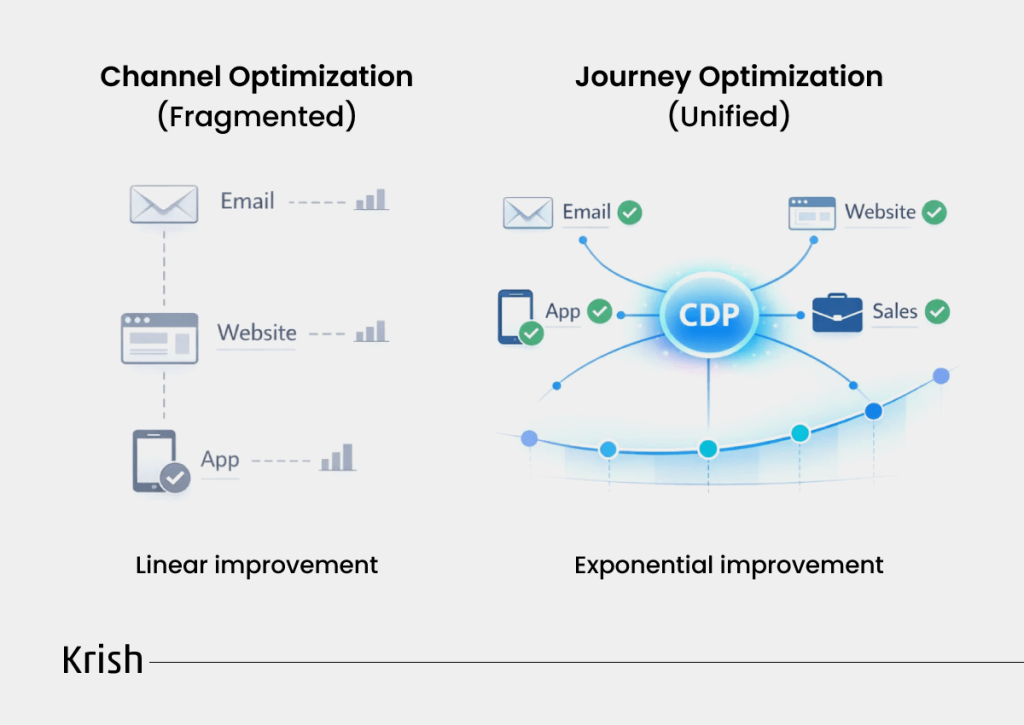
Email personalizes email behavior, websites on session data, and Apps on in-app activity – each channel operates in isolation.
The cost:
A prospect researches integration for three weeks. Attends a webinar on APIs. Downloads competitor comparisons.
Your email sends generic features, your website shows irrelevant case studies, and sales receives a lead with zero context.
Conversion rates plateau. CAC rises. Deal cycles extend.
What Complete Profiles Unlock
Same journey. Unified data.
Website prioritizes integration docs, email now addresses API capabilities, and sales receives context: competitive evaluation, integration concerns, technical depth.
And that is how the gap in data completeness closes!
Real-Time Decisioning vs. Batch Campaigns
Batch: Weekly email to inactive users.
Real-time: User shows declining engagement Monday. Views competitor pricing Tuesday. Receives personalized retention offer Tuesday afternoon. Converts Wednesday.
Event-triggered campaigns from unified data deliver significantly higher conversion than batch campaigns.
The Compounding Loop
Complete data → better models → accurate targeting → higher conversion → more outcomes → richer profiles → better models.
Without unified data: channel optimization. Linear improvement.
With unified data: journey optimization. Exponential improvement.
Personalization becomes commercial infrastructure, not marketing theater. The unknown becomes a profile you can rely on for journey progression.
Connecting Anonymous and Known Behavior
It is clear that unified profiles drive commercial personalization. Now we move on to how identity resolution builds the technical foundation that makes those profiles possible.
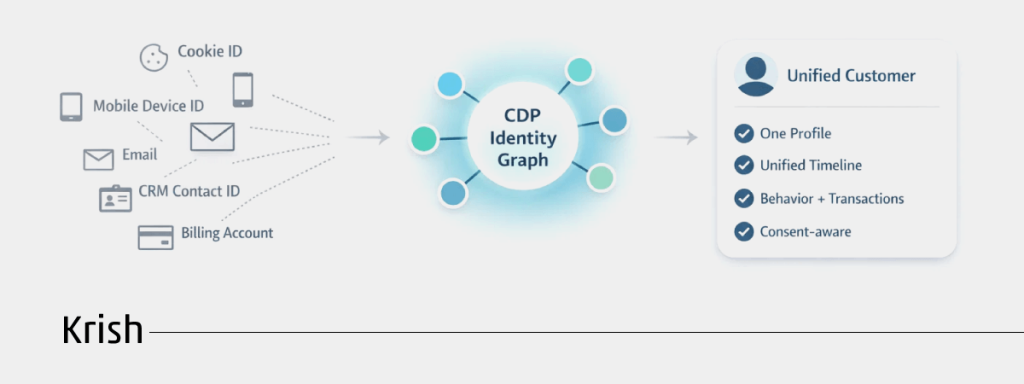
The Core Challenge
A single customer generates multiple identifiers across systems. Mobile device ID. Desktop cookie. Email hash. CRM contact. Product user ID. Billing account number.
Without resolution, these remain separate records, creating fragmented attribution, broken journey tracking, and contradictory personalization. With resolution, they become one coherent customer profile.
Two Resolution Approaches
Deterministic matching links identities through known shared identifiers, email address, phone number, customer ID. When someone logs into your product, the CDP connects their anonymous browsing sessions to their known customer record. High accuracy, limited to authenticated interactions.
Probabilistic matching connects identities through behavioral patterns and contextual signals, device fingerprints, IP address consistency, timing patterns, geographic location. Forrester research shows advanced algorithms achieve 85-92% precision when combining multiple signals.
These methods are not alternatives. They are complementary layers. Deterministic provides high-confidence links when explicit identifiers exist. Probabilistic fills gaps by connecting anonymous behavior to likely known customers.
Anonymous to Known Transition
Most customer journeys begin anonymously. The CDP tracks behavioral signals before identification: content consumed, features explored, competitors researched. When that visitor eventually authenticates, the CDP retroactively connects all prior anonymous activity to their known profile.
This reveals complete research journeys, not just final conversion events. Marketing sees weeks of pre-conversion behavior. Sales receives leads with full behavioral context.
Privacy-First Operation
Identity resolution operates within privacy regulations—GDPR, CCPA, emerging state laws. CDPs manage consent at the profile level. Opt-outs suppress identifiers across all resolution methods. Deletion requests coordinate removal across connected systems.
First-party data with explicit consent replaces third-party tracking. Resolution happens across owned properties, not the open web.
Identity resolution transforms disconnected touchpoints into coherent customer intelligence, enabling accurate attribution, predictive modeling, and cross-channel orchestration.
So far, we have established a solid, unified foundation. Now is the time to talk business!
The Business Impact: Retention, LTV, and Operational Efficiency
CDPs establish unified customer identity through resolution, profile construction, and real-time ingestion. The technical capability is established. The question becomes: what does this infrastructure actually deliver commercially?
Retention Economics
Bain & Company research shows that increasing retention rates by 5% increases profits by 25-95% depending on industry. The impact is multiplicative because retained customers generate revenue with zero acquisition cost, often expand over time, and refer new customers at higher rates.
Traditional retention programs react to lagging indicators: cancellations, purchase cessation, visible disengagement. By that point, customer switching decisions have already been made.
Unified customer profiles enable predictive retention. Churn signals emerge weeks before explicit cancellation through declining product usage, reduced email engagement, increased support friction, and competitive research activity. When these signals exist across disconnected systems, they arrive too late or go unnoticed. When unified in real-time profiles, intervention occurs while customers remain persuadable.
The economics are direct. Say an organization with 10,000 customers at $1,000 annual customer value experiencing 20% annual churn that reduces churn by 3% points generates $300,000 in annual impact. Over three years, accounting for compounding retention effects, the total impact exceeds $1 million. Typical mid-market CDP implementation costs range from $150,000 to $300,000 in the first year.
LTV Expansion Through Behavioral Triggers
Beyond preventing churn, unified customer data enables expansion by identifying when customers are ready to increase spend based on actual usage patterns and engagement signals rather than arbitrary time-based triggers.
Traditional expansion strategies operate on segmentation or tenure milestones. A customer who has been with the company for 90 days receives an upgrade offer. A customer in a specific plan tier sees cross-sell campaigns for complementary products.
Unified profiles enable behavior-driven expansion. Organizations monitor product usage, feature adoption, consumption patterns, and engagement to identify expansion readiness. A customer consistently approaching usage limits receives a proactive upgrade recommendation before hitting constraints. A user adopting advanced features gets targeted messaging about premium capabilities that extend their workflow.
McKinsey research on personalization ROI found that behavior-driven growth strategies generate 10-15% higher revenue per customer compared to segment-based approaches.
The LTV impact compounds with retention. Customers who stay longer and expand more generate exponentially higher value. Organizations that improve retention by 5% and increase expansion rate by 10% through unified customer intelligence see 30-40% lifetime value improvements over a three-year horizon.
Acquisition Efficiency: Attribution and Targeting Precision
While retention and expansion affect existing customers, unified data also improves acquisition efficiency through more accurate attribution and better targeting.
When complete customer journeys are tracked from first anonymous website visit to final conversion and beyond, marketing organizations can accurately attribute value to each touchpoint. This shifts budget allocation from channels that generate volume to channels that generate quality customers.
Organizations using multi-touch attribution based on complete journey data achieve better marketing ROI compared to last-click attribution models.
Advertising platforms allow organizations to build lookalike audiences based on existing customers. The quality of those audiences depends entirely on the quality of the seed data. When seed audiences are defined by high-lifetime-value customers identified through unified behavioral and transactional data, lookalike targeting becomes far more effective. Meta on lookalike audience performance confirms that seed audiences based on lifetime value rather than conversion events generated 35% higher ROI and 42% lower cost per valuable customer.
Unified customer data also prevents wasted spend on existing customers or customers who recently churned. Suppression lists can be dynamically updated based on real-time customer status.
Operational Leverage: Decision Velocity
Beyond direct financial returns, CDPs enable organizational capabilities that create competitive advantage. When customer data is unified and accessible, marketing and product teams can test hypotheses faster: segmenting, activating, measuring, and iterating within days rather than waiting weeks for data engineering support.
When marketing, sales, product, and customer success operate from the same customer data, strategic discussions shift from debating whose numbers are correct to deciding which actions to take. Alignment accelerates and execution improves.
When attribution is accurate and customer economics are visible, leadership can invest in growth with higher confidence. Budget flows to channels and strategies that drive real customer value rather than vanity metrics. In markets where timing matters and customer expectations evolve quickly, decision velocity becomes a structural advantage.
Final Thoughts
Customer interactions generate signals across dozens of systems. Each builds its own version of truth. The result: conflicting attribution, reactive retention, and personalization that contradicts itself.
CRM and DMP architectures cannot solve unified identity. CDPs were purpose-built for it, connecting anonymous to known behavior, resolving identity across devices, updating profiles in real time.
Organizations establishing unified customer intelligence now gain accelerating advantages. Those that delay face widening gaps.
The question is not whether to invest in unified customer intelligence. The question is how quickly your organization can establish this capability before competitors do.
Customer Data Platforms are not marketing technology. They are customer intelligence infrastructure. And in 2026, that infrastructure is no longer optional.
Having unified customer profiles means nothing if they sit unused. Thus next in the MarTech Masterclass series: Episode 9 we examines how to operationalize CDP data across marketing, sales, product, and support, turning infrastructure into execution.
Table of Content
- The Data Problem in Modern Marketing
- Why CRM and DMP Can't Create a Single Customer View
- How a CDP Establishes a Single Source of Truth
- From Unified Customer Profiles to Real Personalization
- Connecting Anonymous and Known Behavior
- The Business Impact: Retention, LTV, and Operational Efficiency
- Final Thoughts
Subscribe with Us!
Never miss any post, stay tuned!

Ankit helps brands navigate their digital maturity journey by bringing together analytics, CRO, ML, and AI in a practical, business-friendly way. Having worked with global teams across industries, he focuses on simplifying complex MarTech concepts and turning them into measurable outcomes. On weekends, you’ll likely find him deep in a reflective read or sharing a coffee with a client while simplifying MarTech in the most human way possible.
Recommended Reading:
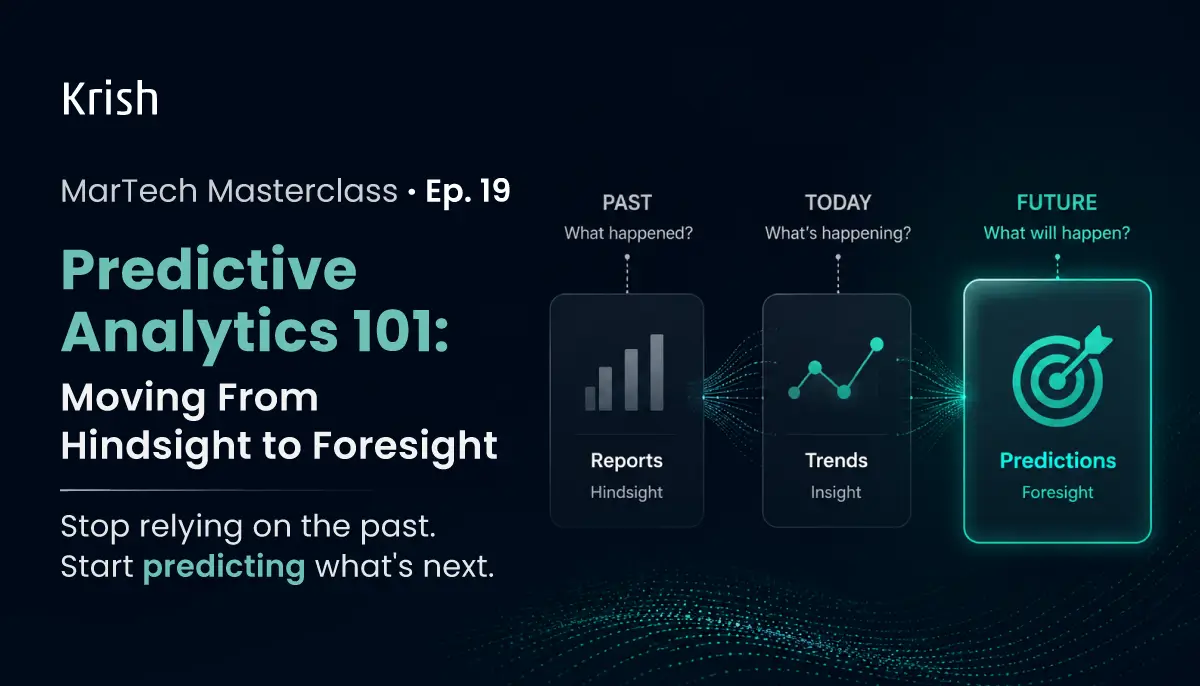
Predictive Analytics 101: Moving From Hindsight to Foresight – MarTech Masterclass Series Ep | 19
9 July, 2026 Most MarTech stacks are architecturally optimized for one thing: describing the past. Revenue last quarter, churn in the last 90 days, campaign performance last week - the dashboards are polished and the data looks clean. Yet every output from that stack is a response to something that has already happened. The customer already churned. The demand spike already passed. The high-value cohort already drifted before anyone noticed.
Subscribe with Us!
Never miss any post, stay tuned!
Trusted by leading brands


