Introduction
Most CRO checklists ask whether you’ve implemented best practices. Enterprise leaders should ask a different question: Is our conversion capability mature enough to scale?
Enterprise Ecommerce Doesn't Have a Conversion Problem. It Has a Maturity Problem.
Walk into almost any enterprise ecommerce boardroom and you’ll hear the same familiar conversations: “Traffic is flat.” “CAC is increasing.” “Meta performance has dropped.” “SEO isn’t generating enough revenue.” “Let’s increase the marketing budget.”
These conversations are logical, but they’re often incomplete. They assume the primary constraint to growth is acquisition, when in reality, the constraint frequently lies somewhere else: inside the website, inside the customer journey, inside the organization’s ability to continuously improve conversion.
Two Shopify Plus brands can invest the same marketing budget, attract the same number of visitors, and sell similar products, yet one consistently outperforms the other. Not because it buys better traffic, but because it converts more of the traffic it already earns. That isn’t luck, it isn’t design preference, and it certainly isn’t achieved through occasional A/B testing. It is the result of conversion maturity.
The best-performing ecommerce organizations don’t treat Conversion Rate Optimization (CRO) as a project. They build it as an organizational capability, one that evolves continuously alongside customer expectations, technology, and market behavior. That is the difference between brands that optimize occasionally and brands that compound growth year after year.
Why Traditional CRO Checklists Fail
Search for a “Shopify CRO checklist” and you’ll find hundreds of articles, most containing variations of the same advice: improve page speed, add reviews, make the CTA bigger, reduce checkout fields, add trust badges, install heatmaps.
None of this advice is wrong. The problem is that it’s incomplete, because it assumes every business has the same problems. A fashion retailer with 150,000 SKUs faces very different optimization challenges than a luxury cosmetics brand, a B2B manufacturer, or a subscription business.
The issue isn’t whether you have reviews. It’s whether your trust ecosystem is mature enough to support enterprise-scale conversion. The issue isn’t whether your pages load quickly. It’s whether performance remains consistent across hundreds of landing pages, thousands of products, and millions of monthly sessions.
Enterprise CRO isn’t about individual tactics. It’s about systems, and systems require maturity.
The Evolution of CRO
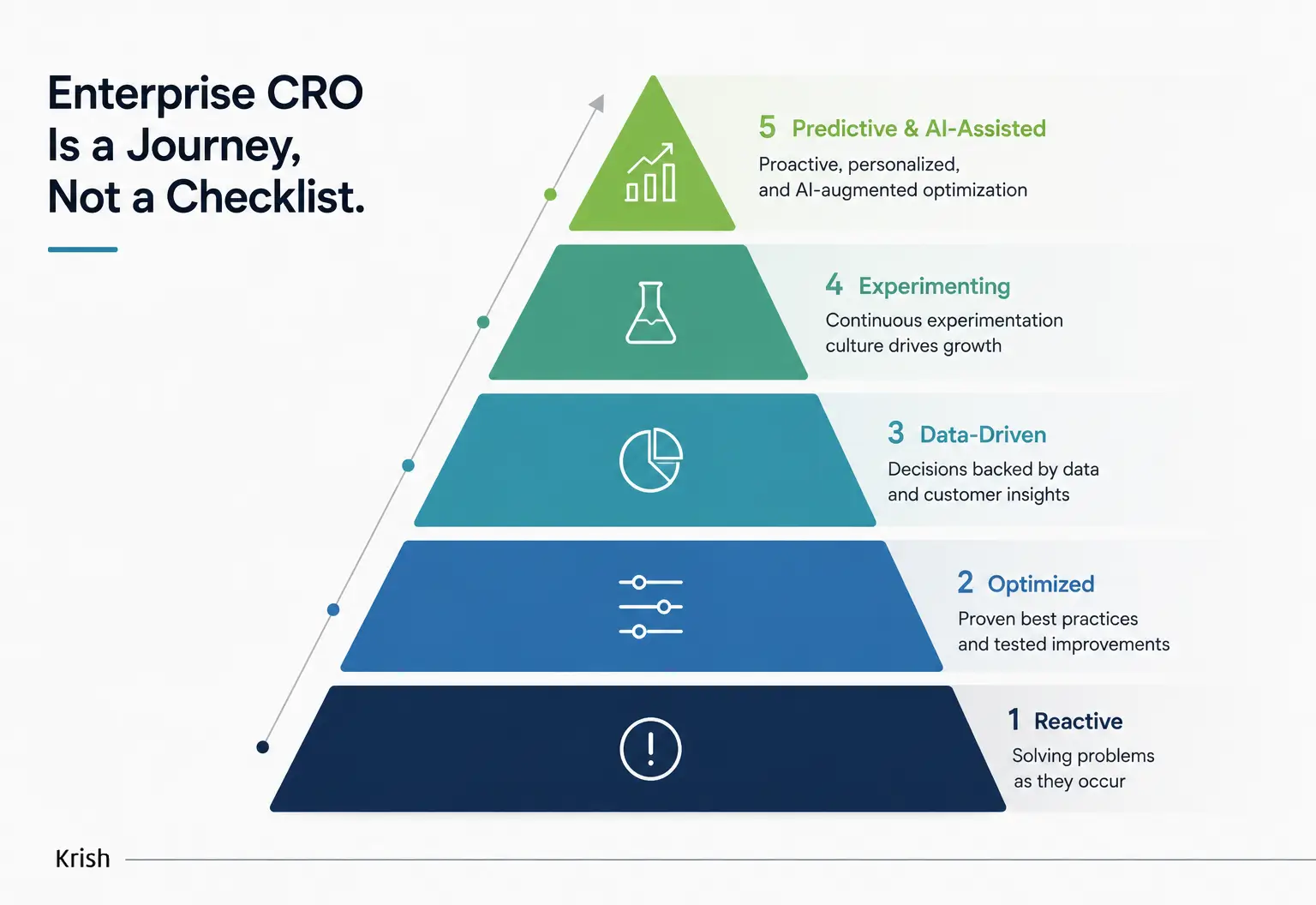
Over the last decade, conversion optimization has evolved through five distinct phases.
Phase One: Opinion-Driven Design: “We think customers will like this.” Design decisions were driven by intuition.
Phase Two: Best Practices: “We’ve copied what successful brands do.” Businesses adopted common UX patterns and ecommerce conventions.
Phase Three: Data-Driven Optimization: “We have analytics.” Decisions became more measurable through funnels, dashboards, heatmaps, and A/B testing.
Phase Four: Continuous Optimization: Today’s leading Shopify Plus merchants no longer optimize occasionally. They build systems that continuously identify, prioritize, and resolve customer friction. Optimization becomes part of the company’s operating model, not an isolated initiative.
Phase Five: AI-Assisted Commerce: 2026 introduces another shift. Customers are no longer the only buyers evaluating your storefront. AI-powered shopping assistants, generative search engines, and autonomous commerce agents all interpret your store differently than humans do. The next customer may not even visit your homepage. An AI shopping assistant may instead evaluate product metadata, structured content, reviews, availability, delivery estimates, and merchant reputation directly. Enterprise CRO is no longer only about human psychology. It’s increasingly about machine comprehension as well.
The Shopify Plus CRO Maturity Model
One of the biggest mistakes organizations make is auditing pages instead of capabilities. A homepage can look modern, checkout can feel polished, and site speed can be acceptable, yet the organization still struggles to improve conversion consistently.
Why? Because mature organizations don’t rely on individual pages. They rely on repeatable systems.
After auditing enterprise ecommerce businesses across multiple industries, we’ve found that conversion maturity consistently depends on six organizational capabilities. These form the Shopify Plus CRO Maturity Model:
- Customer Understanding
- Experience Design
- Trust & Persuasion
- Performance & Technical Excellence
- Experimentation
- Measurement & Governance
Each pillar strengthens the others. Weakness in one eventually limits the entire system.
Pillar One: Customer Understanding
Why Most Optimization Starts Too Late
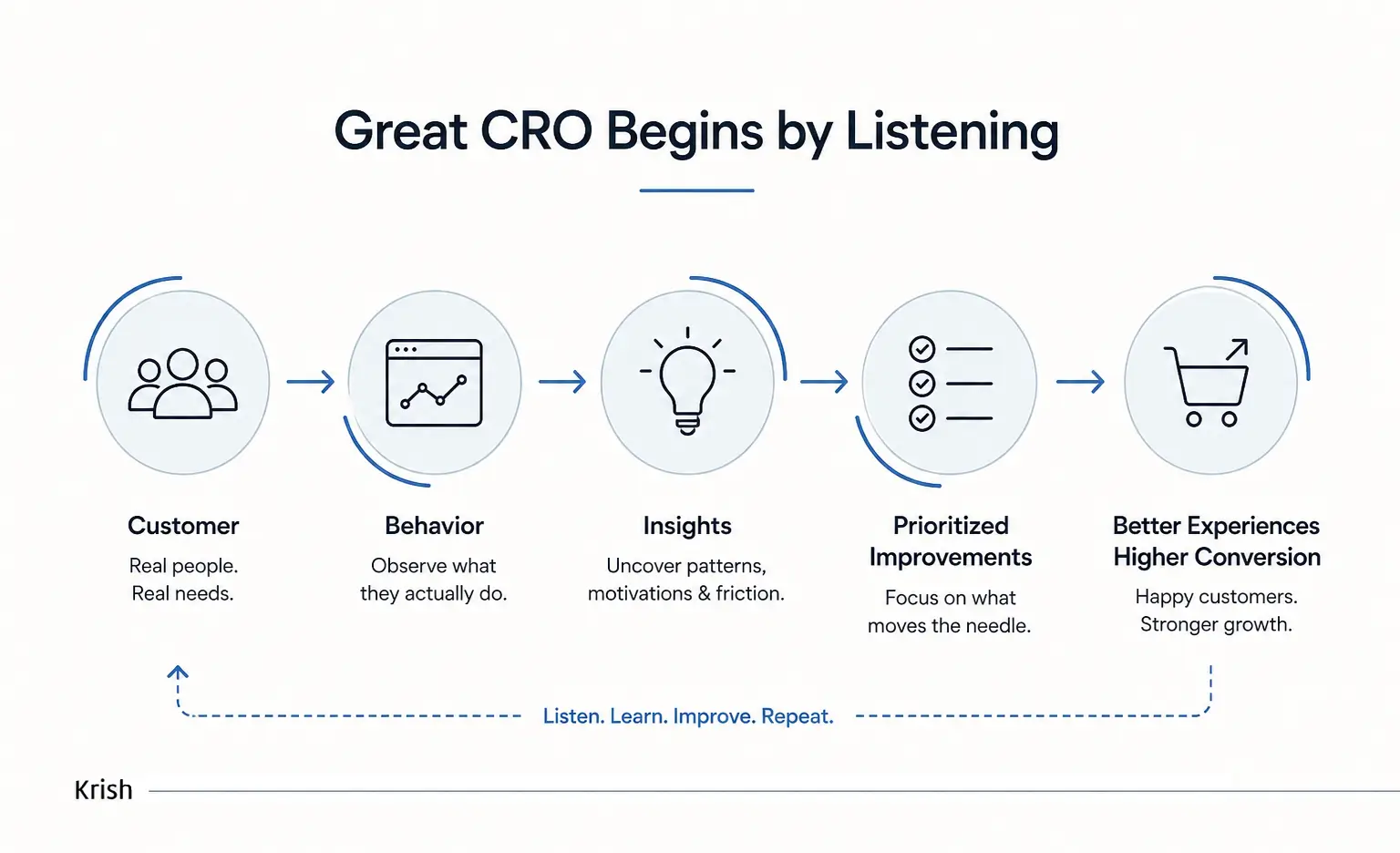
Many optimization initiatives begin after conversion rates decline. By then, revenue has already been lost. The best Shopify Plus brands don’t wait for problems; they actively study customers before problems appear.
They understand something fundamental: when customers hesitate, abandon, or leave, they are communicating something. The challenge is learning to interpret those signals. Customer understanding isn’t about demographics. It’s about behavior, motivation, intent, expectation, and friction. Without those insights, optimization becomes educated guesswork.
Enterprise Audit Checklist: Customer Understanding
Customer Research:
✔ Documented customer personas updated regularly
✔ Jobs-to-be-Done framework established
✔ Customer motivations mapped
✔ Purchase barriers identified
✔ Decision triggers documented
Voice of Customer (VoC):
✔ Customer surveys conducted regularly
✔ Review analysis performed
✔ NPS feedback categorized
✔ Customer interviews completed
✔ Support tickets analyzed
Behavioral Research:
✔ Heatmaps reviewed monthly
✔ Session recordings analyzed
✔ Scroll-depth reports evaluated
✔ Click behavior reviewed
✔ Exit pages investigated
Market Intelligence:
✔ Competitor UX benchmarked
✔ Pricing perception monitored
✔ Category trends reviewed
✔ AI search visibility evaluated
A mature organization doesn’t simply collect this information. It operationalizes it. Research becomes input for product teams, marketing, UX, merchandising, development, and leadership. Everyone works from the same understanding of customer behavior.
Thought Leadership Perspective
One of the biggest misconceptions in ecommerce is that customers make irrational decisions. In reality, customers are remarkably rational. They simply make decisions based on information the business cannot always see.
A visitor doesn’t abandon because your button is blue instead of green. They abandon because they still feel uncertain: they don’t trust delivery, can’t determine product quality, don’t understand sizing, or simply became distracted. Your analytics platform records abandonment. Customer research explains it. That’s a profound difference.
Further reading The Complete Ecommerce CRO Audit Guide: Boost Conversions in 2026 A complete ecommerce CRO audit guide to help you diagnose conversion issues, optimize landing pages, product pages, and checkout, and turn more visitors into buyers in 2026.
Pillar Two: Experience Design
If Customer Understanding answers why people behave the way they do, Experience Design determines how easy it is for them to buy. Many organizations treat UX as visual design, but enterprise CRO treats UX as decision architecture. Every screen, every interaction, and every click either reduces effort or increases it, and the cumulative effect determines conversion performance.
The Customer Journey Is Your Product
Many brands think they sell products. In reality, ecommerce businesses sell buying experiences. A premium watch brand doesn’t only sell watches. It sells confidence, luxury, status, and trust. A B2B supplier isn’t only selling industrial components. It’s selling reliability, operational continuity, and reduced procurement risk. The customer journey communicates those values long before checkout begins.
Enterprise UX Audit Areas
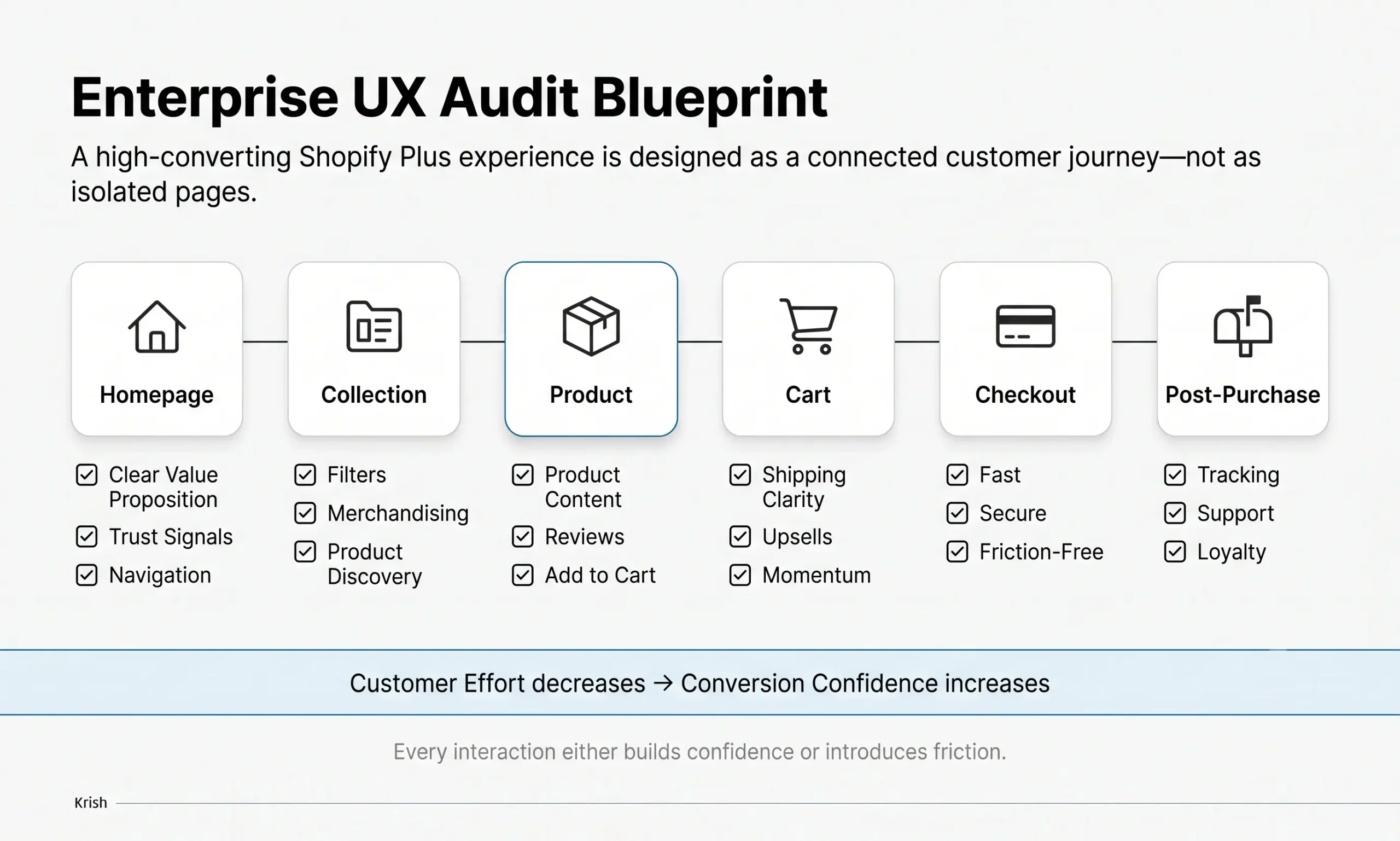
Rather than reviewing isolated pages, evaluate the complete buying journey.
Homepage: Can first-time visitors immediately understand what you sell, who it’s for, why you’re different, and why they should trust you? The homepage isn’t designed to impress stakeholders; it’s designed to orient customers.
Navigation: Navigation should reduce decision-making effort. Audit category structure, menu hierarchy, search prominence, mobile usability, and product discovery speed. Customers should never wonder where to click next.
Collection Pages:
✔ Filtering and sorting
✔ Merchandising logic
✔ Product density
✔ Mobile browsing experience
✔ Category messaging
Collection pages influence discovery more than most organizations realize.
Product Pages: This remains the highest-impact area for enterprise CRO. ✔ Photography and product videos
✔ Reviews and user-generated content
✔ Shipping clarity and return messaging
✔ Availability and FAQs
✔ Related products
✔ Mobile CTA visibility
Every unanswered question reduces confidence. Every reduction in confidence reduces conversion.
Cart Experience: The cart should increase purchase momentum, not interrupt it.
✔ Shipping transparency and delivery estimates
✔ Cross-sells and coupon strategy
✔ Free shipping messaging
✔ Mobile optimization
Checkout : Enterprise checkout should prioritize speed, trust, and simplicity.
✔ Guest checkout and express payment options
✔ Form length and validation messaging
✔ Mobile usability and payment flexibility
Further Reading Funnel Drop-Off Analysis: How to Identify Where You're Losing Conversions Most ecommerce stores lose customers at the same funnel stages, but never know why. This guide walks you through funnel drop-off analysis to spot the exact leaks and fix them before they cost you more sales.
Accessibility: Accessibility is no longer optional. Better accessibility improves usability for everyone, not just users with disabilities.
✔ Keyboard navigation
✔ Color contrast
✔ Screen reader support
✔ Alt text
✔ Focus indicators
Mobile Experience : For many Shopify Plus stores, more than 70% of traffic originates on mobile devices, yet executive dashboards often focus on desktop screenshots. Enterprise audits should evaluate mobile independently, not as a secondary experience.
Experience Design Is About Reducing Cognitive Load
Customers don’t abandon because purchasing is impossible. They abandon because purchasing feels harder than expected. Every unnecessary decision increases mental effort: Should I trust this brand? Is this the right size? How long is delivery? Can I return it?
Each unanswered question consumes mental energy until, eventually, the easiest decision becomes postponing the purchase altogether. Exceptional UX doesn’t persuade customers. It reduces the number of decisions they must make. That distinction separates good ecommerce experiences from exceptional ones.
Pillar Three: Trust & Persuasion
Every ecommerce purchase is an act of risk. Whether the order is worth $40 or $4,000, customers ask themselves the same fundamental question: “What could go wrong if I click Buy Now?”
Sometimes customers hesitate because they’ve never heard of your brand, they’re unsure about sizing, shipping seems unclear, returns appear complicated, or reviews feel insufficient. Enterprise brands often underestimate how much trust influences conversion, not because they ignore it, but because familiarity creates bias. Internal teams already know their products are excellent. Customers don’t. That gap is where revenue quietly disappears.
Enterprise CRO Is Built on Confidence
Traditional CRO discussions revolve around headlines, buttons, forms, colors, and layouts. These elements matter, but they’re not the reason customers buy. People buy because they feel confident, and confidence is built gradually. Every reassuring interaction reduces perceived risk, and every unanswered question increases it.
The highest-converting Shopify Plus stores aren’t necessarily the most visually impressive. They’re the ones that make customers feel safest.
Introducing the Trust Stack™
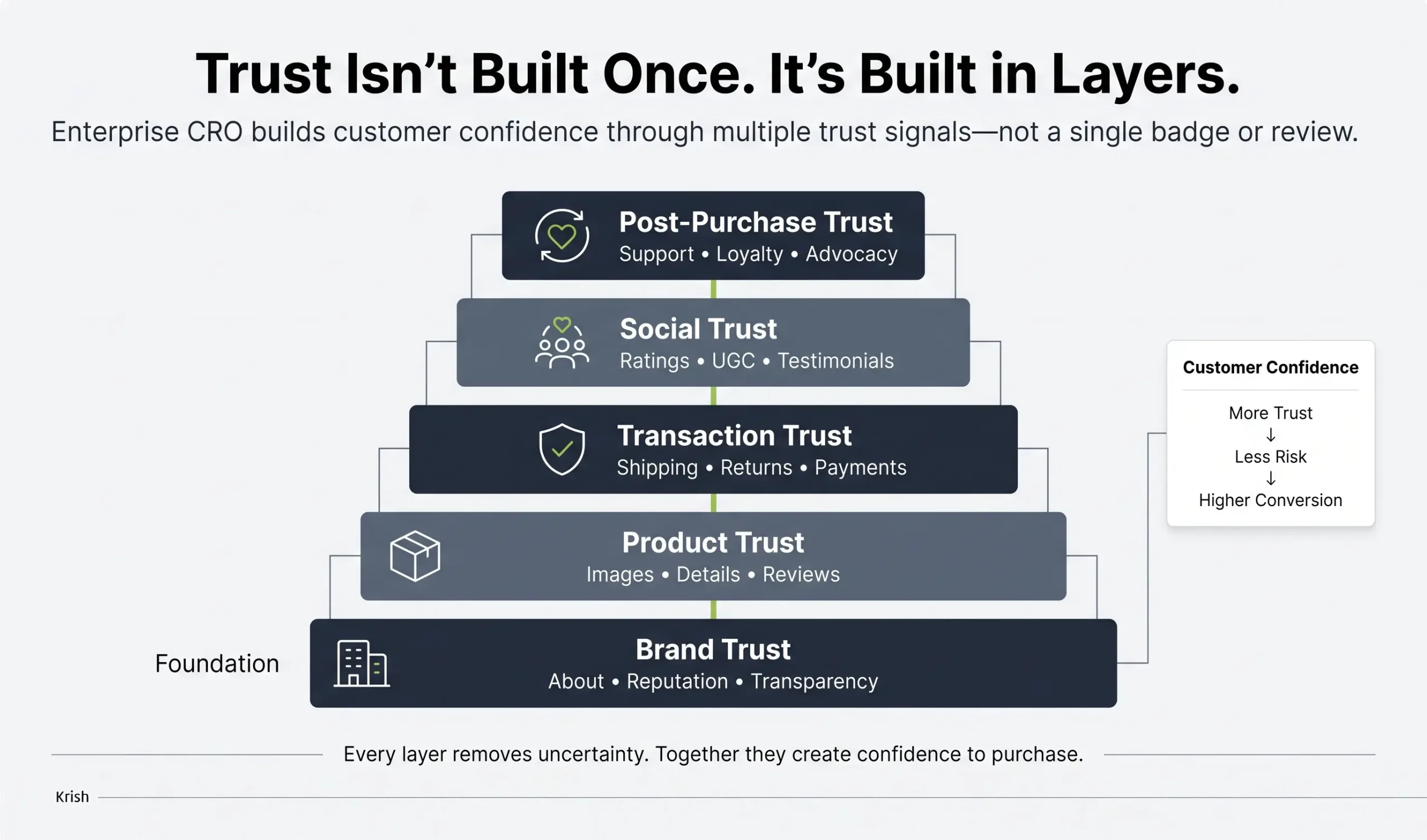
During enterprise CRO audits, we’ve found that trust isn’t created by one element. It is layered. Think of trust like a building: if one floor is weak, the entire structure becomes unstable. We refer to this framework as the Trust Stack™, and it consists of five layers, each answering a different customer question.
Layer 1: Brand Trust – “Can I trust this company?” Signals include your About Us story, media mentions, industry certifications, awards, sustainability commitments, contact information, physical presence, and leadership visibility. Invisible brands create invisible confidence.
Layer 2: Product Trust – “Can I trust this product?”
✔ Product photography and videos
✔ Technical specifications and lifestyle imagery
✔ Product comparisons and FAQs
✔ User-generated content and customer reviews
A customer who understands the product buys faster than one who still has questions.
Layer 3: Transaction Trust – “Can I trust the buying process?”
✔ Delivery estimates and shipping costs
✔ Return policies and payment security
✔ Checkout clarity and express payment methods
✔ Tax transparency
Transaction trust becomes increasingly important as Average Order Value increases.
Layer 4: Social Trust – “Do other people trust this brand?” Signals include customer ratings, review volume and quality, user-generated images, customer videos, and influencer validation. Humans naturally reduce uncertainty by observing the decisions of others, and the best ecommerce experiences make this effortless.
Layer 5: Post-Purchase Trust – Trust shouldn’t end at checkout. Customers continue evaluating your brand after purchase.
✔ Order tracking and delivery communication
✔ Returns experience and customer support
✔ Warranty, loyalty programs, and post-purchase education
Exceptional post-purchase experiences create something more valuable than conversions. They create repeat customers.
The Hidden Cost of Weak Trust
Weak trust increases customer acquisition costs, cart abandonment, return rates, customer support volume, and paid media inefficiency. Imagine spending millions driving qualified visitors to your website, only to lose them because delivery dates aren’t visible or reviews are buried below the fold. This isn’t a marketing problem. It’s an experience problem. The strongest Shopify Plus brands don’t simply acquire trust through advertising; they reinforce it at every touchpoint.
Pillar Four: Performance & Technical Excellence
Many organizations separate technical optimization from CRO, but that separation no longer makes sense. Customers don’t distinguish between UX, performance, development, SEO, and infrastructure. They simply experience your website. Every technical decision influences commercial outcomes, and the best enterprise ecommerce teams understand that technical excellence is customer experience.
Performance Is No Longer a Technical KPI
Historically, page speed belonged to engineering teams. Today, it belongs in executive dashboards, because every delay influences bounce rate, engagement, add-to-cart rate, checkout completion, and revenue. Milliseconds matter, not because Google says so, but because customers notice.
Enterprise Performance Audit Checklist
Core Web Vitals:
✔ Largest Contentful Paint (LCP)
✔ Interaction to Next Paint (INP)
✔ Cumulative Layout Shift (CLS)
Monitor these continuously across templates, devices, and markets. Enterprise stores rarely have one performance score. They have thousands.
Theme Architecture:
✔ Theme complexity and unused code
✔ Legacy components
✔ Component reuse and modular architecture
A well-structured theme improves maintainability and optimization velocity.
App Governance: One of the most common issues in Shopify Plus stores is app proliferation. Every department installs tools: marketing, merchandising, customer service, loyalty, reviews, personalization. Each solves an isolated problem, but collectively they often create performance degradation, JavaScript bloat, tracking conflicts, and UX inconsistency. Enterprise CRO requires app governance, not just app selection.
Media Optimization:
✔ Image compression and responsive images
✔ Modern image formats
✔ Video loading strategy and lazy loading
Large visual assets should improve persuasion, not delay it.
Search & Discoverability:
✔ Typo tolerance and synonyms
✔ Merchandising rules and predictive search
✔ Faceted filtering
Search isn’t a utility. It’s a revenue channel.
Structured Data: Modern ecommerce content is consumed by more than browsers. Search engines, shopping platforms, and AI assistants all rely on structured information.
✔ Product, organization, and FAQ schema
✔ Review schema and breadcrumbs
✔ Availability, pricing, and merchant metadata
The better machines understand your store, the more opportunities they have to recommend it.
The Next Customer May Not Be Human
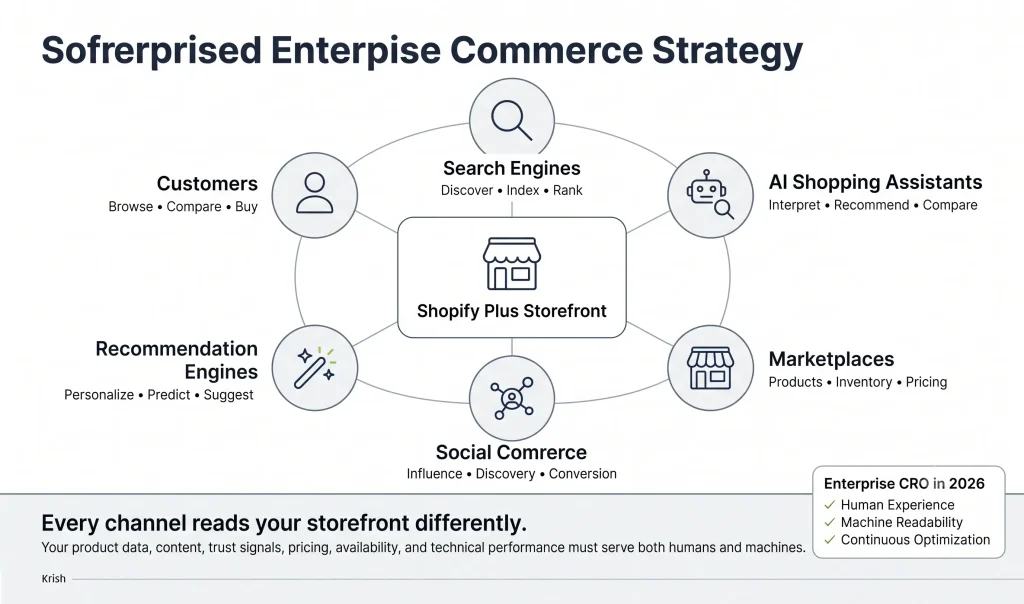
This is perhaps the most important shift facing ecommerce leaders. Historically, optimization focused on one audience: humans. Now there are two, human customers and machine customers, including Large Language Models, AI shopping assistants, and recommendation engines.
Imagine a customer asking an AI assistant: “Find me the best waterproof hiking jacket under $250 that ships within two days and has excellent customer reviews.” The assistant doesn’t admire your homepage. It evaluates structured product data, review quality, shipping metadata, inventory accuracy, and merchant reputation. Brands prepared for this future will become more discoverable. Those relying only on traditional merchandising may gradually lose visibility.
Enterprise AI Readiness Checklist:
✔ Rich product metadata
✔ Consistent taxonomy
✔ Structured specifications
✔ FAQ content
✔ Review quality
✔ Product comparisons
✔ Merchant Center optimization
✔ Semantic internal linking
✔ Knowledge graph consistency
✔ High-quality first-party content
Technical Excellence Is About Optionality
One overlooked benefit of technical maturity is flexibility. Organizations with clean architecture can launch experiments faster, integrate new channels more easily, support AI capabilities sooner, expand internationally with less friction, and respond to changing customer expectations without extensive redevelopment. In contrast, organizations burdened by technical debt spend more time maintaining systems than improving them.
The most successful Shopify Plus brands in 2026 won’t necessarily have the most advanced technology. They’ll have the most adaptable systems. Businesses that treat CRO as an annual redesign project will struggle to keep pace. Businesses that build technical and organizational maturity will continuously evolve alongside the market. That distinction will separate market leaders from everyone else.
Pillar Five: Experimentation
The biggest misconception about Conversion Rate Optimization is that it’s about running A/B tests. It isn’t. A/B testing is simply one tool, and experimentation is a business capability. The highest-performing Shopify Plus merchants don’t celebrate the number of tests they run; they celebrate how quickly they learn.
Two organizations may each run 100 experiments in a year. One generates breakthrough revenue gains, while the other accumulates statistical reports that never influence product decisions. The difference isn’t the volume of experimentation. It’s the maturity of the program.
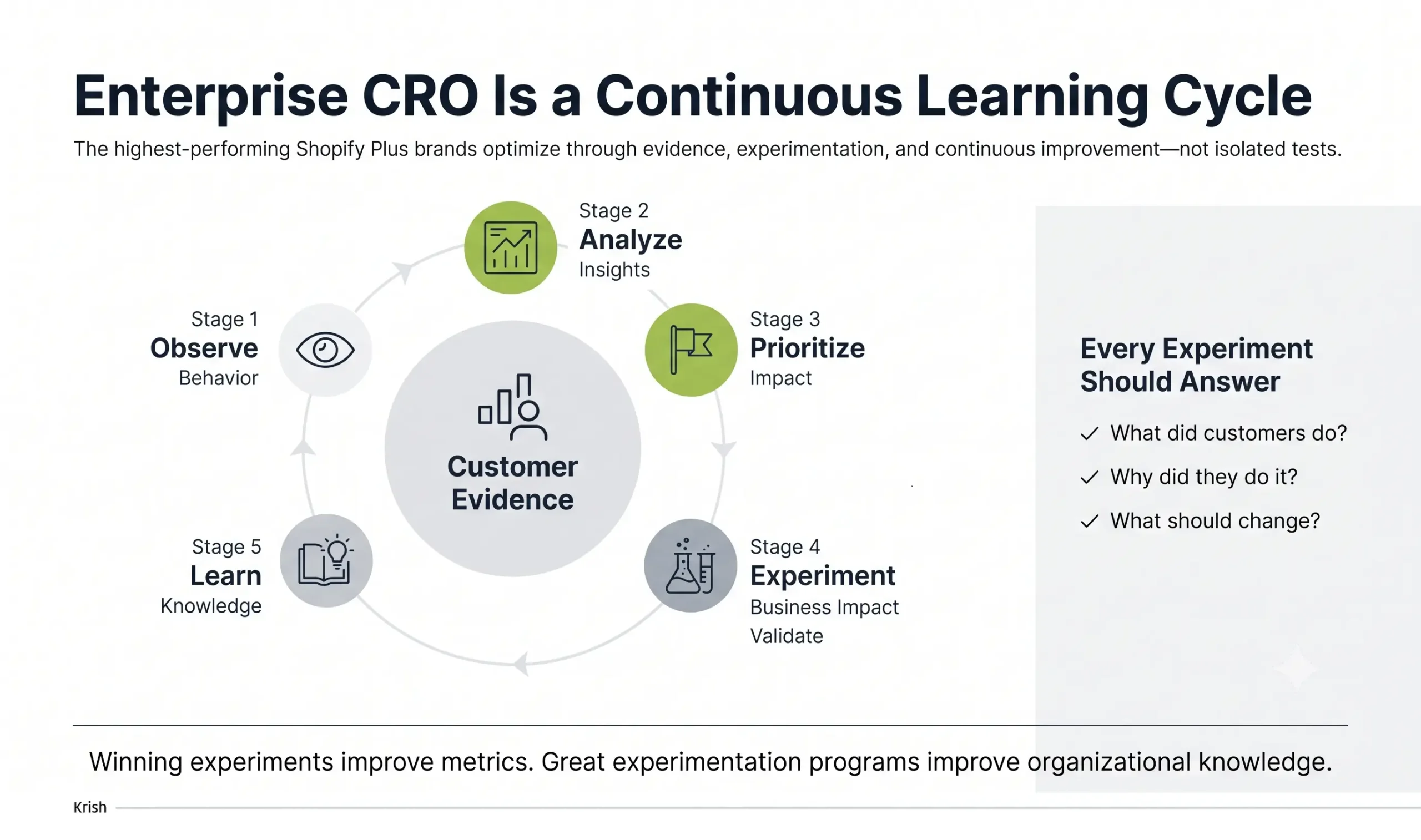
From Random Testing to Continuous Learning
Immature CRO programs often follow a familiar pattern: someone has an idea, a test is launched, the result is inconclusive, and everyone moves on. Enterprise programs operate differently. Every experiment begins with customer evidence, every hypothesis is documented, every outcome is recorded and shared, and every insight informs the next iteration. Optimization becomes compounding knowledge rather than isolated activity.
The Enterprise Experimentation Framework
Every optimization initiative should answer five questions before development begins.
1. What customer problem are we solving?
Not “What should we test?” but “What customer friction have we observed?”
2. What evidence supports this?
Evidence may include GA4 funnel analysis, heatmaps, session recordings, customer interviews, support conversations, and on-site surveys. If evidence doesn’t exist, you’re guessing.
3. What is the hypothesis?
A strong hypothesis follows a simple structure: Because customers struggle with X, we believe changing Y will improve Z, measured by KPI A. For example: Because customers cannot easily compare product variants, introducing a comparison module will increase Add-to-Cart Rate.
4. How will success be measured?
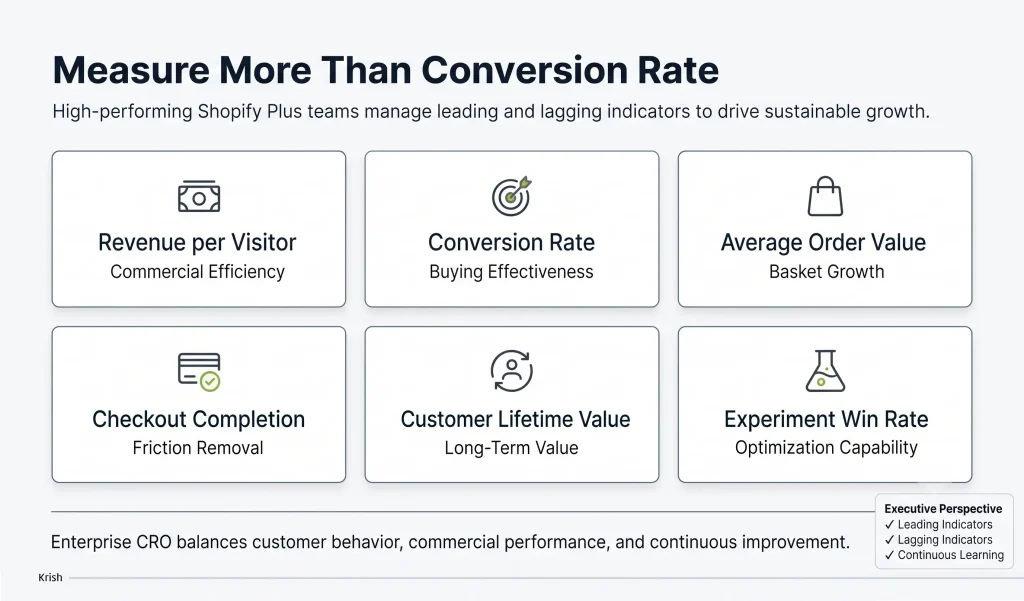
Avoid relying solely on conversion rate. Consider Revenue per Visitor, Add-to-Cart Rate, Checkout Initiation Rate, Average Order Value, Customer Lifetime Value, Exit Rate, and Return Rate. The right KPI depends on the objective.
5. What did we learn?
Not every experiment succeeds, but every experiment should produce learning. Organizations that document insights build a competitive advantage that competitors cannot easily replicate.
Why Most Experimentation Programs Stall
Across enterprise ecommerce organizations, the same obstacles appear repeatedly:
- Lack of prioritization: Everything becomes important, so nothing moves quickly.
- Poor cross-functional collaboration: Marketing owns CRO, development owns implementation, analytics owns reporting, and nobody owns outcomes.
- No experiment repository: Teams repeatedly test ideas that failed years earlier, and knowledge disappears with employees.
- Success defined too narrowly: Only “winning” tests are celebrated, when in reality, disproving assumptions is equally valuable. Every validated insight reduces future risk.
Pillar Six: Measurement & Governance
What gets measured gets managed, and what gets governed gets improved consistently. Enterprise CRO isn’t simply about having dashboards. It’s about ensuring the organization measures what truly drives commercial growth.
Many executive dashboards remain heavily focused on lagging indicators like revenue, orders, and conversion rate. These are important, but they explain outcomes, not causes. Leading organizations complement them with leading indicators that reveal future performance.
The Enterprise Measurement Framework
Layer 1: Acquisition: Qualified Traffic, Revenue by Channel, Cost per Acquisition, New vs Returning Visitors.
Layer 2: Customer Journey: Product View Rate, Add-to-Cart Rate, Checkout Initiation, Funnel Completion.
Layer 3: Commercial Outcomes: Conversion Rate, Revenue per Visitor, Average Order Value, Gross Margin, Customer Lifetime Value.
Layer 4: Optimization Capability: Number of Experiments, Win Rate, Time to Launch, Time to Insight, Time to Scale. This final layer is often overlooked, yet it determines how quickly an organization improves over time.
Further Reading
Macro vs. Micro Conversions: Build a Smarter CRO Strategy
High-performing CRO starts with measuring the right actions. Discover the difference between macro and micro conversions and how they help optimize every stage of the customer journey.
Read the full blog →Governance Is a Competitive Advantage
Many enterprise optimization programs fail because no one owns them. Marketing assumes Product is responsible. Product assumes UX owns the experience. UX assumes Analytics identifies opportunities. Analytics assumes Leadership prioritizes work. The result? Nothing changes.
High-performing Shopify Plus merchants establish clear governance by defining decision-makers, success metrics, experiment approval processes, reporting cadence, and executive accountability. Governance transforms optimization from a side project into a business discipline.
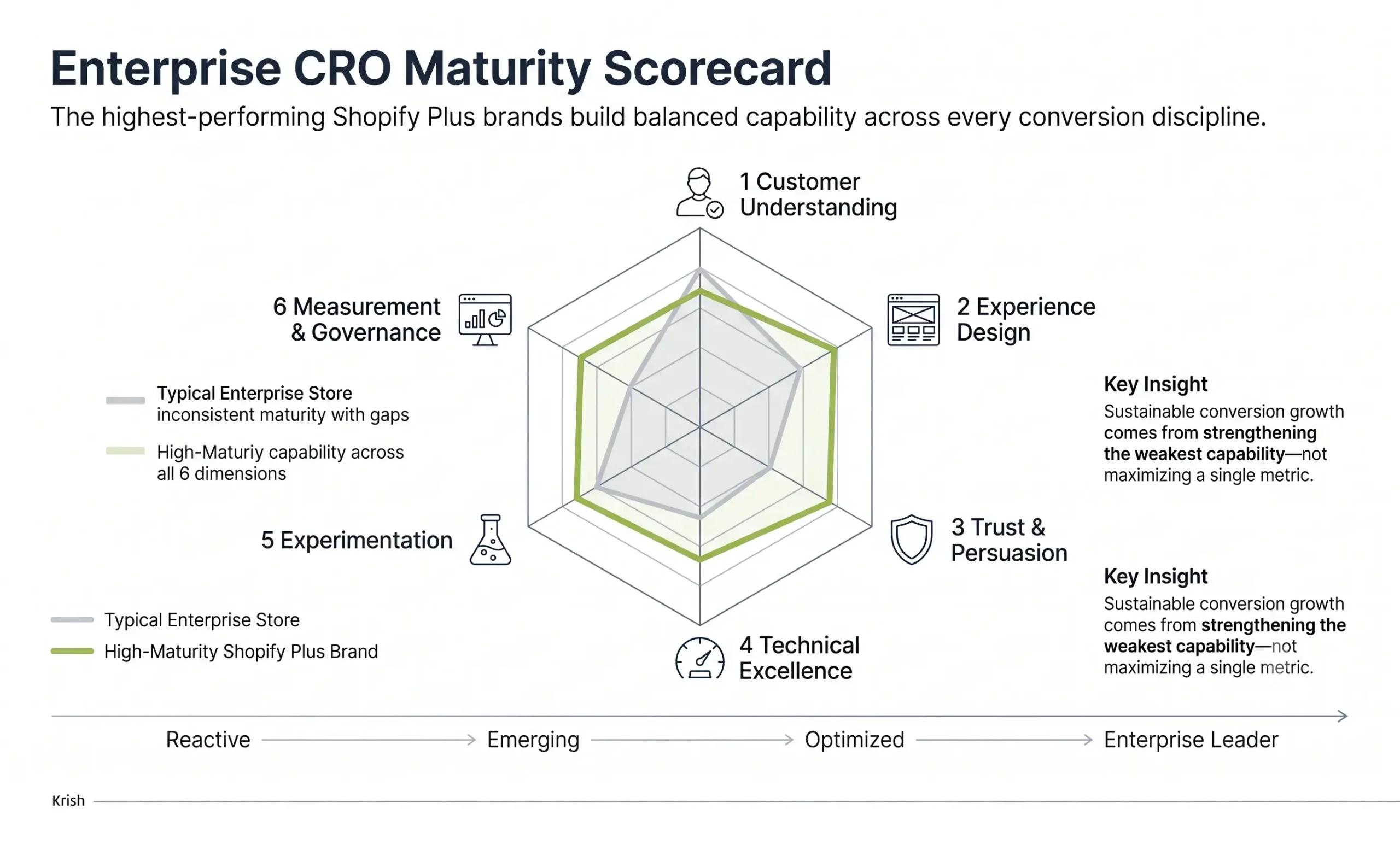
The Enterprise CRO Scorecard
| Pillar | Maximum Score |
|---|---|
| Customer Understanding | 20 |
| Experience Design | 20 |
| Trust & Persuasion | 15 |
| Performance & Technical Excellence | 15 |
| Experimentation | 15 |
| Measurement & Governance | 15 |
| Total | 100 |
0-40 – Reactive: Optimization is inconsistent. Growth depends primarily on increased acquisition.
41-60 – Emerging: Basic CRO practices exist, but capabilities remain fragmented.
61-80 – Optimized: Optimization is embedded into multiple business functions, experiments are regular, and insights influence decisions.
81-100 – Enterprise Leader: Continuous optimization is part of the operating model. Customer understanding, experimentation, governance, and AI readiness work together as a unified system.
Executive Case Study
Consider an international lifestyle retailer operating on Shopify Plus with 820,000 monthly sessions, a $128 Average Order Value, and a 1.8% Conversion Rate. The business believed paid acquisition had reached saturation and marketing proposed increasing media investment. Instead, leadership commissioned a CRO maturity assessment.
Key Findings:
Customer Understanding: Excellent analytics but limited qualitative research. Customer interviews were almost nonexistent.
Experience Design: Strong homepage but weak product discovery. Collection pages lacked merchandising logic, and search relevance was inconsistent.
Trust: Reviews existed but were difficult to discover. Delivery promises varied across product pages, and return policies required multiple clicks.
Technical Performance: Twenty-seven third-party apps, conflicting JavaScript libraries, and declining Core Web Vitals.
Experimentation: Only five experiments conducted over the previous year, none documented beyond presentation slides.
Governance: No executive owner, no optimization roadmap, and no prioritization framework.
Six Months Later:
Instead of increasing acquisition spend, the organization focused on capability maturity, with the following results:
- Conversion Rate: 1.8% to 2.6%
- Revenue per Visitor: +39%
- Average Order Value: +11%
- Mobile Conversion: +27%
- Checkout Completion: +14%
Perhaps most importantly, the business established a repeatable optimization process capable of delivering ongoing improvements. The outcome wasn’t a better website. It was a better operating model.
Real-world result
How Southern Season Revived Foot Traffic and Boosted Revenue Through Smart Digital Strategy
What Enterprise Leaders Should Remember
Technology changes. Customer expectations evolve. Acquisition costs fluctuate. AI reshapes discovery. But one principle remains constant: businesses that understand customers better than competitors consistently outperform them.
That understanding doesn’t emerge from opinions. It emerges from disciplined observation, structured experimentation, and organizational learning. CRO should no longer be viewed as a marketing initiative. It is a business capability. Just as finance manages capital and operations manage supply chains, mature organizations manage customer experience as a strategic asset.
Executive Summary
If you’re evaluating the maturity of a Shopify Plus storefront, assess these six pillars:
- Customer Understanding: Are decisions grounded in behavioral and qualitative insights?
- Experience Design: Is the customer journey intuitive, consistent, and friction-free?
- Trust & Persuasion: Does every touchpoint reinforce confidence?
- Performance & Technical Excellence: Is the storefront fast, scalable, accessible, and AI-ready?
- Experimentation: Is optimization continuous, evidence-based, and well documented?
- Measurement & Governance: Are the right metrics tracked and owned by the right teams?
Organizations that excel across these capabilities don’t simply improve conversion rates. They build a durable competitive advantage.
Begin With a Maturity Assessment, Not Another Redesign
Redesigns are exciting. Optimization is sustainable. Before investing in another theme refresh, redesign initiative, or acquisition campaign, ask a more important question: Is our CRO capability mature enough to support our growth ambitions? If the answer is uncertain, that’s where the greatest opportunity often lies.
Get a Shopify Plus CRO Maturity Assessment
At Krish, we help enterprise ecommerce brands move beyond tactical optimization. Our Shopify Plus CRO Assessment evaluates:
✔ Customer Research & Voice of Customer
✔ End-to-End Experience Design
✔ Trust & Persuasion
✔ Technical Performance & Core Web Vitals
✔ AI & Agentic Commerce Readiness
✔ Experimentation Framework
✔ Measurement & Governance
✔ Executive Prioritization Roadmap
Rather than delivering another generic checklist, we provide a structured maturity assessment aligned to commercial impact, implementation effort, and long-term scalability, helping your team invest where it matters most.
References & Further Reading
This framework is informed by widely accepted principles and industry research, including guidance from Google Search Central (Core Web Vitals, structured data, EEAT), Nielsen Norman Group (UX research and usability heuristics), Baymard Institute (checkout usability and ecommerce UX research), Shopify Plus documentation, the GA4 measurement framework, and research on experimentation culture from leading digital product organizations. While every business is unique, the principles presented here have consistently proven valuable across enterprise ecommerce programs spanning retail, fashion, consumer goods, B2B commerce, luxury, and omnichannel brands.
Frequently Asked Questions
Table of Content
- Introduction
- Enterprise Ecommerce Doesn't Have a Conversion Problem. It Has a Maturity Problem.
- Why Traditional CRO Checklists Fail
- The Evolution of CRO
- The Shopify Plus CRO Maturity Model
- Pillar One: Customer Understanding
- Pillar Two: Experience Design
- Pillar Three: Trust & Persuasion
- Pillar Four: Performance & Technical Excellence
- Pillar Five: Experimentation
- Pillar Six: Measurement & Governance
- Executive Case Study
- What Enterprise Leaders Should Remember
- Executive Summary
- Begin With a Maturity Assessment, Not Another Redesign
- Get a Shopify Plus CRO Maturity Assessment
- References & Further Reading
Subscribe with Us!
Never miss any post, stay tuned!

As Director - Marketing, Zenul leads the marketing and branding at Krish. He brings with him an in-depth understanding of the evolving digital ecosystem and has a proven expertise and experience in strategic planning, market and competition analysis, creating and implementing client-centered, lead-gen and brand marketing campaigns. He has a heart for technology innovation and has been a keynote speaker on various platforms.
Recommended Reading:
The 5 Machine Learning Models Every Marketing Team Should Know – MarTech Masterclass Series Ep | 20
17 July, 2026 Most marketing conversations about machine learning (ML) collapse it into a single capability. Teams talk about "using AI" or "adding ML to the stack" as though it were one tool with one function. It is not, and treating it that way is why most ML initiatives either overreach and fail or underdeliver and disappoint.
Subscribe with Us!
Never miss any post, stay tuned!
Trusted by leading brands


