Introduction
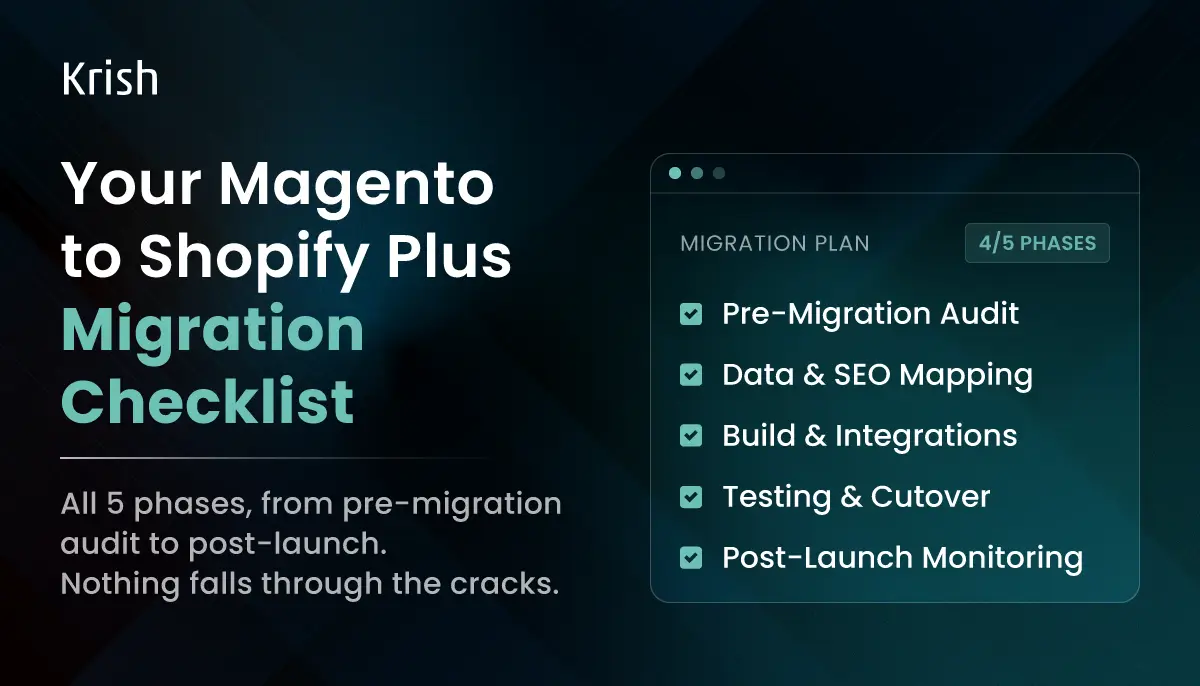
Planning a magento to shopify plus checklist before you start is what separates a smooth migration from a chaotic one. Most migration problems aren’t technical failures, they’re missed steps that nobody flagged early enough. This guide lays out a complete shopify plus migration checklist across all five phases, so whether you’re managing this in-house or working with a shopify plus migration services partner, nothing falls through the cracks.
Quick Answer: A Magento to Shopify Plus migration checklist has 5 core phases: pre-migration audit, data & SEO mapping, build & integrations, testing & cutover, and post-launch monitoring. Skipping the discovery phase is the single most common and most expensive mistake teams make.
Further reading
Magento to Shopify Plus Migration Guide for Enterprise Brands
Adobe's end-of-support deadlines and rising costs are forcing the decision, this complete migration guide covers why enterprise brands are moving to Shopify Plus, what actually changes, and how to protect SEO through the transition.
Read the full blog →Phase 1 - Pre-Migration Audit Checklist
Data Inventory
Products, variants, and metafields: a full count and categorization of everything in your catalog before anything moves.
Customers, addresses, and order history: documenting the full scope of customer data that needs to survive the transition.
URL & SEO Audit
Every indexed URL needs to be captured and documented before migration begins, along with existing metadata and schema.
Integration Inventory (ERP, CRM, ESP, tax, shipping)
Every third-party system connected to your store needs to be listed, along with which ones are business-critical and which could be retired during the move.
Backlink & Search Console Export
Pulling your backlink profile and Search Console history gives you a baseline to measure recovery against after launch.
Our how to perform an ecommerce audit guide covers this entire phase in more depth, including which tools to use for the crawl.
Phase 2 - Data & SEO Mapping Checklist
Field Mapping (Old Platform → Shopify Plus)
Every field in your current system gets mapped to its Shopify Plus equivalent, with a clear plan for anything that doesn’t have a direct match.
301 Redirect Map (Product, Category, Blog, Image URLs)
A complete redirect map covering every URL type, products, categories, blog posts, and images is the backbone of an SEO-safe migration.
Metadata & Schema Migration Plan
Title tags, meta descriptions, and structured data all need to be documented and carried over deliberately, not left to chance.
Data Cleanup & Deduplication
Cleaning duplicate or outdated records before migration prevents carrying old problems into the new platform.
A mid-sized catalog routinely needs anywhere from 2,000 to 20,000 redirect rules once products, collections, blog posts, and legacy campaign URLs are all counted.
Our data migration services handle this field mapping directly, and for a deeper look at exactly what happens to each data type during this phase, see our guide on what happens to your data while migrating from Magento to Shopify Plus. Redirect and canonical handling specific to Magento is also covered in our URL fixes in Adobe Commerce guide.
Further reading
Your Data Migration Blueprint: What Moves, What Stays, What's Risky
Data migration is more than moving files, passwords won't transfer, custom attributes need mapping, and pricing rules require rebuilding. This guide walks through exactly what moves cleanly and what demands manual attention before launch.
Read the full blog →Phase 3 - Build & Integration Checklist
Theme & Storefront Setup
Whether you choose a pre-built theme or a custom design, this is where your new storefront actually takes shape.
App Stack Configuration (reviews, subscriptions, loyalty)
Every Magento extension needs a Shopify equivalent — some are turnkey apps, others require custom development.
Integration Rebuild (ERP, PIM, email/SMS, analytics)
Connected systems need to be reconnected and tested on the new platform, not just carried over by assumption.
B2B & Custom Functionality Setup
Company accounts, net terms, and quantity rules need dedicated configuration if your store serves wholesale customers.
Our Shopify Plus development and B2B wholesale commerce solutions services cover this entire build phase, from storefront to complex B2B configuration.
Phase 4 - Testing & Cutover Checklist
Staging Environment QA (checkout, payments, redirects)
Every critical workflow needs to be tested in staging before it’s ever exposed to real customers.
Full Migration Dry-Run
A complete practice run of the migration, done well before the actual launch date, is what catches the issues that would otherwise surface in production.
Data Freeze Before Launch
Freezing the old site for a defined window before cutover prevents any last-minute data changes from being missed in the final migration.
Launch Day Runbook (DNS, SSL, rollback plan)
A documented, step-by-step runbook for launch day, covering DNS changes, SSL setup, and what triggers a rollback, removes guesswork under pressure.
A full migration dry-run roughly two weeks before launch catches most of the issues that would otherwise surface in production.
Planning a Magento to Shopify Plus migration?
Phase 5 - Post-Launch Checklist (First 0–90 Days)
Week 1: Daily Search Console & Analytics Monitoring
The first week after launch is when redirect gaps, crawl errors, and ranking shifts first surface, daily monitoring catches them early. Our full Magento to Shopify Plus SEO protection guide walks through exactly what to check during this window.
Weeks 2-4: Redirect & Integration Reconciliation
Confirming every redirect resolves correctly and every integration is syncing as expected, rather than assuming everything launched cleanly.
Weeks 4-12: Performance Optimization & CRO
Once the store has stabilized, attention shifts from “did it survive the move?” to “how well is it performing?” This is where ongoing optimization begins.
Our CRO audit services and our guide on macro vs micro conversions are both useful starting points for this phase.
Further reading
How Roomours Boosted Conversions, Cut Load Time to 2 Seconds, and Grew Revenue with a Faster, Smarter Storefront
What Most Teams Get Wrong on Their Migration Checklist
Underestimating the Redirect Map Scope
Teams frequently plan for a fraction of the redirect rules they actually need, discovering the true scope only after launch.
Treating Launch Day as the Finish Line
The real work of stabilization happens in the two weeks after go-live, not on launch day itself.
Skipping the Rollback Plan
A defined rollback trigger and window is often the first thing cut under time pressure, and the first thing teams wish they had when something goes wrong.
Teams that skip a documented rollback plan are consistently the ones caught without options when a critical issue surfaces on launch day.
For a realistic sense of how long each of these phases actually takes, see our full Magento to Shopify Plus migration timeline breakdown. And if budget planning is part of your checklist too, our guide to Magento to Shopify Plus migration cost breaks down where each phase’s spend typically goes.
Ready to plan your Magento to Shopify Plus migration?
Frequently Asked Questions
Table of Content
Subscribe with Us!
Never miss any post, stay tuned!

Manthan is the Director of Solutions at Krish, specializing in solution architecture, strategy, and client engagement. With expertise in eCommerce, Enterprise CMS, cloud solutions, and integrations, he is passionate about bridging technology and business to drive innovation and efficiency. As a techno-functional consultant and SME, he helps brands optimize technology stacks, streamline operations, and scale effectively, enabling sustainable digital transformation in an ever-evolving landscape.
Recommended Reading:
Magento to Shopify Plus Data Migration: What Transfers, What Doesn’t, and How It Works
15 July, 2026 Every magento to shopify plus data migration raises the same anxious question from store owners: will my data actually survive the move? The good news is that most of what matters, products, customers, order history, transfers with the right process. The part that catches teams off guard is what doesn't transfer cleanly, and why. This guide walks through exactly what happens to your data during a shopify plus data migration, so you know what to expect before the project starts.
Subscribe with Us!
Never miss any post, stay tuned!
Trusted by leading brands


